Have you ever wondered why a single thought can change your mood, why a memory can bring tears to your eyes, or why your heart starts beating faster when you feel nervous? These everyday experiences reveal an important relationship between the brain, the mind, and our emotions.
We often talk about thinking with the mind and feeling with the heart. However, emotions are closely connected to the brain, which processes information, interprets experiences, forms memories, and coordinates the body's responses. Our thoughts and feelings also influence how we perceive the world and respond to the people around us.
Understanding how the brain connects the mind and emotions can help us become more aware of our reactions, recognize emotional patterns, and make more thoughtful decisions.
In this article, we will explore the science behind this connection, understand the roles different brain regions play, and discover practical ways to develop greater emotional awareness in everyday life.
What Is the Connection Between the Brain, Mind, and Emotions?
The brain, mind, and emotions are closely related, but they are not interchangeable terms.
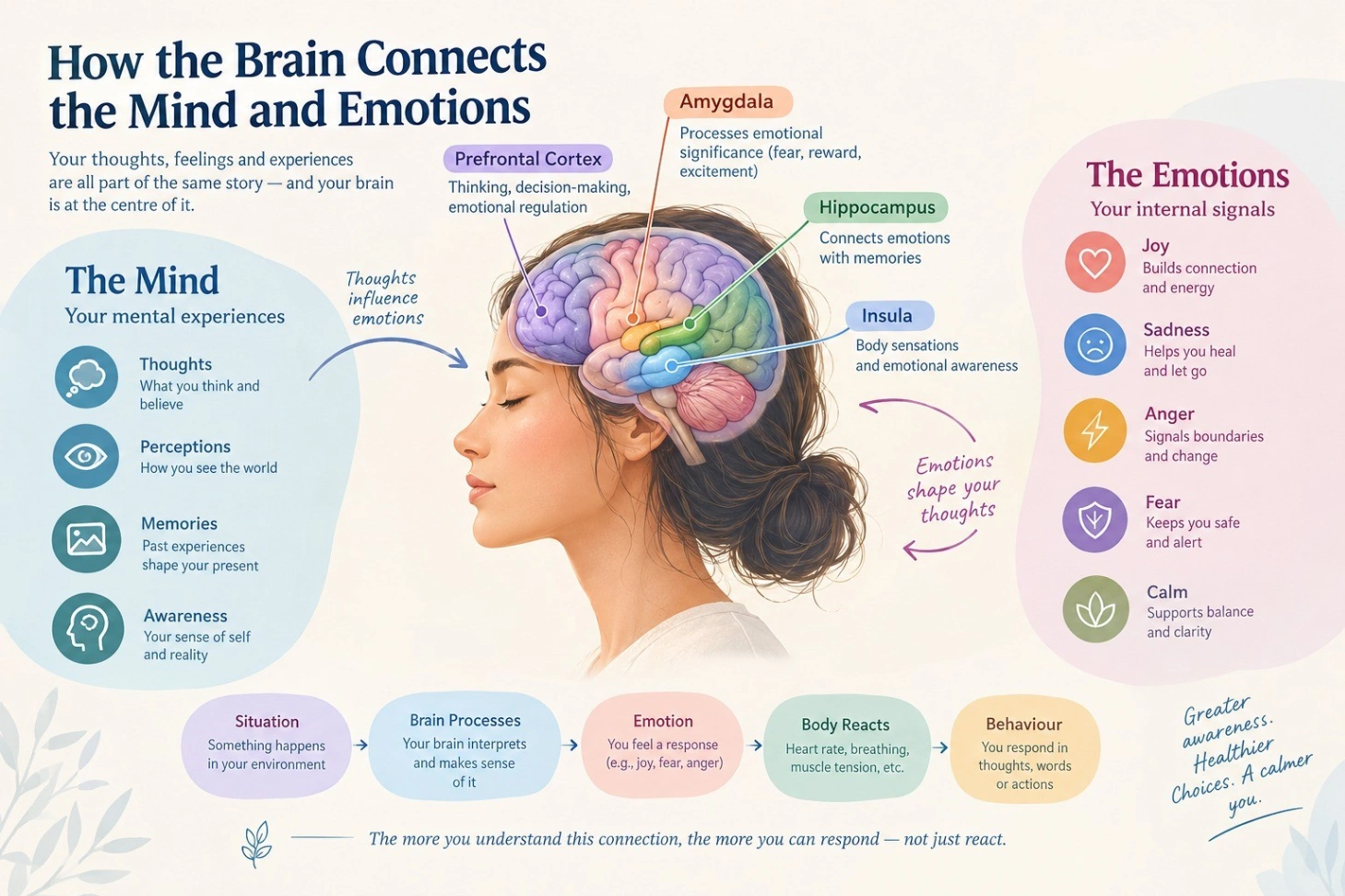
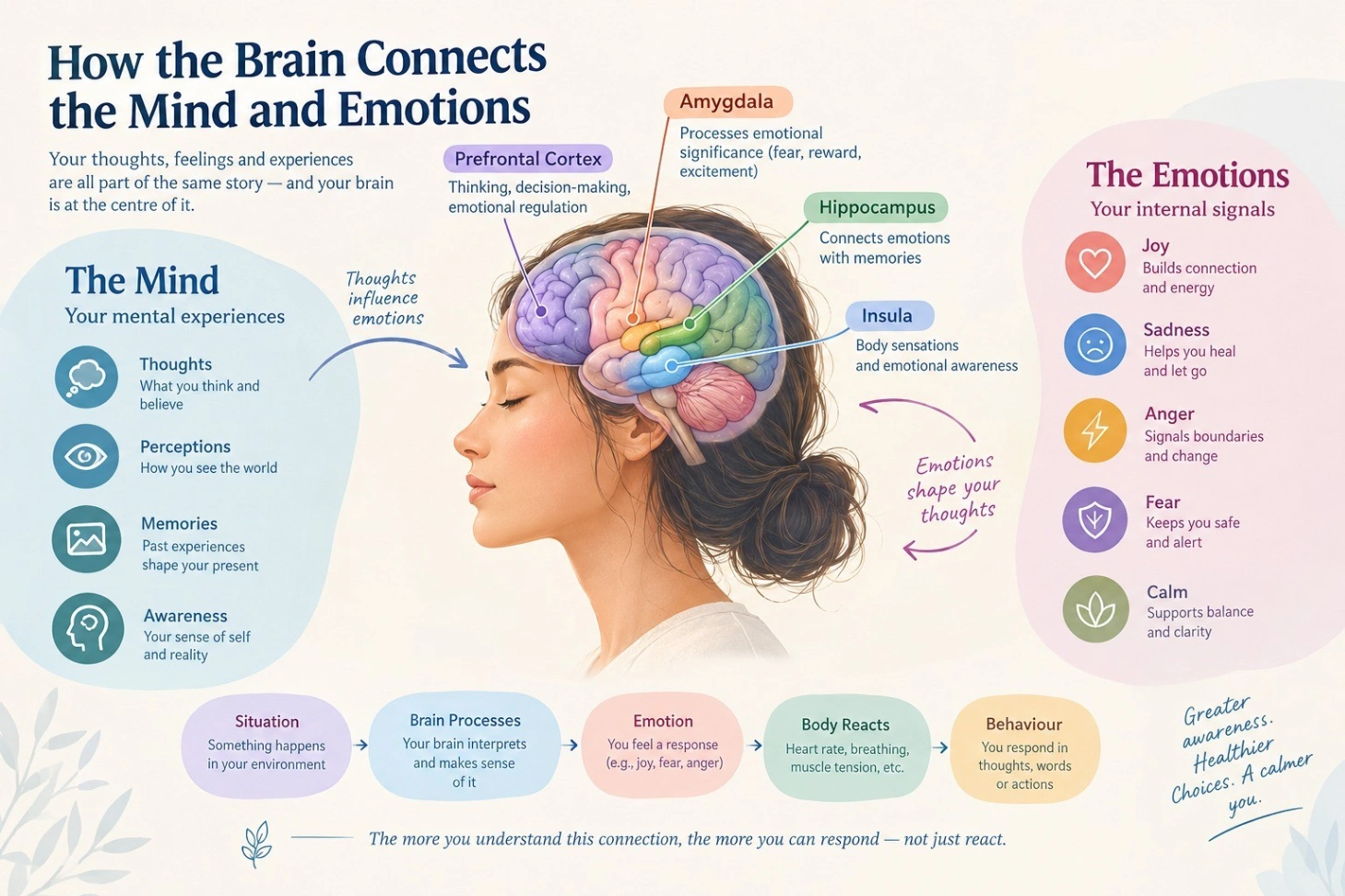
The brain is the physical organ inside your skull. It contains billions of neurons that communicate through electrical and chemical signals. These networks support perception, memory, attention, reasoning, movement, and emotional processing.
The mind refers to our mental experiences, including thoughts, perceptions, memories, imagination, attention, and conscious awareness. Although the mind is often discussed separately from the brain, mental processes are deeply connected to brain activity.
Emotions are responses to experiences that involve several interacting processes. These can include subjective feelings, changes in the body, interpretations of situations, facial expressions, and tendencies to act in particular ways.
For example, imagine that you receive an unexpected message from your manager.
Your brain processes the message, your mind interprets what it might mean, and you may experience anxiety, curiosity, or excitement depending on the circumstances and your expectations.
Your body may also respond. You might notice a faster heartbeat or tension in your shoulders.
This example illustrates how perception, thought, emotion, and physical responses interact.
The relationship is not a simple one-way process. Your existing mood can influence how you interpret the message, while your interpretation can affect how you feel next.
How Does the Brain Process Emotions?
Emotional experiences emerge from interactions between multiple brain regions rather than from a single emotional centre.
Three important areas involved in emotional processing are the amygdala, prefrontal cortex, and hippocampus. Other regions, including the insula and hypothalamus, also contribute to the process.
Design Your Destiny
Your thoughts, emotions, and experiences influence how you see yourself and the world around you. But greater self-awareness can help you understand your patterns, make conscious choices, and move towards the life you want to create
Start Your Journey Today!1. The Amygdala: Recognizing Emotional Significance
The amygdala is a group of structures located deep within the brain. It helps process emotionally significant information, particularly information relevant to potential threats, learning, and important experiences.
For instance, if you hear a sudden, unexpected noise in a dark room, your brain may quickly assess whether the sound could signal danger. Your body may become alert before you have consciously identified the source.
The amygdala contributes to this process, but it does not work alone. Other brain regions help interpret the situation and determine an appropriate response.
The amygdala also participates in processing positive and socially meaningful experiences. It is not simply a fear centre.
Why this matters: Emotional reactions can sometimes begin before we fully understand what triggered them. Recognizing this can help us pause and examine our reactions instead of automatically treating them as accurate descriptions of reality.
2. The Prefrontal Cortex: Thinking Before Reacting
The prefrontal cortex, located toward the front of the brain, contributes to planning, decision-making, working memory, and the regulation of behaviour.
It helps us consider consequences, compare possible responses, and adapt our actions to a situation.
Imagine that someone makes a comment that upsets you. Your first impulse might be to respond angrily.
However, you might pause, consider the person's intention, and decide that asking a question would be more helpful than arguing.
This ability to reflect on a situation and select a response involves networks that include the prefrontal cortex.
Emotional regulation does not mean eliminating emotions or forcing yourself to remain calm at all times. It involves recognizing what you feel and choosing how to respond when possible.
Why this matters: Learning to pause before reacting can create an opportunity to make decisions that reflect your values rather than your immediate impulses.
3. The Hippocampus: Connecting Emotions with Memories
The hippocampus plays an important role in forming and retrieving memories, including memories of experiences and their surrounding context.
Emotional experiences can become closely associated with memories, influencing how we interpret similar situations in the future.
For example, if you once experienced embarrassment while speaking in public, a future presentation might make you nervous even when the audience is supportive.
Your brain may recognize similarities between the present situation and the earlier experience.
However, the current situation may be different from the past. Recognizing this distinction can help you respond to what is actually happening rather than relying entirely on an earlier experience.
Why this matters: Understanding the connection between memory and emotion can help us identify patterns in our reactions and reconsider assumptions that no longer fit our circumstances.
How Do Thoughts Influence Emotions?
Thoughts and emotions influence each other in several ways.
The way you interpret an event can affect the emotional response that follows. Two people may experience the same situation but feel differently because they have different expectations, beliefs, memories, or personal circumstances.
Consider an example: You send a message to a friend, but they do not respond for several hours.
One possible interpretation is, "They must be upset with me." This thought might create anxiety.
Another interpretation is, "They may be busy and will respond when they can." This may lead to a less distressing emotional response.
Neither interpretation is guaranteed to be correct. The important point is that the meaning you assign to an event can influence how you feel about it.
This does not mean that every emotion is caused by a thought. Emotions can also arise through physical sensations, memories, environmental cues, hormonal changes, and other processes that may not be immediately conscious.
However, examining our interpretations can sometimes help us understand and manage emotional experiences.
The Cycle of Thoughts, Feelings, and Behaviour
A common pattern looks like this:
Situation: Something happens in your environment.
Interpretation: You assign meaning to the event.
Emotion: You experience a feeling associated with your interpretation and circumstances.
Physical response: Your body may react through changes in breathing, heart rate, or muscle tension.
Behaviour: You respond by speaking, withdrawing, asking questions, or taking action.
The process is not always linear. Physical sensations can influence thoughts, emotions can affect attention, and behaviour can change how a situation develops.
For example, anxiety might make you avoid a presentation. Avoiding it may provide temporary relief, but it can also prevent you from discovering that you could handle the situation successfully.
Recognizing these patterns is an important step toward developing emotional awareness.
How Do Emotions Affect the Body?
Emotions are not only mental experiences. They are also associated with changes in the body.
When you feel threatened or stressed, your nervous system can activate processes that prepare you to respond. These changes may include a faster heartbeat, increased muscle tension, altered breathing, and heightened alertness.
When a situation feels safe or reassuring, other patterns of physiological activity may become more prominent.
The autonomic nervous system, which regulates many automatic bodily functions, plays an important role in these responses. Hormones and chemical messengers also contribute to how the body responds to stress and other experiences.
For example, before an important interview, you might notice sweaty palms and a racing heart. These sensations do not necessarily mean that something is wrong. They may reflect your body's response to a situation it considers significant.
Learning to recognize physical signs of emotion can help you notice when you are becoming overwhelmed.
Simple strategies such as taking comfortable breaths, relaxing your shoulders, or briefly stepping away from a stressful situation may help you respond more deliberately.
Persistent or severe physical symptoms should not automatically be attributed to emotions; they may require medical evaluation.
Kali Chaudas vs Naraka Chaturdashi : Are They the Same ?
Can You Train Your Brain to Respond to Emotions Differently?
The brain has a capacity for change known as neuroplasticity. Through learning and experience, connections within neural networks can change over time.
This ability supports the development of skills, habits, and new ways of responding to familiar situations.
For example, someone who frequently reacts impulsively may learn to recognize emotional triggers, pause before responding, and practise alternative behaviours.
These changes do not happen automatically or at the same pace for everyone. They may require repeated practice, patience, and support.
Here are five practical approaches that can help you develop emotional awareness.
1. Practise Mindful Breathing
Take a few minutes to sit comfortably and notice your natural breathing.
Pay attention to the air entering and leaving your body. When thoughts arise, acknowledge them and gently return your attention to your breath.
You do not need to force your mind to become empty.
This exercise gives you an opportunity to notice distractions and practise redirecting your attention.
2. Name the Emotion You Are Experiencing
When you notice a strong reaction, pause and ask yourself what you are feeling.
Is it frustration, disappointment, fear, sadness, embarrassment, or something else?
Naming an emotion can help you distinguish between different experiences and understand what may be contributing to them.
For example, what initially feels like anger may include disappointment or fear of rejection.
You do not have to identify the emotion perfectly. The goal is to become curious about your experience rather than reacting automatically.
3. Question Your First Interpretation
When something upsetting happens, ask yourself:
What actually happened?
What am I assuming about the situation?
Is there another reasonable explanation?
What information do I still need?
These questions can help you separate observable facts from assumptions.
They are particularly useful when uncertainty, misunderstandings, or past experiences influence your interpretation of events.
4. Build a Regular Reflection Habit
Spend five minutes at the end of the day reflecting on your emotional experiences.
You might write down what happened, how you felt, what you thought about the situation, and how you responded.
Over time, you may notice recurring patterns, such as becoming irritable when tired or feeling anxious when expectations are unclear.
Recognizing these patterns can help you identify situations in which you may benefit from rest, communication, preparation, or additional support.
Why Do We Celebrate Diwali ? Meaning , History and Significance
5. Prioritize Sleep, Movement, and Connection
Emotional well-being is influenced by more than thoughts alone.
Insufficient sleep, prolonged stress, limited physical activity, and social isolation can affect mood, attention, and the ability to manage everyday challenges.
Regular physical activity, adequate sleep, balanced nutrition, and supportive relationships can contribute to overall well-being.
These habits do not eliminate difficult emotions, nor should they be treated as a cure for mental health conditions. However, they can provide a supportive foundation for emotional health.
The Role of Self-Awareness in Understanding Your Emotions
Self-awareness involves noticing your thoughts, emotions, habits, and reactions with greater clarity.
Instead of immediately identifying with every thought or feeling, you can learn to observe what is happening and consider how you want to respond.
For example, there is a difference between saying, "I am a failure," and recognizing, "I am having the thought that I have failed."
The second statement creates some distance between your identity and your current thought.
It does not dismiss the possibility that you made a mistake. Instead, it allows you to examine the situation more objectively and decide what you can learn from it.
Developing this kind of awareness can help you communicate more thoughtfully, recognize emotional triggers, and respond to challenges with greater flexibility.
It also encourages compassion toward yourself and others. People do not always have complete control over their initial emotional reactions, but they can often learn ways to understand and manage them.
Conclusion: Understanding Your Brain Can Change How You Respond
The connection between the brain, mind, and emotions is complex and constantly influenced by our experiences, memories, physical states, and surroundings.
The brain processes information and coordinates many of the mechanisms involved in emotional experiences. Our thoughts and interpretations influence how we understand events, while emotions can shape our attention, decisions, and behaviour.
Understanding this relationship does not mean that we can control every feeling or prevent every difficult experience. It means we can become more aware of what is happening within us and explore healthier ways to respond.
Begin with a small step. Notice an emotion before reacting to it. Question an assumption that creates unnecessary worry. Take a few mindful breaths when you feel overwhelmed.
Over time, these practices can help you understand your emotional patterns and make more intentional choices.
Personal Session
Sometimes, understanding what we feel and why we react in certain ways requires time, reflection, and a fresh perspective. A personal session offers an opportunity to explore your experiences, reflect on recurring patterns, and consider meaningful steps towards greater self-awareness
Book NowRead Latest Articles
Overthinking Everything? Ancient Gita Wisdom for a Thinking Mind
Do Positive Affirmations Really Work? The Science Behind Self-Talk
Frequently Asked Questions
Q. How does the brain connect the mind and emotions?
The brain connects the mind and emotions through networks that process thoughts, memories, perceptions, and emotional responses. The amygdala helps evaluate emotionally significant information, the prefrontal cortex supports decision-making and emotional regulation, and the hippocampus contributes to memory. Together with other brain regions and body systems, these processes influence how we feel, interpret experiences, and respond to everyday situations.Q. How are the brain and mind connected?
The brain is the physical organ responsible for processing information and coordinating many bodily functions. The mind refers to mental experiences such as thoughts, perceptions, memories, and awareness. These experiences are closely associated with brain activity, although the exact relationship between brain processes and subjective experience remains an important topic of scientific and philosophical research.Q. Can you train your brain to manage emotions?
You can develop skills that support emotional regulation through repeated practice, reflection, and learning. Techniques such as mindfulness, cognitive reappraisal, emotional labelling, and problem-solving may help you respond more thoughtfully to difficult situations. Progress varies between individuals, and professional support can be useful when emotional difficulties persist.Q. Why do memories trigger strong emotions?
Memories can become associated with emotional experiences. When a current situation resembles something that happened in the past, recalling that experience may influence your feelings and expectations. The hippocampus contributes to memory formation and context, while other brain networks participate in emotional processing. The strength and nature of these responses vary between people.Q. What is emotional regulation?
Emotional regulation refers to the processes through which people influence which emotions they experience, when they experience them, and how they express or respond to them. It may involve recognizing an emotion, reconsidering a situation, taking a pause, or choosing a constructive action. Emotional regulation does not mean suppressing every difficult feeling