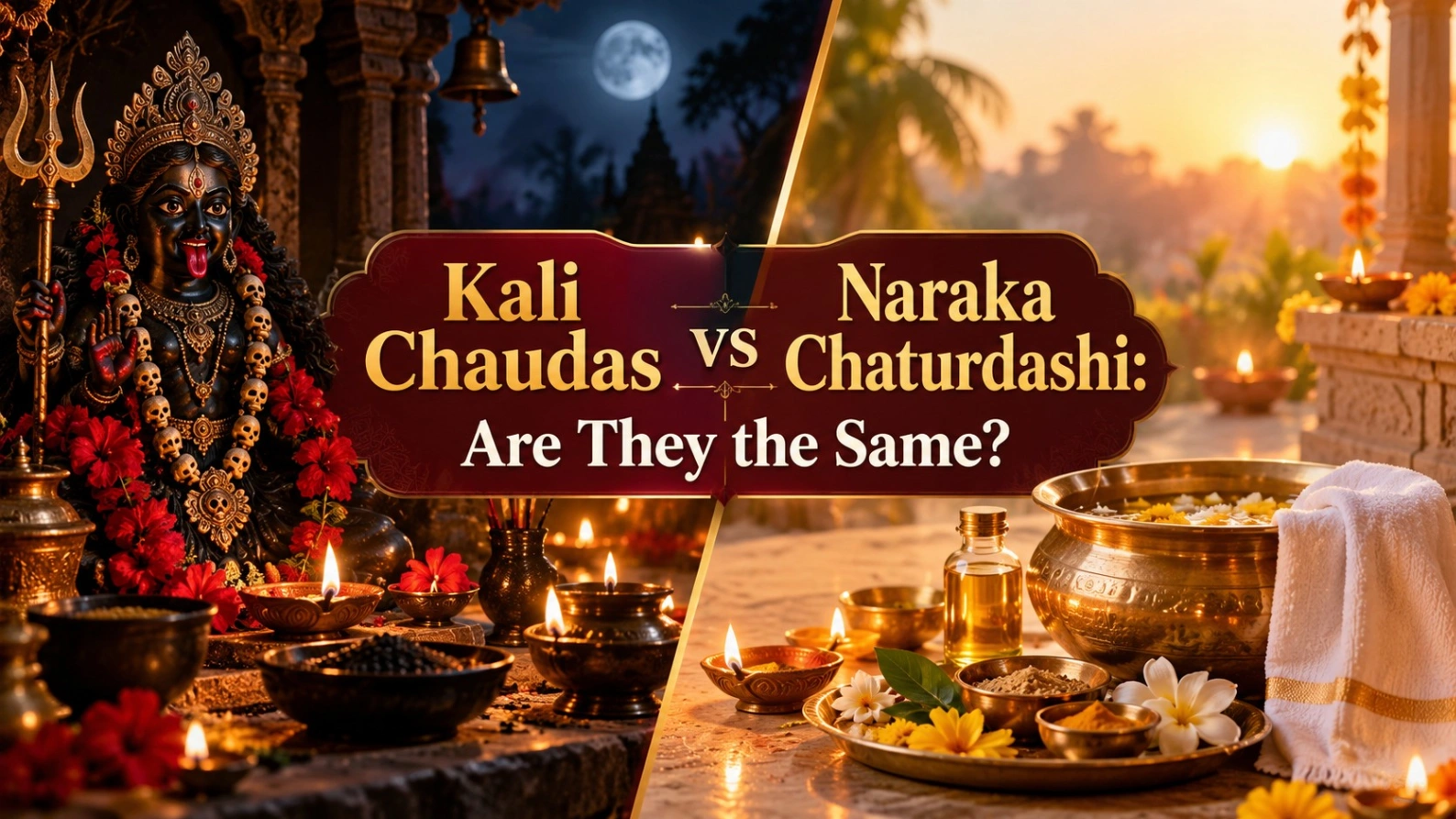
Kali Chaudas and Naraka Chaturdashi are often mentioned together during the Diwali festival period, which is why many people assume they are simply two names for the same observance.
However, the traditional distinction is more nuanced.
Kali Chaudas and Naraka Chaturdashi are related because both are observed around Krishna Paksha Chaturdashi during the Diwali period, but they are not necessarily the same festival. Their ritual timing, deity focus and regional traditions are different, and depending on how Chaturdashi Tithi falls, the two observances can even occur on different civil dates. Drik Panchang explicitly notes that Kali Chaudas should not be mixed with Roop Chaudas or Naraka Chaturdashi and that the two can fall on consecutive days.
This distinction is especially useful for anyone searching Kali Chaudas vs Naraka Chaturdashi, because many online calendars combine the names even though traditional Panchang rules separate them.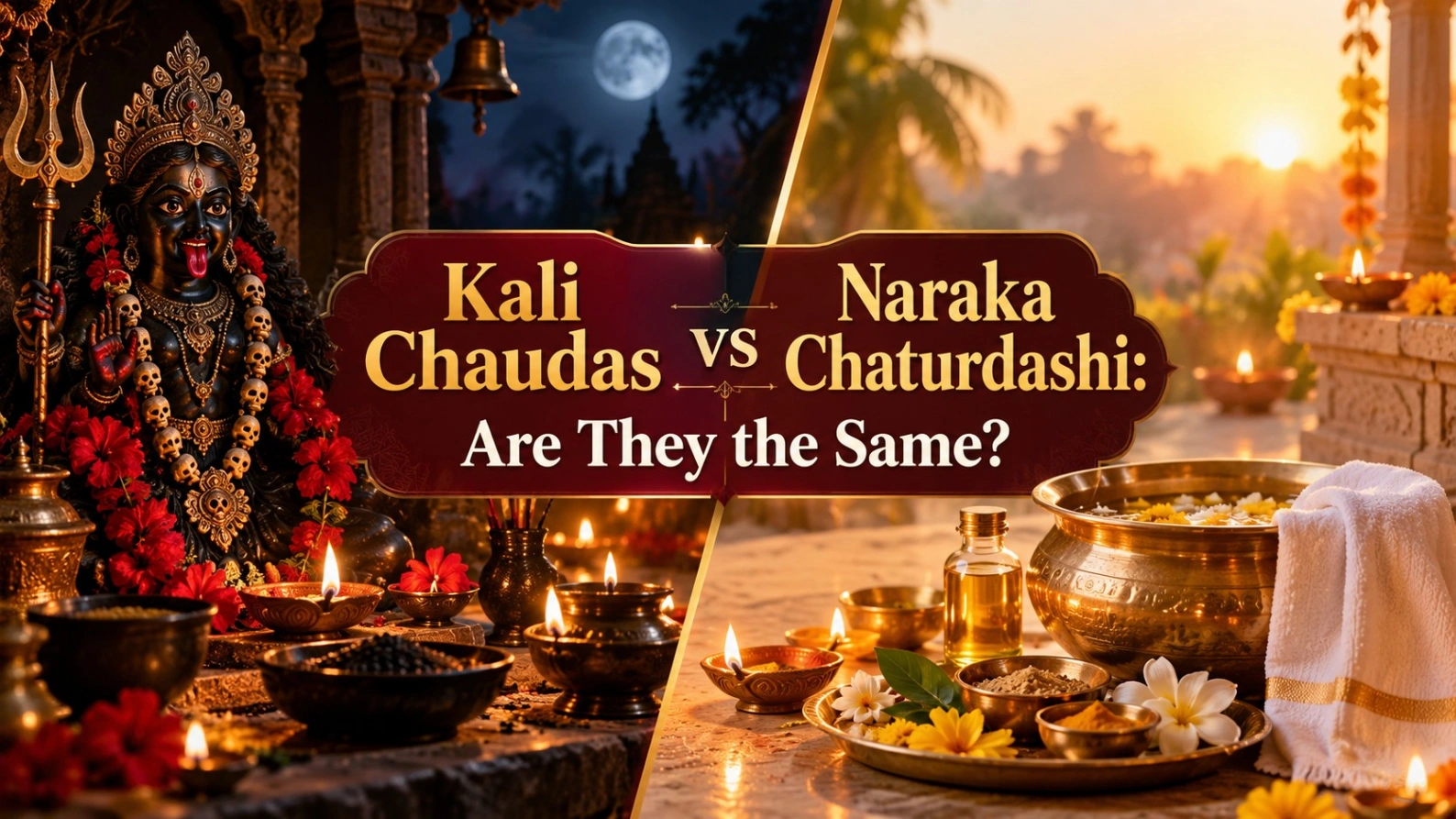
Are Kali Chaudas and Naraka Chaturdashi the Same?
The short answer is: not exactly.
Both are connected with Chaturdashi Tithi during the Diwali period, but they are determined differently.
Kali Chaudas is traditionally associated with midnight worship and is observed when Chaturdashi prevails during Maha Nishita, or the deep midnight period. It is especially important in western India, particularly Gujarat.
Naraka Chaturdashi, on the other hand, is associated with Abhyang Snan before sunrise. The observance is determined based on Chaturdashi prevailing during the early morning period before sunrise.
Because these time rules are different, Kali Chaudas and Naraka Chaturdashi may sometimes fall on the same date and sometimes on two consecutive dates.
What Is Kali Chaudas?
Kali Chaudas is a Diwali-period observance especially popular in Gujarat and other western Indian traditions.
It is also known as Bhut Chaturdashi in some contexts. Drik Panchang specifically notes that Kali Chaudas is mainly observed in western states, particularly Gujarat.
The ritual focus is traditionally linked with:
protection from negative forces
worship during the night
fierce divine forms
spiritual protection
removal of fear and negativity
The festival is determined according to whether Chaturdashi Tithi prevails during Maha Nishita, the midnight period.
This midnight-based rule is one of the clearest ways to distinguish Kali Chaudas from Naraka Chaturdashi.
Design Your Destiny
Kali Chaudas and Naraka Chaturdashi both remind us, in different ways, that darkness is not only something outside us. Fear, ego, negativity and unconscious patterns can also become inner obstacles.
Start Your Journey Today!What Is Naraka Chaturdashi?
Naraka Chaturdashi is a major Diwali-period observance popularly known as Choti Diwali, Roop Chaturdashi or Roop Chaudas in many regions.
The festival is traditionally associated with:
the defeat of Narakasura
purification
early morning Abhyang Snan
removal of negativity
preparation for Diwali
One of the most important rituals is Abhyang Snan, the sacred oil bath performed before sunrise while Chaturdashi Tithi is still prevailing. Drik Panchang notes that this Chaturdashi bath is the most significant of the Diwali Abhyang Snan observances.
So while Kali Chaudas is strongly linked to midnight ritual timing, Naraka Chaturdashi is defined by pre-sunrise purification.
Kali Chaudas vs Naraka Chaturdashi: Main Difference
The biggest difference is timing and ritual focus.
Aspect | Kali Chaudas | Naraka Chaturdashi |
|---|---|---|
Tithi Basis | Chaturdashi during Maha Nishita | Chaturdashi before sunrise |
Main Time | Midnight | Early morning |
Popular Region | Especially Gujarat / western India | Widely celebrated across India |
Main Focus | Protection, fierce divine worship, removal of negative forces | Purification, Narakasura story, Abhyang Snan |
Other Names | Bhut Chaturdashi | Choti Diwali, Roop Chaudas |
Can Dates Differ? | Yes | Yes |
Traditional Panchang guidance specifically warns that the two should not automatically be treated as the same observance.
Why Are They Often Confused?
The confusion happens mainly because both festivals occur during Krishna Chaturdashi in the Diwali period.
In many years, the same Chaturdashi Tithi stretches across both midnight and the following morning. This can make both observances fall on the same civil date.
Some calendars therefore list the names together.
Drik Panchang itself notes that many Panchangs do not clearly distinguish Kali Chaudas from Roop Chaudas and Naraka Chaturdashi, which is why readers need to be careful while checking dates.
The festivals are related by tithi, but not identical by ritual logic.
Is Kali Chaudas the Same as Choti Diwali?
Not necessarily.
Choti Diwali is more commonly used as a popular name for Naraka Chaturdashi. Drik Panchang specifically lists Naraka Chaturdashi as also being known as Choti Diwali, Roop Chaturdashi and Roop Chaudas.
Kali Chaudas is a distinct observance with its own midnight-based ritual tradition.
However, because both fall so close together, some regional communities may loosely use overlapping names.
For SEO purposes, it is useful to make this distinction very clear:
Choti Diwali = Naraka Chaturdashi more commonly
while
Kali Chaudas = separate Chaturdashi observance with midnight worship traditions
Kali Chaudas vs Naraka Chaturdashi : Are They the Same ?
Is Kali Chaudas the Same as Roop Chaudas?
Again, no.
Roop Chaudas is a popular name for Naraka Chaturdashi, especially in traditions emphasizing purification, beauty rituals and Abhyang Snan.
Kali Chaudas is centered around different ritual timing and symbolism.
The confusion exists mainly because all these observances cluster around the same Chaturdashi Tithi.
Why Is Kali Chaudas Celebrated?
Kali Chaudas is traditionally observed for spiritual protection and removal of negative influences.
It is associated with fierce forms of divine energy and night-time worship.
Drik Panchang notes that some Kali Chaudas traditions involve midnight worship connected with the Goddess and Veer Vetal, which is why Maha Nishita timing becomes important.
Because of these associations, the festival has a more protective and esoteric character than Naraka Chaturdashi.
Why Is Naraka Chaturdashi Celebrated?
Naraka Chaturdashi is associated with the destruction of evil and the purification that precedes Diwali.
The day is popularly linked with the story of Narakasura and the broader theme of light overcoming darkness.
Its defining ritual, however, is the Abhyang Snan before sunrise, which symbolises cleansing and renewal.
This makes Naraka Chaturdashi feel more closely connected with the household preparation for Diwali.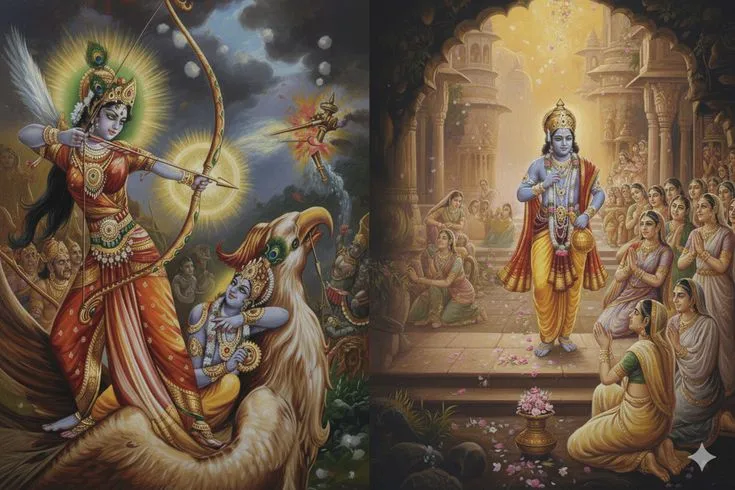
What Is the Role of Abhyang Snan?
Abhyang Snan is one of the most important rituals of Naraka Chaturdashi.
It traditionally involves applying oil, often sesame oil, before bathing early in the morning. Drik Panchang notes that sesame oil is traditionally used for the ritual and that the bath is performed between moonrise and sunrise while Chaturdashi Tithi is prevailing.
The symbolism is purification.
It represents removing physical and spiritual impurity before the main Diwali celebrations.
What Is Maha Nishita in Kali Chaudas?
Maha Nishita refers to the deep midnight period used for determining certain nocturnal rituals.
For Kali Chaudas, the date is traditionally chosen when Chaturdashi Tithi prevails during this midnight period.
This is the key Panchang rule distinguishing Kali Chaudas from Naraka Chaturdashi.
In simple terms:
Kali Chaudas looks at midnight.
Naraka Chaturdashi looks at pre-sunrise.
Kali Chaudas 2026 and Naraka Chaturdashi 2026
In 2026, Chaturdashi Tithi begins on November 7 and ends on November 8. One 2026 Panchang listing shows Chaturdashi beginning around 10:47 AM on November 7 and ending around 11:27 AM on November 8.
Because the tithi spans both midnight and the following morning, the two observances are determined according to their respective ritual rules rather than simply by the date label.
This is exactly why Kali Chaudas and Naraka Chaturdashi should not be automatically merged.
Regional Differences Matter
Indian festivals are often shaped by regional customs.
In Gujarat, Kali Chaudas has a strong identity of its own.
In other regions, Naraka Chaturdashi or Choti Diwali is far more prominent.
In Maharashtra and parts of South India, early morning Abhyang Snan is a major Diwali tradition.
Because of these differences, one family may refer to the day as Kali Chaudas while another may observe Naraka Chaturdashi with completely different rituals.
Both can be culturally valid within their respective traditions.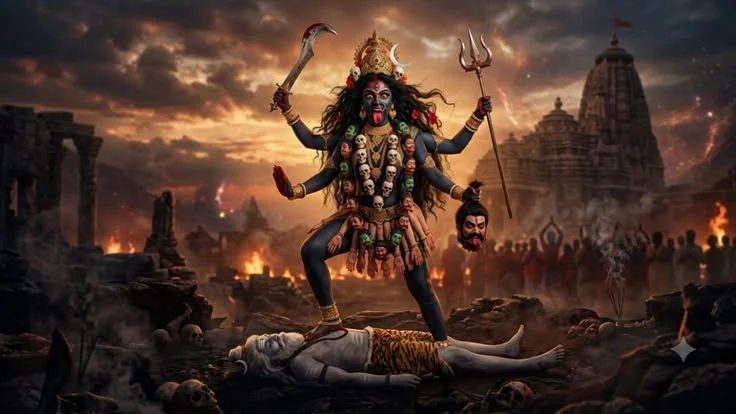
Is Kali Chaudas the Same as Bengal Kali Puja?
No.
This is another common confusion.
Drik Panchang clearly notes that Kali Chaudas should not be confused with Bengal Kali Puja, which is observed when Amavasya Tithi prevails during midnight, generally after the Kali Chaudas observance.
So there are three distinct ideas:
Kali Chaudas – Chaturdashi, midnight-based
Naraka Chaturdashi – Chaturdashi, pre-sunrise based
Kali Puja – Amavasya, especially important in Bengal
This distinction is extremely useful for readers because the names are often mixed online.
Why Is Kheer Kept Under Moonlight on Sharad Purnima
Spiritual Difference Between the Two
Spiritually, both festivals deal with overcoming darkness, but their emphasis differs.
Kali Chaudas
Focuses more on:
protection
fierce spiritual energy
overcoming fear
removal of negative influences
night-time worship
Naraka Chaturdashi
Focuses more on:
purification
cleansing
destruction of evil
preparation for Diwali
early morning renewal
So both belong to the same larger Diwali spiritual landscape, but they express different aspects of it.
Kali Chaudas vs Naraka Chaturdashi at a Glance
Kali Chaudas:
Observed based on Chaturdashi during midnight
Especially important in Gujarat
Associated with protection and night worship
Also called Bhut Chaturdashi in some traditions
Naraka Chaturdashi:
Observed based on Chaturdashi before sunrise
Widely known as Choti Diwali
Associated with Abhyang Snan and purification
Also known as Roop Chaudas or Roop Chaturdashi
Personal Session
Festivals often become moments of reflection, especially when they symbolise purification, courage and transformation.
Book Now
Read Latest Articles
Vaikunth Chaturdashi: Why Are Vishnu & Shiva Worshipped Together?
Bhai Dooj Date: Tilak Muhurat, Puja Time & Complete Vidhi
Frequently Asked Questions
Q.Are Kali Chaudas and Naraka Chaturdashi the same?
No, not exactly. Both are observed around Krishna Chaturdashi during Diwali, but their ritual timing differs. Kali Chaudas is determined when Chaturdashi prevails during the midnight Maha Nishita period, while Naraka Chaturdashi is linked with pre-sunrise Abhyang Snan. Depending on the tithi, they may fall on the same date or on consecutive days.Q.Is Kali Chaudas the same as Naraka Chaturdashi?
No. Traditional Panchang rules distinguish them by ritual timing and purpose.Q.Which one is Choti Diwali?
Naraka Chaturdashi is more commonly known as Choti Diwali.Q.What is Kali Chaudas?
Kali Chaudas is a Chaturdashi observance associated with midnight worship, protection and fierce divine energy, especially in Gujarat.Q.What is Naraka Chaturdashi?
Naraka Chaturdashi is a Diwali-period festival associated with purification, the Narakasura story and early morning Abhyang Snan.Q. Can Kali Chaudas and Naraka Chaturdashi fall on different dates?
Yes. Because one is determined by midnight Chaturdashi and the other by pre-sunrise Chaturdashi, they can fall on consecutive civil dates.Q. Is Roop Chaudas the same as Kali Chaudas?
No. Roop Chaudas is generally another name for Naraka Chaturdashi.