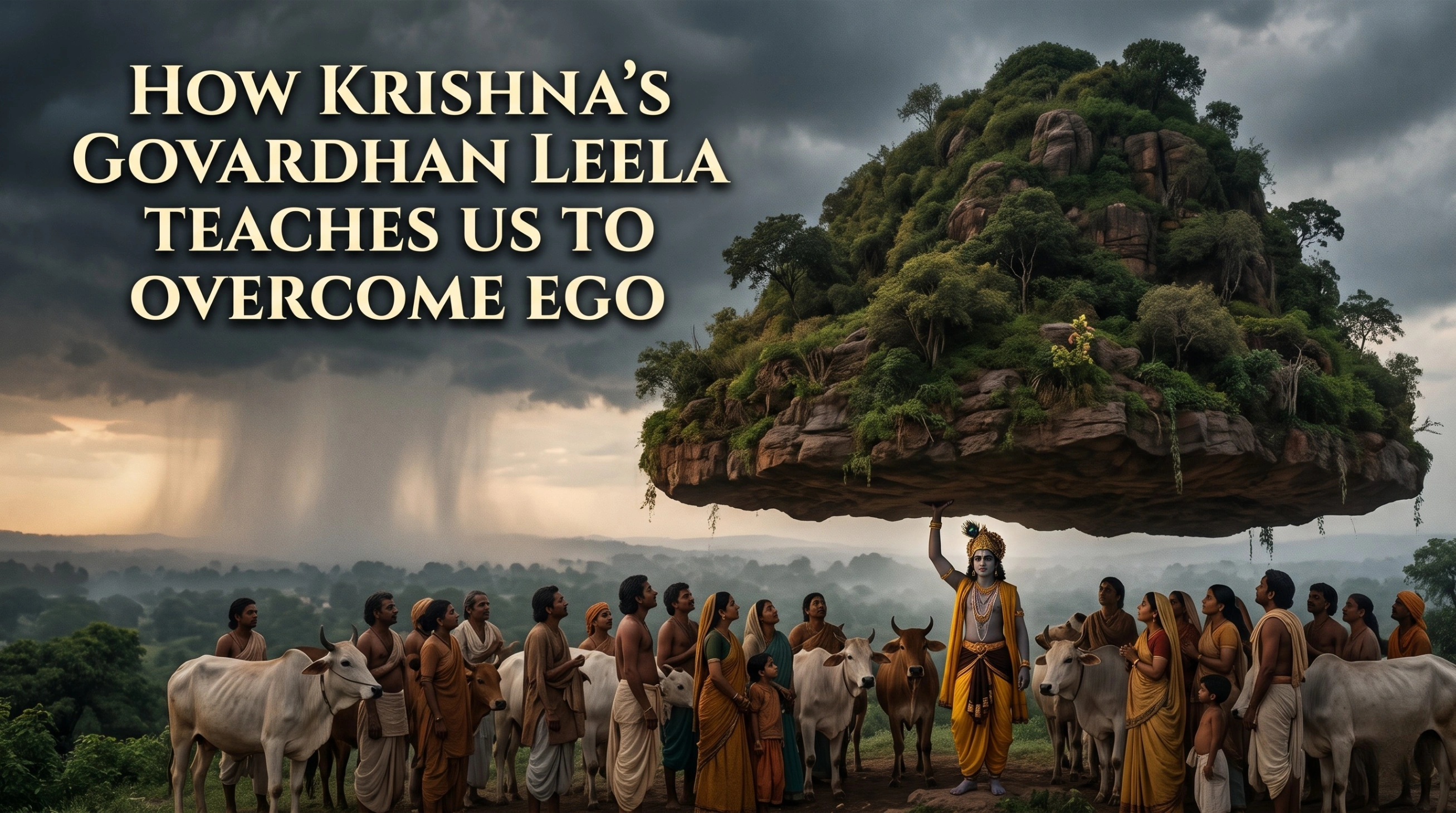
The story of Lord Krishna lifting Govardhan Hill is one of the most inspiring episodes in Hindu tradition. Known as Govardhan Leela, this divine event teaches profound lessons about humility, devotion, courage, gratitude, and the dangers of excessive pride. It reminds us that true strength does not come from displaying power or demanding recognition. It comes from wisdom, compassion, and an understanding of our place in the larger world.
According to the Bhagavata Purana, the people of Vrindavan worshipped Lord Indra, the deity associated with rain and storms. Young Krishna encouraged them to honour Govardhan Hill and appreciate the natural environment that sustained their lives. When Indra became angry and sent torrential rain upon the region, Krishna lifted Govardhan Hill on his little finger, providing shelter to the people and their cattle.
Beyond its miraculous events, Govardhan Leela offers a timeless lesson about overcoming ego. It shows how pride can cloud judgement, how humility opens the door to understanding, and how genuine leadership protects rather than intimidates.
These teachings connect meaningfully with the vision of Science Divine Foundation: Sound Body, Sound Mind and Self-Realisation. By understanding our thoughts, recognising our limitations, and learning to act with awareness, we can begin to overcome the ego-driven patterns that affect our relationships and decisions.
Let us explore the story of Govardhan Leela, its deeper spiritual meaning, and the practical lessons it offers for living with greater humility and inner peace.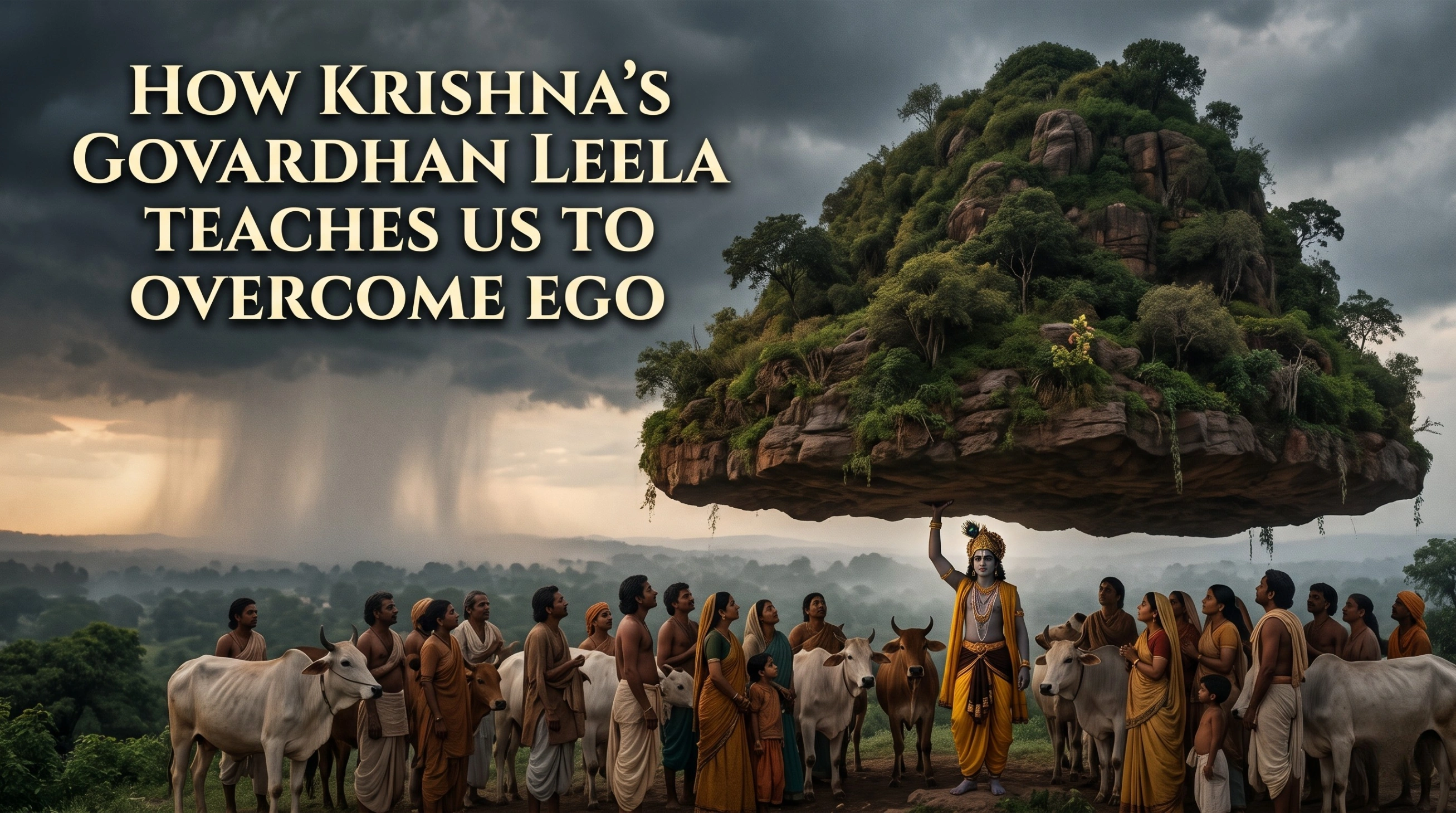
What Is Govardhan Leela?
Govardhan Leela refers to the traditional story in which Lord Krishna lifts Govardhan Hill to protect the residents of Vrindavan from devastating rainfall sent by Lord Indra.
The episode is described in the Bhagavata Purana, particularly in its account of Krishna's childhood in Vrindavan. The story is celebrated during Govardhan Puja, observed as part of the Diwali festival in many Hindu traditions.
Govardhan Hill is associated with Krishna's divine play, the devotion of the people of Braj, and the relationship between humanity and nature.
The story is also a spiritual lesson about the difference between genuine strength and pride. Indra possesses immense power, but his anger reveals the dangers of arrogance. Krishna, despite appearing as a young cowherd, demonstrates wisdom, courage, and compassion by protecting an entire community.
This contrast makes Govardhan Leela much more than a story of supernatural power. It invites us to examine our own attitudes: Do we use our abilities to serve others, or do we use them to feel superior?
The Story of Krishna Lifting Govardhan Hill
To understand the lesson of overcoming ego, it helps to explore the story step by step.
1. The People of Vrindavan Prepare for Indra's Worship
The residents of Vrindavan traditionally performed a ceremony to honour Lord Indra, seeking favourable rainfall for their agricultural activities and the well-being of their community.
As the deity associated with rain and storms, Indra was believed to play an important role in sustaining life and crops.
Young Krishna questioned the purpose of the ritual. He encouraged the residents to recognise the importance of Govardhan Hill, the surrounding pastures, the cows, and the natural resources that supported their daily lives.
Rather than performing a ritual merely because it was customary, Krishna encouraged the people to appreciate the immediate sources of their livelihood and well-being.
Design Your Destiny
Your growth begins when you become conscious of the thoughts, habits, and reactions that shape your life. Explore Science Divine Foundation's teachings and resources to deepen your self-awareness, reflect on spiritual wisdom, and bring meaningful change into your everyday actions.
Start Your Journey Today!2. Krishna Encourages Gratitude Towards Nature
Krishna explained that the residents depended on the land, vegetation, water, and cattle for their survival. Govardhan Hill provided resources and supported the ecosystem in which their community flourished.
The people accepted Krishna's reasoning and performed offerings in honour of Govardhan Hill instead.
This decision became the turning point in the story. Krishna's teaching redirected their attention towards gratitude, responsibility, and a closer understanding of the natural world.
The lesson is relevant even today. We often become so focused on our ambitions that we overlook the people, resources, and circumstances that make our achievements possible.
Recognising these contributions can help us develop gratitude instead of assuming that everything we possess is solely the result of our individual efforts.
3. Lord Indra Becomes Angry
When Indra learned that the people of Vrindavan had redirected their worship, he became furious. He interpreted their decision as an insult to his authority.
According to the story, Indra sent powerful clouds and relentless rain to punish the residents. The rainfall threatened the people, their homes, and their cattle.
Indra's reaction illustrates how ego can distort our understanding of a situation. Instead of considering Krishna's reasoning, he responded as though his position had been challenged.
In everyday life, a similar pattern can occur when someone disagrees with us. We may become defensive, dismiss another person's perspective, or attempt to prove that we are right.
Govardhan Leela reminds us that disagreement does not always mean disrespect. Sometimes, it presents an opportunity to reconsider our assumptions.
4. Krishna Lifts Govardhan Hill
As the storm intensified, the residents of Vrindavan sought Krishna's protection. In response, Krishna lifted Govardhan Hill on his little finger and invited the people and their cattle to take shelter beneath it.
For seven days, according to the traditional account, Krishna held the hill while the community remained protected from the storm.
This extraordinary act demonstrates Krishna's divine power and his compassion towards those who depend on him.
It also reveals a contrast between Indra's response and Krishna's actions. Indra uses power to punish those he believes have challenged him, whereas Krishna uses his power to protect those in danger.
The story invites us to consider what strength means in our own lives. Is strength about making others fear us, or is it about helping others feel safe?
True leadership is demonstrated not merely by authority, status, or recognition, but by the responsibility we accept for the well-being of others.
5. Indra Realises His Mistake
When Indra recognises that his storm cannot overcome Krishna's protection, he understands the limits of his own power. In the traditional account, he eventually acknowledges his mistake and seeks forgiveness.
His realisation marks an important turning point. The story does not present pride as an unavoidable quality; it shows that recognition of one's error can open the way to humility.
We all make mistakes, and we may sometimes act out of insecurity, anger, or a desire to prove ourselves. What matters is whether we can recognise these patterns and choose a better response.
Admitting that we were wrong does not make us weak. It allows us to learn, repair relationships, and develop a more honest understanding of ourselves.
Kali Chaudas vs Naraka Chaturdashi : Are They the Same ?
How Govardhan Leela Teaches Us to Overcome Ego
The story offers several practical lessons for understanding and overcoming ego in daily life.
1. Recognise That Pride Can Distort Your Judgement
Indra's anger begins when he interprets the residents' decision as a challenge to his authority. His pride prevents him from considering another perspective.
Ego can operate similarly in our lives. We may believe that our experience makes us right, that our position deserves unquestioned respect, or that admitting a mistake will reduce our worth.
The first step towards overcoming ego is to notice these reactions.
When you feel defensive, pause and ask yourself: Am I trying to understand this situation, or am I simply trying to win?
This question can help create space between an emotional reaction and a thoughtful response.
2. Practise Humility Without Losing Confidence
Humility does not mean thinking poorly of yourself or denying your abilities. It means recognising your strengths without assuming that you are superior to others.
Krishna's actions in Govardhan Leela demonstrate strength without arrogance. He protects the residents rather than using his power to demand admiration.
In everyday life, humility may mean listening to a colleague's suggestion, acknowledging a family member's contribution, or admitting that you need help.
Confidence allows us to act. Humility allows us to keep learning.
Together, they help us grow without becoming trapped in the need to prove ourselves.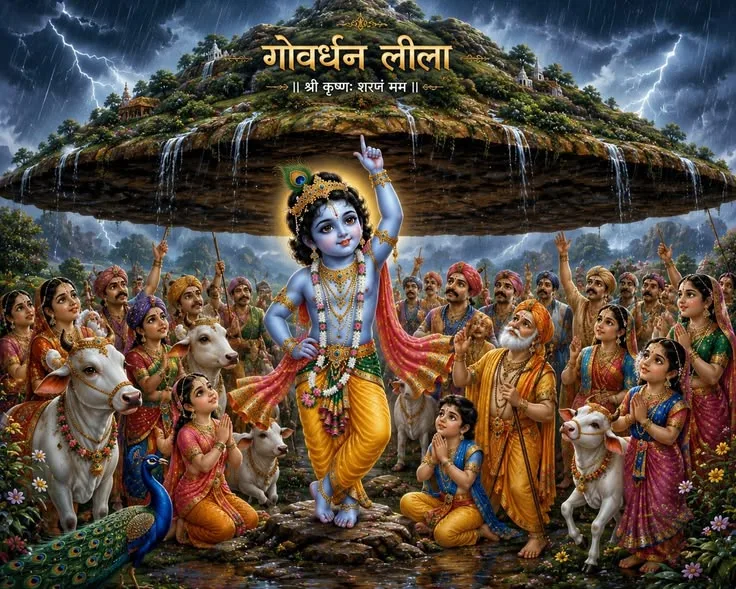
3. Replace Entitlement with Gratitude
The residents of Vrindavan learn to appreciate the natural resources that sustain their lives. Their change in perspective highlights the importance of gratitude.
Ego often encourages us to focus on what we believe we deserve. Gratitude helps us notice what we already receive from others and from the world around us.
You can practise gratitude by acknowledging the people who support you, appreciating opportunities to learn, and recognising the effort behind your everyday comforts.
Gratitude does not mean ignoring difficulties or accepting unfair treatment. It means developing a fuller understanding of life rather than viewing everything through the lens of personal entitlement.
4. Use Your Strength to Support Others
Krishna lifts Govardhan Hill to protect the community. His power is expressed through service rather than domination.
This offers a useful lesson for leadership, family life, and professional relationships.
If you have knowledge, use it to help others understand. If you hold responsibility, use it fairly. If someone is struggling, offer support instead of using their difficulty to feel more powerful.
A meaningful measure of strength is not how many people depend on you out of fear, but how responsibly you treat those who rely on you.
5. Learn to Accept Your Mistakes
Indra's eventual acknowledgement of his error demonstrates the importance of self-correction.
People sometimes resist admitting mistakes because they fear criticism or embarrassment. Yet refusing to acknowledge an error can make a difficult situation worse.
When you recognise that you have acted unfairly, take responsibility for your behaviour. Offer an apology where appropriate, make amends when possible, and consider what you can do differently next time.
Self-awareness allows us to learn without turning every mistake into a judgement about our entire identity.
6. Remember That You Are Part of Something Larger
Govardhan Leela highlights the relationship between the community, nature, and the forces that sustain life.
The story encourages us to move beyond the belief that everything revolves around our individual achievements or desires.
Our lives are influenced by family, society, nature, education, opportunities, and countless contributions from others.
Recognising this interconnectedness can soften excessive pride and encourage responsibility towards the world around us.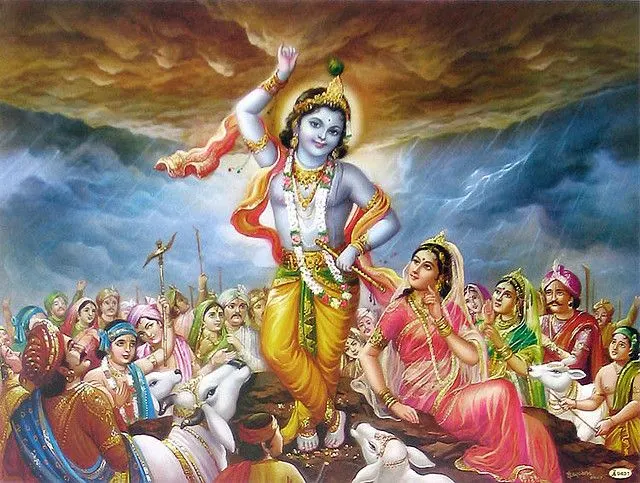
What Is the Connection Between Govardhan Leela and the Bhagavad Gita?
Although Govardhan Leela is a story from Krishna's childhood traditions, its lessons can be explored alongside the teachings of the Bhagavad Gita.
In Bhagavad Gita 2.47, Krishna teaches Arjuna to focus on action without becoming excessively attached to its results. This principle encourages sincere effort while recognising that outcomes are not entirely within our control.
Ego can arise when we become overly identified with success, recognition, status, or the need to be seen as superior. We may begin to measure our worth through external achievements and become distressed when circumstances do not match our expectations.
The Gita's teaching invites us to act responsibly without allowing the desire for recognition to dominate our choices.
Similarly, Bhagavad Gita 16.4 identifies arrogance, pride, and conceit among qualities associated with an unhealthy disposition. This provides a useful starting point for reflecting on how pride can affect our behaviour.
These teachings do not suggest that ambition or confidence is inherently wrong. Rather, they encourage us to pursue our goals with discernment, responsibility, and awareness.
The message of Govardhan Leela becomes especially meaningful when we ask ourselves whether our actions are guided by wisdom and care or by the need to protect our ego.
How Science Divine Foundation Connects Govardhan Leela with Self-Realisation
Science Divine Foundation's vision of Sound Body, Sound Mind and Self-Realisation offers a meaningful way to explore the deeper lessons of Govardhan Leela.
Overcoming ego begins with becoming aware of our inner patterns. We may notice that criticism triggers defensiveness, disagreement produces anger, or success creates a desire for constant recognition.
Without awareness, these reactions can influence our relationships and decisions before we have a chance to examine them.
Self-awareness encourages us to pause and observe these patterns. Instead of automatically reacting, we can ask what is driving our behaviour and whether our response reflects our deeper values.
This approach connects with the foundation's emphasis on bringing spiritual wisdom into everyday living. Its guiding message, “Gita ko sirf padhna nahi, Gita ko jeena hai,” reminds us that spiritual teachings become meaningful when they influence our actions.
In the context of Govardhan Leela, this can mean choosing humility over arrogance, gratitude over entitlement, and service over the need to dominate.
Self-realisation is a deeper and ongoing journey of understanding oneself. It invites us to look beyond habitual reactions and develop greater clarity about our thoughts, motivations, and identity.
The story of Krishna lifting Govardhan Hill can therefore serve as a reminder that personal growth does not depend only on acquiring knowledge or achieving success. It also involves examining the attitudes through which we live.
Science Divine Foundation encourages people to explore this inward journey and consider how awareness can support a more balanced and purposeful life.
How to Stay Happy Even When Life Is Difficult
Five Daily Practices to Overcome Ego
You do not need to wait for a major life event to practise humility. Small, consistent actions can help you become more aware of your reactions.
Pause before responding. When you feel defensive or angry, take a moment before speaking. Give yourself time to understand what has triggered the reaction.
Listen to understand. Allow others to express their perspectives without immediately preparing a counterargument.
Acknowledge other people's contributions. Recognise the support, knowledge, and effort that help you succeed.
Admit mistakes honestly. Treat errors as opportunities for learning rather than threats to your self-worth.
Reflect at the end of the day. Ask yourself where you acted with humility, where ego influenced you, and what you could do differently tomorrow.
These practices are not about eliminating every feeling of pride. They are about learning to recognise when pride becomes an obstacle to understanding, connection, and responsible action.
Conclusion: Let Krishna's Govardhan Leela Inspire Inner Growth
Krishna's Govardhan Leela is a powerful story about divine protection, but its lessons extend into everyday life. Through Indra's pride and Krishna's compassionate strength, the story invites us to examine our attitudes towards power, recognition, gratitude, and responsibility.
It teaches us that humility is not weakness, that admitting mistakes creates opportunities for growth, and that genuine strength is expressed through service rather than domination.
The Bhagavad Gita offers complementary wisdom about self-awareness, responsible action, and freedom from excessive attachment to outcomes. The vision of Science Divine Foundation encourages us to bring such wisdom into our everyday choices as we work towards a sound body, a sound mind, and self-realisation.
The next time you feel the need to prove that you are right, pause and reflect. Could listening help more than arguing? Could gratitude change your perspective? Could acknowledging a mistake make you stronger rather than weaker?
Overcoming ego begins when we become willing to understand ourselves honestly. Let Govardhan Leela inspire you to live with greater humility, compassion, and awareness.
Personal Session
Every person's journey towards self-understanding is different. If you would like to reflect on recurring patterns, explore spiritual wisdom, or take a more conscious approach to life's challenges, connect with Science Divine Foundation to learn about available personal sessions.
Book Now
Read Latest Articles
Overthinking Everything? Ancient Gita Wisdom for a Thinking Mind
Do Positive Affirmations Really Work? The Science Behind Self-Talk
Frequently Asked Questions
Q.How does Krishna's Govardhan Leela teach us to overcome ego?
Krishna's Govardhan Leela teaches us to overcome ego by showing the dangers of pride and the importance of humility, gratitude, and service. Lord Indra's anger reflects how arrogance can cloud judgement, while Krishna's protection of Vrindavan demonstrates compassionate strength. The story encourages us to accept mistakes, respect others, and use our abilities to help rather than dominate people.Q.What is the story of Krishna's Govardhan Leela?
According to the Bhagavata Purana, Krishna encouraged the people of Vrindavan to honour Govardhan Hill and appreciate the natural resources that sustained them. Lord Indra became angry and sent heavy rain, so Krishna lifted the hill to shelter the residents and their cattle.Q.What is the main lesson of Govardhan Leela?
The story teaches humility, gratitude, courage, and compassion. It highlights the dangers of arrogance and shows that true strength is best expressed through protection, responsibility, and service to others.Q.Why did Lord Krishna lift Govardhan Hill?
In the traditional story, Krishna lifted Govardhan Hill to protect the people and cattle of Vrindavan from the severe storm sent by Lord Indra. The act demonstrates Krishna's divine power and his care for the community.Q.What does Lord Indra's ego teach us?
Indra's reaction illustrates how pride can make a person interpret disagreement as an insult. His eventual recognition of his mistake reminds us to reconsider our assumptions, accept our limitations, and learn from errors.Q.How is Govardhan Leela connected to the Bhagavad Gita?
Govardhan Leela and the Bhagavad Gita can both inspire reflection on humility, responsible action, and self-awareness. Bhagavad Gita 2.47 teaches us to focus on our actions without excessive attachment to results, while 16.4 identifies arrogance and pride among qualities to be mindful of.Q.How does Science Divine Foundation connect with Govardhan Leela?
Science Divine Foundation's vision of Sound Body, Sound Mind and Self-Realisation encourages individuals to develop self-awareness and apply spiritual wisdom in daily life. Govardhan Leela offers a practical opportunity to reflect on humility, gratitude, and acting beyond ego-driven reactions.