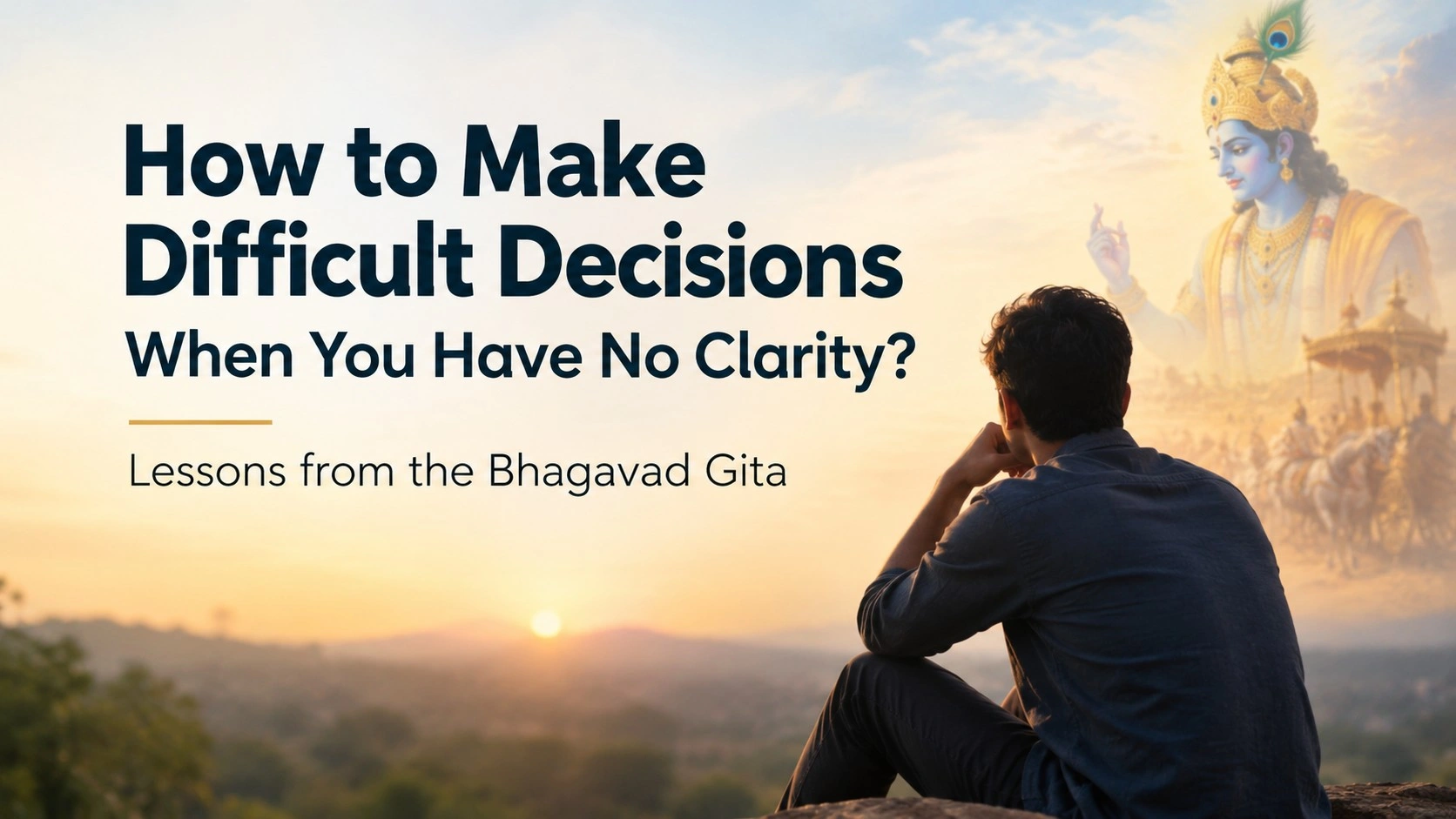
There are moments in life when making a decision feels almost impossible. You may have two career options, be uncertain about a relationship, struggle with a major financial choice, or simply feel stuck between what your heart wants and what you believe you should do. The more you think about the situation, the more confused you become. You keep asking yourself, “What is the right decision?” but clarity seems further away.
This experience is not new. One of the most powerful examples of decision-making under extreme uncertainty comes from the Bhagavad Gita. Before the great battle of Kurukshetra, Arjuna finds himself overwhelmed by doubt, fear, attachment and conflicting responsibilities. He knows he must act, but he cannot see clearly what the right action is.
His dilemma is remarkably relevant to modern life. We may not stand on a battlefield, but we regularly face our own crossroads. The question is not always how to find a perfect answer. Sometimes, the real question is how to develop enough inner clarity to act wisely even when certainty is impossible.
The Bhagavad Gita offers a powerful framework for understanding this process.
Why Do We Struggle to Make Difficult Decisions?
When we face an important decision, we often believe that we need complete clarity before taking action. But life rarely gives us that luxury.
Our judgment can become clouded by fear, attachment, social expectations, past experiences and the desire to control the outcome. We may worry about making the wrong choice, disappointing someone, losing an opportunity or regretting our decision later.
This creates a cycle of overthinking.
We analyse every possible outcome, imagine worst-case scenarios and repeatedly change our minds. Instead of helping us reach clarity, excessive thinking can increase confusion.
The problem, therefore, may not always be the absence of information. Sometimes, it is the emotional noise surrounding the information we already have.
This is where the Bhagavad Gita's approach to decision making becomes meaningful.
Design Your Destiny
Your life is shaped by the decisions you make every day. But meaningful decisions become easier when you learn to understand your mind, your values and your deeper purpose. Through Design Your Destiny, explore how timeless wisdom can become practical guidance for modern life. Move beyond confusion, reconnect with your inner direction and learn to approach life's crossroads with greater awareness and confidence.
Start Your Journey Today!Arjuna's Dilemma: A Powerful Example of Confusion
Arjuna's dilemma is one of the central starting points of the Bhagavad Gita.
Standing on the battlefield, Arjuna sees people he knows and loves on both sides. His emotions overwhelm him. He begins questioning whether the battle is worth fighting and whether his responsibility is morally justified.
He is not simply confused about what action to take. He is struggling with conflicting values.
On one side is his responsibility. On the other are his relationships and emotional attachments.
His situation illustrates an important truth about difficult decisions: confusion often arises when different things that matter to us pull us in different directions.
Modern decisions can create similar conflicts.
You may want career growth but also want more time with your family. You may want to leave a situation but fear hurting someone. You may know you need change but feel comfortable with what is familiar.
Like Arjuna, you may not lack intelligence. You may simply be emotionally entangled in the decision.
Bhagavad Gita on Decision Making: Start by Calming the Mind
One of the first lessons we can draw from the Gita is that meaningful decisions become difficult when the mind is overwhelmed.
When fear, anxiety and attachment dominate our thinking, our perception can become narrow. We may focus only on what we could lose rather than considering the larger picture.
Therefore, before asking, “What should I choose?”, ask:
“What state of mind am I making this decision from?”
Am I deciding from fear?
Am I deciding because I want approval?
Am I avoiding discomfort?
Am I reacting emotionally?
Or am I thinking about what genuinely aligns with my responsibilities and values?
This small shift can create significant clarity.
Sometimes the first step toward a better decision is not finding more answers. It is becoming calm enough to see the questions clearly.
How to Find Clarity in Difficult Decisions
Clarity does not necessarily mean knowing exactly what will happen.
Instead, clarity can mean understanding why you are choosing something and what principles are guiding your choice.
When you have no clarity, try separating the decision into three layers.
Overthinking Everything? Ancient Gita Wisdom for a Thinking Mind
1. What Can I Control?
Identify the things that are within your control.
Your preparation, effort, communication, attitude and actions are generally within your influence. Other people's reactions, unexpected events and the ultimate outcome may not be.
This distinction prevents you from spending all your mental energy trying to predict the unpredictable.
2. What Is My Responsibility?
The Gita's concept of dharma provides another useful lens.
Dharma can be understood broadly as one's responsibility, duty or the right course of action according to one's circumstances and principles.
Instead of asking only:
“What do I want?”
you can also ask:
“What is my responsibility in this situation?”
This does not mean ignoring your emotions or personal needs. It means looking beyond immediate comfort and considering your deeper values and responsibilities.
3. What Action Is Required Now?
You do not always need to solve your entire future today.
Sometimes you only need to identify the next right step.
If you are confused about your career, you may not need to decide your entire professional life. You might need to research an opportunity, speak to someone experienced or develop a particular skill.
If you are confused about a relationship, you may not need to know exactly what the relationship will look like five years from now. You may first need an honest conversation.
Clarity often emerges through thoughtful action, not endless thinking.
Detachment: One of the Most Important Lessons for Decision Making
One of the most well-known teachings associated with the Bhagavad Gita is the principle of acting without attachment to the fruits of action.
This is particularly relevant when making difficult decisions.
Often, we become paralysed because we want a guarantee that our decision will produce the desired result.
But no decision comes with complete certainty.
You can make a thoughtful career choice and still encounter unexpected challenges. You can make a relationship decision with the best intentions and still experience an unpredictable outcome.
Detachment does not mean becoming careless or indifferent.
It means doing your best without allowing your peace of mind to depend entirely on controlling the result.
This distinction can dramatically change decision-making.
Instead of asking:
“What choice guarantees the best outcome?”
ask:
“Given what I know today, what is the most responsible action I can take?”
That is a much more practical question.
How to Make Decisions When You Are Confused
When you feel stuck, use a simple Gita-inspired decision framework.
Pause
Do not immediately react to intense emotions. Give yourself enough space to observe what you are feeling.
Identify the Conflict
Write down the two or more forces pulling you in different directions.
For example:
Security vs growth
Comfort vs responsibility
Fear vs opportunity
Personal desire vs duty
Short-term happiness vs long-term wellbeing
Naming the conflict can make confusion more manageable.
Separate Facts from Fear
Ask yourself what you actually know and what you are merely imagining.
“What if everything goes wrong?” is a fear-based prediction, not a fact.
This distinction can help reduce unnecessary overthinking.
Identify Your Values
Ask:
What matters most to me in this situation?
Your values can provide a compass when circumstances are uncertain.
Consider Your Dharma
What responsibilities do you have?
What action is consistent with your principles?
What would you respect yourself for doing, even if the outcome were not perfect?
Take the Next Responsible Action
Once you have considered the situation carefully, act.
You do not need perfect certainty.
You need sufficient clarity to take the next meaningful step.
Release the Need to Control Everything
After making the decision, avoid repeatedly revisiting it simply because you cannot control the outcome.
Learn, adapt and continue moving forward.
Krishna's Advice: Do Not Let Confusion Become Inaction
The conversation between Krishna and Arjuna is powerful because Krishna does not simply remove every uncertainty from Arjuna's life.
Instead, Krishna helps Arjuna understand his situation differently.
This is an important distinction.
Sometimes we expect clarity to arrive as a perfect answer:
“This is definitely the right choice.”
But real clarity may look more like:
“I understand my values, I understand my responsibility, I have considered the consequences, and I am willing to act despite uncertainty.”
That is a deeper form of clarity.
It does not eliminate uncertainty.
It teaches us how to move through uncertainty.
Bhagavad Gita on Action and Uncertainty
One reason difficult decisions become so stressful is that we want certainty before action.
But uncertainty is an unavoidable part of life.
You cannot know exactly how every decision will unfold. Waiting until everything is predictable may mean waiting forever.
The Gita's emphasis on action offers another perspective: focus on performing your role sincerely rather than becoming consumed by the outcome.
This can be especially valuable in modern life, where constant comparison and information overload can make every decision feel enormous.
Sometimes, the goal is not to make a flawless decision.
The goal is to make a conscious decision and then engage with it fully.
When You Should Not Make a Decision Immediately
Although action is important, the lesson is not “always act quickly.”
Sometimes the wisest action is to pause.
If you are extremely angry, emotionally overwhelmed or under intense pressure, give yourself time before making an irreversible decision.
Likewise, if you do not have essential information, gather it.
Spiritual wisdom and practical wisdom can work together.
Pause when emotions are controlling you.
Research when information is missing.
Reflect when values are unclear.
Act when you have enough clarity to move forward.
This creates a balanced approach to difficult decisions.
You Do Not Need Perfect Clarity to Move Forward
Perhaps the most important lesson is that clarity is not always something you find before taking action.
Sometimes clarity develops because you take the right next step.
Arjuna begins the Gita in a state of profound confusion. Through dialogue, reflection and understanding, he moves toward a position where he is prepared to act.
This offers a powerful lesson for anyone standing at a crossroads.
You may not know exactly what the future holds.
You may still have doubts.
You may still feel afraid.
But you can ask yourself:
What is within my control?
What is my responsibility?
What aligns with my deeper values?
What action can I take today?
Can I act sincerely without becoming obsessed with the outcome?
These questions can transform decision-making from a search for perfect certainty into a practice of conscious living.
Why Is Gen Z So Mentally Exhausted Even When Life Seems Fine
Living the Gita: From Reading Wisdom to Applying It
The Bhagavad Gita is not only a philosophical text to be read. Its teachings can become practical tools for navigating everyday life.
Every difficult decision becomes an opportunity to practise awareness, responsibility, courage and detachment.
This is at the heart of Living the Gita.
To live the Gita means bringing its wisdom into ordinary moments—when you are confused, when you are afraid, when you have to choose, when the outcome is uncertain and when you must decide how to respond to life's challenges.
You may not always have complete clarity.
But you can cultivate a clearer mind.
You may not control the outcome.
But you can control the sincerity of your action.
And you may not know exactly where the path will lead.
But you can still take the next step with awareness.
Sometimes, clarity does not come from knowing the entire path. It comes from knowing the next right step.
Personal Session
Sometimes, the hardest decisions are the ones we cannot resolve alone. If you are standing at a personal, professional or emotional crossroads and need a deeper space for reflection, a personal session can help you step back from the noise, understand what is truly driving your confusion and explore your next step with greater clarity.
Book Now
Read Latest Articles
What Is Bhakti? Meaning, Importance & Spiritual Significance
Do Positive Affirmations Really Work? The Science Behind Self-Talk
Frequently Asked Questions
How does the Bhagavad Gita help with difficult decisions?
The Bhagavad Gita teaches us to approach difficult decisions with a calm mind, understand our responsibilities, act according to our values and avoid excessive attachment to outcomes. Arjuna's dilemma shows that clarity does not always mean knowing the future. It means understanding your duty, making a thoughtful choice and taking action without allowing fear, confusion or attachment to completely control your decisions.What does the Bhagavad Gita say about decision making?
The Bhagavad Gita encourages thoughtful action based on one's responsibilities, values and dharma rather than fear, confusion or excessive attachment to outcomes. Its dialogue between Krishna and Arjuna offers a framework for acting wisely even when circumstances are uncertain.How can I make a difficult decision when I have no clarity?
Start by calming your mind and separating facts from fears. Identify the actual conflict, clarify your values, understand your responsibilities and determine what is within your control. Then choose the most responsible next action rather than waiting for perfect certainty.What can Arjuna's dilemma teach us about decision making?
Arjuna's dilemma demonstrates that even a capable person can become confused when emotions, relationships and responsibilities conflict. His conversation with Krishna shows the importance of reflection, understanding one's responsibility and moving from emotional confusion toward conscious action.What is the role of detachment in decision making?
Detachment means doing your best without becoming excessively dependent on a particular outcome. It does not mean indifference. It allows you to focus on the quality of your actions while accepting that some results remain outside your control.How can Bhagavad Gita help with overthinking?
The Gita can provide a framework for shifting attention from endless prediction toward responsibility and action. Instead of trying to guarantee a perfect outcome, you can focus on understanding your values, responsibilities and the next meaningful action available to you.What is dharma in the context of decision making?
Dharma can be understood as one's duty, responsibility or appropriate course of action within a particular situation. When making a difficult decision, reflecting on your responsibilities and principles can help you move beyond immediate emotions and consider what action is aligned with your deeper values.Does clarity come before action?
Not always. Sometimes taking a thoughtful, manageable action creates additional information and perspective, which leads to greater clarity. The goal is not necessarily to eliminate every uncertainty before acting, but to make a conscious and responsible decision with the understanding available to you.