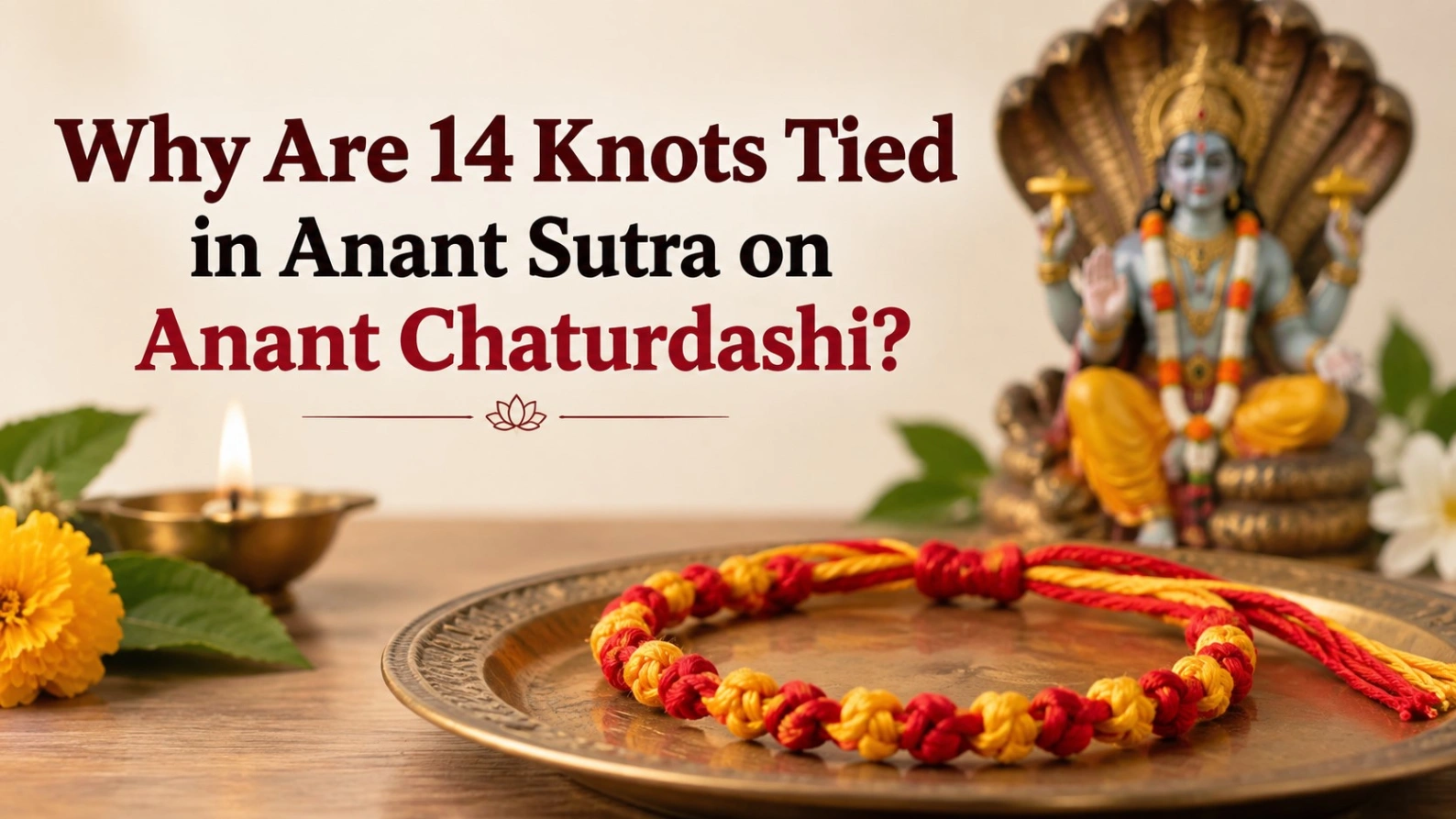
A sacred thread with 14 carefully tied knots is one of the most recognizable symbols associated with Anant Chaturdashi. But why exactly fourteen? Why not twelve, sixteen or any other number?
The answer lies in the spiritual symbolism connected with Lord Vishnu in His Anant form, meaning the Infinite or Endless One.
According to the most widely followed traditional interpretation, the 14 knots in Anant Sutra symbolize the 14 Lokas or realms described in Hindu cosmology. Together, they represent the entirety of creation over which the infinite presence of Lord Vishnu extends. The thread therefore becomes much more than a ritual object it symbolizes faith, continuity, divine protection and remembrance of the infinite.
This is why understanding why 14 knots are tied in Anant Sutra can reveal the deeper philosophy hidden within a seemingly simple Anant Chaturdashi ritual.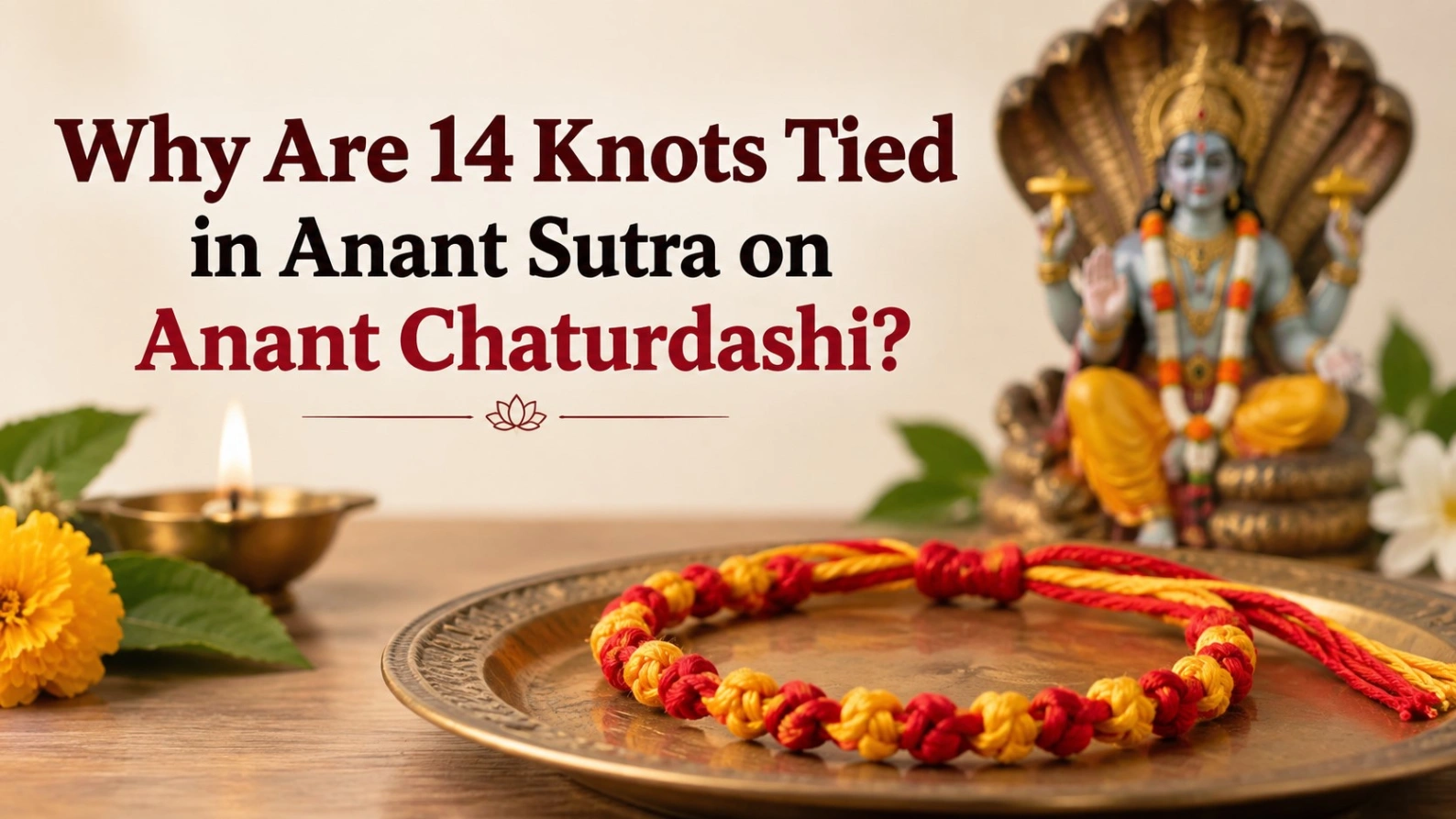
What Is Anant Sutra?
The Anant Sutra, also called Anant Dora or Anant thread in different regions, is a sacred thread worshipped and traditionally tied during the observance of Anant Chaturdashi.
“Anant” means endless, eternal or infinite. In the context of Anant Chaturdashi, it refers particularly to Lord Vishnu worshipped as Anant, the limitless divine presence.
The Anant Sutra traditionally contains 14 knots. The thread is first included in the worship and is then worn according to the custom followed by the devotee's family or region.
Because of this, the Anant Sutra meaning is not limited to wearing a sacred thread for good fortune. It represents a devotional commitment, a reminder to remain connected with dharma, faith and the infinite divine presence even while facing the changing circumstances of everyday life.
Design Your Destiny
Your thoughts, choices and actions shape the direction of your life. Design Your Destiny helps you move beyond unconscious patterns and understand how spiritual wisdom can be applied to relationships, career, emotions and everyday decisions. Explore Design Your Destiny and begin creating your life with greater awareness, clarity and purpose.
Start Your Journey Today!Why Does Anant Sutra Have 14 Knots?
The number 14 is central to the symbolism of Anant Chaturdashi.
The most commonly repeated explanation states that the 14 knots in Anant Sutra represent the 14 Lokas, or fourteen planes of existence described in traditional Hindu cosmology.
These are understood broadly as seven higher realms and seven lower realms.
The seven higher Lokas are commonly described as:
Bhuloka
Bhuvarloka
Svargaloka or Svarloka
Maharloka
Janaloka
Tapoloka
Satyaloka
The seven lower realms are commonly identified as:
Atala
Vitala
Sutala
Talatala
Mahatala
Rasatala
Patala
Names or their ordering can vary somewhat across traditional accounts, so the deeper symbolism is more important than treating the knots as a rigid numbered chart.
Together, the fourteen realms represent the vastness and completeness of creation.
The significance of 14 knots in Anant Sutra therefore lies in remembering that Anant, the Infinite, is not limited to one place, circumstance or form. The divine presence encompasses all creation.
What Do the 14 Knots of Anant Sutra Symbolize?
At the most direct level, the 14 knots are traditionally connected with the 14 Lokas. But spiritually, their symbolism can be understood even more deeply.
A knot joins and holds a thread firmly together. In the same way, every knot can remind a devotee of the connection between the individual and the infinite.
The uninterrupted thread may be seen as continuity, while the knots mark important points along that continuity.
Together they can symbolize:
Faith: Remaining connected with the divine even when circumstances change.
Commitment: Remembering the spiritual vows and values one has chosen to follow.
Protection: Traditionally, the sacred thread is associated with seeking Lord Anant's blessings and protection.
Unity: The fourteen realms may appear different, yet all remain part of one existence.
Infinity: Lord Vishnu as Anant represents that which has no beginning and no end.
This gives the Anant Sutra 14 knots meaning both a cosmological and deeply personal dimension.
Why Is Anant Sutra Tied on Anant Chaturdashi?
Anant Chaturdashi is dedicated to the worship of Lord Vishnu in His Anant form.
The sacred thread becomes a physical reminder of this worship. Rather than allowing devotion to remain only in the few minutes spent performing puja, wearing the Anant Sutra allows the symbolism of the vrata to accompany the devotee into daily life.
The thread effectively asks a profound question:
Can we remember the Infinite while living within the limited circumstances of everyday life?
Work changes. Relationships change. Success and disappointment come and go. The body changes, thoughts change and circumstances constantly shift.
Yet the concept of Anant points toward something beyond this constant change, the eternal divine reality.
Seen in this way, the Anant Chaturdashi Anant Sutra is a reminder to remain inwardly anchored even while life continues to change around us.
Connection Between the 14 Knots and Lord Vishnu
The word Anant itself offers the key to understanding the ritual.
Lord Vishnu is revered as the sustainer of the universe, while His Anant form represents infinity and endlessness.
If the fourteen Lokas symbolize the totality of cosmic existence, the 14 knots collectively become a symbolic expression of the divine presence extending throughout those realms.
Therefore, when someone asks, “Why Anant Sutra has 14 knots?”, the simplest answer is:
The knots traditionally represent the fourteen Lokas, while the thread represents the infinite divine principle connecting and sustaining existence.
This is why the ritual goes beyond simply tying a decorative thread.
Is There Another Meaning Behind the Number 14?
Yes. Hindu traditions can have regional and family variations, and not every household explains the fourteen knots in exactly the same way.
While the 14 Lokas interpretation is among the most widely cited, some traditions also connect the number fourteen with the observance of the Anant Vrat for fourteen years.
Sources describing the vrata therefore sometimes present more than one symbolic explanation for the number 14.
This variation is important because Hindu ritual traditions have developed through different regions, lineages and family customs.
Therefore, where a family's established tradition differs, devotees generally follow the practice taught within their own household or spiritual tradition.
Living The Gita Movement
The Bhagavad Gita is not merely something to be read or listened to. It is the art of awakening within oneself and experiencing the truth of life. The vision of the Living the Gita Movement is to bring the wisdom of the Gita out of books and transform it into a lived experience.
Join NowHow Is the Anant Sutra Traditionally Worn?
The Anant Sutra is generally worshipped before being tied.
In widely followed customs, men wear the Anant Sutra on the right arm, while women wear it on the left. However, practices can differ depending on family and regional traditions.
The spiritual intention behind wearing the thread is more important than treating it merely as an accessory.
It should ideally remind the wearer of the vow, prayer and devotion associated with Anant Chaturdashi.
Because customs concerning how long the thread is worn and how it is later removed can also vary, devotees may follow their family's established tradition or the guidance of their priest or spiritual teacher.
Vishwakarma Puja 2026 Muhurat: Best Puja Time, Date & Vidhi
Spiritual Significance of Anant Sutra
The Anant Sutra significance becomes clearer when we look beyond the external ritual.
Human beings naturally seek stability. We want relationships to remain secure, careers to progress smoothly and circumstances to stay under our control.
But life is constantly changing.
Anant Chaturdashi points toward another kind of stability, not stability of circumstances, but stability of consciousness and faith.
The sacred thread can remind us:
Everything outside changes, but our connection with the divine can remain constant.
The knots also present a beautiful metaphor for life's difficulties.
Life itself has many “knots” like fear, attachment, confusion, ambition, disappointment and uncertainty.
Spiritual wisdom does not necessarily remove every difficult situation immediately. Instead, it transforms how we understand and respond to those situations.
The Anant Sutra can therefore become an invitation to move from anxiety toward trust, from attachment toward surrender and from temporary concerns toward awareness of something greater.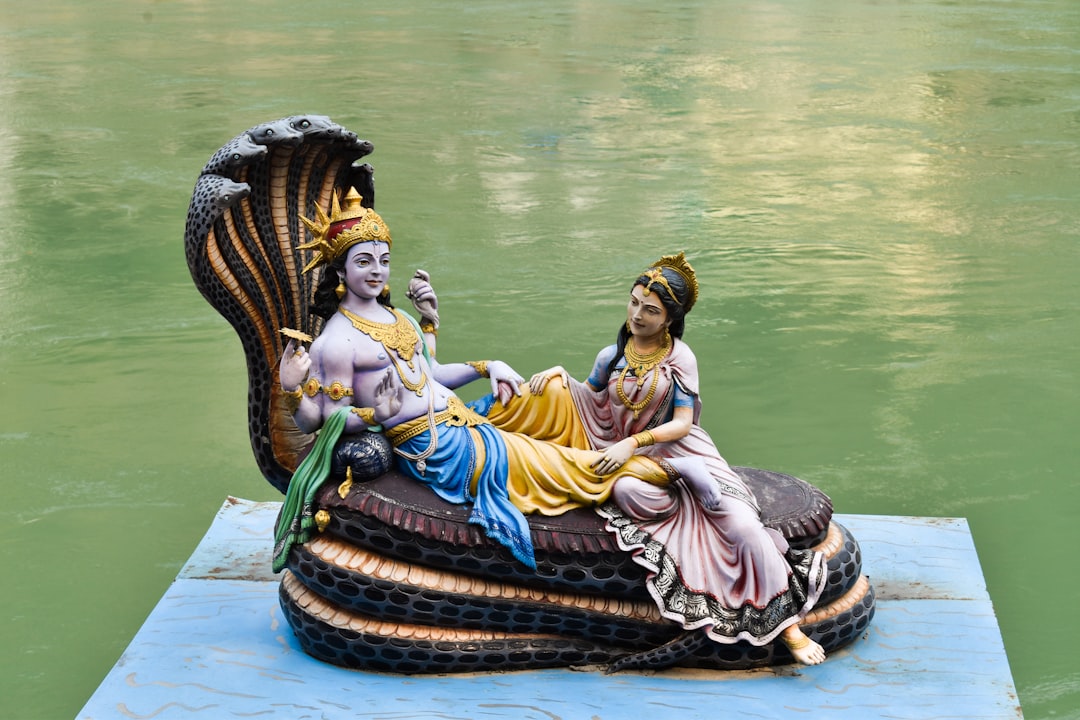
What Can the 14 Knots Teach Us Today?
Ancient rituals remain meaningful when their wisdom enters modern life.
Today, our “knots” may look very different.
One knot may be career anxiety.
Another may be relationship conflict.
Another could be comparison with others.
Others might include financial pressure, fear about the future, social-media overload or uncertainty about important decisions.
Anant Chaturdashi reminds us not to become so absorbed in these temporary knots that we forget the larger thread running through life.
The spiritual message can be simple:
Problems may be many, but consciousness that witnesses them is deeper. Circumstances may be limited, but the divine is Anant, infinite.
This understanding turns the Anant Sutra from an external ritual into an inner teaching.
Anant Sutra and the Meaning of Spiritual Commitment
A sacred thread gains meaning from the awareness with which it is worn.
Simply tying fourteen knots does not automatically create spiritual transformation.
The deeper invitation is to remember what the thread represents.
Faith must enter our choices.
Devotion must influence our actions.
Wisdom must appear in the way we respond when life does not go according to plan.
The Anant Sutra can therefore act as a daily reminder:
Am I responding from fear or awareness?
Am I holding tightly to outcomes, or doing my duty sincerely?
Am I allowing temporary difficulties to define my entire life?
Am I remembering the larger purpose behind my actions?
When a ritual inspires these questions, spirituality begins moving from temple worship into everyday living.
Parsva Ekadashi: Date, Vrat Katha, Puja Vidhi & Significance
Common Questions About Anant Sutra 14 Knots
People searching for the Anant Chaturdashi 14 knots tradition often assume that every knot must have a separate personal wish attached to it.
The more commonly cited traditional explanation, however, associates the fourteen knots collectively with the fourteen Lokas.
Similarly, the Anant Sutra should not be viewed simply as a magical thread guaranteeing wealth or success.
Its deeper importance lies in the faith, prayer, vrata and remembrance associated with Lord Anant.
Ritual becomes most meaningful when accompanied by understanding.
So, why are 14 knots tied in Anant Sutra on Anant Chaturdashi?
The most widely followed explanation is that the 14 knots represent the 14 Lokas, symbolizing the entirety of creation and Lord Vishnu's infinite presence throughout it.
Yet the message of the Anant Sutra can reach far beyond the number fourteen.
The thread reminds us that while our circumstances constantly change, the deeper spiritual reality is Anant, limitless.
When we understand the meaning behind the ritual, the Anant Sutra is no longer merely something tied around the arm.
It becomes a reminder to carry faith into uncertainty, awareness into action and spirituality into everyday life.
That is where ritual becomes realization.
Personal Session
Sometimes general spiritual knowledge is not enough. If you are facing confusion, emotional challenges, relationship concerns or an important life decision, a Personal Session can help you look at your situation with greater clarity and awareness. Book a Personal Session and receive focused spiritual guidance for the questions that matter most to you.
Book NowRead Latest Articles