
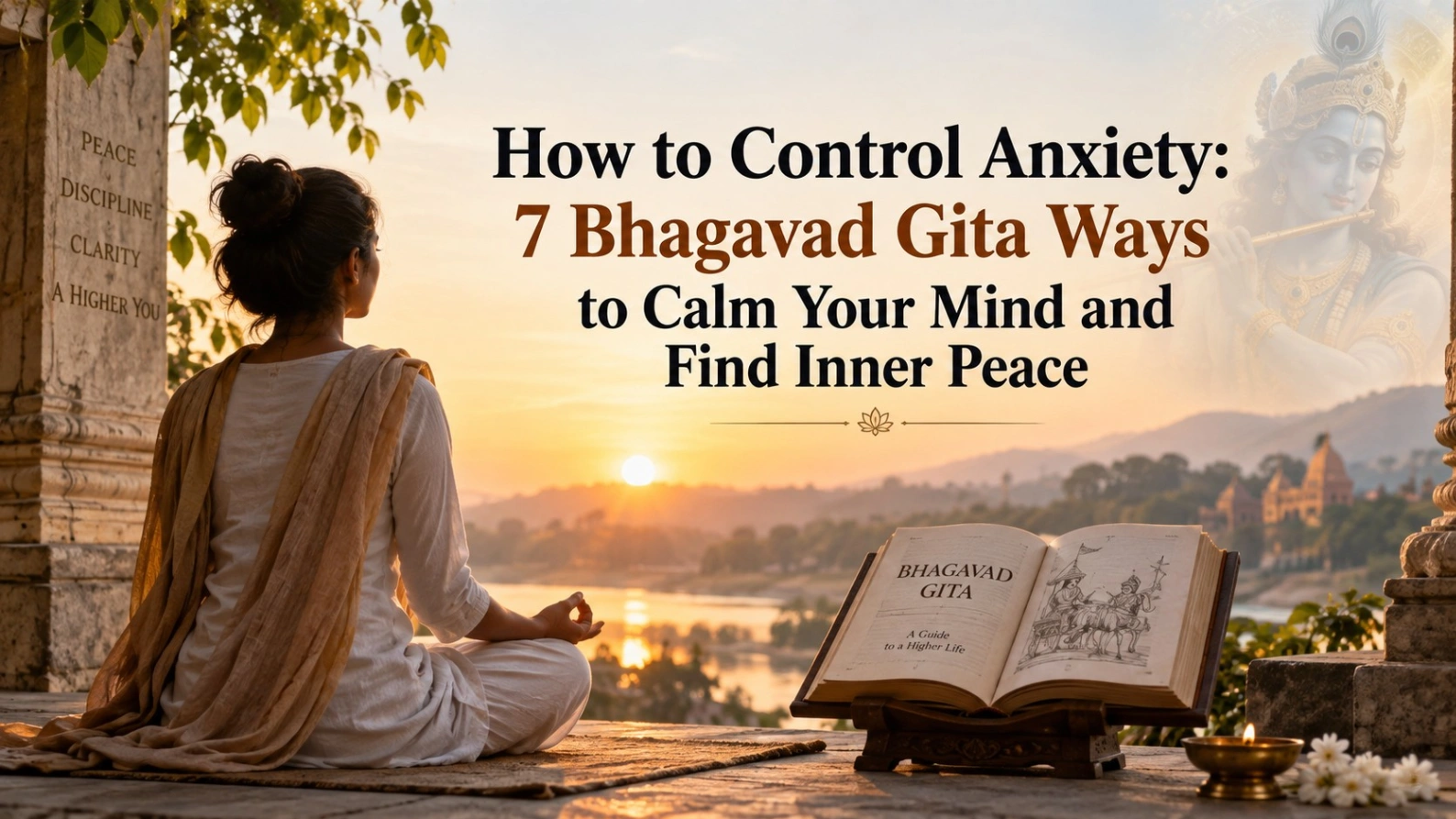
Anxiety has become one of the most common emotional struggles of modern life. The mind keeps moving from one thought to another, often worrying about situations that have not even happened yet. Questions such as “What if I fail?”, “What if something goes wrong?”, or “What if I am not able to handle the future?” can repeat themselves so often that they begin to disturb our peace.
If you are searching for how to control anxiety, the first thing to understand is that anxiety is not always created by the situation itself. Very often, it is created by the way the mind repeatedly interprets, predicts and reacts to that situation. This is also why people who want to know how to calm your mind often discover that simply telling themselves to “stop thinking” does not work.
The Bhagavad Gita offers a deeper approach. Instead of asking us to suppress thoughts, it teaches us how to understand the mind, observe it, train it and act with greater awareness. The Gita does not promise a life without challenges. Instead, it teaches us how to remain inwardly steady even when life outside remains uncertain.
This is also the essence of the Living the Gita Movement. The purpose is not merely to read the Bhagavad Gita or admire its teachings, but to bring those teachings into everyday life. When fear appears, when the mind becomes restless, when expectations create pressure, or when uncertainty makes us anxious, that is precisely when the Gita needs to be lived.
Understand That You Are Not Every Thought That Appears in Your Mind
One of the biggest reasons anxiety becomes overwhelming is that we tend to believe every thought that enters the mind. If the mind says, “Something bad is going to happen,” we immediately start reacting as though the event has already happened. If the mind says, “I may fail,” the body begins experiencing the fear of failure before any result has even arrived.
This is where a deeper understanding of awareness becomes important. The Bhagavad Gita repeatedly explains the importance of mastering the mind rather than becoming controlled by it. When we are completely identified with our thoughts, every thought has the power to disturb us. But when we begin observing those thoughts, we create some distance between ourselves and the mental story.
This is the essence of Sakshi Bhav, or the attitude of the witness. Instead of saying, “I am anxious,” try noticing, “There is anxiety arising in my mind.” Instead of saying, “Everything is going wrong,” recognise that the mind is producing a fearful interpretation of the situation.
This small shift can be powerful. You are not denying what you feel. You are simply refusing to become completely lost in it.
If you want to understand how to reduce anxiety, start by learning to observe your thoughts before reacting to them. The mind may continue producing fear, but you do not have to follow every fearful thought.
Design Your Destiny
Knowing what creates fear, stress and overthinking is only the beginning. Real change begins when awareness becomes action. Design Your Destiny helps you move towards a more conscious way of living by understanding your inner patterns, observing your mind and applying spiritual wisdom to everyday challenges. Take the next step towards clarity, awareness and conscious living.
Start Your Journey Today!Bring the Wandering Mind Back to the Present
The mind naturally wanders. It moves into the past and replays what has already happened. Then it moves into the future and imagines what might happen. Somewhere between memories and predictions, the present moment disappears.
The Bhagavad Gita acknowledges this restless nature of the mind. Krishna does not tell Arjuna that a disciplined mind will never wander. Instead, the teaching is to repeatedly bring the wandering mind back.
This is extremely practical for anyone trying to learn how to calm their mind. Calmness does not mean that your mind will suddenly become completely silent. Calmness begins when you stop allowing every thought to carry you away.
If you notice yourself worrying about tomorrow, gently return to what is happening today. If your mind starts replaying yesterday’s conversation, bring your attention back to the work in front of you. If you start imagining ten different negative possibilities, return to your breathing and to the reality of the present moment.
This is why meditation is so closely connected with inner peace. Meditation is not about forcing the mind to become blank. It is about becoming aware when the mind wanders and learning to return.
With regular practice, this ability becomes stronger. Gradually, the mind may still wander, but you become less controlled by its movement.
Focus on Your Actions Instead of Obsessing Over Results
One of the most powerful teachings in the Bhagavad Gita is the teaching of Karma Yoga. Krishna reminds Arjuna that his responsibility lies in performing the right action, not in controlling every possible result.
This principle is especially important for people struggling with anxiety and overthinking.
Much of our anxiety begins when we become excessively attached to outcomes. We worry about whether we will get the job, whether someone will accept us, whether a relationship will work, whether a business decision will succeed, or whether the future will unfold exactly as we expect.
The problem is that no matter how much we think, many outcomes remain outside our complete control.
Suppose you have an interview tomorrow. Your responsibility is to prepare sincerely, understand the role, practise your answers and present yourself well. But whether you are finally selected depends on several factors, many of which you cannot control.
Anxiety keeps asking, “What if I do not get selected?”
The Bhagavad Gita asks a more useful question: “What is the best action you can take right now?”
This shift from outcome to action can significantly reduce mental pressure. It does not mean that you stop caring about results. It means that you stop sacrificing your peace to things you cannot completely control.
Anxiety Is Not the Problem: It’s a Spiritual Wake-Up Call
4. Stop Trying to Solve the Entire Future Today
Anxiety often comes from mentally living in a future that has not yet happened.
The mind wants certainty. It wants to know exactly what will happen tomorrow, next month or next year. But life rarely gives us that certainty.
This is why learning how to stop overthinking is not about finding answers to every possible question. Sometimes the real solution is accepting that some questions do not need to be answered today.
Ask yourself, “Is this problem actually happening right now, or am I imagining a future possibility?”
If the problem requires action today, take that action. If there is nothing useful you can do at the moment, repeatedly thinking about it will not create more control.
The Bhagavad Gita teaches us to remain committed to our present duty. This principle can help bring the mind back from imaginary futures into practical reality.
You do not have to solve the next five years today. You only need to become aware of the next conscious step available to you.
When practised regularly, this can become one of the simplest spiritual answers to how to control anxiety and overthinking.

5. Understand the True Meaning of Detachment
Detachment is sometimes misunderstood as becoming emotionless or no longer caring about anything. But the Bhagavad Gita does not ask us to stop caring. It teaches us to stop becoming internally dependent on every external outcome.
You can work hard without allowing one result to determine your self-worth. You can love deeply without trying to control another person. You can pursue success without believing that your happiness will only begin after you achieve it.
This is where Bhagavad Gita for stress and anxiety becomes relevant to modern life.
We often create mental pressure through statements such as, “This must happen,” “I must succeed,” or “Things must go according to my plan.”
The stronger the attachment, the stronger the fear of losing the desired outcome.
Detachment does not mean saying, “I do not care what happens.” It means saying, “I will give my complete effort, but I will not allow the outcome alone to control my inner peace.”
This attitude can create tremendous freedom. You remain responsible, sincere and committed, but you stop demanding that life obey every expectation of your mind.
6. Replace Overthinking With Conscious Action
People searching for how to stop overthinking often make one common mistake: they try to solve overthinking with even more thinking.
They analyse every situation repeatedly. Then they analyse why they are analysing it. Eventually, the mind becomes trapped in a loop.
The Bhagavad Gita repeatedly emphasises conscious action. When something can be done, action is more useful than endless mental repetition.
Whenever you notice yourself overthinking, ask a simple question: “Is there something useful I can do about this situation right now?”
If the answer is yes, take the next step.
If you are worried about an exam, study. If you are worried about a difficult conversation, prepare for it. If you are worried because you have incomplete information, gather what you reasonably can.
But if there is genuinely nothing you can do at that moment, recognise that another hour of thinking will probably not produce a better solution.
Overthinking gives the illusion of control. Conscious action creates real movement.
Living the Gita means learning when to think, when to act and when to let go.

7. Develop Sakshi Bhav and Learn to Witness the Mind
One of the deepest ways to understand the Bhagavad Gita for anxiety is through the practice of witnessing.
Imagine sitting beside a road and watching vehicles pass. You can see every vehicle without getting inside each one.
Thoughts are similar.
A fearful thought appears. Notice it.
A negative memory appears. Notice it.
A prediction about the future appears. Notice it.
An insecurity appears. Notice it.
You do not have to enter every thought and travel wherever it wants to take you.
This is the practice of Sakshi Bhav.
When you begin observing your mind, you create a space between the thought and your reaction. That small space gives you the ability to choose your response.
Instead of reacting immediately to anger, you can observe it.
Instead of becoming consumed by fear, you can observe it.
Instead of allowing anxiety to dictate your next decision, you can pause and ask what the situation actually requires.
This witnessing attitude does not remove all difficult emotions. But it changes your relationship with them.
And that change can become the beginning of inner freedom.
Living The Gita Movement
The Bhagavad Gita is not merely something to be read or listened to. It is the art of awakening within oneself and experiencing the truth of life. The vision of the Living the Gita Movement is to bring the wisdom of the Gita out of books and transform it into a lived experience.
Join NowBhagavad Gita for Mental Peace: From Reading Wisdom to Living It
The Bhagavad Gita for mental peace becomes truly meaningful when its teachings move beyond intellectual understanding.
It is easy to appreciate detachment when life is going according to plan. The real practice begins when an important outcome becomes uncertain.
It is easy to speak about calmness when your mind is already peaceful. The real practice begins when thoughts are racing.
It is easy to discuss awareness. The real practice begins when anger, fear, insecurity or disappointment appears.
This is exactly what the Living the Gita Movement represents.
The Gita should not remain limited to a book that we open occasionally. Its teachings can become part of the way we approach work, relationships, uncertainty, ambition, fear and everyday decisions.
When anxiety arises, practise witnessing instead of immediately reacting.
When the future frightens you, return to the action available today.
When the mind wanders, gently bring it back.
When you become obsessed with an outcome, remember that effort is your responsibility, while every result is not completely in your control.
In this way, spiritual knowledge becomes practical living.
7 Mindset Hacks to Stop Overthinking Naturally
How to Calm Your Mind Through a Daily Gita Practice
You do not need to make dramatic changes to begin practising these teachings.
Start the day with a few minutes of silence before entering the noise of messages, notifications and responsibilities. Sit quietly and observe your breathing. Notice what thoughts are already moving through the mind without judging them.
During the day, whenever you notice anxiety increasing, ask yourself three simple questions: “What am I thinking right now?”, “What is actually within my control?”, and “What conscious action can I take next?”
These questions can help separate facts from imagined fears.
At night, reflect on your day. Notice where the mind controlled your reactions and where you were able to remain aware. Do this without guilt. The purpose is not to judge yourself, but to become more conscious.
Over time, this daily practice can help you understand that mental peace is not always created by changing every external situation. Sometimes it comes from changing the way you relate to the situation.
Do Not Fight the Mind—Learn to Understand It
If you are searching for how to control anxiety, the Bhagavad Gita offers an important shift in perspective.
You do not need to fight every thought.
You need to understand the mind.
You need to recognise when it is wandering into imagined futures, when it is becoming attached to outcomes and when it is creating fear from possibilities rather than realities.
Through conscious action, detachment, awareness and Sakshi Bhav, the mind can gradually become more disciplined and balanced.
The goal is not to become someone who never experiences fear or worry. The goal is to become someone who can experience those emotions without automatically becoming controlled by them.
This is where the Bhagavad Gita becomes more than philosophy.
It becomes a way of living.
And this is the spirit of Living the Gita Movement: to move from reading the Gita to practising it, from understanding wisdom to applying it, and from being controlled by the mind to living with greater awareness, clarity and inner peace.
If anxiety is severe, persistent or begins interfering with work, relationships, sleep or everyday functioning, spiritual practices can be supportive but should not replace appropriate professional mental-health care.
Personal Session
Need Personal Guidance for the Challenges You Are Facing? Sometimes understanding spiritual wisdom is easy, but applying it to our own relationships, career, emotions and life decisions can feel difficult. A Personal Session with Sakshi Shree can help you gain a deeper perspective on the challenges occupying your mind and discover a more conscious way forward.
Book NowRead Latest Articles