
Overthinking can turn even a small concern into an endless cycle of “what ifs.” You may replay an old conversation again and again, worry about decisions that have not yet been made, imagine negative future situations, or analyse the same problem repeatedly without finding clarity. If you are wondering how to stop overthinking, the Bhagavad Gita offers a deeply practical perspective on the restless mind and how it can gradually become calm, focused, and balanced.
Thousands of years ago, Arjuna stood in a state of deep confusion. His mind was filled with doubt, fear, uncertainty, and questions about what he should do. Lord Krishna did not simply tell him to stop thinking. Instead, he helped Arjuna understand the nature of the mind, the importance of action, the need for detachment, and the value of inner awareness. These Bhagavad Gita teachings for anxiety and overthinking remain relevant even today because although our circumstances have changed, the basic nature of the human mind has not. Modern life brings career pressure, relationship stress, social comparison, fear of failure, uncertainty about the future, and constant mental stimulation. The Gita teaches us how to face these situations without allowing the mind to become our master.
Why Do We Overthink?
Overthinking often begins when the mind tries to gain complete certainty about something that cannot be completely controlled. A person may keep wondering whether they are making the right decision, whether they will succeed, whether other people approve of them, or whether something might go wrong in the future. The mind believes that thinking about the situation one more time will provide an answer. However, instead of reaching a conclusion, it often returns to the same thoughts again.
There is an important difference between thinking and overthinking. Healthy thinking generally leads toward understanding, a decision, or some form of action. Overthinking, on the other hand, repeatedly circles around the same concern without producing meaningful clarity. This is where the Bhagavad Gita on overthinking becomes extremely useful. Krishna does not teach us to abandon intelligence or stop using the mind. He teaches us to understand the mind and develop a healthier relationship with it.
Design Your Destiny
Are repetitive thoughts, fear or uncertainty keeping you from moving forward? Design Your Destiny helps you move from unconscious patterns to greater clarity, awareness and purposeful action. Learn to understand your mind, transform limiting patterns and consciously create a more meaningful direction for your life. Begin Your Design Your Destiny journey today.
Start Your Journey Today!The Bhagavad Gita Accepts That the Mind Is Restless
One of the most relatable moments in the Bhagavad Gita appears when Arjuna openly tells Krishna that the mind is restless, turbulent, powerful, and extremely difficult to control. He even compares controlling the mind to controlling the wind. This observation is important because it shows that experiencing a restless mind does not mean that a person is failing spiritually. The wandering nature of the mind is recognised within the Gita itself.
The first step in understanding how to control the mind according to Bhagavad Gita teachings is therefore to stop becoming frustrated every time a thought appears. When people are overthinking, they often try to force themselves to stop thinking. Ironically, this resistance can make them even more aware of their thoughts. A more useful approach is to notice what the mind is doing without immediately believing or following every thought.
For example, instead of becoming completely absorbed in the thought “Something bad is going to happen,” you can recognise, “My mind is imagining a negative outcome.” Instead of thinking, “I will definitely fail,” you can notice, “My mind is afraid of failure right now.” This small change creates a little distance between you and the thought. You begin to realise that a thought is an experience occurring in your awareness; it is not necessarily a fact or a prediction of reality.
Abhyasa and Vairagya: Krishna’s Formula for the Restless Mind
After Arjuna describes how difficult the mind is to control, Krishna explains that the restless mind can gradually be steadied through Abhyasa, or consistent practice, and Vairagya, or detachment. This teaching provides one of the clearest answers to the question of how to stop overthinking according to the Bhagavad Gita.
Abhyasa means repeatedly training the mind. Mental calm is usually not created through one meditation session, one spiritual discourse, or one inspiring quote. It develops through practice. Each time the mind wanders and you consciously bring your attention back to the present moment, you are strengthening your ability to manage your attention.
Imagine that you are working on an important project and suddenly begin worrying about whether the project will succeed. You notice the thought and return to your work. A few minutes later, the worry appears again. You bring your attention back once more. This repeated return is Abhyasa. The goal is not to become angry with yourself because the mind wandered. The practice itself lies in returning.
Vairagya adds another dimension. Detachment does not mean becoming careless, unambitious, or emotionally disconnected from life. It means gradually reducing the mental demand that everything must happen exactly according to your expectations. A large portion of overthinking comes from wanting absolute control over outcomes. We want certainty that our effort will succeed, that someone will respond positively, or that our plans will unfold exactly as imagined. Vairagya teaches us to give our best while loosening our attachment to what remains outside our control.
Together, Abhyasa and Vairagya form one of the most practical Krishna teachings on overthinking. Practice teaches the mind where to return, while detachment reduces the pressure that keeps pulling it into imagined futures.
What Bhagavad Gita Says About Dreams, Goals and Ambition
Bring the Wandering Mind Back to the Present
Another important teaching appears in Bhagavad Gita Chapter 6, where Krishna explains that whenever the restless and wandering mind moves away, it should gradually be brought back. This idea is extremely relevant to meditation for overthinking because it changes our understanding of what meditation actually means.
Many people believe that they are bad at meditation because thoughts continue to appear. They may sit quietly for a few minutes and then become frustrated when memories, plans, fears, and random thoughts arise. However, meditation does not necessarily mean that thoughts disappear completely. The practice lies in becoming aware that the mind has wandered and gently bringing attention back.
This same principle can be applied throughout the day. If you notice yourself worrying about something that may happen next week, ask yourself whether there is something meaningful you can do about it right now. If there is, take that action. If there is not, recognise that continuing to mentally rehearse the situation may not change the outcome. This simple shift from “What might happen?” to “What can I do now?” is one of the most practical ways to understand how to calm the mind according to Bhagavad Gita wisdom.
The future exists largely as an idea in the mind until it becomes the present. When attention repeatedly returns to the action available now, the mind gradually becomes less trapped in imagined scenarios.

Focus on Action Instead of Constantly Thinking About Results
One of the most famous teachings of the Bhagavad Gita is Krishna’s guidance to focus on action without becoming excessively attached to its fruits. This principle is particularly relevant to overthinking because many repetitive thoughts revolve around results.
A student worries about examination marks before the examination is complete. A professional keeps thinking about whether they will receive a promotion. Someone attending an interview imagines rejection before the interview has even happened. A business owner constantly worries about whether an initiative will succeed. In all these situations, the mind is spending energy on an outcome that is not fully available for control.
The Bhagavad Gita redirects attention toward what is actually within our sphere of action. A student may not be able to guarantee a particular score, but they can control how sincerely they study today. A professional cannot guarantee a promotion, but they can improve their work, communication, preparation, and discipline. A person cannot completely control how someone else perceives them, but they can control the honesty and maturity of their own response.
This is why the Bhagavad Gita for students, working professionals, entrepreneurs, and anyone experiencing uncertainty remains so relevant. Krishna’s teaching does not eliminate ambition. Instead, it redirects mental energy from obsessive concern about the result toward meaningful effort in the present.
When we constantly ask, “What will happen?” anxiety often increases. When we ask, “What is the best action available to me right now?” clarity begins to return.
Equanimity Can Protect the Mind From Emotional Extremes
Another major teaching of the Bhagavad Gita is Samatva, or equanimity. Krishna encourages Arjuna to remain balanced in success and failure rather than allowing every external outcome to completely determine his inner state.
Overthinking becomes especially intense when our emotional wellbeing becomes dependent upon external validation. If someone praises us, we feel confident. If someone criticises us, we may replay their words throughout the day. If an outcome is favourable, we feel secure. If something goes wrong, we may immediately begin questioning our ability, future, or self-worth.
The Gita’s teaching of equanimity does not require us to become emotionless. It encourages us to participate fully in life without surrendering our entire inner state to every changing circumstance. Success and failure both provide experiences, but neither needs to define our entire identity.
This is one reason why the Bhagavad Gita for mental peace is so much more than a philosophy of withdrawal. Krishna teaches Arjuna in the middle of responsibility, not away from responsibility. The Gita therefore offers a philosophy for remaining internally balanced while continuing to participate in work, relationships, decisions, and everyday challenges.
A useful question to ask yourself when overthinking a result is, “Can I give my best effort without allowing this outcome to define who I am?” The more honestly we practise this attitude, the less power uncertain outcomes hold over the mind.
Sakshi Bhav: Learn to Witness Your Thoughts
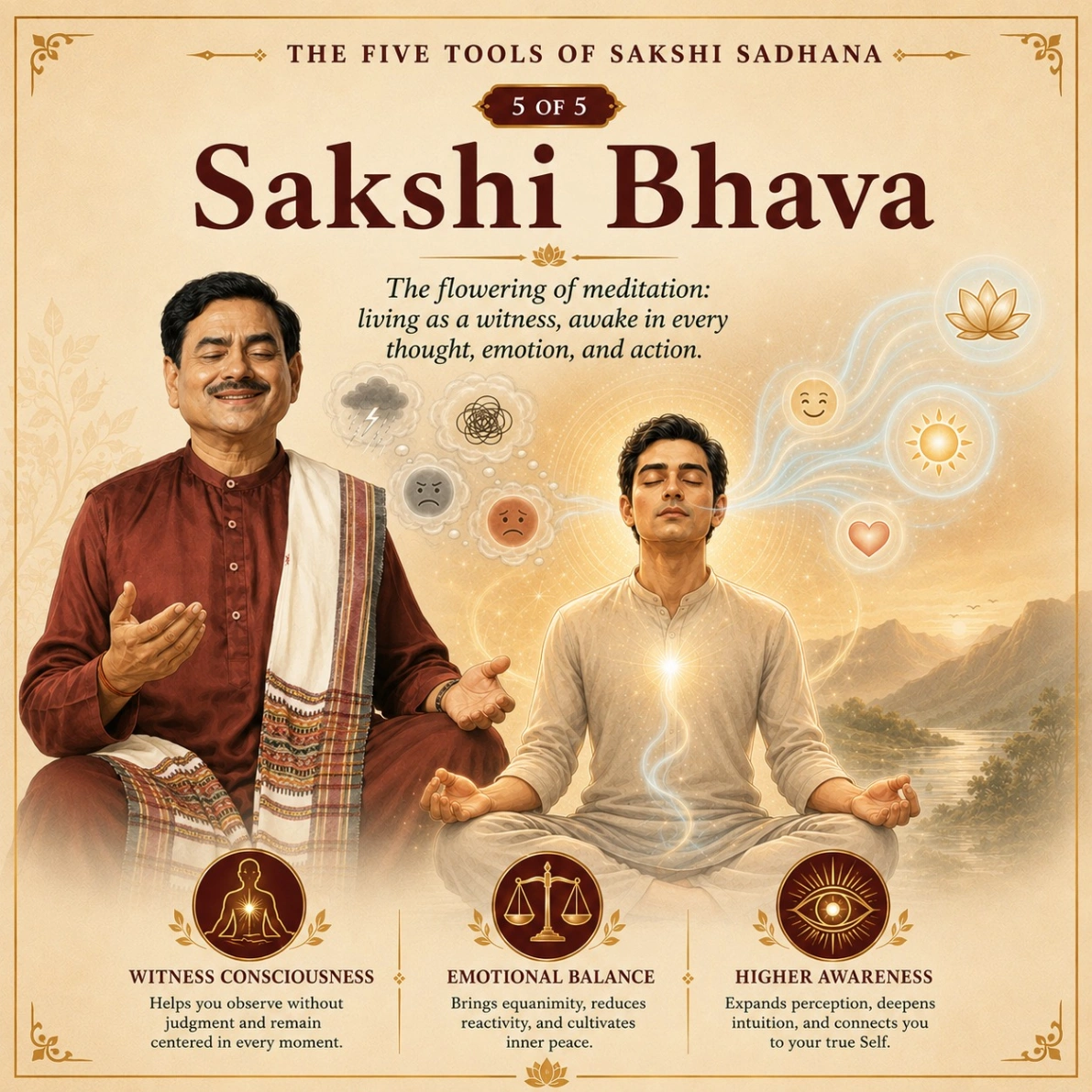
One of the most powerful ways to understand overthinking is through the concept of Sakshi Bhav, the attitude of becoming a witness or observer of the mind. In ordinary experience, we often identify immediately with whatever thought appears.
If the mind says, “I might fail,” we quickly begin feeling as though failure is inevitable. If the thought says, “They do not respect me,” the body may react with anger or insecurity before we have examined whether the thought is even accurate. When every thought is treated as truth, the mind begins controlling our emotional state.
Sakshi Bhava meditation introduces a different relationship with thoughts. Instead of immediately becoming the thought, you observe it. Rather than saying, “I am anxious,” you may recognise, “I am noticing anxiety.” Instead of saying, “I cannot stop thinking,” you notice, “There are many thoughts moving through the mind right now.”
This is the essence of witness consciousness. You are aware of mental activity without automatically allowing every thought to carry you away.
A simple Sakshi Bhava meditation can begin by sitting comfortably and closing the eyes. Allow the breath to remain natural. Instead of trying to create an empty mind, allow thoughts to arise. When a thought appears, notice what kind of thought it is. It may be a memory, a plan, a fear, a judgement, or an imagined situation. Rather than following the entire story created by the thought, simply observe that it has appeared. Then gently return awareness to the breath or the present moment.
When another thought comes, repeat the process. The purpose is not to suppress thoughts but to become more aware of them. With consistent practice, a person may begin to recognise that thoughts are temporary movements within the mind rather than absolute truths that must always be obeyed.
This understanding forms an important part of self awareness meditation, Sakshi Bhav, and the broader idea of learning how to observe your thoughts without automatically reacting to them.
Sakshi Sadhana and the Practice of Conscious Observation
Sakshi Sadhana takes the principle of witnessing deeper by encouraging a person to cultivate awareness not only during meditation but throughout everyday life. Instead of trying to replace every uncomfortable thought with a positive one, Sakshi Sadhana invites us to first become aware of the mental process itself.
When anger appears, observe it before reacting. When fear arises, become aware of it before assuming that the feared outcome will happen. When the mind imagines ten different futures, notice that the mind is imagining. When an old memory suddenly returns, recognise that a memory has appeared rather than allowing it to completely determine the present moment.
This does not mean becoming passive. In fact, awareness can make action more intelligent. Once you can see what is happening in the mind, you become better positioned to distinguish between a thought that requires action and a thought that is simply repetitive mental noise.
For someone struggling with overthinking, this distinction can be transformative. Instead of asking, “How do I stop every thought?” the question becomes, “Which thoughts require my action, and which thoughts can I simply observe and allow to pass?”
Krishna’s Mantra: 5 Bhagavad Gita Principles to Win in Life
Living the Bhagavad Gita in Everyday Life
Understanding spiritual teachings intellectually is useful, but transformation begins when those teachings enter everyday behaviour. You may know that attachment creates anxiety, yet still spend hours worrying about results. You may understand that attention should return to the present, yet continue replaying what happened yesterday. You may read about equanimity while allowing a single criticism to disturb the rest of your day.
The deeper question therefore becomes how to apply Bhagavad Gita in daily life.
This is where the philosophy behind the Living the Gita Movement becomes especially meaningful. Living the Gita means moving beyond merely reading its teachings and beginning to practise them in ordinary situations.
When you stop obsessing over the result and focus sincerely on your effort, you are applying the Gita. When you recognise anger before immediately reacting, you are applying the Gita. When fear arises but you still perform your responsibility, you are applying the Gita. When thoughts appear and you become their witness instead of becoming trapped inside them, you are applying the Gita.
This philosophy can be expressed simply as: Gita ko sirf padhna nahi, Gita ko jeena hai.
The Bhagavad Gita becomes most meaningful when its wisdom begins shaping how we work, think, communicate, respond, and make decisions.
Living The Gita Movement
The Bhagavad Gita is not merely something to be read or listened to. It is the art of awakening within oneself and experiencing the truth of life. The vision of the Living the Gita Movement is to bring the wisdom of the Gita out of books and transform it into a lived experience.
Join NowHow to Stop Overthinking in Daily Life Using Gita Wisdom
When you notice yourself entering an overthinking spiral, begin by observing what the mind is actually saying. Ask yourself whether the thought is a fact, a possibility, a fear, or an assumption. Many thoughts feel convincing simply because they repeat themselves, but repetition does not necessarily make a thought true.
Once you recognise the thought, accept that complete certainty may not be possible. Human beings often overthink because uncertainty feels uncomfortable. The Gita’s teachings on detachment remind us that we can act sincerely without knowing every future outcome.
Then bring the mind back to action. Ask yourself what useful step is available right now. If you can prepare, communicate, learn, apologise, decide, or take another meaningful action, do it. If no action is currently possible, continuing to mentally repeat the problem may not provide additional clarity.
Finally, practise detachment from the result after you have done what is genuinely within your control. This combination of observation, awareness, action, and detachment closely reflects the practical spirit of the Bhagavad Gita and can gradually reduce the hold that repetitive thinking has over everyday life.
If you are searching for how to stop overthinking, the Bhagavad Gita does not simply tell you to silence the mind. It offers a deeper understanding of why the mind becomes restless and how it can gradually be trained.

Krishna acknowledges the difficulty of controlling the mind and teaches the importance of practice and detachment. He encourages us to repeatedly bring wandering attention back, focus on actions instead of obsessing over results, and cultivate inner balance in both success and failure.
Through Sakshi Bhav, we can go a step further and learn to witness thoughts without automatically identifying with them. Through Sakshi Bhava meditation and Sakshi Sadhana, the relationship between the observer and the thought can become clearer.
The aim is not to stop thinking completely. Thinking is an essential part of human intelligence. The aim is to prevent repetitive thoughts from controlling our peace, decisions, and behaviour.
The more we practise awareness, conscious action, detachment, and witness consciousness, the easier it becomes to understand the difference between a useful thought and an endless mental loop.
Ultimately, this is the deeper meaning of living spiritual wisdom. The Bhagavad Gita is not meant only to be understood intellectually. Its teachings become transformative when they enter our daily life.
The journey from overthinking to awareness begins when we stop treating every thought as a command and begin learning to witness the mind with greater clarity.
Personal Session
Sometimes a situation becomes so mentally overwhelming that general guidance does not provide the clarity you need. Whether the concern relates to a decision, relationship, career, emotional pattern, or another personal challenge, deeper individual guidance can help you look at the situation from a more conscious perspective.
Book NowRead Latest Articles