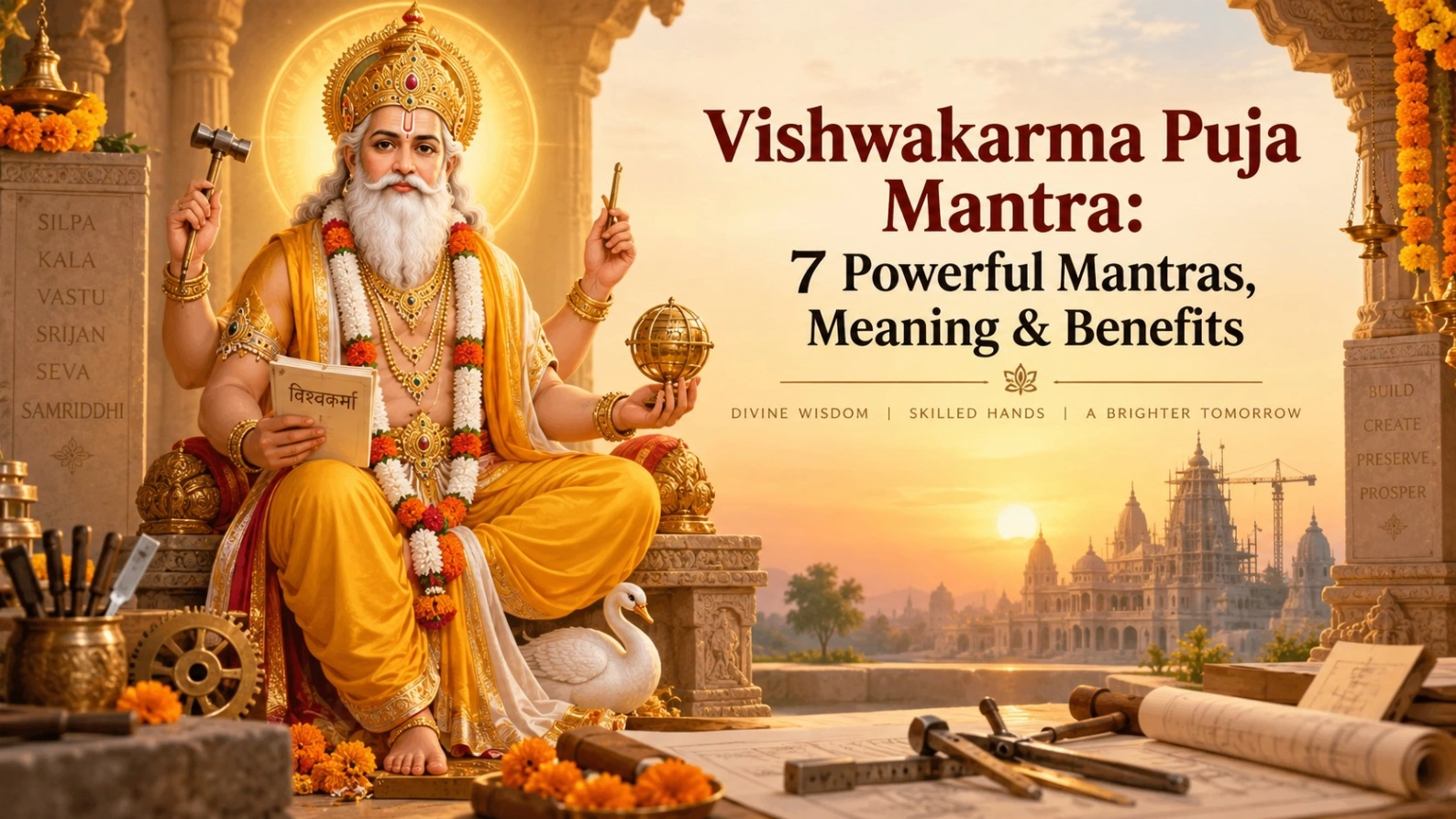
Lord Vishwakarma is revered in Hindu tradition as the divine architect and master craftsman, closely associated with creativity, construction, craftsmanship, engineering, tools and skilled work. Vishwakarma Puja therefore holds special significance for artisans, architects, engineers, technicians, business owners, factory workers and others whose livelihood depends upon skill, machinery or creative ability.
One of the most meaningful ways to worship him is through a Vishwakarma Puja mantra. Devotees traditionally chant Vishwakarma mantras while offering flowers, incense and prayers, seeking blessings for wisdom, professional excellence, creativity and the safe use of tools and machinery.
If you are looking for a Vishwakarma mantra in Hindi, a Vishwakarma mantra in Sanskrit, or want to understand the meaning and traditional benefits of these sacred chants, this guide brings together seven commonly recited forms.
Mantras may differ slightly according to region, family tradition or spiritual lineage. Therefore, if your family or priest follows a particular version, that traditional form can be given preference.
Who Is Lord Vishwakarma?
Lord Vishwakarma is traditionally honoured as the celestial architect or divine craftsman. His worship is particularly associated with professions that transform ideas into physical creation like architecture, engineering, manufacturing, mechanics, design and craftsmanship.
On Vishwakarma Puja, many devotees clean their workplaces, factories, shops, instruments, machines and tools before worship. This act carries an important spiritual message: work itself can become worship when performed with awareness, discipline and sincerity.
A Lord Vishwakarma mantra is therefore not merely a prayer for material success. It can also be viewed as a reminder to cultivate excellence, responsibility and respect for one's craft.
Design Your Destiny
Knowing a mantra is one step. Transforming the way you think, choose and live is the deeper journey. Design Your Destiny helps you understand your inner patterns, develop greater awareness and apply timeless spiritual wisdom to the challenges of modern life. Begin your journey with Design Your Destiny and learn to create your life consciously—one thought, one decision and one action at a time.
Start Your Journey Today!7 Powerful Vishwakarma Puja Mantras
1. Simple Vishwakarma Mantra
Mantra
ॐ विश्वकर्मणे नमः॥
Om Vishwakarmane Namah
This is one of the simplest and easiest Vishwakarma mantras for devotees to remember and chant. A closely matching form is commonly included in Vishwakarma worship guides.
Meaning
The mantra means:
“Salutations to Lord Vishwakarma.”
It is a simple expression of reverence and surrender.
Traditional Benefits
Devotees chant this mantra while praying for:
Skill and concentration
Creativity in work
Professional progress
Better craftsmanship
Wisdom while solving problems
Positive intention before beginning work
Beginners looking for an easy Vishwakarma Puja mantra in Hindi or Sanskrit can begin with this invocation.
2. Vishwakarma Puja Mantra
Mantra
नमस्ते विश्वकर्माय, त्वमेव कर्तृता सदा।
शिल्पं विधाय सर्वत्र, त्वं विश्वेशो नमो नमः॥
Namaste Vishwakarmaya, Tvameva Kartrita Sada,
Shilpam Vidhaya Sarvatra, Tvam Vishvesho Namo Namah.
This prayer is widely presented in contemporary Vishwakarma Puja guides.
Meaning
The devotee offers salutations to Lord Vishwakarma, honouring the divine principle of creation, craftsmanship and skill present throughout the world.
Traditional Benefits
This Vishwakarma Puja mantra may be recited when worshipping Lord Vishwakarma's image or while offering prayers to one's workplace, machinery and tools.
It encourages gratitude for the ability to create, build and work skilfully.
Parsva Ekadashi: Date, Vrat Katha, Puja Vidhi & Significance
3. Vishwakarma Gayatri Mantra
Mantra
ॐ चतुर्भुजाय विद्महे
हंसवाहनाय धीमहि।
तन्नो विश्वकर्मा प्रचोदयात्॥
Om Chaturbhujaya Vidmahe,
Hamsavahanaya Dhimahi,
Tanno Vishwakarma Prachodayat.
Versions of this Vishwakarma Gayatri mantra appear across devotional mantra collections.
Meaning
The prayer invokes Lord Vishwakarma and asks that divine wisdom illuminate and guide the devotee's intellect.
Traditional Benefits
The Gayatri form is particularly suitable for those praying for:
Mental clarity
Creative intelligence
Better decision-making
Concentration
Inspiration
Excellence in one's profession
For students, designers, engineers and skilled professionals, its symbolism can serve as a reminder to combine knowledge with responsibility.
4. Vishwarupa Vishwakarma Mantra
Mantra
ॐ अनन्ताय विद्महे
विश्वरूपाय धीमहि।
तन्नो विश्वकर्मा प्रचोदयात्॥
Om Anantaya Vidmahe,
Vishwarupaya Dhimahi,
Tanno Vishwakarma Prachodayat.
This is another commonly circulated Gayatri-style Vishwakarma invocation.
Meaning
The mantra meditates upon the infinite, universal form associated with Lord Vishwakarma and seeks guidance for the intellect.
Traditional Benefits
Devotees may use this mantra to cultivate:
Broader thinking
Creativity
Patience
Awareness
Focus during complex work
Its deeper spiritual message is that creativity should not remain limited by ego but should contribute meaningfully to the larger world.
5. Prajapati Vishwakarma Mantra
Mantra
ॐ प्रजापतये विद्महे
पुरुषाय धीमहि।
तन्नो विश्वकर्मा प्रचोदयात्॥
Om Prajapataye Vidmahe,
Purushaya Dhimahi,
Tanno Vishwakarma Prachodayat.
This is also found among traditional-style Vishwakarma Gayatri variations used by devotees.
Meaning
The mantra meditates upon the creative principle represented by Prajapati and asks Vishwakarma to guide the mind toward wisdom.
Traditional Benefits
It is traditionally associated with prayers for:
Constructive thinking
New ideas
Purposeful creation
Knowledge
Professional discipline
People beginning a new project, enterprise or creative undertaking may choose this mantra as part of their prayer.
Vishwakarma Puja 2026 Muhurat: Best Puja Time, Date & Vidhi
6. Vishwarakshaka Vishwakarma Mantra
Mantra
ॐ सर्वेश्वराय विद्महे
विश्वरक्षकाय धीमहि।
तन्नो विश्वकर्मा प्रचोदयात्॥
Om Sarveshvaraya Vidmahe,
Vishwarakshakaya Dhimahi,
Tanno Vishwakarma Prachodayat.
Variants of this mantra are included in Vishwakarma Gayatri collections.
Meaning
The mantra meditates upon Lord Vishwakarma as a divine protector and seeks illumination and guidance.
Traditional Benefits
During Vishwakarma Puja, devotees traditionally pray for the safe and smooth functioning of tools and machinery as well as wellbeing at the workplace.
This mantra therefore fits naturally into prayers centred on:
Workplace wellbeing
Responsible use of machinery
Protection during skilled work
Awareness and attentiveness
Professional stability
7. Sarvarupa Vishwakarma Gayatri Mantra
Mantra
ॐ सर्वरूपाय विद्महे
विश्वकर्मणे धीमहि।
तन्नो विश्वकर्मा प्रचोदयात्॥
Om Sarvarupaya Vidmahe,
Vishwakarmane Dhimahi,
Tanno Vishwakarma Prachodayat.
A version of this mantra is also found among collections of Vishwakarma Gayatri prayers.
Meaning
The mantra contemplates the universal creative presence of Vishwakarma and asks for the intellect to be inspired and guided.
Traditional Benefits
Devotees may chant it while seeking:
Creative inspiration
Wisdom
Professional excellence
Focus
Skill development
A deeper connection between work and spirituality
How to Chant Vishwakarma Mantra
You do not need an elaborate practice to begin chanting a powerful Vishwakarma mantra. Sincerity and concentration are more important than complexity.
Before beginning, bathe and wear clean clothes if possible. Clean the place where you will worship and place an image or murti of Lord Vishwakarma respectfully.
If the worship is taking place at an office, workshop or factory, tools and machinery are traditionally cleaned as part of Vishwakarma Puja. Flowers, incense, fruits, sweets, water and other customary puja offerings may then be arranged.
Sit calmly and remember Lord Vishwakarma.
Begin with:
ॐ विश्वकर्मणे नमः॥
You may then recite one or more of the longer mantras according to your tradition.
Some devotional traditions recommend repeated japa, including 108 repetitions of a simple mantra. However, there is no need to become anxious about achieving a particular number. If your family follows a prescribed ritual, follow that tradition or seek guidance from a knowledgeable priest.
Most importantly, chant with attention rather than mechanically repeating words.
Vishwakarma Mantra Benefits
The benefits of Vishwakarma mantra are traditionally understood in a devotional and spiritual sense rather than as guaranteed material outcomes.
1. Encourages Focus
Mantra chanting creates a dedicated period in which attention is withdrawn from distractions and directed toward a single sacred thought.
2. Inspires Creativity
Because Lord Vishwakarma represents craftsmanship and creation, devotees often worship him while seeking inspiration and greater skill in their work.
3. Develops Respect for Work
Vishwakarma Puja carries a powerful principle: the tools through which we earn, build and create deserve respect.
4. Encourages Professional Discipline
Prayer can remind us that success is linked not only to ambition but also to consistency, responsibility and excellence.
5. Cultivates Gratitude
Offering prayers before one's machines, instruments or professional tools encourages gratitude for the resources and abilities that support one's livelihood.
6. Supports Inner Positivity
Regular devotional chanting may create a quiet moment of reflection and help establish a positive intention before beginning work.
7. Connects Work With Spirituality
Perhaps the most meaningful Vishwakarma Puja mantra benefit is the recognition that spirituality need not remain separate from daily responsibilities.
Your office, workshop, studio, factory or desk can itself become a space for mindful action.
Living The Gita Movement
The Bhagavad Gita is not merely something to be read or listened to. It is the art of awakening within oneself and experiencing the truth of life. The vision of the Living the Gita Movement is to bring the wisdom of the Gita out of books and transform it into a lived experience.
Join NowWhich Vishwakarma Mantra Is Best?
If you are a beginner, the simplest option is:
ॐ विश्वकर्मणे नमः॥
Om Vishwakarmane Namah
If you want a longer meditation-oriented prayer, you can choose the Vishwakarma Gayatri mantra:
ॐ चतुर्भुजाय विद्महे, हंसवाहनाय धीमहि।
तन्नो विश्वकर्मा प्रचोदयात्॥
There is no need to chant all seven mantras every day. Choose a mantra that connects naturally with your devotional tradition and chant it sincerely.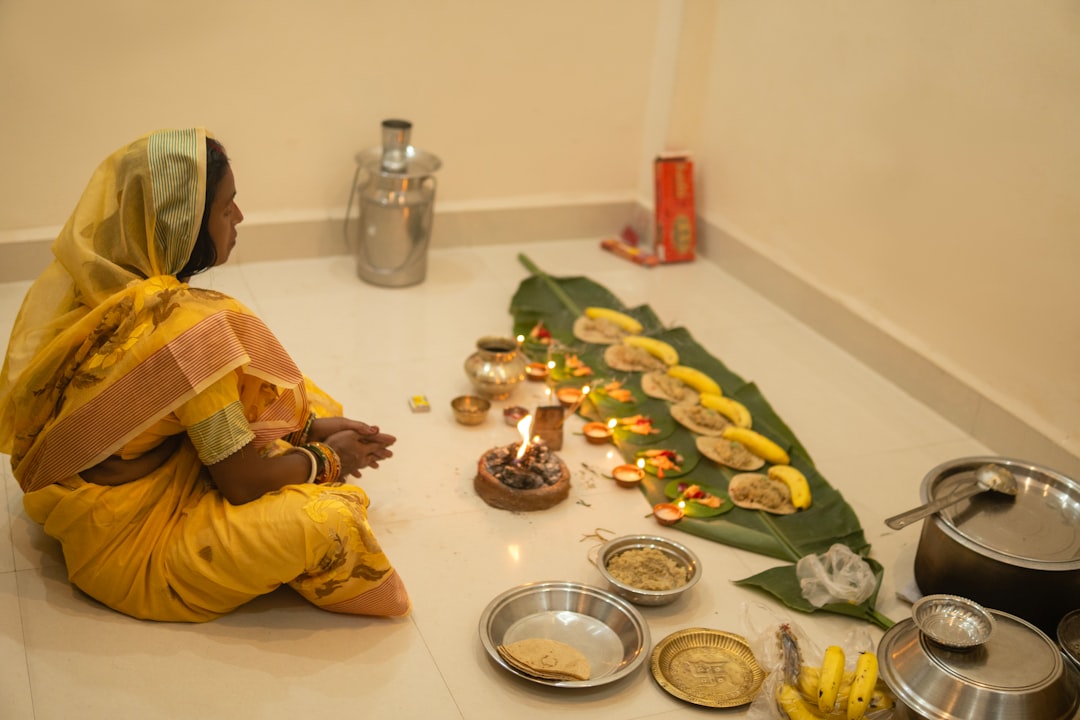
Spiritual Meaning of Vishwakarma Puja
The deeper message of Vishwakarma Puja extends beyond machines and professions.
Every human being creates something.
An engineer creates structures.
An artist creates beauty.
A teacher creates understanding.
An entrepreneur creates possibilities.
A parent shapes a home.
A worker contributes through skill and effort.
The spiritual lesson is therefore not simply to ask, “What am I creating?”
It is also to ask:
“With what consciousness am I creating it?”
When work is driven only by ego, comparison or reward, even achievement can produce dissatisfaction. But when action is performed with awareness, excellence and a sense of contribution, ordinary work can become meaningful.
This is where Vishwakarma worship can become relevant even in modern life.
A Vishwakarma Puja mantra represents much more than a request for professional achievement. It is an opportunity to honour skill, creativity, discipline and the tools through which we contribute to the world.
Whether you chant Om Vishwakarmane Namah, the Vishwakarma Gayatri mantra, or another traditional Lord Vishwakarma mantra, approach the practice with sincerity and awareness.
Ultimately, the deeper teaching is simple: respect your work, refine your skill and bring consciousness into whatever you create.
Personal Session
Every person's questions, struggles and inner journey are different. If you are seeking clarity about your emotions, relationships, decisions, purpose or spiritual growth, a Personal Session can help you explore your situation through focused, one-to-one guidance. Book a Personal Session and take the next step toward greater clarity, awareness and inner transformation.
Book NowRead Latest Articles