
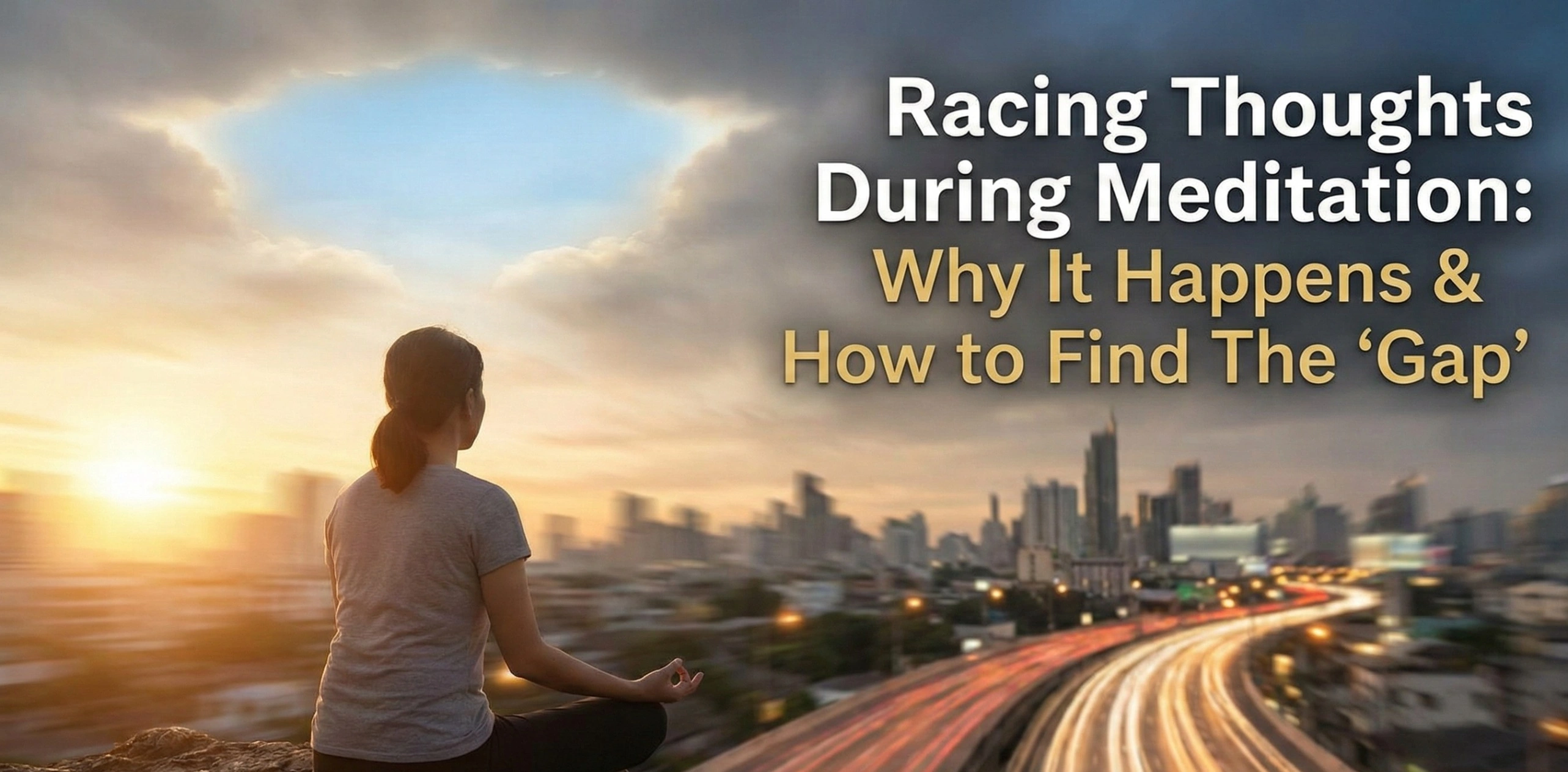
It is the most common struggle for anyone trying to find inner peace. You sit down, close your eyes, and suddenly, an internal dialogue begins.
In fact, it feels like your thoughts are moving faster than ever before. You might think, "I was peaceful before I sat down! Why is my mind a highway now?"
If this sounds familiar, I have good news: You are actually very lucky.
The fact that you are noticing the chaos means you have successfully taken the first step. You are trying. The "thirst" for the destination has awakened in you. However, to handle these racing thoughts during meditation, we need to stop fighting them and start understanding the art of "Witnessing."
Why Your Mind Races When You Meditate
First, let's address the elephant in the room. Many people give up on meditation because they believe they are "bad at it" due to excessive thinking.
Here is the truth: Your thoughts are not actually moving faster. They have always been this chaotic. The difference is that for the other 23.5 hours of the day, you were too distracted by the outside world to notice them.
When you sit for meditation, you remove the distractions. For the first time, you are face-to-face with the reality of your mind. Do not be discouraged. To reach the peak of silence, you must first acknowledge the noise.

Stop Chasing the Flower: The Gardener’s Mindset
Imagine you want a rose garden. You cannot stand in the yard chanting "Rose, Rose, Rose" and expect a flower to appear. That’s not how nature works.
Instead, you forget about the flower. You focus on the soil. You add manure, you water the ground, you plant the seed, and you ensure the sunlight is right. If you take care of the soil, the rose blooms as a natural by-product.
Meditation is the flower. You cannot force it. Your existence (Body, Mind, Emotions) is the soil.
If you want to stop racing thoughts during meditation, stop obsessing over "meditating" and start tending to the soil. You need to align your body, your thoughts, and your emotions using a technique called Sakshi Bhav (The Witnessing Attitude).
The 3 Levels of Witnessing (Sakshi Bhav)
To quiet the noise, you must stop identifying with the noise. You are the observer, not the participant. Here is how to practice this across the three layers of your life.
Level 1: Detaching from the Body
The most fundamental spiritual truth is this: You are not the body.
If you were the body, you would cease to exist the moment the body dies. Yet, the soul remains. To practice this:
Become a Spectator: Throughout the day, watch your body act as if it were someone else’s.
The Practice: When you are walking, say to yourself, "The body is walking." When you are eating, watch the hand lift the food and think, "The body is eating."
Create a mental distance. Stand outside your physical form and watch it function. This breaks your identification with the physical form.
Level 2: Treating Thoughts as Guests
This is where you tackle the racing thoughts during meditation.
Most of us identify with our thoughts. If a sad thought comes, we think, "I am sad." If a clever thought comes, we think, "I am clever."
But you are not your thoughts. Thoughts are merely guests. They come, stay for a moment, and leave. You are the host.
Try this visualization: Close your eyes and imagine your mind is a street. Watch the thoughts pass by like cars or pedestrians.
"Here comes a thought about dinner."
"Here comes a thought about work."
"There goes a memory from childhood."
Don't stop them. Don't analyze them. Just watch them. You will notice something miraculous: The moment you simply watch a thought without engaging with it, it disappears.
Level 3: Transforming Emotions through Observation
The third layer is your emotions: anger, love, greed, attachment.
When an emotion like anger strikes, we usually get lost in it. We say, "I am angry." In that moment, you lose your consciousness; you enter a state of temporary madness. Later, you regret it, saying, "I don't know what came over me."
The Solution: Next time anger arises, pause. Treat it as a rare opportunity. Stand back and watch the energy of anger rise in your chest. Say to yourself: "Anger is rising in this body."
If you can witness the anger, you cannot be possessed by it. The heat of the anger will transform into the warmth of compassion. This is the alchemy of witnessing.

The 21-Day Challenge: Finding the "Gap"
The ancient texts and enlightened masters don't ask you to believe in theories. They ask you to experiment.
If you are struggling with racing thoughts during meditation, try this for the next 21 days:
Disconnect: Set aside 30 minutes where you mentally "say goodbye" to the world. For this half-hour, assume the world has ended. No phone, no family, no worries.
Sit & Watch: Close your eyes. Do not chant. Do not breathe in a specific pattern. Just sit and watch the screen of your mind.
The Interval: As you practice witnessing thoughts as "guests," you will notice that the traffic slows down. Suddenly, there will be a gap— a silence between one thought leaving and the next arriving.
That gap is the soul. That interval is where bliss enters.
"If you can look at thoughts for just 10 minutes a day, you will see gaps appearing. In those gaps, you establish a relationship with your soul for the first time."
You do not need to run to the mountains to find peace. You do not need to forcibly stop your mind. You simply need to stop identifying with the traffic and start standing on the sidewalk.
When you prepare the soil by witnessing your body, mind, and emotions, the flower of meditation will bloom on its own.
Frequently Asked Questions
Why do my thoughts race when I meditate?
What is the "Witnessing" technique in meditation?
Is it bad if I have racing thoughts during meditation?
How long does it take to quiet the mind?
Can I meditate if I am angry?
Do I need to sit in a specific posture to control my thoughts?
Ready to start?
Action Step: Tonight, set a timer for 10 minutes. Sit comfortably, close your eyes, and label every thought that comes up ("Planning," "Remembering," "Judging") without getting involved in the story.