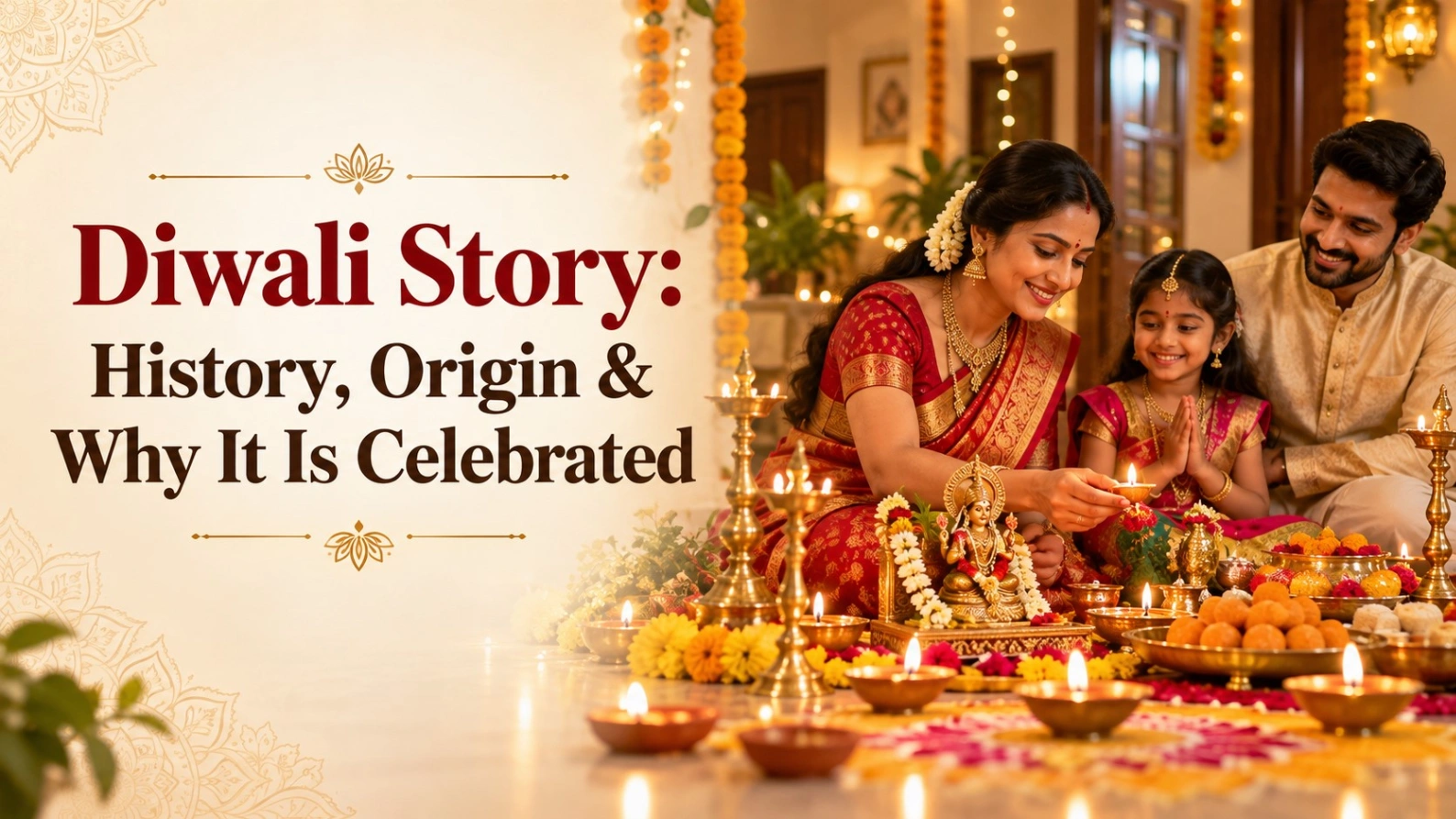
Few festivals illuminate India quite like Diwali. Homes glow with diyas, rangolis brighten entrances, families gather for prayers and celebrations, and sweets are exchanged with loved ones. Yet behind these familiar traditions lies a fascinating collection of stories that explain the deeper meaning of the Festival of Lights.
The Diwali story is not limited to a single legend.
Across India, different communities connect Diwali with different sacred events. In northern India, one of the most widely known traditions associates Diwali with Lord Rama’s return to Ayodhya after fourteen years of exile and his victory over Ravana. In many households, Goddess Lakshmi is worshipped for prosperity and auspiciousness. In parts of southern and western India, traditions also remember Lord Krishna’s victory over Narakasura.
Despite these variations, the central message remains remarkably consistent: light triumphs over darkness, goodness over evil, knowledge over ignorance and hope over despair. India’s official tourism portal similarly presents Diwali as a festival symbolizing the victory of light and goodness while recognising several regional traditions.
Understanding the Diwali history and origin therefore means exploring the many stories and traditions that have shaped the festival over centuries.
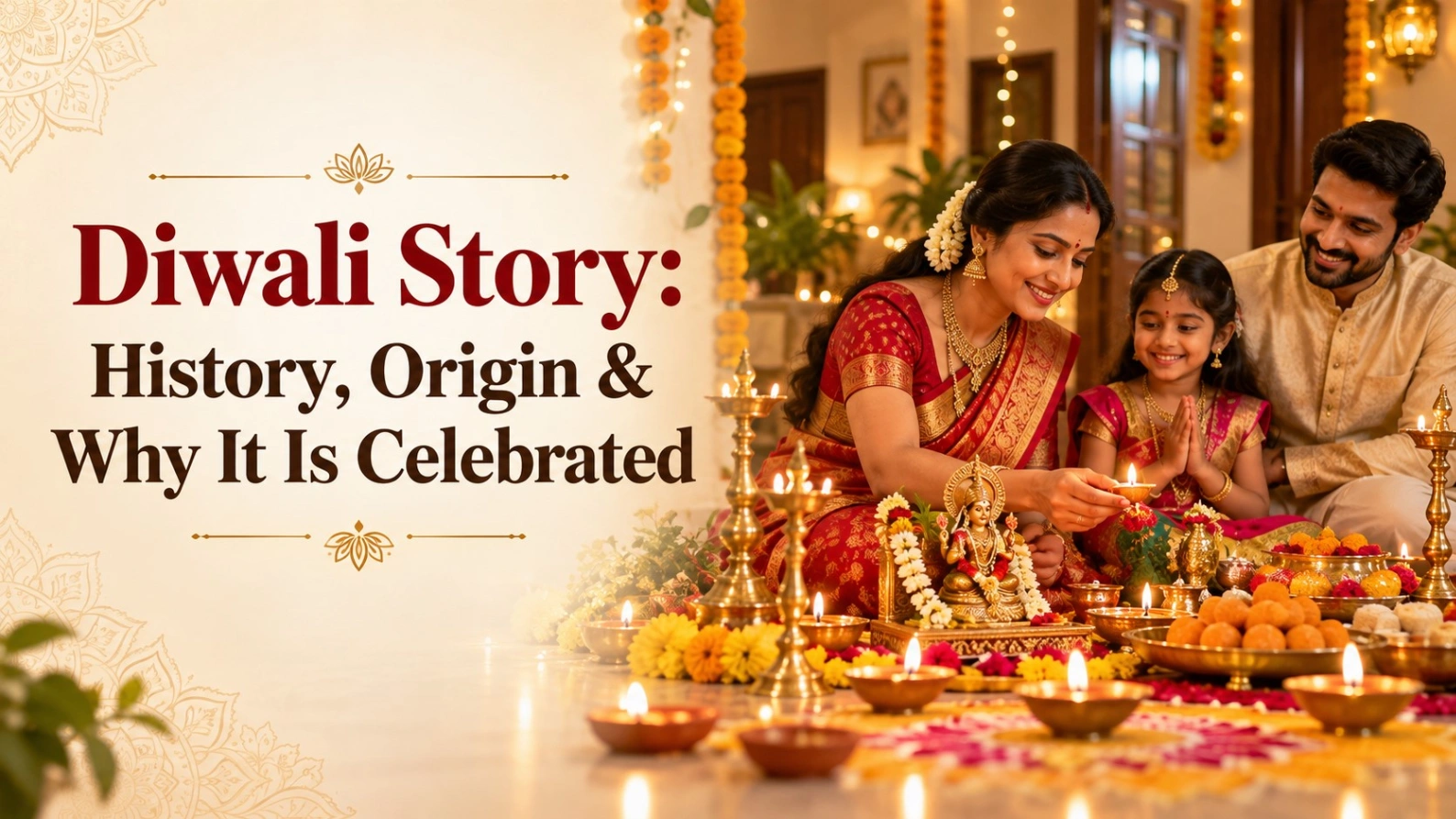
What Is Diwali?
Diwali, also known as Deepavali, is one of the most widely celebrated festivals in India.
The word “Deepavali” comes from Sanskrit words commonly interpreted as a row of lamps. This is reflected in the countless earthen diyas lit during the festival.
Diwali celebrations generally extend across several days, with different days associated with traditions such as Dhanteras, Naraka Chaturdashi or Choti Diwali, Lakshmi Puja, Govardhan Puja and Bhai Dooj.
Although the rituals vary across regions, Diwali usually represents renewal, prosperity, gratitude, family togetherness and spiritual awakening.
The illumination of homes is more than decoration. Symbolically, lighting a diya reminds us to remove inner darkness and cultivate wisdom, compassion and awareness.
Diwali Story of Lord Rama’s Return to Ayodhya
The most popular Diwali story in North India is associated with Lord Rama.
According to the Ramayana tradition, Lord Rama was sent into exile for fourteen years. His wife Sita and brother Lakshmana accompanied him.
During this period, Ravana, the ruler of Lanka, abducted Sita.
A great battle followed, in which Lord Rama defeated Ravana and eventually returned to Ayodhya with Sita and Lakshmana.
Popular tradition says that the people of Ayodhya welcomed Rama by illuminating the city with lamps.
Today, this story has become one of the most powerful explanations for why Diwali is celebrated.
Ayodhya continues to hold special importance during Diwali. Contemporary Deepotsav celebrations there explicitly commemorate Lord Rama’s return after fourteen years of exile and use millions of lamps to symbolise righteousness, faith and the victory of good over evil.
The Rama story gives the lighting of diyas a deeper meaning.
Each lamp represents the return of hope after difficulty, truth after deception and light after darkness.
Why Is Diwali Celebrated?
One of the most searched questions about the festival is: Why is Diwali celebrated?
The answer depends partly on regional and religious traditions.
For many Hindus in North India, Diwali honours Lord Rama’s return to Ayodhya.
In numerous households, the main evening of Diwali is associated with Goddess Lakshmi, the goddess of prosperity, abundance and auspiciousness.
In parts of South India and Goa, traditions around Diwali and Naraka Chaturdashi are linked with Lord Krishna’s defeat of Narakasura.
Other traditions connect the festival with King Bali or different sacred events.
Despite this diversity, Diwali universally conveys an uplifting message.
It encourages people to move from darkness towards light, from confusion towards wisdom and from negativity towards higher awareness.
That is why Diwali remains meaningful far beyond its rituals.
Design Your Destiny
Diwali reminds us that real transformation begins within. Design Your Destiny helps you move beyond limiting patterns, understand your mind and apply spiritual wisdom to everyday challenges. Learn how to replace unconscious reactions with awareness and create a life rooted in clarity, purpose and inner balance.
Start Your Journey Today!Diwali History and Origin
The exact origin of Diwali cannot easily be reduced to one event or one historical date.
The festival developed through multiple religious, regional and cultural traditions over a long period.
References to festivals of lamps and related celebrations appear in historical and literary traditions, while different communities gradually connected the festival with stories meaningful to them.
For example, historical discussions have noted references to “Dipotsava,” or a festival of lamps, in earlier Indian literature and later associations with Lakshmi, King Bali, Krishna and Yama.
This makes the history of Diwali particularly fascinating.
Rather than having one simple beginning, Diwali grew into a large cultural tradition incorporating several stories, rituals and philosophical ideas.
The widespread practice of lighting lamps became one of the strongest threads connecting these different traditions.
Diwali Story of Goddess Lakshmi
No discussion of the Diwali story is complete without Goddess Lakshmi.
Lakshmi is worshipped as the goddess of prosperity, abundance, fortune and auspiciousness.
On Diwali evening, millions of families perform Lakshmi Puja.
Homes are cleaned and decorated, entrances are illuminated and prayers are offered with the intention of welcoming prosperity and positive energy.
The association between Diwali and Lakshmi is deeply embedded in many household traditions.
Spiritually, however, Lakshmi should not be understood only as material wealth.
Prosperity may also include peace of mind, gratitude, good relationships, wisdom and the ability to live with balance.
This broader interpretation gives Lakshmi Puja a deeper dimension.
Preparing the home becomes symbolic of preparing the mind.
Removing clutter externally can remind us to remove negativity internally.
Lighting lamps becomes a reminder to cultivate awareness.
Diwali Story of Krishna and Narakasura
Another important Deepavali story involves Lord Krishna and the demon king Narakasura.
This story is especially significant in traditions surrounding Naraka Chaturdashi, which is observed around Diwali.
According to the popular legend, Narakasura became extremely powerful and caused suffering.
Lord Krishna ultimately defeated him, freeing those who had suffered under his rule.
In Goa, the tradition remains particularly visible. Large effigies representing Narakasura are created and destroyed around Naraka Chaturdashi, symbolising the defeat of evil.
The story once again reflects Diwali’s central spiritual principle: darkness cannot permanently overcome light.
This narrative also explains why the Diwali origin story differs across India.
For some communities, Rama is central. For others, Krishna and Narakasura hold greater ritual importance.
The Diwali story is not limited to a single legend.
Why Are Diyas Lit on Diwali?
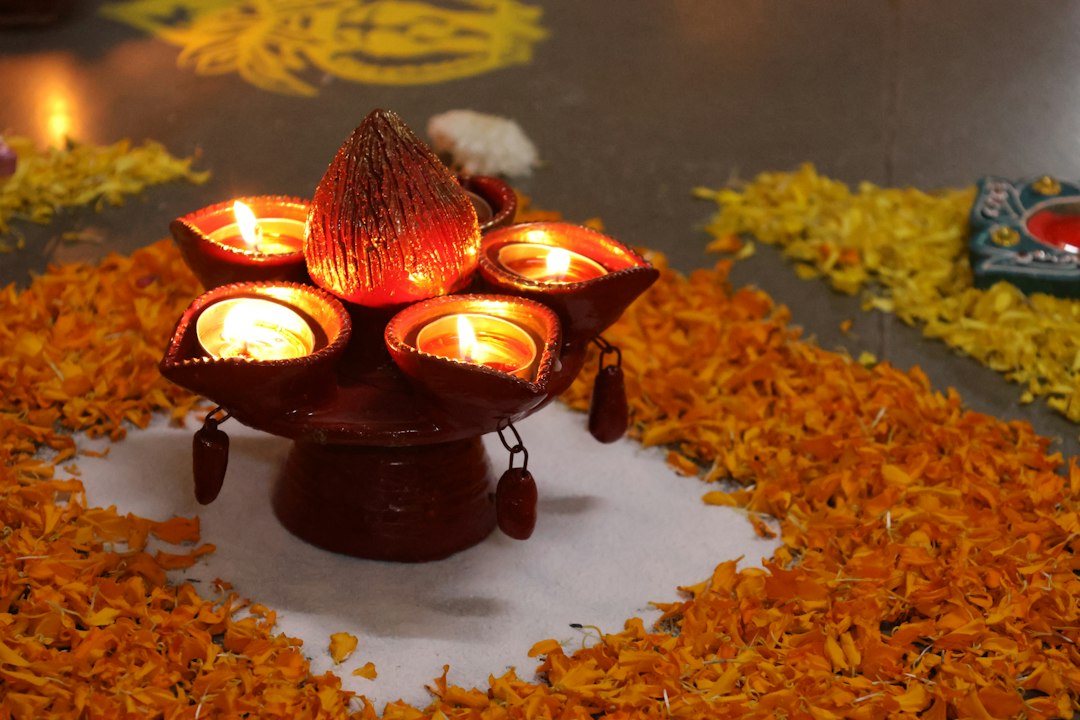
The diya is perhaps the most recognisable symbol of Diwali.
In the Rama tradition, lamps are associated with the joyful welcome given to Lord Rama upon his return to Ayodhya.
But the diya also carries universal spiritual symbolism.
Fire produces light, and light allows us to see clearly.
Spiritually, therefore, a diya represents knowledge, awareness, truth and hope.
Lighting a diya can be viewed as a simple personal reminder:
Let knowledge remove ignorance.
Let awareness overcome unconscious behaviour.
Let compassion replace anger.
Let hope replace fear.
This explains why Diwali is called the Festival of Lights.
Why Is Goddess Lakshmi Worshipped on Diwali?
Lakshmi Puja is one of the most important Diwali rituals in many parts of India.
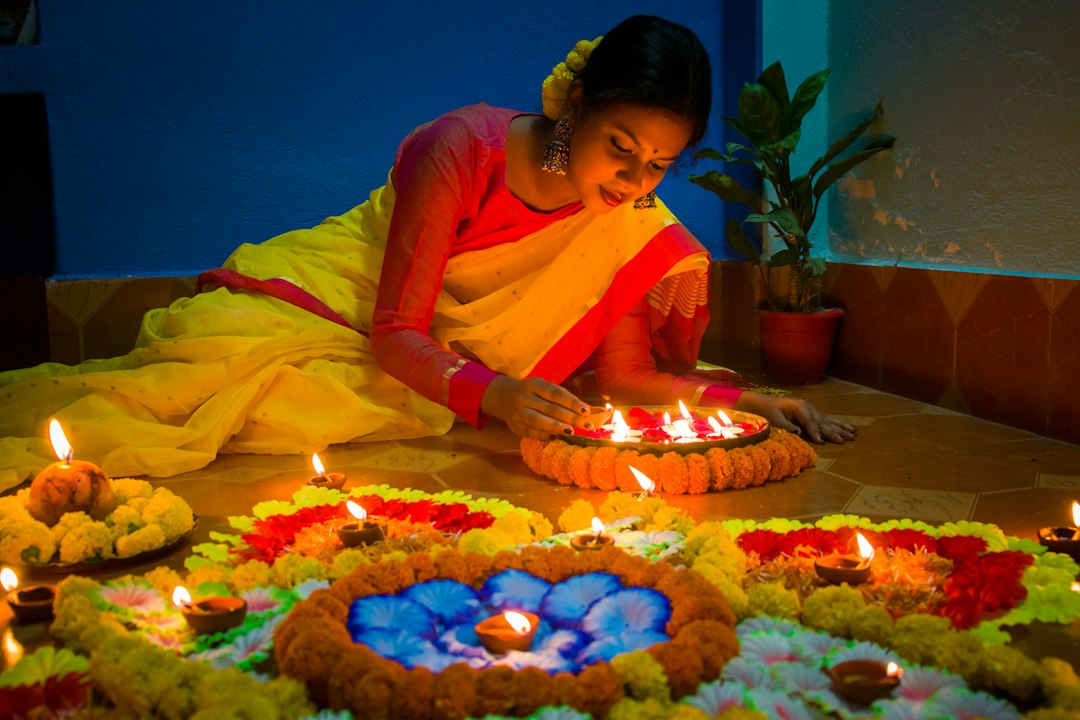
People traditionally clean their homes before Diwali and decorate entrances with rangoli, lamps and flowers.
These preparations are associated with welcoming auspiciousness and prosperity.
Goddess Lakshmi symbolises abundance, good fortune and well-being.
However, spiritual prosperity is not limited to money.
A person may have wealth yet still lack peace.
Therefore, the deeper lesson of Lakshmi worship is to seek abundance together with balance, wisdom and gratitude.
True prosperity means having enough while also appreciating what one already has.
Different Diwali Stories Across India
An important fact about Diwali history is that there is no single story followed uniformly throughout India.
Different regions emphasise different traditions.
Lord Rama and Ayodhya
In much of North India, Diwali is strongly associated with Lord Rama’s return to Ayodhya.
Krishna and Narakasura
In several southern and western traditions, Naraka Chaturdashi recalls Krishna’s victory over Narakasura. India’s official tourism portal explicitly highlights this regional connection.
Goddess Lakshmi
Across many regions, Lakshmi Puja forms the heart of Diwali evening.
King Bali
Some traditions also connect the Diwali period with King Mahabali and Lord Vishnu.
These different stories demonstrate the diversity of Indian spirituality.
Instead of weakening the festival’s meaning, they broaden it.
Each narrative points toward similar ideas: victory over negativity, renewal, devotion and spiritual awakening.
What Is the Spiritual Meaning of Diwali?
Beyond lamps, sweets and celebrations, Diwali carries a profound inner message.
The darkness we need to overcome is not only physical darkness.
It can also represent anger, ego, jealousy, fear, ignorance, greed and unconscious habits.
The lamp symbolises the awareness required to recognise and transform these tendencies.
This is why the meaning of Diwali can be applied to daily life.
If anger arises, awareness becomes the lamp.
If fear arises, courage becomes the lamp.
If confusion arises, wisdom becomes the lamp.
If hopelessness arises, faith becomes the lamp.
The true celebration of Diwali therefore begins within.
How Did Diwali Start?
People frequently search “how did Diwali start?”, but the answer is more complex than identifying one beginning.
Diwali appears to have evolved through a combination of ancient lamp festivals, religious stories, seasonal practices and regional traditions.
Over time, different communities associated these celebrations with significant sacred narratives.
That is why Diwali today simultaneously carries connections with Rama, Lakshmi, Krishna, Bali and other traditions.
Rather than asking for one exact beginning, it may be more accurate to understand Diwali as a festival that developed and expanded over centuries.
Its central symbol the lamp ultimately became a universal expression of hope and spiritual illumination.
What Does the Diwali Story Teach Us Today?
The Diwali story remains meaningful because its lessons are timeless.
Lord Rama’s story reminds us that difficult periods eventually end.
The Narakasura story represents the defeat of destructive forces.
Lakshmi Puja reminds us to value prosperity while maintaining gratitude and balance.
The diya reminds us to cultivate inner awareness.
Diwali also encourages forgiveness, reconnection and fresh beginnings.
Families clean their homes, wear new clothes, exchange sweets and meet loved ones.
These external actions can inspire an inner renewal as well.
We can clean resentment from relationships.
We can remove harmful habits.
We can begin again with greater awareness.
That may be the most powerful interpretation of Diwali.
The Diwali story cannot be explained through only one legend.
Its rich history includes traditions associated with Lord Rama’s return to Ayodhya, Goddess Lakshmi, Lord Krishna’s victory over Narakasura and several other regional beliefs.
What connects all these stories is a single powerful idea: light ultimately triumphs over darkness.
When we understand the Diwali history and origin, the festival becomes much more than an occasion for decorations and celebrations.
Every diya becomes symbolic.
Every prayer becomes meaningful.
Every new beginning becomes an opportunity for transformation.
Whether you know it as Diwali or Deepavali, its timeless message remains the same: illuminate the world around you by first awakening the light within yourself.
Personal Session
Sometimes understanding the path ahead requires deeper reflection and personalised guidance. A personal session can help you explore emotional patterns, relationships, inner conflicts, purpose and the challenges holding you back from living with greater clarity.
Book Now
Read Latest Articles