Stress has become an almost unavoidable part of modern life. Work deadlines, financial responsibilities, social expectations, constant notifications, information overload and uncertainty about the future can leave the mind feeling exhausted even when the body is resting.
We often look for modern solutions to modern problems: productivity systems, wellness apps, exercise programs, therapy, supplements and relaxation techniques. Many of these approaches can be valuable. Yet there is another source of insight that has been explored for thousands of years: ancient Indian wisdom.
The question is not whether ancient teachings can magically eliminate modern stress. They cannot. The more useful question is whether their principles can help us understand why the mind becomes stressed and how we can respond to pressure differently.
From the Bhagavad Gita to yoga and meditation traditions, ancient Indian thought offers ideas about attachment, action, awareness, self-discipline and inner balance. When interpreted responsibly and applied to modern life, these ideas can become practical tools for emotional well-being.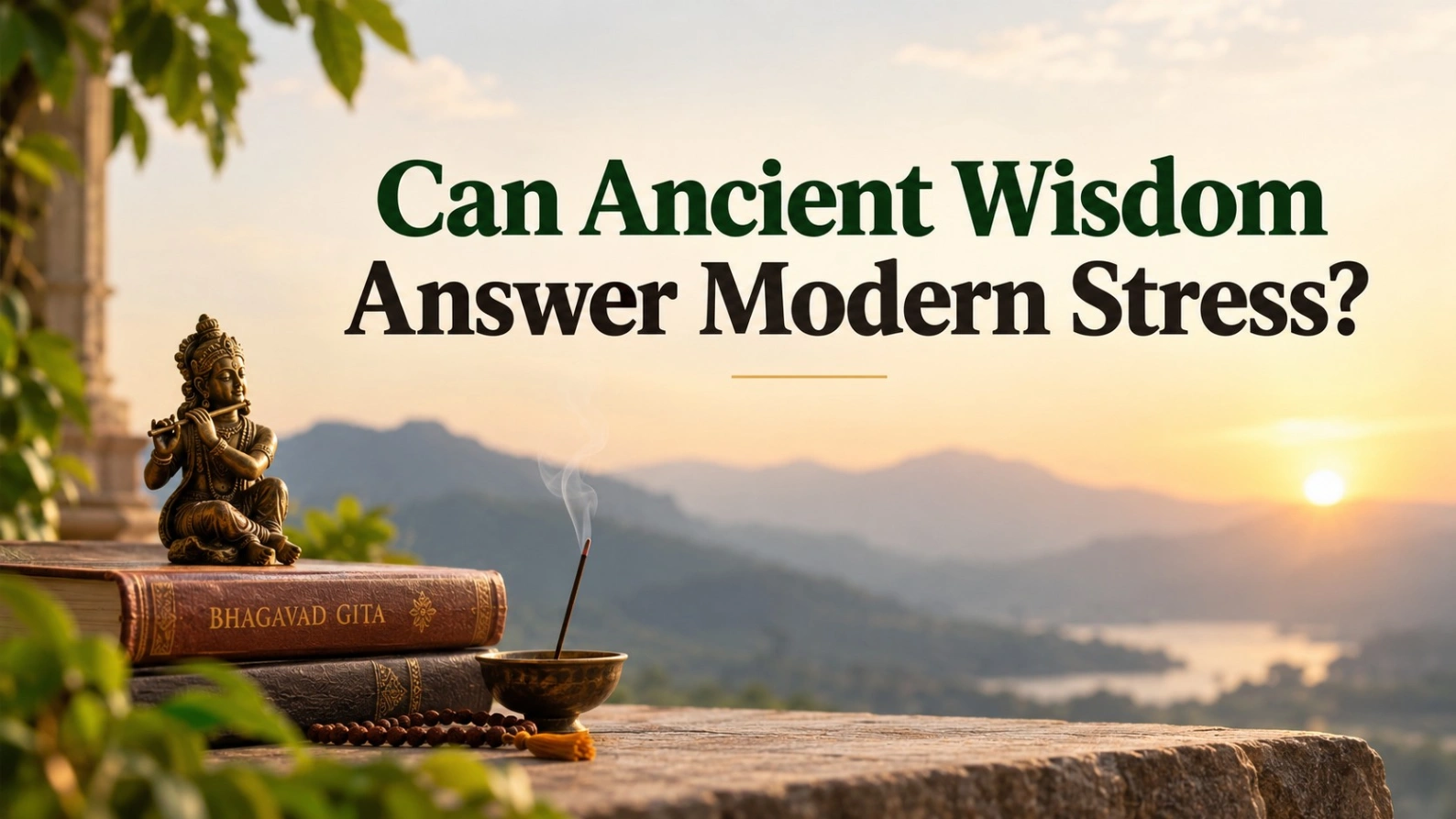
Why Does Modern Life Create So Much Stress?
Stress is not simply about having a busy schedule. Two people can face similar circumstances and experience very different levels of stress.
One reason is our relationship with uncertainty and control.
Modern life encourages us to constantly think about what could happen next. Will I succeed? What will people think of me? Will I meet my target? What if I make the wrong decision? What happens if things do not go according to plan?
Technology can intensify this cycle. We may begin the day by checking messages and end it by scrolling through social media. Between those moments, work notifications, news updates and responsibilities continuously compete for our attention.
This can create a mind that is physically present but mentally somewhere else.
Ancient Indian wisdom repeatedly explores this problem: How can a person remain steady when circumstances keep changing?
That question is remarkably relevant today.
Design Your Destiny
Your life is shaped not only by what happens to you, but also by how consciously you respond to what happens. If you are ready to understand your patterns, strengthen your inner clarity and create a more purposeful direction in life, explore Design Your Destiny—a journey toward greater self-awareness, clarity and conscious action.
Start Your Journey Today!What Can Ancient Wisdom Teach Us About Stress?
Ancient wisdom does not provide one single formula for stress relief. Instead, it offers principles for developing a different relationship with thoughts, actions and circumstances.
Three ideas are particularly relevant:
Focus on what is within your control.
Reduce excessive attachment to outcomes.
Cultivate awareness and inner balance.
These principles can be found in different forms across Indian philosophical and yogic traditions.
The goal is not to escape responsibilities. It is to learn how to engage with them without allowing every external event to determine our internal state.
Bhagavad Gita and Stress Management
The Bhagavad Gita presents a powerful conversation about duty, uncertainty, fear and decision-making. At the beginning of the text, Arjuna is overwhelmed by emotional conflict and uncertainty about what he should do.
Although the circumstances of the Gita are very different from those of modern life, the emotional dilemma is familiar.
We too can feel overwhelmed when facing difficult choices.
Should I change my career? How will I handle failure? What if my efforts do not produce the result I expect? How can I make the right decision when the future is uncertain?
One of the central teachings associated with the Gita is the importance of focusing on one's actions rather than becoming consumed by the results.
This does not mean that results are irrelevant. Rather, it encourages us to distinguish between our responsibility to act and our inability to completely control the outcome.
That distinction can be extremely useful for stress management.
Focus on Your Actions, Not Constantly on the Outcome
Imagine preparing for an important presentation.
You can control how well you prepare, how clearly you communicate and how calmly you respond to questions.
But you cannot completely control how every person reacts.
If your mind remains focused on the uncontrollable outcome, anxiety can increase. If your attention shifts toward doing your best with what is within your control, the same situation may feel more manageable.
This is one way ancient wisdom for modern stress can become practical.
Instead of asking:
“What if everything goes wrong?”
we can ask:
“What is the best action available to me right now?”
That simple shift can bring attention from an imagined future back to the present moment.
How Ancient Vedic Philosophies Match Modern Quantum Theories
Understanding Attachment and Stress
Another important concept in Indian philosophy is attachment.
Attachment does not simply mean caring about something. Caring about your work, relationships or goals is natural.
The problem begins when our sense of peace becomes completely dependent on getting the outcome we want.
For example:
“I will be happy only if I get promoted.”
“I will feel successful only if everyone appreciates me.”
“I can relax only when everything is perfect.”
These beliefs can create continuous psychological pressure.
Ancient wisdom encourages a more balanced approach: act sincerely, care deeply, but do not make your entire sense of inner stability dependent on a particular outcome.
This perspective can help us pursue goals without allowing every success or setback to define our emotional state.

Ancient Wisdom for Mental Peace
Mental peace does not necessarily mean having a life without problems.
A peaceful mind can still experience disappointment, uncertainty and difficulty. The difference is in how those experiences are processed.
Ancient Indian traditions often emphasize awareness, self-discipline and equanimity.
This suggests an important distinction:
Peace is not always the absence of difficulty; sometimes it is the ability to remain balanced while difficulty is present.
This perspective is especially relevant in a world where avoiding every source of stress is impossible.
Instead of trying to control everything around us, we can develop greater awareness of what is happening within us.
Yoga and Stress Management
Yoga is often associated with physical postures, but the broader yogic tradition encompasses much more than exercise.
Breath awareness, concentration, meditation, self-discipline and mindful movement can all be part of a broader approach to well-being.
From a modern lifestyle perspective, yoga can provide an opportunity to pause.
Consider what happens during a few minutes of slow, attentive breathing. Attention moves away from emails, deadlines and notifications and toward the body and breath.
That pause can help interrupt the cycle of constant mental stimulation.
Yoga should not be viewed as a guaranteed cure for stress or mental health conditions. However, practices such as gentle movement, breathing exercises and mindfulness may complement a healthy lifestyle.
Meditation for Modern Stress
Meditation is another ancient practice that has found a place in modern wellness.
At its simplest, meditation involves deliberately training attention and developing awareness.
A person may sit quietly and observe the breath. Thoughts may appear. Instead of immediately following every thought, the person notices it and gently returns attention to the chosen object.
This teaches an important skill: a thought does not always require an immediate reaction.
That can be particularly valuable in modern life.
A stressful thought such as “I cannot handle this” can quickly become a chain of additional thoughts. Awareness creates a small space between the thought and the response.
With consistent practice, that space can become an important part of emotional regulation.
How to Apply Ancient Indian Wisdom to Everyday Stress
Ancient teachings become meaningful when they can be translated into everyday actions.
Here are a few simple practices inspired by these principles.
1. Identify What You Can Control
When you feel overwhelmed, divide the situation into two categories:
Within my control:
My preparation, communication, choices, habits and response.
Outside my complete control:
Other people's opinions, unexpected events and the final outcome.
Put your energy into the first category.
2. Start the Day Without Immediate Digital Overload
Instead of checking notifications immediately after waking up, spend a few minutes in silence, mindful breathing or reflection.
This creates a deliberate beginning rather than allowing external demands to control your attention from the first minute of the day.
3. Practice One-Task Attention
Multitasking can make the mind feel scattered.
Choose one important task and give it your attention for a defined period. When distractions arise, gently return to the task.
This is a simple modern application of the ancient principle of disciplined attention. 
4. Pause Before Reacting
When something stressful happens, create a small pause.
Take a slow breath.
Notice what you are feeling.
Then decide how you want to respond.
The pause may be only a few seconds, but it can prevent an automatic emotional reaction from becoming a larger problem.
5. Reflect at the End of the Day
Before sleeping, ask yourself:
What did I do well today?
What did I learn?
What was outside my control?
What can I do differently tomorrow?
This transforms the day from a collection of stressful events into an opportunity for reflection and learning.
Science and Spirituality: A New Way to Understand Life
Can Ancient Wisdom Replace Modern Mental Health Support?
No.
This is an important distinction.
Ancient wisdom can provide philosophical perspectives and practices that may support emotional well-being, but it should not be presented as a replacement for professional mental health care.
Persistent anxiety, severe stress, depression, panic symptoms, sleep problems or significant changes in daily functioning deserve appropriate professional attention.
Ancient practices such as meditation, yoga and reflective exercises can potentially complement professional care and healthy lifestyle habits, depending on an individual's circumstances.
The strongest approach is not “ancient versus modern.”
It can be ancient wisdom combined with modern understanding.
Ancient Wisdom Meets Modern Life
Perhaps the most valuable lesson is not a particular technique but a change in perspective.
Modern life often tells us that we need to control more, achieve more and respond faster.
Ancient wisdom asks us to consider something different:
Can we act with greater awareness, discipline and balance even when we cannot control everything around us?
That question remains relevant whether someone is dealing with workplace pressure, relationship difficulties, academic competition, financial uncertainty or the everyday noise of digital life.
The objective is not to create a life without challenges.
It is to develop the inner resources to meet challenges more consciously.
Ancient wisdom for modern stress does not mean going back in time or rejecting modern science and psychology.
It means revisiting timeless questions about the mind, action, attachment and inner balance and asking how their insights can be applied responsibly today.
The Bhagavad Gita reminds us to focus on our actions rather than becoming consumed by outcomes. Yoga encourages disciplined awareness of the body and mind. Meditation offers a way to observe thoughts rather than automatically following them.
Together, these ideas suggest a powerful possibility:
We may not always be able to change the situation immediately, but we can learn to change the way we meet it.
And sometimes, that is where meaningful change begins.
Personal Session
Sometimes, understanding a concept is not enough—you need a space to explore how it applies to your own life. If stress, uncertainty or repeated patterns are making it difficult to move forward, consider a personal session for deeper reflection and individualized guidance.
Book Now
Read Latest Articles
What Is My Purpose in Life?How to Discover Your True Calling
Bhai Dooj Date: Tilak Muhurat, Puja Time & Complete Vidhi
Frequently Asked Questions
Can ancient wisdom help with modern stress?
Yes. Ancient Indian traditions offer principles such as focusing on what is within our control, reducing excessive attachment to outcomes, cultivating awareness and practicing meditation or yoga. These approaches may support emotional well-being and help people develop healthier responses to everyday stress, but they should complement—not replace—professional mental health support when needed.How does the Bhagavad Gita help with stress management?
The Bhagavad Gita explores themes such as duty, uncertainty, action, attachment and mental balance. One relevant principle is focusing sincerely on one's actions without becoming excessively attached to the results. Applied to modern life, this can help shift attention from uncontrollable outcomes toward constructive actions in the present.What does ancient Indian wisdom say about stress?
Ancient Indian philosophical traditions explore the relationship between the mind, desires, attachment, action and inner balance. Rather than suggesting that all difficulties can be eliminated, many teachings emphasize developing greater awareness and equanimity while responding appropriately to life's challenges.Can yoga reduce stress?
Yoga can be a useful component of a healthy stress-management routine. Practices involving mindful movement, breathing and relaxation can create opportunities to slow down and reconnect with the body. However, yoga should not be considered a universal treatment for serious mental health conditions.Is meditation useful for modern stress?
Meditation can help develop attention and awareness. Regular practice may help a person notice thoughts and emotions without immediately reacting to them. For some people, this can become a useful tool for managing everyday stress alongside sleep, physical activity, social connection and other healthy habits.What is the simplest ancient practice for managing stress?
A simple starting point is mindful breathing. Spend a few minutes sitting comfortably, notice your natural breathing and gently bring your attention back whenever the mind wanders. The purpose is not to stop thoughts but to practice observing them without immediately following every thought.