Have you ever tried to concentrate on a task while your mind kept wandering? Or experienced a strong emotion that made it difficult to think clearly? These experiences are common parts of everyday life, and meditation offers one way to develop greater awareness of them.
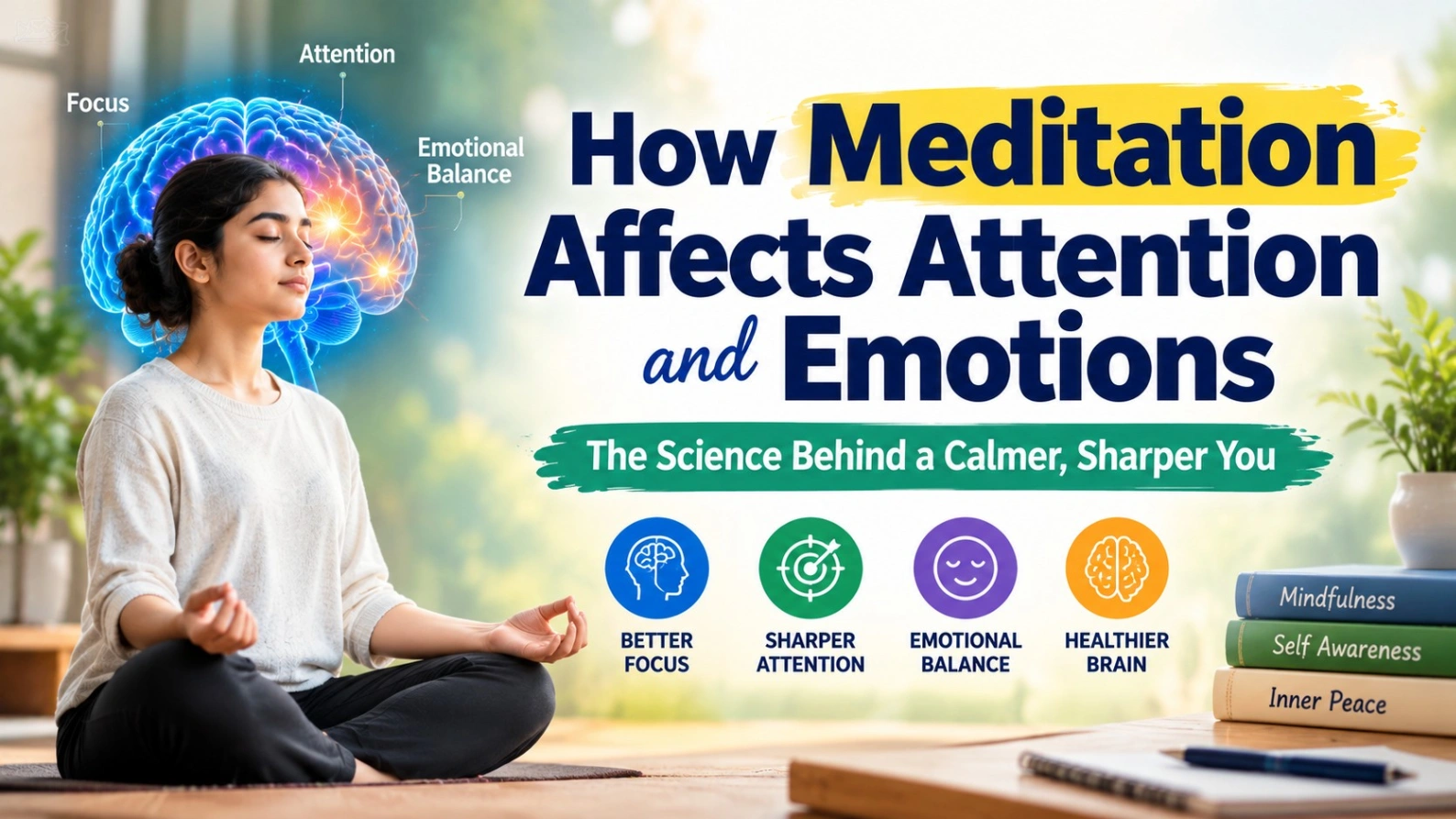
How meditation affects attention and emotions is an increasingly interesting topic in neuroscience and psychology. Meditation practices encourage people to pay attention to their present experience, notice thoughts without immediately reacting to them, and redirect their focus when it wanders.
Scientific research suggests that mindfulness meditation may support aspects of attention and emotional regulation, although the benefits vary between individuals and practices. Understanding these effects can help us approach meditation with realistic expectations and use it as a practical tool for personal development.
In this article, we explore the connection between meditation, attention, and emotions, what researchers have discovered about the brain, and how you can begin practising mindfulness in everyday life.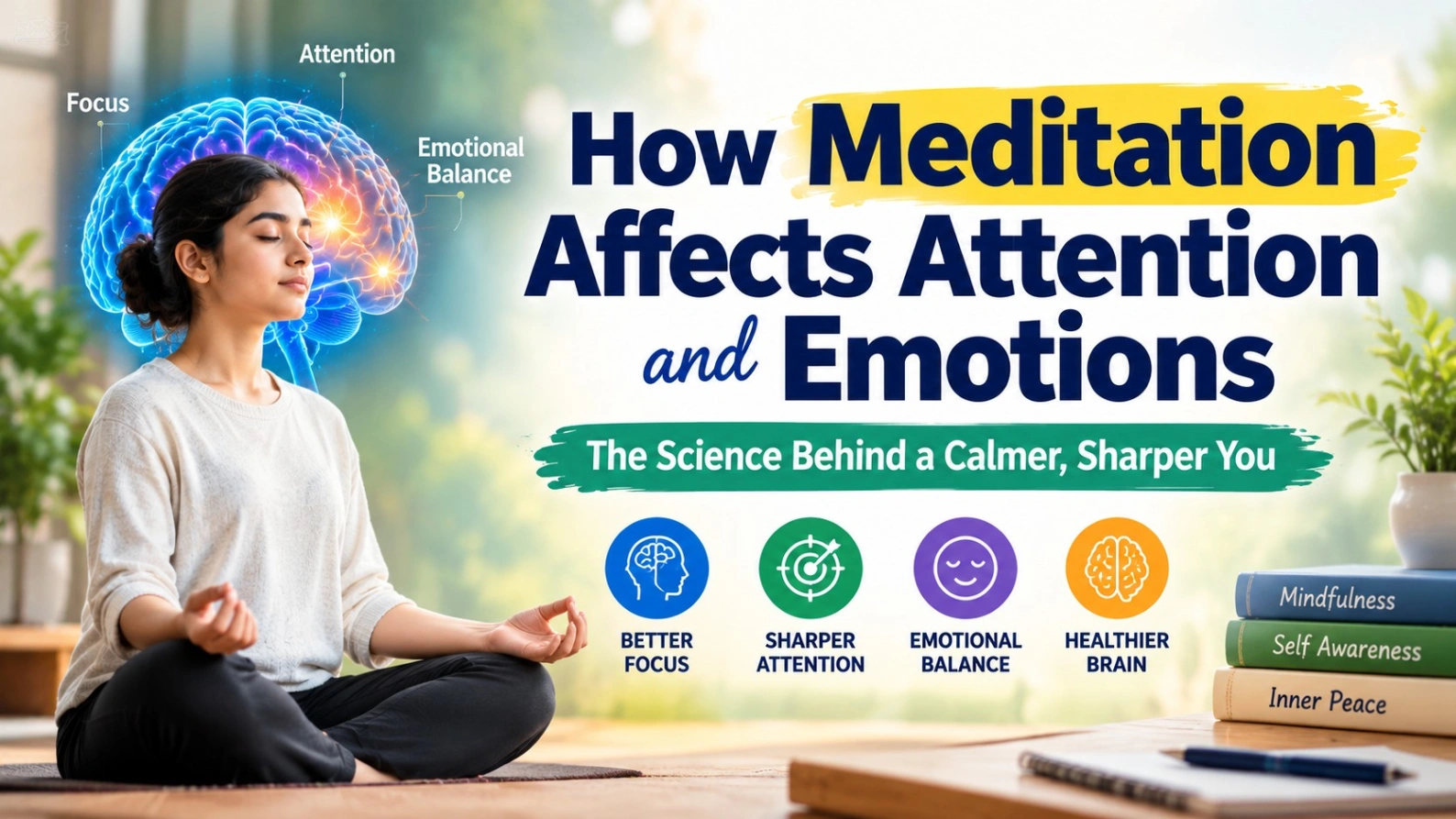
What Is Meditation?
Meditation is a group of mental practices designed to cultivate qualities such as attention, awareness, calmness, and compassion. Different traditions use different methods, including breath awareness, mantra repetition, focused attention, and open monitoring.
Mindfulness meditation involves paying attention to present-moment experiences with an attitude of openness rather than immediately judging or avoiding them.
For example, you might notice the sensation of breathing, the sound of traffic outside, or a feeling of frustration arising during a difficult task. Instead of automatically following every thought, you practise recognising what is happening and choosing where to direct your attention.
Meditation does not require you to stop thinking completely. Thoughts and emotions will continue to arise. The practice involves learning to notice them and respond more deliberately.
1. How Meditation Affects Attention
Attention is the ability to select information, maintain concentration, and shift focus when necessary. It allows us to read a book, listen to a conversation, solve problems, and complete everyday responsibilities.
However, attention is easily distracted by notifications, environmental noise, worries, memories, and unrelated thoughts.
Meditation provides an opportunity to practise directing attention intentionally.
Design Your Destiny
Personal growth begins with understanding your thoughts, developing awareness, and making intentional choices. Explore the connection between inner awareness, spiritual wisdom, and everyday life with Science Divine Foundation.
Start Your Journey Today!Focused attention and concentration
In focused-attention meditation, you choose an object, such as your breathing, and try to keep your attention on it.
When you notice that your mind has wandered, you gently return your focus to the chosen object.
This process involves several mental skills: maintaining attention, recognising distraction, disengaging from unrelated thoughts, and redirecting attention.
With repeated practice, these skills may become more familiar. Some research suggests that meditation training can benefit particular aspects of attention, although results differ across studies and cognitive tasks.
The goal is not to eliminate distractions forever. It is to become more aware of them and practise returning to what matters.
Becoming aware of mind wandering
Mind wandering occurs when attention moves away from the current activity towards unrelated thoughts. Sometimes this is useful for creativity and reflection, but frequent distraction can make demanding tasks more difficult.
Meditation encourages you to recognise mind wandering without automatically criticising yourself.
Imagine you are studying and suddenly begin thinking about an upcoming deadline. Rather than spending several minutes worrying about the distraction, you notice it and return to your work.
This simple act of noticing and redirecting attention is an important part of mindfulness practice.
Improving everyday focus
Meditation may complement habits that support concentration, such as reducing digital distractions, organising tasks, and taking regular breaks.
For students, professionals, and anyone managing multiple responsibilities, even a brief period of intentional attention can provide an opportunity to pause and reset.
However, meditation is not a guaranteed way to improve memory, intelligence, or productivity. Its effects depend on the person, the technique, the amount of practice, and the outcome being measured.
2. How Meditation Affects Emotions
Emotions are natural responses to experiences, thoughts, relationships, and perceived challenges. Happiness, sadness, anger, fear, and excitement all provide information about how we are responding to the world.
Problems can arise when an emotion feels so intense that it becomes difficult to respond thoughtfully.
Mindfulness meditation may help people become more aware of emotional experiences and develop a different relationship with them.

Recognising emotions earlier
Many emotional reactions develop quickly. A frustrating comment may trigger irritation before we have consciously considered why it affected us.
Mindfulness encourages us to notice emotional signals, thoughts, and bodily sensations as they occur.
For example, you might recognise that your shoulders are tense and your thoughts are becoming impatient during a disagreement.
Noticing these signs does not automatically remove the emotion, but it may create an opportunity to pause before responding.
Over time, this awareness can support more thoughtful decisions in everyday situations.
Responding instead of reacting automatically
An automatic reaction happens when we respond immediately to an experience without considering other options.
Suppose someone criticises your work. You might instantly feel defensive and respond harshly. A mindful approach involves noticing the initial reaction, acknowledging the discomfort, and deciding how to respond.
You can still disagree, set boundaries, or express disappointment. Mindfulness is not about accepting every situation or suppressing your emotions.
Instead, it encourages a little more space between what you experience and what you choose to do next.
Understanding difficult feelings without judging yourself
People sometimes respond to difficult emotions by criticising themselves for having them.
For example, a student who feels nervous before an examination might think, "I should not be feeling this way."
This second layer of self-criticism can add to the original discomfort.
Mindfulness offers another approach: recognise the feeling, acknowledge that it is part of the current experience, and decide what would be helpful next.
You might tell yourself, "I notice that I am nervous. I can take a breath and begin with the first question."
This does not guarantee that anxiety will disappear. It provides a practical way to continue responding constructively even when uncomfortable feelings remain.
Bhagavad Gita for Exam Stress: 5 Lessons to Learn
3. What Happens in the Brain During Meditation?
Researchers use tools such as functional magnetic resonance imaging (fMRI) and electroencephalography (EEG) to investigate brain activity associated with meditation.
Findings suggest that different meditation practices engage different brain regions and networks. There is no single brain response that explains every meditation technique.
Several systems are particularly relevant to attention and emotional regulation.
The prefrontal cortex and executive control
The prefrontal cortex contributes to complex processes such as planning, decision-making, and regulating behaviour.
Meditation research has investigated how attention-related brain systems participate when people notice distractions and return their focus to a chosen object.
These processes overlap with some functions involved in executive control. However, this does not mean meditation automatically strengthens every prefrontal function or produces the same effects in everyone.
The anterior cingulate cortex and attention monitoring
The anterior cingulate cortex is involved in monitoring behaviour, detecting conflicts, and supporting aspects of attention and cognitive control.
During focused-attention meditation, a person repeatedly notices when attention has drifted and attempts to bring it back.
Researchers have studied the involvement of this region in such processes, although its activity varies depending on the task and meditation method.
Brain networks and emotional awareness
Meditation studies also investigate the insula, amygdala, and interconnected brain networks involved in bodily awareness, emotional processing, and attention.
The insula contributes to awareness of internal bodily signals. The amygdala participates in processing emotionally significant information, including potential threats.
It would be misleading to say that meditation simply switches off the amygdala or permanently changes one specific brain region. Research examines more complex patterns of brain activity and connectivity, and results vary across studies.
Overall, neuroscience offers promising insights into how meditation relates to attention and emotional regulation, but many details remain under investigation.
4. Can Meditation Help Manage Stress?
Stress can influence concentration, decision-making, sleep, and emotional responses. When someone feels overwhelmed, it may become harder to focus on the present task or respond calmly to a challenge.
Mindfulness meditation can provide a structured opportunity to pause, observe current experiences, and practise responding with greater awareness.
A systematic review published in JAMA Internal Medicine found moderate evidence that mindfulness meditation programmes produced improvements in anxiety and depression symptoms in the studies reviewed. Evidence for some other outcomes, including attention and general stress, was less conclusive.
This distinction matters: meditation may be helpful for some people, but it is not a universal solution or a substitute for appropriate medical or psychological care.
For everyday stress, meditation can be combined with other supportive habits, including regular physical activity, adequate sleep, social connection, and breaking demanding tasks into manageable steps.
How to Stay Calm in Stressful Situations:12 Simple Technique
5. A Simple Meditation Practice for Attention and Emotions
You do not need special equipment or a complicated routine to begin practising mindfulness. Start with a comfortable position and a few minutes of gentle attention.
Step 1: Choose a quiet place. Sit comfortably in a position that allows you to remain relaxed and alert.
Step 2: Notice your breathing. Pay attention to the natural sensation of breathing. There is no need to force deep breaths or change your breathing pattern.
Step 3: Recognise distractions. When thoughts, sounds, or feelings draw your attention away, simply notice that this has happened.
Step 4: Return your attention. Gently bring your focus back to your breathing. Treat each return as part of the practice rather than a failure.
Step 5: Observe your emotions. If a feeling arises, see whether you can name it quietly, such as "worry," "frustration," or "excitement," without needing to act on it immediately.
Step 6: Finish gently. After three to five minutes, notice how you feel and return to your next activity without expecting a particular result.
You can practise for longer if it feels comfortable. Consistency is more useful than forcing yourself through a session that feels distressing.
Meditation can occasionally bring uncomfortable thoughts or feelings to the surface. If a practice increases distress, stop or try a gentler approach. Seek guidance from a qualified professional if difficulties persist.
6. How to Bring Mindfulness Into Everyday Life
Formal meditation is only one way to practise awareness. Everyday activities can also become opportunities to notice your attention and emotional responses.
While studying: Notice when your attention drifts, then return to the next small task.
During conversations: Listen to the other person instead of preparing your response before they finish speaking.
When frustrated: Pause briefly and notice your reaction before deciding what to say.
While walking: Pay attention to the sensations of movement and your surroundings.
Before sleeping: Take a few quiet moments to notice your breathing and let the day's activities settle.
These practices are not intended to remove every negative thought or emotion. They help you become more aware of what is happening so that you can make more deliberate choices.
Understanding how meditation affects attention and emotions reveals an important connection between awareness and everyday behaviour.
Meditation trains people to notice when attention wanders, return to the present, and observe emotional experiences without immediately reacting to them. Research suggests that some meditation practices may support aspects of attention and emotional regulation, although the size and consistency of these benefits vary.
You do not need to achieve a perfectly quiet mind to benefit from practising awareness. Begin with a few minutes, approach distractions with patience, and choose a method that feels comfortable for you.
Over time, mindfulness can become one part of a broader approach to personal growth, alongside healthy routines, supportive relationships, and professional help when necessary.
The goal is not to control every thought or emotion. It is to understand your experiences more clearly and respond to them with greater intention.
Personal Session
every person's experiences, questions, and aspirations are different. If you would like to explore your personal goals, spiritual questions, or self-development journey in greater depth, contact Science Divine Foundation to learn about its available personal guidance sessions
Book Now
Read Latest Articles