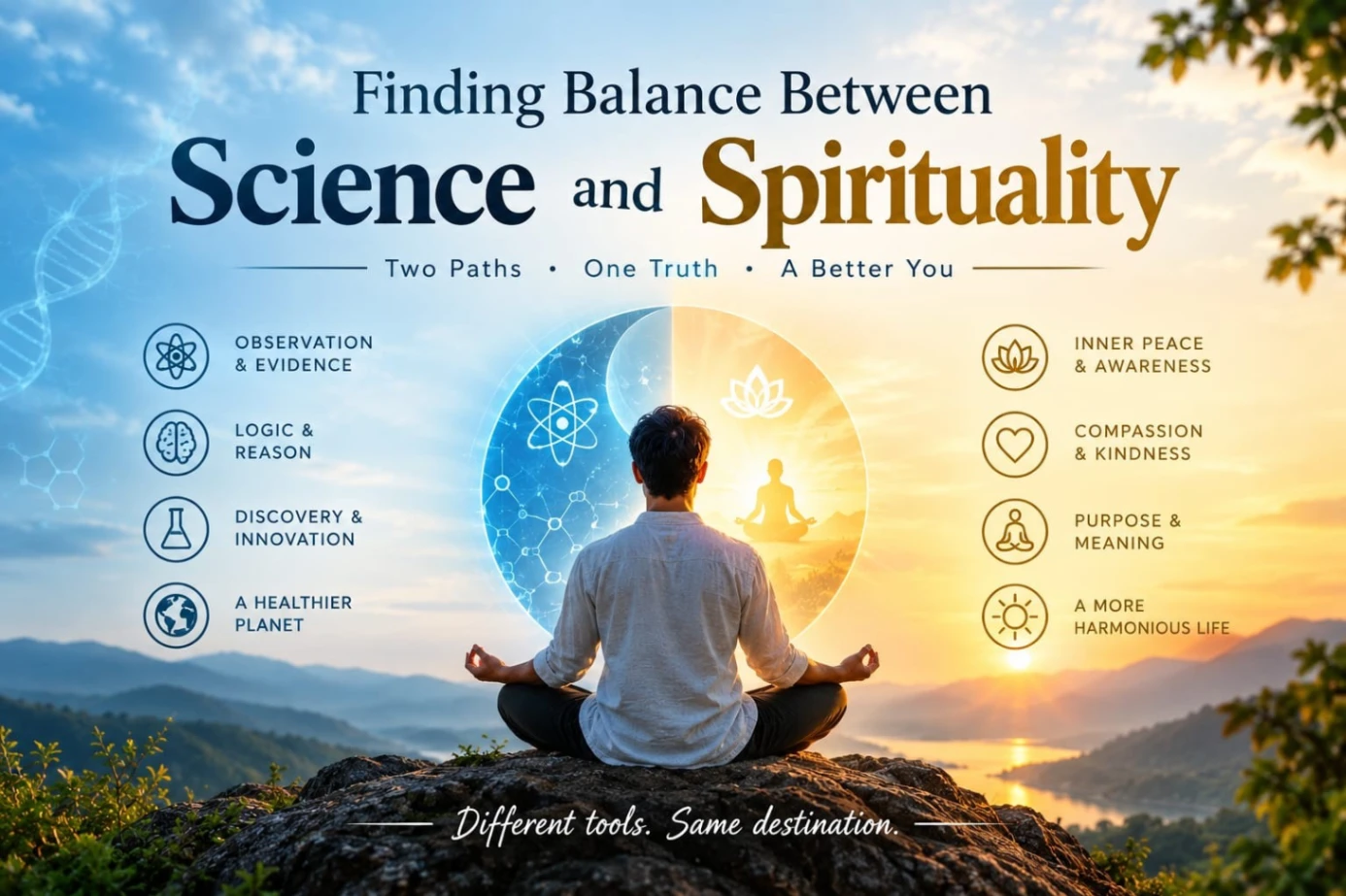
Introduction: Can Science and Spirituality Exist Together?
We live in a world where scientific discoveries are transforming how we understand the universe, the human brain, and our everyday lives. At the same time, people are increasingly exploring spirituality to find inner peace, meaning, and a deeper understanding of themselves.
This raises an important question: Can science and spirituality coexist, or must we choose between rational thinking and spiritual understanding?
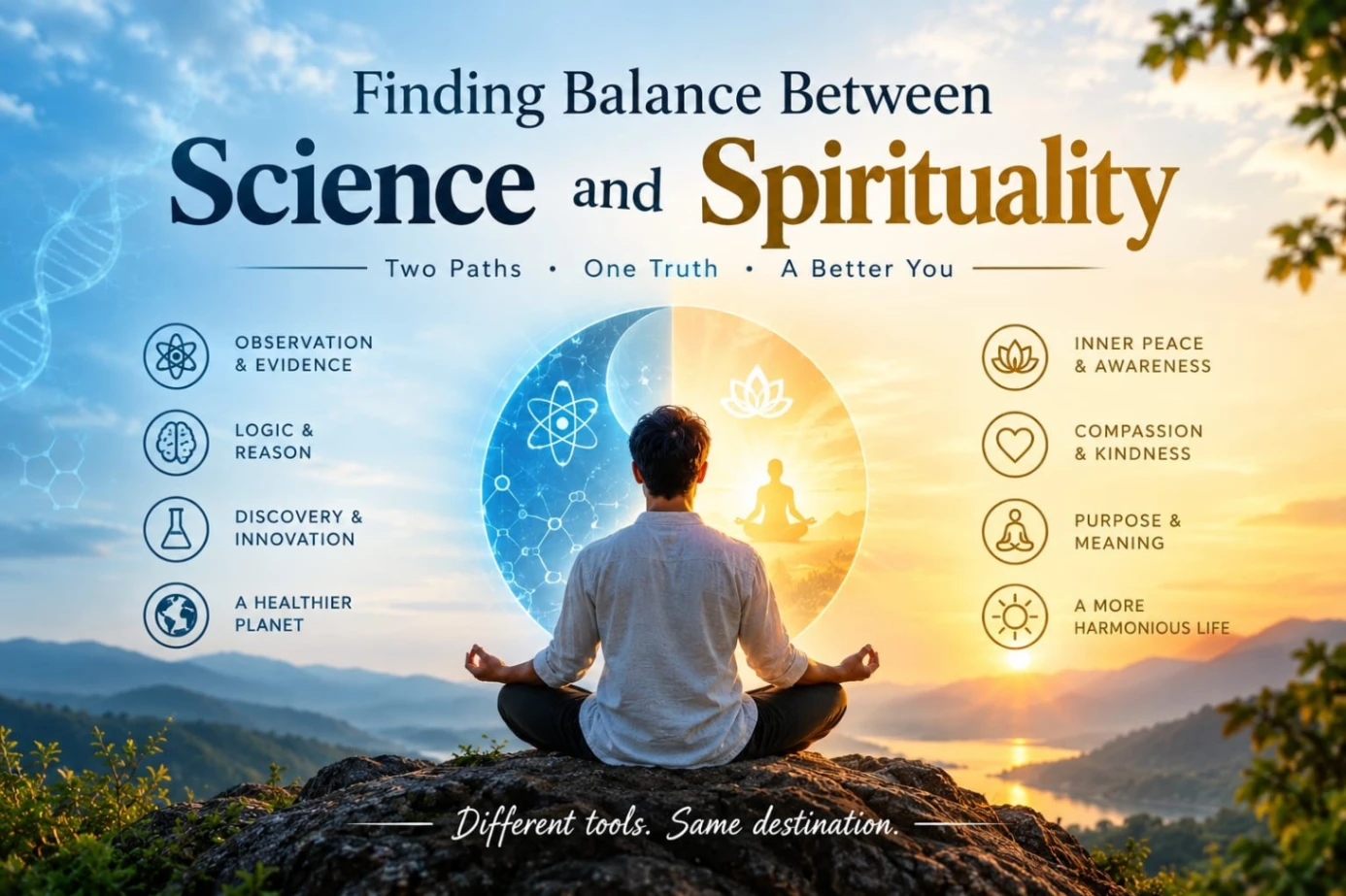
The answer may be found in recognizing that they approach different dimensions of human experience. Science investigates the natural world through observation, experimentation, and evidence. Spirituality explores questions of meaning, awareness, purpose, and our relationship with life.
Finding balance between science and spirituality does not mean accepting every spiritual belief as scientific fact. Instead, it means remaining curious, appreciating scientific evidence, and exploring our inner experiences with awareness and an open mind.
From understanding the effects of meditation on the brain to exploring ancient philosophical teachings about consciousness, there are many opportunities to bring these perspectives into everyday life.
Let's explore how science and spirituality can complement each other and help us develop a more balanced approach to modern living.
1. Understanding the Difference Between Science and Spirituality
Before exploring their connection, it is important to understand what science and spirituality mean.
What Is Science?
Science is a systematic way of understanding the natural world. It uses observation, experimentation, measurable evidence, and critical thinking to investigate questions about reality.
Scientific methods help us understand how the brain functions, how diseases develop, how the universe evolves, and how our bodies respond to different experiences.
One of the greatest strengths of science is its willingness to revise existing explanations when new evidence emerges.
Science generally asks questions such as:
How does the human brain process emotions?
What happens in the body during meditation?
How do sleep, stress, and physical activity affect well-being?
What evidence supports a particular explanation?
What Is Spirituality?
Spirituality is a broad concept that involves exploring meaning, purpose, self-awareness, and our relationship with existence. It can be religious or non-religious, depending on an individual's beliefs and experiences.
For some people, spirituality involves prayer, meditation, or sacred texts. For others, it means observing their thoughts, cultivating compassion, connecting with nature, or reflecting on the deeper questions of life.
Spirituality may encourage questions such as:
Who am I beyond my thoughts and social roles?
What gives my life meaning?
How can I respond to difficult situations with greater awareness?
Can I observe my emotions without allowing them to control every decision?
Science primarily investigates how the natural world works, while spirituality often explores how we experience life and what meaning we give it. Their methods and aims can differ, but they can still inform our understanding of ourselves.
Design Your Destiny
Discover how self-awareness, conscious choices, and purposeful action can help you approach life's challenges with greater clarity. Take a step toward understanding your patterns, reconnecting with your values, and creating a life aligned with what truly matters to you.
Start Your Journey Today!2. The Connection Between Science and Spirituality
The relationship between science and spirituality becomes particularly interesting when we examine human experiences such as attention, emotions, compassion, and self-awareness.
For centuries, spiritual traditions have included practices such as meditation, contemplation, and mindful observation. Today, researchers investigate some of these practices to understand their possible effects on the brain, stress, and psychological well-being.
For example, research on mindfulness-based interventions has explored whether structured mindfulness practices can help people manage stress and emotional difficulties.
However, it is important to distinguish between evidence supporting a particular practice and evidence supporting an entire spiritual philosophy. Research demonstrating potential benefits of mindfulness does not automatically establish the truth of every spiritual claim.
Similarly, scientific explanations of brain activity do not necessarily settle philosophical questions about the meaning of consciousness.
A balanced perspective allows us to appreciate both scientific investigation and personal reflection without confusing one for the other.
Instead of asking whether science or spirituality is superior, we can ask a more useful question: What can each teach us about living more consciously?
3. What Science Tells Us About Meditation and Mindfulness
Meditation is one of the clearest examples of an area where scientific research and spiritual practice intersect.
Many meditation traditions encourage people to pay attention to the present moment, observe their thoughts, and develop a less reactive relationship with their experiences.
Modern researchers study meditation and mindfulness to understand their effects on attention, emotional regulation, stress, and mental health.
How Can Meditation Support Well-Being?
1. Managing stress
Some mindfulness-based programs can help people manage perceived stress. By deliberately directing attention to the present moment, individuals may learn to recognize stress responses rather than reacting automatically.
2. Developing emotional awareness
Mindfulness encourages people to notice emotions as they arise. Recognizing anger, anxiety, or frustration can create an opportunity to choose a response instead of immediately acting on an impulse.
3. Improving attention
Meditation practices often involve returning attention to a chosen focus, such as the breath, whenever the mind wanders. With practice, this can help people become more aware of where their attention goes.
4. Supporting self-reflection
Observing thoughts can help individuals recognize recurring patterns, assumptions, and habits. This awareness may support more thoughtful decisions in everyday life.
The effects of meditation vary between individuals, and not every practice works equally well for everyone. Meditation should not be treated as a guaranteed cure for mental or physical health conditions.
Nevertheless, mindfulness offers a practical way to explore the relationship between attention, thoughts, emotions, and behavior.
4. Ancient Spiritual Wisdom and Modern Scientific Thinking
Ancient spiritual and philosophical traditions have explored questions about human suffering, desire, identity, responsibility, and awareness for thousands of years.
One example is the Bhagavad Gita, which discusses action, duty, attachment, self-knowledge, and the challenges of maintaining balance during difficult circumstances.
Its teachings can encourage reflection on questions that remain relevant today: How do we fulfil our responsibilities without becoming overwhelmed by outcomes? How can we act thoughtfully when emotions run high? How do we distinguish between what we can control and what we cannot?
These questions can also be explored through psychology and behavioral science, although the approaches and underlying assumptions may differ.
Consider the idea of acting without excessive attachment to results. In practical terms, a person can focus on preparing well for an examination, performing sincerely at work, or communicating honestly in a relationship without assuming that every outcome is under their control.
This does not mean ignoring consequences or abandoning goals. It means recognizing the difference between responsible effort and the desire to control everything.
Similarly, the spiritual practice of observing thoughts can be compared with psychological approaches that develop awareness of mental patterns. Such comparisons can be useful, but they do not mean that ancient teachings and modern scientific theories are identical.
Spiritual wisdom can offer questions for reflection, while science can help investigate specific claims about human behavior and experience.
Together, these approaches can encourage a more thoughtful understanding of life.
5. Why Do We Need a Balance Between Science and Spirituality Today?
Modern life offers extraordinary technological opportunities, but it also presents challenges involving stress, constant connectivity, information overload, and pressure to succeed.
We can access information within seconds, communicate across continents, and use technology to improve productivity. Yet having more information does not automatically provide clarity about how to live.
This is where a balanced approach can become valuable.
Information Is Not the Same as Wisdom
Science and technology can help us solve practical problems, but decisions also involve values, priorities, and responsibilities.
For instance, technology may make it possible to work continuously. It does not determine how much time we should dedicate to work compared with family, health, rest, or personal growth.
Scientific evidence can inform decisions about sleep and physical health. Self-reflection can help us recognize why we repeatedly sacrifice sleep to meet unrealistic expectations.
Similarly, psychology can help us understand emotional patterns, while reflective practices can encourage us to examine our motivations.
The goal is not to replace practical solutions with spirituality. It is to combine reliable information with thoughtful decision-making.
Moving Beyond Two Extremes
An unbalanced approach can emerge when people dismiss every spiritual question as meaningless simply because it cannot be measured scientifically.
The opposite problem occurs when spiritual explanations are used to dismiss established evidence or discourage necessary medical care.
A more constructive approach recognizes the limitations of both personal intuition and scientific investigation.
Scientific methods are essential when evaluating empirical claims. Personal reflection can help us examine values and meaning, even when those questions do not have simple experimental answers.
Finding balance means knowing which approach is appropriate for the question we are asking.
6. Five Practical Ways to Balance Science and Spirituality in Daily Life
Understanding the relationship between science and spirituality is useful, but applying that understanding to everyday life makes it meaningful.
Here are five practical ways to begin.
1. Develop a Daily Mindfulness Practice
Set aside five to ten minutes each day to sit quietly and observe your breathing.
When thoughts arise, notice them without judging yourself. Your mind may wander toward unfinished tasks, worries, or memories. Gently return your attention to your breath.
The objective is not to eliminate thoughts or force the mind to become completely silent. It is to become more aware of your attention and reactions.
If meditation feels uncomfortable, try a shorter session or another gentle mindfulness practice.
2. Use Scientific Evidence to Make Informed Decisions
When you encounter claims about meditation, spirituality, health, or consciousness, ask what evidence supports them.
Distinguish between personal experiences, philosophical interpretations, preliminary findings, and well-established scientific conclusions.
For health concerns, rely on qualified healthcare professionals and credible medical information rather than assuming that spiritual practices can replace treatment.
An open mind does not require accepting every claim. Genuine curiosity includes the willingness to question and investigate
.How to Stay Happy Even When Life Is Difficult
3. Practise Self-Observation Before Reacting
The next time you feel irritated, anxious, or defensive, pause before responding.
Notice what is happening within you. What thoughts are present? What emotion are you experiencing? What response would be consistent with your values?
For example, if a colleague criticizes your work, your immediate reaction might be anger or embarrassment. Observing that reaction can help you separate the feedback itself from the assumptions you make about it.
You may then respond more constructively.
This practice combines reflective awareness with a practical skill: creating space between an emotional trigger and an action.
4. Make Time for Both Learning and Reflection
Read about science, psychology, philosophy, and spiritual traditions. Explore different perspectives without assuming that every source is equally reliable.
You might spend one part of your day learning about how attention works and another reflecting on how you use your attention.
Ask yourself whether your daily habits reflect your priorities. Consider whether your goals support your well-being and whether your decisions align with your values.
Learning helps expand understanding, while reflection helps connect that understanding to personal experience.
5. Turn Awareness Into Responsible Action
Inner reflection becomes more meaningful when it influences how we treat others and fulfil our responsibilities.
Practise listening carefully, communicating honestly, respecting boundaries, and acknowledging mistakes.
If you recognize that stress makes you impatient, use that awareness to develop healthier responses rather than simply accepting the behavior as part of your personality.
If you value compassion, look for practical ways to demonstrate it.
A balanced life is not created through meditation alone. It also involves the everyday choices through which we express our understanding.
7. Common Misconceptions About Science and Spirituality
A thoughtful exploration of science and spirituality also requires addressing common misunderstandings.
Misconception 1: Science and spirituality are always in conflict.
Not necessarily. Some spiritual beliefs make empirical claims that can be investigated scientifically, while other spiritual questions concern meaning, values, or personal experience. Conflict depends partly on the specific claims and interpretations involved.
Misconception 2: Everything spiritual has been scientifically proven.
This is incorrect. Research supports certain findings about specific practices, including some mindfulness-based interventions. It does not validate every claim associated with spirituality, energy, consciousness, or healing.
Misconception 3: Meditation means stopping all thoughts.
Many meditation practices focus on noticing thoughts and returning attention to the present. Having thoughts during meditation is normal and does not automatically mean the practice is unsuccessful.
Misconception 4: Spirituality means avoiding practical responsibilities.
Spiritual reflection can coexist with work, relationships, financial planning, and healthcare. For many people, it supports a more deliberate approach to fulfilling those responsibilities.
Misconception 5: Scientific thinking leaves no room for meaning.
Science can investigate many aspects of human experience, but questions about purpose, values, and how we should live also involve philosophical and ethical reflection.
Understanding these distinctions helps us approach both science and spirituality with greater clarity.

8. Finding Your Own Balance Through Self-Awareness
There is no single formula for balancing science and spirituality because individuals have different beliefs, responsibilities, experiences, and needs.
For one person, balance may involve a regular meditation practice. For another, it may mean questioning long-held assumptions, spending more time in nature, or learning to respond to difficult emotions with greater awareness.
The starting point is honest self-observation.
Notice what occupies your attention throughout the day. Are your decisions driven by fear, comparison, habit, or thoughtful consideration? Do you make space for rest and reflection? Are you willing to question your assumptions when new information becomes available?
You do not need to answer every question immediately.
Sometimes, the first step toward greater clarity is simply noticing what is happening without rushing to judge it.
This is where the practice of conscious living becomes relevant. It encourages us to participate in life fully while remaining aware of our thoughts, emotions, choices, and responsibilities.
Science can help us investigate the world around us. Spiritual reflection can encourage us to examine our experience of that world. Neither requires us to abandon curiosity, responsibility, or reason.
Instead, both can become part of a continuing journey of learning and self-discovery.
Kali Chaudas vs Naraka Chaturdashi : Are They the Same ?
A More Conscious Way of Living
Finding balance between science and spirituality is not about choosing one side or forcing them to provide identical answers. It is about understanding their different purposes and recognizing where they can complement one another.
Science offers systematic methods for investigating the natural world. Spirituality can provide a framework for exploring meaning, self-awareness, and personal values.
Mindfulness, meditation, critical thinking, and thoughtful action offer practical ways to bring these perspectives into everyday life.
The journey begins with simple questions: Can you observe your thoughts before reacting? Can you remain curious without accepting every claim? Can you pursue your goals while staying connected to your values?
You do not need to understand everything about the universe to begin understanding yourself more clearly.
Sometimes, a more balanced life starts with a simple pause: noticing what you think, recognizing what you feel, and choosing your next action with greater awareness.
Personal Session
Sometimes, the answers we seek begin with understanding the thoughts, expectations, and emotions that shape our everyday choices. A personal session offers an opportunity to reflect on your experiences, explore your perspectives, and consider how you want to move forward. Whether you are seeking clarity, greater self-awareness, or a deeper understanding of your life's direction, give yourself the space to pause and reflect.
Book NowRead Latest Articles
Overthinking Everything? Ancient Gita Wisdom for a Thinking Mind
Do Positive Affirmations Really Work? The Science Behind Self-Talk