
The bell rings. The hallway floods with noise. Papers shuffle, lockers slam, and the energy in the room spikes.
Sound familiar?
If you are an educator, you know that the modern school day is a marathon. Between standardized testing pressures and the social complexities of growing up, students are carrying a heavy cognitive load. This is exactly why mindfulness in schools is shifting from a "nice-to-have" to a "must-have."
As we look toward World Meditation Day 2025, we have a golden opportunity. It’s a chance to hit the pause button and equip our students with tools to navigate their emotions.
But here is the good news: You don’t need to be a yoga expert or silence the entire building for an hour. Whether you need meditation for kids that actually keeps them engaged, or quick brain breaks for kids to reset the room, this guide has you covered.
Here are 10 practical, low-prep World Meditation Day activities designed to improve focus, lower stress, and bring a little peace to your hallways.
Why Prioritize School Mental Health Activities?
Before we jump into the how, let's talk about the why.
Implementing classroom mindfulness activities is a core component of effective Social-emotional learning (SEL) activities. When we teach a child to breathe through a difficult moment, we aren't just calming them down; we are physically altering their brain chemistry.
Studies show that regular mindfulness practice can:
Significantly improve student focus and information retention.
Reduce cortisol (stress) levels.
Foster empathy and reduce bullying.
Serve as one of the most effective calming activities for anxious students.
By engaging in these activities, you are telling your students: "Your mental health matters just as much as your grades."
Whole-School Initiatives to Start the Day
These activities are designed to build a collective culture of calm across the campus.
1. The "Mindful Minute" Assembly
Start World Meditation Day 2025 with a shared intention. The energy of a whole school being silent simultaneously is incredibly powerful.
How to Execute: During the morning assembly or PA announcements, guide the school through 60 seconds of silence.
The Hook: "We are going to take one minute to reboot our brains like a computer."
The Action: Ask students to close their eyes or look at their shoes.
The Focus: Instruct them to listen to their own breathing.
The Finish: Use a chime or a soft bell to signal the end.
Teacher Tip: Don’t expect perfect silence the first time. Giggles happen. Validate it, smile, and try again. It’s about the effort, not perfection.
2. The Silent Sensory Nature Walk
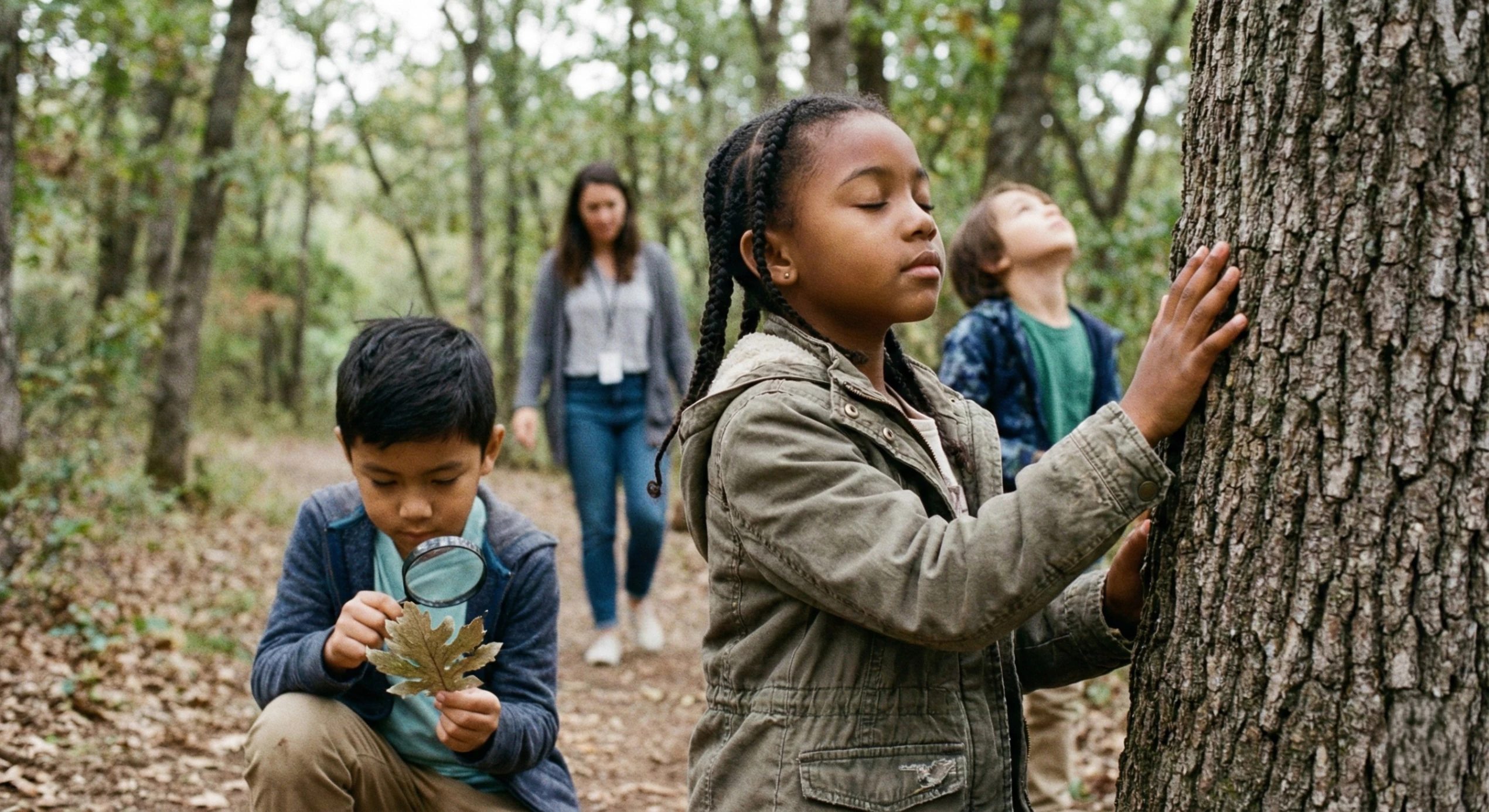
Fresh air is a natural antidote to anxiety. Sensory walk ideas are excellent because they move mindfulness out of the head and into the body.
The Activity: Take your class (or the whole grade level) for a 10-minute walk around the school grounds. The only rule? Absolute silence.
Instruct students to find:
5 things they see: (e.g., a specific cloud shape, a bug, a crack in the pavement).
4 things they hear: (e.g., wind in trees, distant cars, footsteps).
3 things they feel: (e.g., sun on their face, the texture of their sweater).
Why It Works: This grounding technique forces the brain to switch from "worry mode" (thinking about the future) to "sensing mode" (living in the present), making it a top choice for school mental health activities.
Classroom-Based Mindfulness Activities
These ideas are perfect for transitions like coming in from recess or switching subjects.
3. Five-Finger Breathing (Starfish Breathing)
If you are looking for mindful breathing exercises for kids that they can do anywhere (even during a test), this is the gold standard.
How to Do It:
Have students hold up one hand, spreading fingers wide like a starfish.
With the index finger of the other hand, start at the base of the thumb.
Inhale deeply through the nose while tracing up the thumb.
Exhale slowly through the mouth while sliding down the other side.
Repeat for all five fingers.
Why It Works: It combines physical touch with breath control. This multi-sensory approach is one of the best calming activities for anxious students because it gives them a physical anchor when their mind feels floaty or panicked.
4. The Gratitude Jar
Mindfulness isn’t just about emptying the mind; it’s about orienting it toward the positive. Gratitude activities for students are scientifically proven to boost serotonin.
The Setup:
Place a clear jar on your desk.
Hand out small slips of paper.
The Prompt: "Close your eyes. Take three deep breaths. Think of one thing—big or small—that made you smile today."
Have them write it down and fold it into the jar.
The Payoff: Read three slips aloud at the end of the day. It ends the school day on a high note, regardless of what happened during math class.
5. The "Bell Listening" Challenge
Do you struggle to get the class to settle down? This exercise turns quiet time into a game, making it one of the most effective classroom mindfulness activities for energetic groups.
The Activity: You will need a singing bowl, a triangle, or a phone app that plays a gong sound.
Tell students: "I’m going to ring this bell. It will make a long sound."
"Your job is to listen like a detective."
"Raise your hand the exact second you can no longer hear the sound."
Why It Works: It forces students to concentrate intensely on an auditory signal. To hear the faint end of the chime, they have to stop talking and stop fidgeting. It instantly resets the room's volume.
6. Mindful Eating Experience
This is often the most memorable activity for students. It transforms a mundane act into a meditation.
The Process: Give each student a raisin, a grape, or a small square of chocolate. Ask them to wait.
See: Look at the food. Examine the wrinkles or the shine.
Smell: Hold it to their nose. What does it scent like?
Touch: How does it feel in the hand?
Taste: Place it on the tongue. Don't chew yet. Notice the urge to swallow.
Chew: Finally, chew slowly and swallow.
Teacher Tip: This is great for discussing "impulse control" with students. It teaches them to respond rather than react.
Active & Creative Brain Breaks
Not all meditation requires sitting still. In fact, for many kids, movement is their meditation.
7. Mindful Coloring
Art is a gateway to the "flow state." Mindful coloring is a fantastic SEL activity for quiet time or for students who finish work early.
The Activity: Provide "Mandala" sheets (circular geometric patterns). Play some lo-fi beats or classical music. Give students 15–20 minutes where the only goal is to stay within the lines and focus on the colors.
Why It Works: Repetitive motions like coloring lower activity in the amygdala (the brain’s fear center). It allows the brain to rest without zoning out completely.
8. Yoga for the Classroom (Chair Yoga)
You don’t need gym mats or athletic wear. Yoga for the classroom is accessible to everyone and helps release the physical tension of sitting at a desk.
Try this 3-minute sequence:
The Seated Mountain: Feet flat on the floor, spine straight, hands on knees. Breathe.
Shoulder Rolls: Inhale shoulders up to ears, exhale roll them down the back.
The Twist: Right hand on left knee, gently look over the left shoulder. Switch.
This acts as a physical reset button and helps improve student focus for the next lesson.
9. Cloud Busting Visualization
This is a classic 5-minute meditation for students. It teaches them that they are not their thoughts; they are the observer of their thoughts.
The Script: "Lay your head on your desk or lie on the floor. Close your eyes. Imagine your mind is the big, blue sky. Now, imagine your thoughts are clouds. Some are fluffy and white (happy thoughts), some are grey and heavy (worries). Don’t try to grab the clouds. Don’t try to push them away. Just watch them float by. You are the sky, not the clouds."
Don't Forget the Educators
We cannot have regulated students with dysregulated teachers. Teacher wellbeing is the foundation of a healthy school ecosystem.
10. The Teacher Decompression Zone
For World Meditation Day, the administration or the PTA should create a sanctuary for staff.
The Idea: Designate the staff room or a corner of the library as a "Quiet Zone."
Ambiance: Dim the lights. Use battery-operated candles.
Senses: A diffuser with lavender or eucalyptus oil.
The Rule: No grading, no complaining about students, no shop talk.
Encourage staff to take just 10 minutes here. Reducing teacher stress is the fastest way to support reducing classroom anxiety overall.
Making It Stick Beyond 2025
World Meditation Day 2025 is a fantastic launchpad, but the real magic happens in the days that follow. You don’t need to overhaul your curriculum. Just pick two of these ideas maybe the Gratitude Jar on Fridays and Starfish Breathing before tests and make them routine.
By integrating these simple brain breaks for kids, you aren't taking time away from learning; you are creating the conditions for learning to happen.