
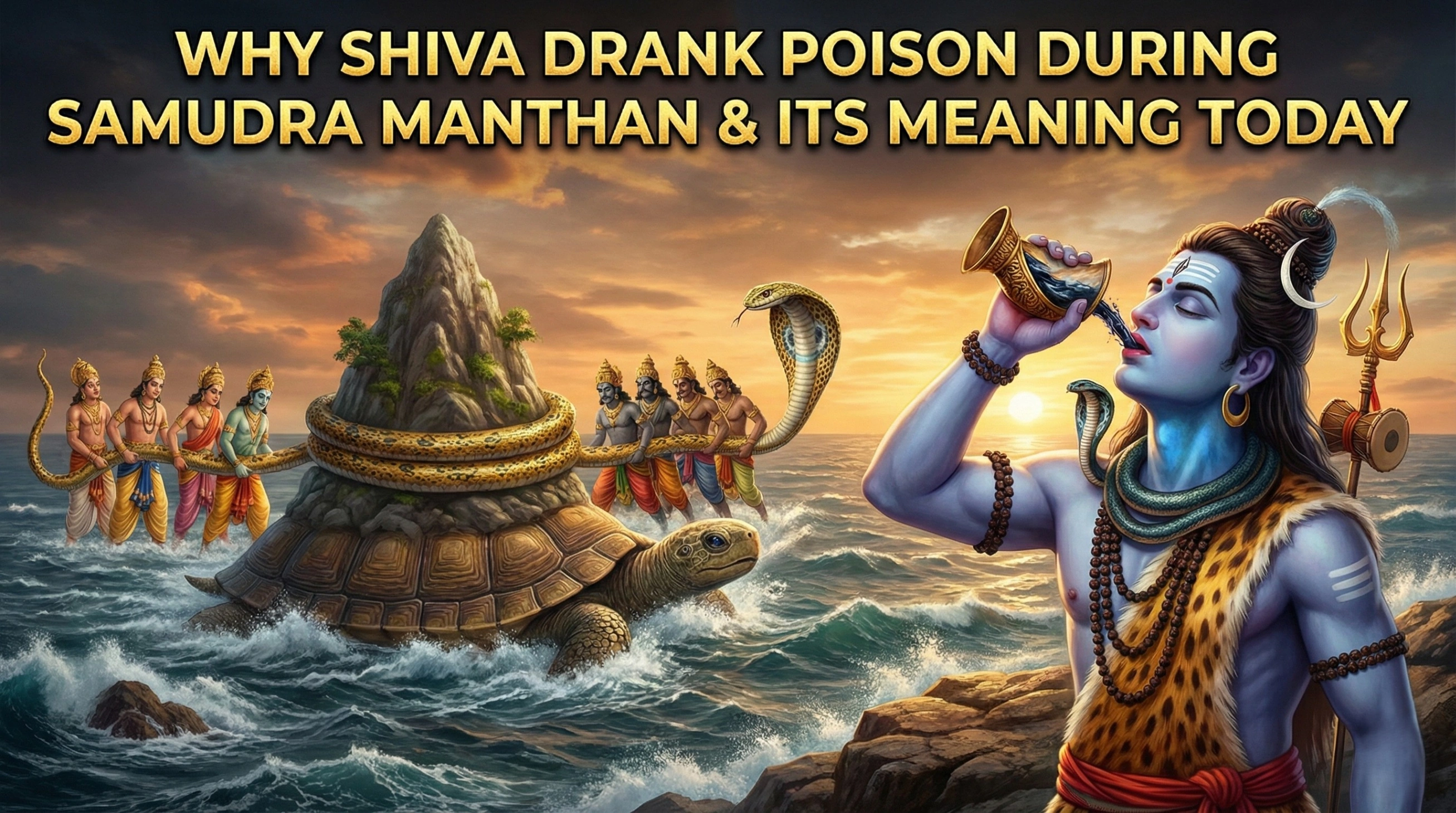
Why Lord Shiva drank poison during the Samudra Manthan is one of the most powerful and misunderstood stories in Hindu philosophy. When the ocean of milk was churned in the great cosmic event known as Samudra Manthan, what emerged was not only divine nectar but also halahal poison, capable of destroying all creation. At that critical moment, Shiva drank the poison to save the universe; an act that transformed him into Neelkanth, the blue-throated one.
But this story is far more than mythology. The spiritual meaning of Shiva drinking poison holds deep relevance even today about responsibility, balance, sacrifice, and how to deal with negativity in life.
What Is Samudra Manthan?
Samudra Manthan, literally meaning churning of the ocean, is one of the most significant events in Hindu scriptures. Devas (gods) and Asuras (demons) came together to churn the cosmic ocean to obtain amrit, the nectar of immortality.
Using Mount Mandara as the churning rod and Vasuki, the serpent, as the rope, the churning began. While the goal was divine nectar, the process brought out both good and destructive forces— a crucial lesson in itself.
When Poison Emerged During Samudra Manthan
Before amrit appeared, a deadly poison called halahal surfaced. This poison was so potent that its fumes alone could annihilate the universe. Panic spread across the cosmos. Neither Devas nor Asuras could handle it.
This moment answers a key question people often search for:
“Poison came out during Samudra Manthan— why?”
The deeper meaning is clear: when you churn life deeply through effort, ambition, or transformation both nectar and poison emerge.
Why Did Lord Shiva Drink the Poison?
When no one could contain the poison, all beings turned to Shiva.
Shiva chose to drink the poison not for personal glory, immortality, or power but out of pure compassion and responsibility. He did not swallow it fully; instead, he held it in his throat. Parvati placed her hand around his neck to prevent it from spreading, turning his throat blue.
This is why Shiva is called Neelkanth.
So when people ask:
Why only Shiva drank poison?
Why Shiva did not die after drinking poison?
The answer lies in his nature. Shiva represents detachment, mastery over self, and balance between destruction and creation.

The Meaning of Neelkanth: Shiva’s Blue Throat Explained
The blue throat of Shiva is not just a physical marker; it’s a symbol.
Poison stayed in the throat, not the heart or stomach → Shiva did not internalize negativity.
He held it consciously, without letting it spread.
He neither rejected the poison nor allowed it to consume him.
The significance of Neelkanth Shiva teaches us a profound life lesson:
You cannot avoid negativity in life, but you can choose where it stays.
Spiritual Meaning of Shiva Drinking Poison
The spiritual meaning of Shiva drinking poison goes far beyond mythology.
1. Holding Responsibility Without Complaining
Shiva didn’t create the poison, yet he took responsibility for it. This reflects leadership at the highest level—taking charge when chaos arises.
2. Not Passing Negativity Forward
Shiva absorbed the poison so others could live. In modern life, this reflects emotional maturity not transmitting pain, anger, or trauma further.
3. Balance Between Action and Detachment
Shiva acted when needed, but remained inwardly detached. This is the essence of yogic wisdom.
Symbolism of Shiva Drinking Poison in Modern Life
The symbolism of Shiva drinking poison is extremely relevant today.
Stress
Toxic work environments
Emotional burdens
Social pressure
Just like Samudra Manthan, modern life constantly churns. Poison inevitably emerges.
Shiva teaches us:
Face negativity consciously
Do not suppress, but do not spread it either
Hold it with awareness until it dissolves
What Shiva Drinking Poison Teaches Us
If you wonder what Shiva drinking poison teaches us, here are the key lessons:
Strength is calm, not aggression
True sacrifice is silent
Leadership is responsibility, not dominance
Inner mastery matters more than outer control
Shiva did not run away from poison. He also did not let it define him.
Why Shiva Did Not Drink Amrit
An often overlooked question: Why didn’t Shiva drink amrit instead?
Because Shiva is beyond fear of death. Immortality was never his pursuit. His role is cosmic balance—not personal gain.
This contrasts sharply with modern ambition, where people chase rewards but avoid responsibility.
Lesson from Samudra Manthan for Today
The lesson from Samudra Manthan is simple yet powerful:
Growth brings challenges
Transformation releases toxicity
Someone must hold space for chaos
In families, organizations, and societies, Shiva energy is about holding the difficult so others can thrive without ego.
Shiva’s Sacrifice Meaning in Daily Life
The meaning of Lord Shiva’s sacrifice is not self-destruction. It is conscious acceptance.
He did not become bitter
He did not demand worship
He did not seek validation
That is why Shiva remains the ultimate yogi.
Why This Story Matters Today More Than Ever
In a world overloaded with noise, outrage, and emotional toxicity, Shiva’s poison story is a guidebook.
Don’t absorb negativity into your identity
Don’t pass it to others
Hold it at the level of awareness
That is real strength.
Planning to observe Maha Shivaratri this year? Explore our detailed guide on Maha Shivaratri 2026, covering the date, importance of the night, step-by-step puja vidhi, and fasting rules for devotees.
Read here: Maha Shivaratri 2026: Date, Significance, Puja Vidhi & Fasting Rules