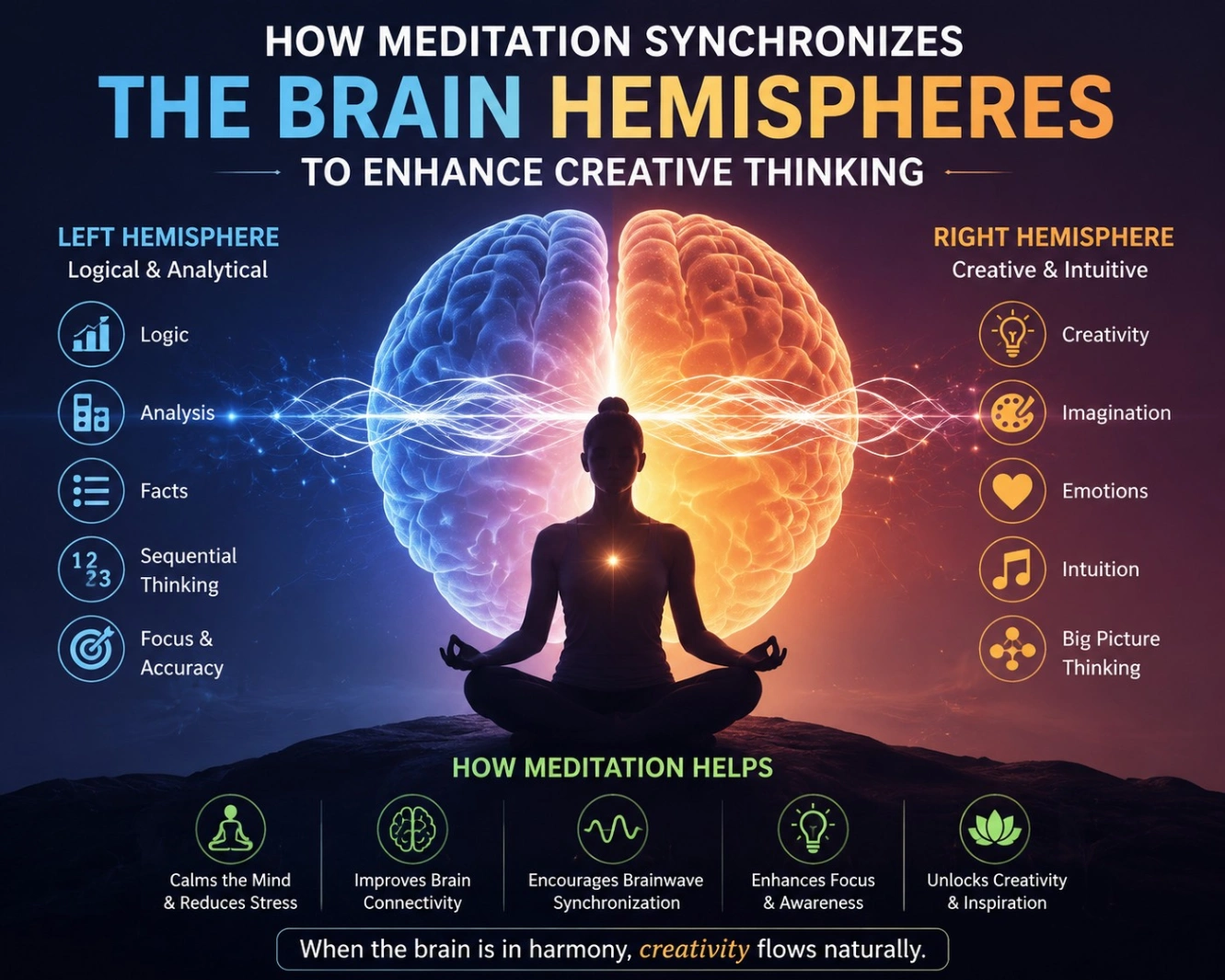


What happens to your brain when you meditate? It does not suddenly become silent, perfect or immune to stress. Instead, meditation gives the brain repeated practice in noticing where attention has gone and returning to the present. This simple mental exercise is why the benefits of meditation are now studied in psychology, clinical research and neuroscience.
The neuroscience of meditation is still developing, and researchers are careful not to overstate what brain scans can prove. Yet the evidence suggests that mindfulness meditation may support attention, stress management, emotional regulation and sleep for some people. Think of it less as instant “brain rewiring” and more as a learnable habit that creates a little more pause, clarity and choice.

Meditation, Mindfulness and the Brain
Meditation is not one single practice. Focused-attention meditation may use the breath, a sound, a visual point or a mantra. Mindfulness involves paying attention to the present moment, including thoughts, emotions and body sensations, without immediately judging them. Guided meditation, body scans, loving-kindness practice and mindful movement are also common types of meditation.
This distinction matters. The phrase meditation and brain can make the practice sound mysterious, but you are not trying to stop all thoughts. You are learning to recognise distraction, worry or planning, and gently return to an anchor. That return is the training. Over time, it may support meditation for focus, meditation for concentration, self awareness and mental clarity.
Design Your Destiny
Your mind can become your greatest ally. Begin your journey with Design Your Destiny and discover practical tools for greater awareness, emotional balance, inner peace and purposeful living.
Start Your JourneyHow Meditation Changes the Brain
The best explanation for how meditation changes the brain is to think in networks, not in one magical “meditation centre.” Neuroimaging studies examine areas and networks involved in attention, awareness of body sensations, self-referential thought and emotional regulation. Research on long-term mindfulness programmes has explored frontal areas linked with attention, the cingulate cortex and insula, the amygdala, and frontoparietal networks connected with emotional regulation.
The meditation prefrontal cortex connection is often discussed because this region helps direct attention and regulate behaviour. But it is too simplistic to say that meditation activates one brain area and solves every problem. The effects of meditation on the brain vary with the technique, the person, the setting and the consistency of practice.
In daily life, the takeaway is useful: each time you notice your mind has wandered and return to the breath, you practise attention control. This can make meditation benefits for students especially practical. It may support a steadier study routine, but it does not replace sleep, revision, treatment or healthy daily habits.
Meditation, Mind Wandering and Overthinking
Sitting quietly can reveal just how quickly the mind plans, replays conversations and predicts the future. That does not mean you are bad at meditation. It means you are becoming aware of mental activity rather than being completely carried away by it.
Studies of mindfulness often examine the default mode network because it is linked with self-referential thinking and mind wandering. Mindfulness meditation gives you a chance to observe, “I am having the thought that I will fail,” instead of instantly treating that thought as a fact. This is why meditation for overthinking can be so valuable. The aim is not to eliminate thoughts. It is to create distance from them and respond with greater intention.
Meditation for peace of mind, then, is not about a blank mind. It is about a less automatic relationship with mental noise.
The Amygdala, Stress Response and Emotional Balance
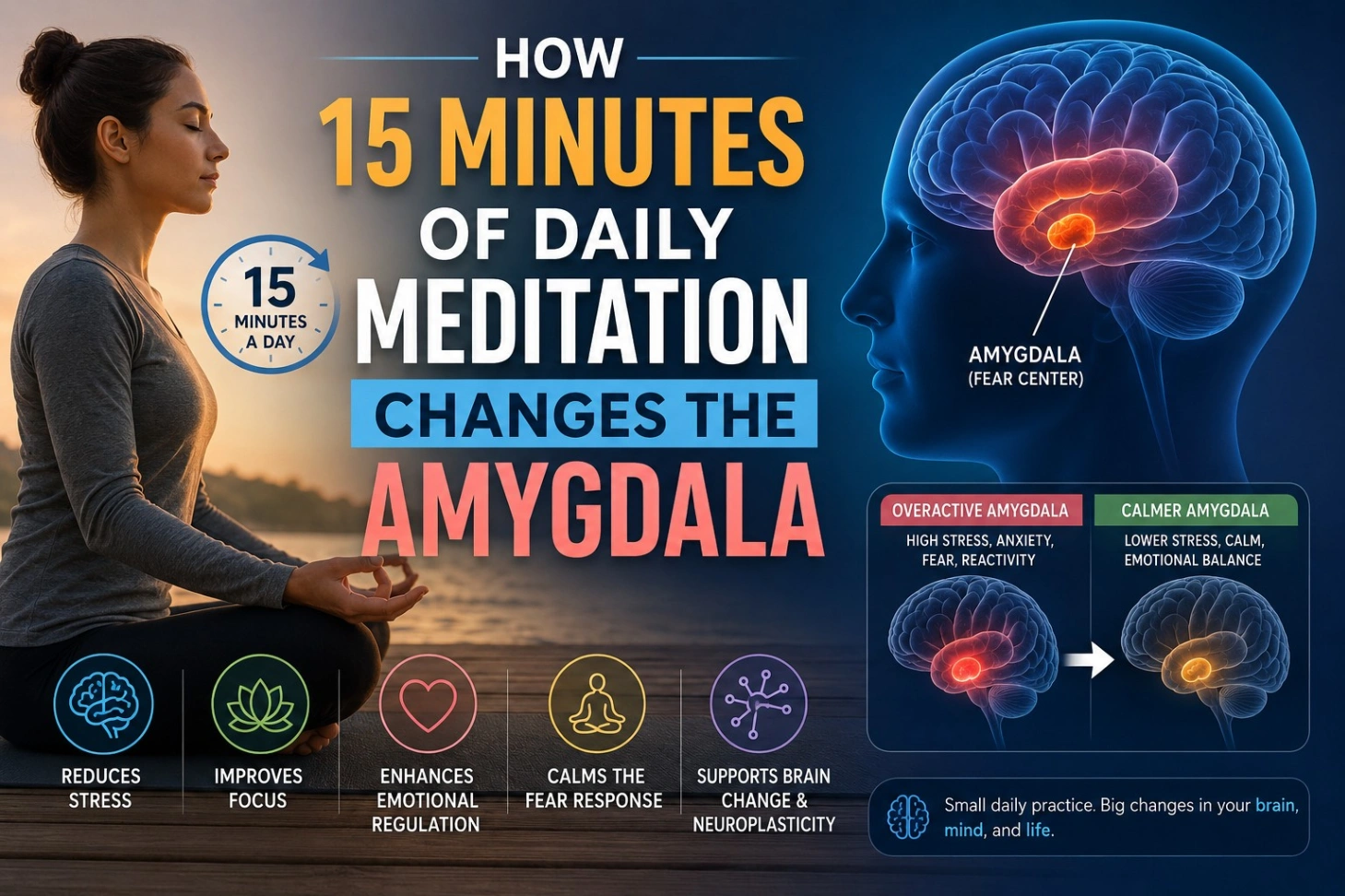
The amygdala helps the brain detect emotionally important or threatening information. That is why meditation and amygdala research receives so much attention. But meditation does not “switch off” the amygdala, nor should it. You need a functioning alarm system. What mindfulness may support is a more flexible response to stress.
Meditation for stress can create a pause between a trigger and your reaction. You may notice a tight chest, racing thoughts or irritation before sending a message, making a decision or entering an argument. A few slower breaths, awareness of the body or a moment of stillness may not remove the situation, but it can give you space to choose your next step.
These mindfulness benefits matter for emotional health. A large review found that mindfulness meditation programmes showed moderate evidence of improving anxiety, depression and pain outcomes, while the wider evidence base remains mixed across methods and populations. For people seeking meditation for anxiety or meditation for mental health, meditation is best viewed as a supportive practice, not a guaranteed cure or substitute for professional care.
Does Meditation Rewire the Brain? The Truth About Neuroplasticity
Does meditation rewire the brain? The honest answer is that meditation may contribute to neuroplasticity, but “rewiring” is a metaphor, not a promise. Neuroplasticity is the brain’s capacity to adapt through learning, experience and repeated behaviour.
Some imaging studies report structural or functional differences in experienced meditators and in people after mindfulness-based training. Researchers have examined areas related to attention, interoception, memory and emotion regulation. At the same time, systematic reviews point to small samples, inconsistent methods and possible bias in parts of this research. That is why claims about guaranteed brain changes after meditation, thicker brains or a fixed transformation timeline should be treated cautiously.
A more useful way to understand meditation and neuroplasticity is behavioural. Repeatedly pausing, noticing and returning to the present makes that response more familiar. How meditation rewires your brain is less like overnight transformation and more like creating a pathway that becomes easier to use when life becomes difficult.

Can Meditation Improve Brain Function, Memory and Concentration?
Can meditation improve brain function? It may support certain attention and self-regulation skills, but “brain function” is too broad for a universal promise. Meditation and memory are connected because attention shapes what you take in. It is difficult to remember a lecture, book or conversation when your mind is somewhere else.
Meditation for concentration is not about forcing yourself to focus for hours. It is about practising the cycle of notice, return and continue. This makes daily meditation benefits more realistic. A five- or ten-minute practice most days can be more useful than one long session every few weeks.
Try using mindfulness before activities that require attention. Take three breaths before opening your laptop, begin a study session with a one-minute body check, or pause before a difficult conversation. These small practices build mental clarity without requiring a dramatic routine.
Meditation for Sleep, Calm and Inner Peace
When the body is tired but the mind is still active, meditation for sleep can become a calming part of a wind-down routine. Mindfulness meditation may reduce insomnia symptoms and improve sleep quality for some people, though it is not more effective than established approaches such as cognitive behavioural therapy or exercise.
Keep the routine simple. Dim lights, move away from the phone, try a short body scan or listen to a guided meditation. You are not trying to force sleep. You are inviting the body to slow down and allowing thoughts to pass without solving every problem at midnight.
Meditation and brain waves are often oversimplified online. No single alpha or theta pattern proves that a person has reached a perfect meditative state. A more meaningful measure is whether practice helps you settle attention, recognise emotions and act with more awareness.
How to Meditate for Beginners
Meditation for beginners does not require special clothing, a silent room or an hour of free time. Start with five minutes.
Sit in a comfortable but alert position. Choose an anchor, such as your natural breath, sounds around you or sensations in your feet. Notice one breath at a time. When thoughts pull you away, quietly name the experience, such as “thinking” or “planning,” and come back to the anchor.
That is how to meditate. The mind wandering is not the failure. The return is the practice. A guided meditation may be helpful when you are just starting because it offers a gentle structure.

How Long Does Meditation Take to Change the Brain?
There is no honest one-size-fits-all answer to how long meditation takes to change the brain. Some research studies structured programmes lasting several weeks, while others examine people with years of experience. Your experience may look different from someone else’s.
Look for small changes over time rather than chasing a perfect feeling after each session. You may catch overthinking earlier, pause before reacting, return to work more easily or sleep with less mental noise. These practical shifts are often more important than trying to measure your meditation brain benefits.
What happens to your brain when you meditate is not magic and not a single event. Meditation practises attention, present-moment awareness and emotional regulation. The scientific benefits of meditation are promising for stress, anxiety, focus, sleep and emotional balance, but they differ from person to person.
Start small, choose a practice you can repeat and let consistency matter more than performance. The benefits of meditation according to neuroscience become most meaningful when they help you live with a little more calm, clarity and inner peace.
Personal Session
When life feels confusing or emotionally heavy, a personal session can bring you back to clarity. Receive one-to-one guidance to understand your challenges, reconnect with yourself and move forward with greater calm and direction.
Book Now