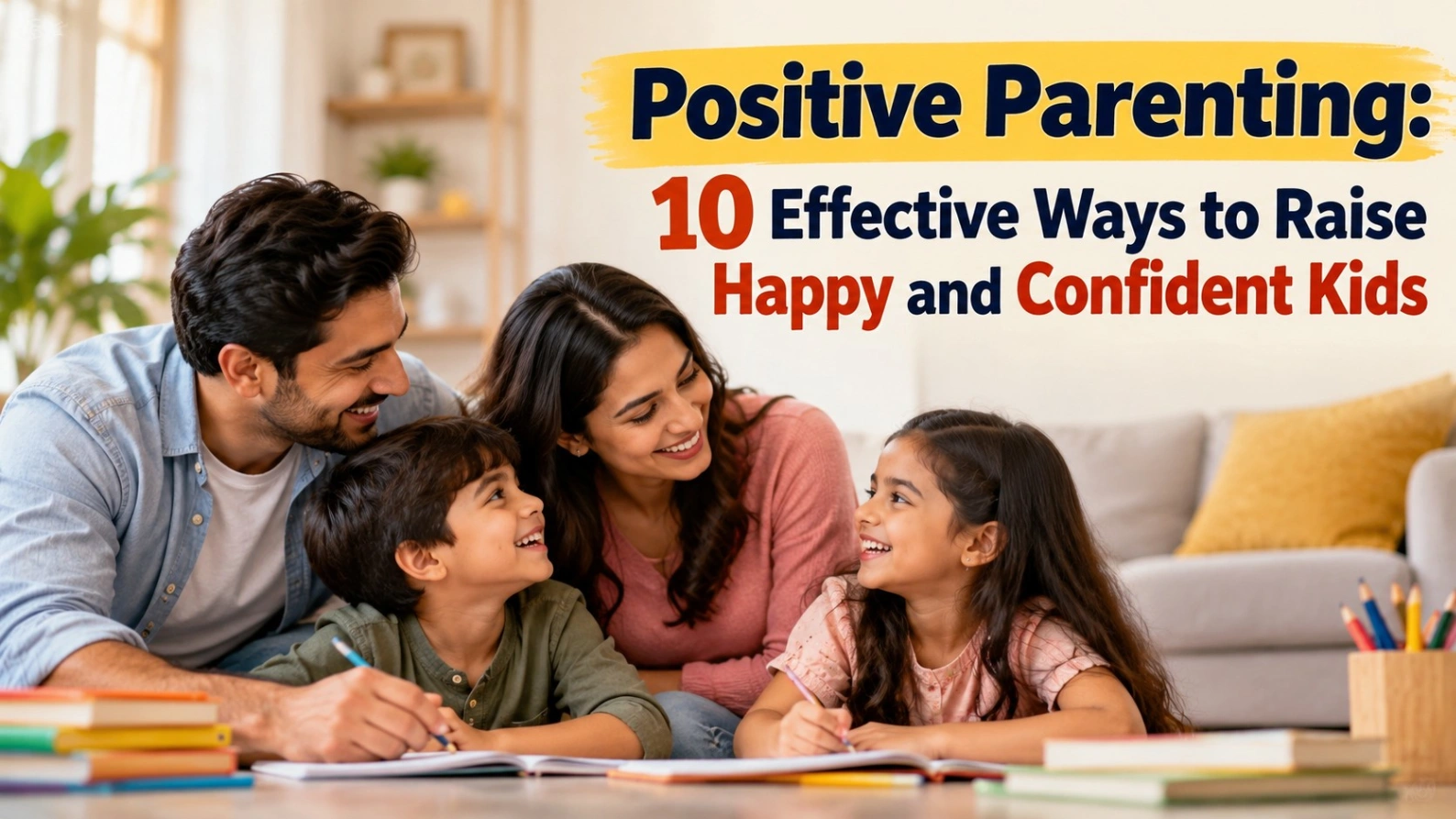
Every parent wants their child to grow up happy, confident, emotionally strong and capable of making good decisions. But raising a confident child is not about making life easy for them, praising everything they do or protecting them from every disappointment.
Positive parenting is about creating a safe, loving and respectful relationship in which children are guided with clear expectations while also being encouraged to think, communicate, solve problems and gradually become independent.
Current child-development guidance describes parenting as a process that nurtures, protects and guides children while preparing them for independence. A safe and loving home, predictable responses, conversation, play, reading, healthy routines and supportive relationships all contribute to healthy development.
UNICEF similarly describes positive parenting as an approach in which children learn best when they feel loved, safe and understood rather than frightened into obedience.
So, how can parents put this into practice every day?
Here are 10 effective positive parenting strategies to raise happy and confident kids.
What Is Positive Parenting?
Positive parenting is an approach that combines warmth, connection, guidance and healthy boundaries.
It does not mean allowing children to do whatever they want.
Instead, parents communicate expectations clearly, respond consistently, listen to their children and teach behaviour rather than relying only on fear, shame or punishment.
The ultimate goal is not simply to create an obedient child.
It is to raise a child who gradually learns:
how to understand emotions
how to make decisions
how to solve problems
how to respect boundaries
how to recover from mistakes
how to communicate effectively
how to become independent
CDC guidance specifically describes parenting as preparing children for independence as they grow.
1. Build Connection Before Correction
Children are more likely to listen and cooperate when they feel emotionally connected to their parents.
That does not mean every behaviour should be accepted. It means that before correcting a child, parents should try to understand what is happening underneath the behaviour.
A child who is shouting may be tired.
A child refusing homework may be overwhelmed.
A toddler having a tantrum may not yet have the language to explain frustration.
Connection might look as simple as saying:
“I can see you're upset.”
“Tell me what happened.”
“I'm listening.”
Once children feel heard, they are often more receptive to guidance.
Strong communication supports secure parent-child relationships, and CDC guidance recommends active listening, giving children full attention and acknowledging their feelings.
Connection should not replace boundaries. It simply creates a healthier foundation for enforcing them.
Design Your Destiny
Parenting shapes far more than behaviour—it influences how children eventually see themselves, relationships and the world around them. When parents become more aware of their own reactions and patterns, they create space for children to grow with greater confidence and emotional security.
Start Your Journey Today!2. Listen to Your Child Without Immediately Judging
One of the simplest positive parenting techniques is also one of the hardest: listen fully.
Parents often rush to give advice, correct facts or solve the problem.
Sometimes children simply need to be heard first.
When your child tells you something difficult, avoid immediately responding with:
“That is silly.”
“You're overreacting.”
“Why did you do that?”
“There's nothing to be upset about.”
Instead, try:
“That sounds difficult.”
“What happened next?”
“How did that make you feel?”
“What do you think you could do now?”
This helps children learn that their feelings can be discussed safely.
CDC guidance recommends active listening and reflecting children's feelings as ways to strengthen connection and help them feel safe.
Over time, children who feel comfortable talking to their parents are more likely to communicate openly about friendships, school pressure, mistakes and difficult experiences.
3. Praise Effort, Not Only Results
Children naturally enjoy praise.
But the type of praise parents give matters.
If children constantly hear:
“You are so smart.”
“You are the best.”
“You always win.”
they may begin to believe that their value depends on always performing well.
Instead, notice effort, persistence and improvement.
Say:
“You kept trying even when that was difficult.”
“I noticed how carefully you worked on that.”
“You made a mistake and tried again.”
“That took patience.”
The American Academy of Pediatrics' HealthyChildren guidance recommends recognising children's effort as well as achievement when supporting healthy self-esteem.
This helps children understand that success is not only about being naturally talented.
Effort, learning, persistence and problem-solving matter too.
4. Give Children Age-Appropriate Choices
Children develop confidence when they experience a healthy sense of control over their lives.
That does not mean letting a five-year-old decide everything.
It means offering choices that are appropriate for their age.
For example:
“Would you like the blue shirt or the green shirt?”
“Would you like to do homework before your snack or after?”
“Would you rather tidy your books or toys first?”
Older children may be involved in larger decisions about activities, study schedules or responsibilities.
HealthyChildren identifies age-appropriate decision-making as one of the building blocks of self-esteem because it helps children feel capable of influencing important parts of their lives.
Choices also reduce unnecessary power struggles.
Parents still define the boundaries, while children practise decision-making within those boundaries.
5. Encourage Independence
Confidence grows from experience.
If parents constantly do everything for children because it is faster or easier, children may miss valuable opportunities to discover what they can handle themselves.
Depending on age, children can learn to:
put toys away
dress themselves
pack a school bag
prepare a simple snack
help set the table
manage homework
complete household tasks
solve small problems independently
HealthyChildren recommends giving young children responsibilities such as putting away toys or helping with household tasks, noting that independence develops through practice.
Parents should remain available when help is genuinely needed.
The goal is not to say, “You're on your own.”
The message should be:
“I believe you can try. I'm here if you need help.”
That combination of independence and support builds genuine confidence.
Navratri Day 6:Maa Katyayani Puja Vidhi,Story & Significance
6. Set Clear and Consistent Boundaries
Positive parenting is sometimes misunderstood as permissive parenting.
It is not.
Children actually benefit from knowing where boundaries are.
Clear expectations create predictability.
Instead of constantly changing rules depending on mood, decide which family expectations genuinely matter.
For example:
“We speak respectfully.”
“We put screens away during dinner.”
“We finish responsibilities before gaming.”
“We do not hit when we are angry.”
The consequence should ideally relate to the behaviour and focus on teaching rather than humiliation.
A child who throws a toy may temporarily lose access to the toy.
A teenager who repeatedly ignores an agreed screen limit may need a revised device schedule.
Children need both warmth and structure.
Positive parenting works best when empathy and limits exist together.
7. Teach Children to Understand Their Emotions
Emotionally confident children are not children who never become angry, disappointed or afraid.
They are children who gradually learn what to do with those emotions.
Parents can help by naming feelings.
“You seem disappointed.”
“You're frustrated because the game ended.”
“You were nervous before your presentation.”
Then help children distinguish between feelings and behaviour.
“You're allowed to feel angry. You cannot hit someone because you're angry.”
This is a powerful lesson.
It teaches children that emotions themselves are not bad, but they are responsible for learning healthy ways to express them.
Listening, reflecting feelings and creating emotional safety are consistent with CDC recommendations for positive parent-child communication.
Parents can also model healthy coping by saying:
“I'm frustrated, so I'm going to take a few minutes before we continue this conversation.”
Children learn emotional regulation partly by watching adults regulate themselves.
8. Allow Your Child to Make Safe Mistakes
It can be painful for parents to watch children fail.
The instinct is often to rescue them immediately.
But mistakes are essential for learning confidence.
A child may forget homework.
Lose a game.
Struggle with a project.
Make a poor decision.
Have an argument with a friend.
When parents solve every problem instantly, children may learn:
“I need someone else to fix things for me.”
Instead, ask:
“What happened?”
“What did you learn?”
“What could you do differently next time?”
“What do you think your options are?”
Healthy self-esteem develops partly through problem-solving, independence and learning consequences. HealthyChildren specifically recommends giving children opportunities to reason, problem-solve and consider the outcomes of their choices.
Of course, parents should intervene when safety is involved.
But everyday mistakes can become powerful teaching moments.
9. Spend Regular One-on-One Time Together
Children do not always need elaborate outings or expensive experiences.
They need attention.
Even 10 or 15 minutes of focused connection can matter.
You might:
read together
walk together
cook
play a game
talk before bedtime
draw
listen to music
sit together without phones
The important part is presence.
CDC child-development guidance highlights family activities such as playing, talking, singing and reading as valuable parts of children's healthy development.
Try to occasionally let the child choose the activity.
This communicates:
“You are important enough for me to give you my attention.”
That feeling of security becomes part of the foundation of confidence.
10. Model the Behaviour You Want to See
Children pay close attention to how adults behave.
If parents constantly tell children to remain calm while shouting themselves, children notice.
If parents demand respect but regularly insult others, children notice.
If parents expect children to apologise but never apologise themselves, children notice.
One of the most powerful positive parenting strategies is therefore simply to model what you hope your child develops.
If you make a mistake, say:
“I was too harsh earlier. I'm sorry.”
If you are stressed, show healthy coping.
If you disagree with someone, demonstrate respectful communication.
If you fail, let your child see you try again.
Parents do not need to appear perfect.
In fact, seeing adults make mistakes, accept responsibility and repair relationships can teach children something far more useful than perfection ever could.
Vaikunth Chaturdashi: Why Are Vishnu & Shiva Worshipped Together?
How Positive Parenting Builds Confidence
Confidence is not created through endless compliments.
Real confidence comes from repeated experiences of thinking:
“I am loved even when I make mistakes.”
“I can learn difficult things.”
“My voice matters.”
“I can solve problems.”
“I can ask for help.”
“I can recover when something goes wrong.”
“I am responsible for my choices.”
Positive parenting creates the conditions in which these beliefs can grow.
UNICEF notes that positive parenting can support children's self-esteem by encouraging open conversations about thoughts, beliefs and feelings.
Positive Parenting Does Not Mean Perfect Parenting
No parent remains patient every day.
Parents become tired.
They get frustrated.
They misunderstand situations.
They sometimes respond too quickly.
Positive parenting is not about eliminating every mistake.
It is about how families respond afterward.
Parents can repair.
They can apologise.
They can revisit the conversation.
They can say:
“I didn't handle that very well. Can we try again?”
This teaches children an important truth: strong relationships do not require perfection. They require honesty, accountability and repair.
What Parents Should Avoid
Certain habits can slowly weaken children's confidence if they become frequent patterns.
These include:
constant comparison with siblings or classmates
humiliating children publicly
labelling them as “lazy,” “bad” or “stupid”
doing everything for them
expecting perfection
ignoring their emotions
using fear as the primary method of discipline
making love or approval feel conditional on achievement
Instead of saying:
“Why can't you be like your brother?”
try:
“Let's focus on what you can improve.”
Instead of:
“You always mess everything up.”
try:
“That didn't work. Let's think about what you can try next.”
Language becomes part of the way children eventually speak to themselves.
Positive Parenting by Age
Positive parenting changes as children develop.
A toddler needs simple language, routines and immediate guidance.
A school-age child can handle more responsibility, choices and problem-solving.
A teenager needs increasing independence, privacy and opportunities to participate in meaningful decisions.
The CDC therefore provides positive parenting guidance by developmental stage rather than treating every child the same.
The principle remains consistent:
Give children the combination of connection, guidance and age-appropriate independence they need at their current stage.
10 Positive Parenting Tips at a Glance
1. Connect before correcting
Help children feel understood before discussing behaviour.
2. Listen without immediate judgement
Create space for honest communication.
3. Praise effort and persistence
Do not focus only on winning or results.
4. Offer age-appropriate choices
Give children healthy opportunities to make decisions.
5. Encourage independence
Let children practise doing things themselves.
6. Maintain clear boundaries
Warmth and structure should work together.
7. Teach emotional skills
Help children name, understand and manage feelings.
8. Allow safe mistakes
Use setbacks as opportunities for learning.
9. Spend focused time together
Connection does not need to be complicated.
10. Model what you teach
Children learn enormously from watching adults.
Personal Session
Every family is different, and sometimes general parenting advice does not address the deeper patterns affecting communication, relationships or emotional well-being. A personal session can provide space to explore your individual concerns, recurring patterns and challenges with greater depth and awareness.
Book Now
Read Latest Articles
9 Colour of Navratri 2026: DayWise List, Date & Significance
Bhai Dooj Date: Tilak Muhurat, Puja Time & Complete Vidhi
Frequently Asked Questions
Q.What is positive parenting?
Positive parenting is an approach that combines warmth, communication, clear boundaries and age-appropriate independence. Parents focus on guiding and teaching children rather than relying primarily on fear or punishment. It helps children feel safe and understood while gradually developing confidence, emotional regulation, problem-solving skills and independence.Q.How can I raise a confident child?
Give your child opportunities to make age-appropriate decisions, solve problems, try independently and recover from mistakes. Praise genuine effort rather than only outcomes.Q.Does positive parenting mean no discipline?
No. Positive parenting still requires clear rules, expectations and consequences. The difference is that discipline focuses more on teaching appropriate behaviour than creating fear.Q.How can parents build children's self-esteem?
Listen to children, recognise their effort, give meaningful responsibilities, offer appropriate choices and help them develop real skills. HealthyChildren identifies decision-making, independence, self-control and encouragement as important building blocks of self-esteem.Q.Should parents praise children often?
Praise can be useful when it is genuine and specific. Try praising effort, persistence, kindness and improvement rather than giving constant general praise.Q.How can I help my child become independent?
Give age-appropriate responsibilities and resist doing tasks your child can reasonably learn to do. Provide guidance when needed while allowing practice.Q.How should parents deal with children's emotions?
Listen, acknowledge the feeling and then guide behaviour. Children can learn that every emotion is valid, while not every behaviour is acceptable.