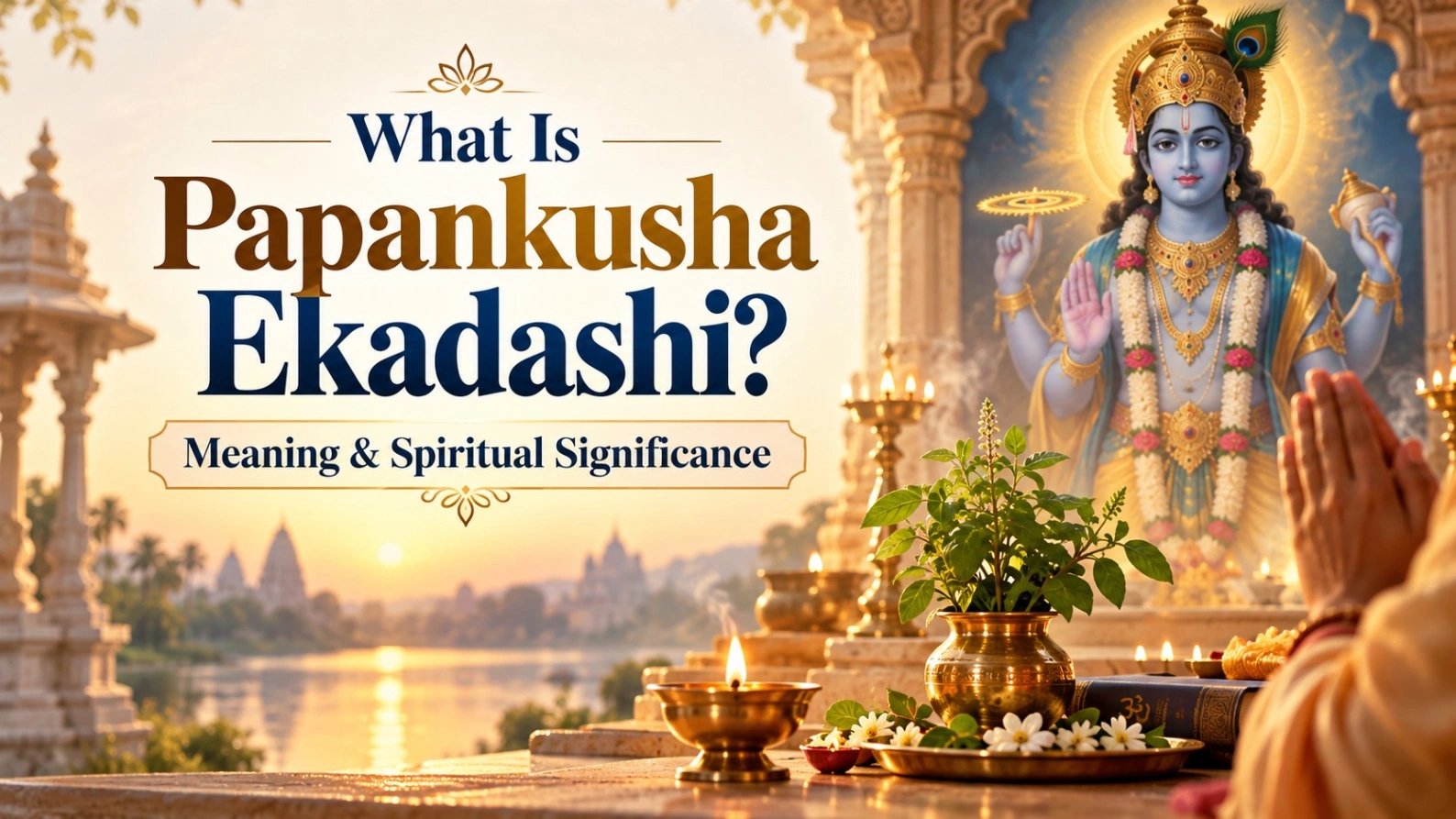
Papankusha Ekadashi is a sacred Hindu fasting day dedicated to Lord Vishnu. It is observed on the Ekadashi Tithi of Shukla Paksha in the Hindu month of Ashwin, or the eleventh lunar day of the waxing phase of the Moon. The day is associated with spiritual purification, self-discipline, devotion and freedom from negative actions and tendencies.
In 2026, Papankusha Ekadashi will be observed on Thursday, October 22. Since Ekadashi dates and Parana timings are based on lunar calculations and sunrise, devotees should follow a Panchang calculated for their location for exact timings.
But Papankusha Ekadashi is much more than simply abstaining from food for a day. Its deeper spiritual message is about learning to control the tendencies that lead a person away from truth, awareness and dharma.
The word Papankusha itself reveals this meaning. It is traditionally understood through two Sanskrit-derived words: “Papa,” meaning sin or wrongful action, and “Ankusha,” meaning a goad or instrument used for control. Symbolically, Papankusha Ekadashi represents the spiritual discipline that brings harmful impulses under control.
It therefore reminds a seeker that real transformation begins not merely by performing rituals but by becoming conscious of thoughts, desires, reactions and actions.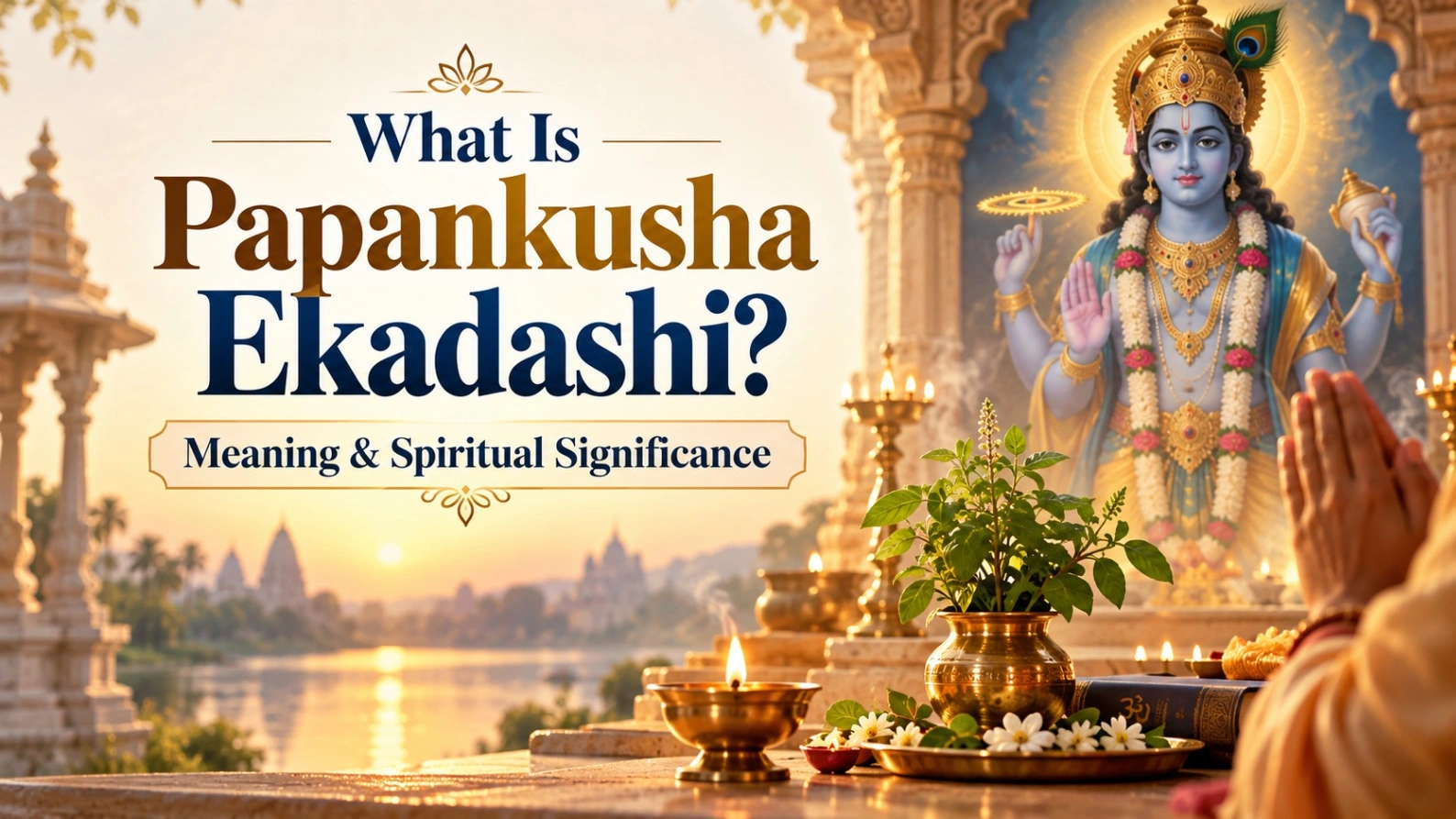
What Does Papankusha Ekadashi Mean?
The meaning of Papankusha Ekadashi is closely connected with the idea of overcoming negative karma and tendencies.
“Papa” refers broadly to actions that create suffering, negativity or spiritual bondage, while “Ankusha” refers to a goad—traditionally an instrument used to guide or control an elephant.
This symbolism carries an important spiritual teaching.
The human mind can sometimes behave like an uncontrolled elephant. Desires, anger, greed, attachment, jealousy and ego can pull a person in different directions. A small moment of awareness, however, can redirect even a powerful mental tendency.
Papankusha Ekadashi therefore symbolises placing the ankusha of awareness and self-control over the restless mind.
Traditionally, devotees observe the day through fasting, worship of Lord Vishnu, prayer, mantra chanting, charity and restraint of the senses. These practices are intended to shift attention away from ordinary distractions and towards spiritual reflection.
Papankusha Ekadashi falls during Ashwin Shukla Paksha and is dedicated particularly to Lord Vishnu. Traditional observances also associate the day with worship of Vishnu in His Padmanabha form.
Design Your Destiny
Ready to Take Control of Your Inner World? Your thoughts, habits and reactions silently shape the direction of your life. Design Your Destiny helps you move from unconscious patterns to conscious living through practical spiritual wisdom. Learn how to observe your mind, overcome limiting patterns, develop inner clarity and create a life guided by awareness rather than fear, attachment or conditioning.
Start Your Journey Today!Why Is Papankusha Ekadashi Celebrated?
Papankusha Ekadashi is observed primarily to worship Lord Vishnu and seek spiritual purification.
According to Hindu religious tradition, Ekadashi is considered especially favourable for withdrawing attention from excessive worldly indulgence and directing the mind toward God.
Papankusha Ekadashi carries an additional emphasis on the purification of karma and the restraint of negative tendencies.
Devotees traditionally believe that sincerely observing the vrat, remembering Lord Vishnu, performing charitable acts and living with self-control on this day generates punya or spiritual merit.
However, the deeper meaning of the observance is not that one day of fasting automatically erases the consequences of harmful behaviour.
Spiritually, the vrat can be understood as an opportunity to recognise one's mistakes, consciously change harmful habits and begin living with greater awareness.
Fasting becomes meaningful when the discipline of the body is accompanied by purification of thought, speech and behaviour.
Spiritual Significance of Papankusha Ekadashi
The spiritual significance of Papankusha Ekadashi goes far beyond ritual fasting.
At its heart, the day is about gaining mastery over oneself.
Most spiritual traditions repeatedly emphasise that external circumstances are not the only source of suffering. Much suffering comes from uncontrolled desire, expectation, anger, attachment and repetitive patterns of thought.
Papankusha Ekadashi offers a deliberate pause.
For one day, devotees voluntarily reduce food, entertainment and unnecessary distractions. This creates space to observe what the mind constantly demands.
When a desire arises and a person consciously chooses not to obey it immediately, something important happens: there is a small gap between the impulse and the action.
That gap is awareness.
And spiritual freedom begins in that gap.
Therefore, Papankusha Ekadashi can be understood as a day for developing self-restraint, awareness, devotion and conscious action.
The vrat asks an important inner question:
Are you controlling your desires, or are your desires controlling you?
Connection Between Papankusha Ekadashi and Lord Vishnu
Papankusha Ekadashi is dedicated to Lord Vishnu, the preserver and sustainer in the Hindu tradition.
Lord Vishnu represents preservation, balance, order and dharma. Worshipping Vishnu on Ekadashi therefore carries symbolic significance: a devotee seeks to preserve inner balance and remain established in righteous action despite the fluctuations of the mind.
On Papankusha Ekadashi, Lord Vishnu is traditionally worshipped in His Padmanabha form.
Devotees may offer flowers, Tulsi leaves, fruits, incense and lamps while chanting Vishnu mantras and remembering His divine qualities.
Commonly recited mantras include:
Om Namo Bhagavate Vasudevaya
and
Om Namo Narayanaya
The purpose of mantra chanting is not merely repetition. Repeated remembrance helps bring the wandering mind back to one spiritual centre.
What Does Papankusha Ekadashi Teach Us?
Papankusha Ekadashi offers several teachings that can be applied even beyond the religious observance.
1. Awareness Comes Before Transformation
You cannot change a habit you are unwilling to observe.
Papankusha Ekadashi encourages introspection. Instead of automatically reacting to desires or emotions, observe them.
Ask yourself: Why am I angry? Why am I attached to this outcome? Why am I repeatedly reacting in the same way?
Observation creates the possibility of transformation.
2. Self-Control Is Not Suppression
Spiritual discipline does not mean forcibly suppressing every desire.
It means becoming capable of choosing consciously.
A person who cannot say “no” to an impulse is controlled by that impulse. Fasting symbolically trains the mind to understand that every desire does not have to be fulfilled immediately.
3. Purification Requires Right Action
The idea of removing “papa” should not be understood only as performing a ritual to remove past wrongdoing.
True purification also requires changing how one lives.
Compassion, honesty, forgiveness, charity, responsibility and conscious behaviour are equally important spiritual practices.
4. Devotion Helps Quiet the Ego
When attention remains constantly centred on “me,” “mine,” “my success,” “my problems” and “my expectations,” mental suffering increases.
Devotion redirects attention from the individual ego toward something greater.
That shift itself can create inner peace.
Why Is Fasting Observed on Papankusha Ekadashi?
Fasting is one of the central practices associated with Ekadashi.
Traditionally, many devotees avoid grains and certain other foods, while some observe fruit-based fasting or more restrictive forms according to their health, ability and family tradition.
The word fasting should not, however, be understood merely as “not eating.”
Spiritually, upavasa is often understood as moving closer to the Divine.
Therefore, the real fast should also include fasting from anger, gossip, dishonesty, excessive entertainment, criticism and unnecessary sensory indulgence.
If a person avoids food throughout the day but remains angry, judgmental and restless, the deeper purpose of the vrat may remain unfulfilled.
Papankusha Ekadashi invites devotees to create simplicity externally so that greater awareness can arise internally.
How Is Papankusha Ekadashi Observed?
The precise traditions may differ between families, regions and Vaishnava traditions, but a simple observance can include waking early, bathing and making a Sankalpa to observe the vrat sincerely.
A clean space can be prepared for Lord Vishnu's worship. Devotees may offer Tulsi leaves, flowers, fruits, incense and a diya.
Vishnu Sahasranama, Bhagavad Gita verses or Vishnu mantras may be recited.
Throughout the day, devotees try to avoid unnecessary distractions and dedicate more time to prayer, meditation, seva or spiritual reading.
Charity is also traditionally considered important. Food, clothes or other useful items may be offered to people in need according to one's ability.
The fast is generally concluded through Parana on Dwadashi, the following lunar day, within the prescribed local time.
Those with medical conditions, pregnant women, elderly people or anyone for whom strict fasting may be unsafe should prioritise health and follow an appropriate form of spiritual observance.
Papankusha Ekadashi and the Concept of Karma
Papankusha Ekadashi is strongly associated with purification from papa or negative karma in traditional religious belief.
But karma is often misunderstood simply as punishment or reward.
At a deeper level, every repeated action creates tendencies.
Repeated anger makes anger easier. Repeated compassion makes compassion easier. Repeated attachment strengthens attachment. Repeated awareness strengthens awareness.
Our actions gradually shape our inner nature.
Seen through this lens, Papankusha Ekadashi becomes extremely relevant to modern life.
The purpose is not merely to worry about past mistakes.
The more useful question is:
What am I repeatedly choosing today?
A conscious action in the present can become the beginning of an entirely new pattern.
Bhai Dooj Story: History, and Origin Why It Is Celebrated
Papankusha Ekadashi and the Control of the Mind
One of the strongest symbols connected with Papankusha Ekadashi is the ankusha, or goad.
Imagine the mind as a powerful elephant.
An uncontrolled elephant can move with enormous force in any direction. Similarly, an uncontrolled mind can be dragged by fear, greed, desire, anger, comparison or attachment.
The spiritual path does not ask us to destroy the mind.
It asks us to guide it.
Awareness becomes the ankusha.
Whenever anger appears, observe it.
Whenever jealousy appears, observe it.
Whenever fear appears, observe it.
Whenever desire appears, observe it.
Instead of immediately saying, “I am angry,” notice, “Anger is arising in my mind.”
This small shift creates the position of the witness.
You begin to understand that a thought is happening within you, but the thought is not your entire identity.
That recognition is an important step toward inner freedom.
Benefits of Observing Papankusha Ekadashi
Traditional scriptures and devotional traditions associate Papankusha Ekadashi with considerable spiritual merit. Devotees observe the vrat seeking Lord Vishnu's blessings, purification and progress toward moksha.
From a practical spiritual perspective, sincerely observing the day may also encourage:
Greater self-control: Voluntarily limiting food and distractions strengthens discipline.
Mental clarity: Reducing external stimulation can create space for reflection.
Devotion: Prayer and mantra chanting strengthen spiritual focus.
Awareness of habits: Fasting reveals how frequently the mind demands stimulation or gratification.
Compassion: Charity reminds devotees to move beyond self-centred living.
Forgiveness: Reflecting on past actions can encourage repentance and healthier choices.
Inner peace: Turning inward temporarily can help reduce mental noise.
These benefits become more meaningful when the principles of Ekadashi are carried into daily life.
Papankusha Ekadashi 2026 Date
In 2026, Papankusha Ekadashi falls on Thursday, October 22, 2026.
For New Delhi, Panchang calculations list the Ekadashi Tithi as beginning on the afternoon of October 21 and ending on the afternoon of October 22.
Because exact Ekadashi and Parana timings may vary depending on location and tradition, devotees should always consult a reliable Panchang for their city before beginning or breaking the vrat.
Vaikuntha Chaturdashi: Date, Story,Puja Vidhi & Significance
The Deeper Message of Papankusha Ekadashi
The most powerful lesson of Papankusha Ekadashi is simple:
Spirituality begins when unconscious living becomes conscious living.
A ritual can remind us of this truth, but eventually the teaching has to enter daily life.
Can you observe anger before speaking?
Can you notice attachment without immediately acting upon it?
Can you recognise ego when it demands validation?
Can you pause before repeating a behaviour you know creates suffering?
That pause is your inner ankusha.
Papankusha Ekadashi therefore is not merely about controlling food for one day. It represents learning to direct the entire inner mechanism of thought, emotion and action.
When awareness becomes stronger, harmful patterns gradually lose their hold.
And when actions become conscious, purification is no longer only a religious idea—it becomes a lived experience.
Papankusha Ekadashi is an important Ekadashi observed during the Shukla Paksha of Ashwin and dedicated to Lord Vishnu, particularly His Padmanabha form.
Its name symbolises using the ankusha of self-control and awareness to overcome papa—actions and tendencies that lead us away from spiritual clarity.
Devotees traditionally observe the day through fasting, Vishnu worship, mantra chanting, charity, prayer and self-restraint. Yet its deepest teaching lies beyond ritual.
Papankusha Ekadashi reminds us that the greatest victory is not controlling the world outside us but understanding and guiding the world within us.
Observe the mind. Become conscious of your actions. Let go of harmful patterns. Choose awareness over impulse.
That is where spiritual purification truly begins.
Personal Session
Sometimes understanding the teaching is easy, but applying it to your own relationships, emotions, career and life challenges requires deeper clarity. A Personal Session can help you identify the patterns holding you back, understand your inner conflicts and receive personalised spiritual guidance for moving forward with greater awareness and peace.
Book NowRead Latest Articles
9 Colour of Navratri 2026: DayWise List, Date & Significance
Bhai Dooj Date: Tilak Muhurat, Puja Time & Complete Vidhi
Frequently Asked Questions
What is Papankusha Ekadashi?
Papankusha Ekadashi is a sacred Hindu fasting day observed on Ashwin Shukla Ekadashi and dedicated to Lord Vishnu. The word combines “Papa,” meaning wrongful action or sin, and “Ankusha,” meaning a goad or means of control. Spiritually, it represents overcoming negative tendencies through fasting, devotion, awareness, self-control and righteous action.When is Papankusha Ekadashi 2026?
Papankusha Ekadashi will be observed on Thursday, October 22, 2026. Since Ekadashi and Parana timings depend on local sunrise and lunar calculations, devotees should consult a Panchang for their city.Which God is worshipped on Papankusha Ekadashi?
Papankusha Ekadashi is dedicated to Lord Vishnu, particularly His Padmanabha form. Devotees worship Vishnu through prayers, Tulsi offerings, mantras and devotional practices.Why is Papankusha Ekadashi important?
Papankusha Ekadashi is traditionally associated with spiritual purification, Vishnu worship, self-control and freedom from negative karma. At a deeper level, it reminds devotees to examine and transform harmful habits.What should we do on Papankusha Ekadashi?
Devotees may observe fasting, worship Lord Vishnu, chant Vishnu mantras, read spiritual texts, meditate, perform charity and avoid anger, dishonesty, excessive entertainment and other unnecessary distractions.What mantra can be chanted on Papankusha Ekadashi?
Two widely recited Vishnu mantras are “Om Namo Bhagavate Vasudevaya” and “Om Namo Narayanaya.”