

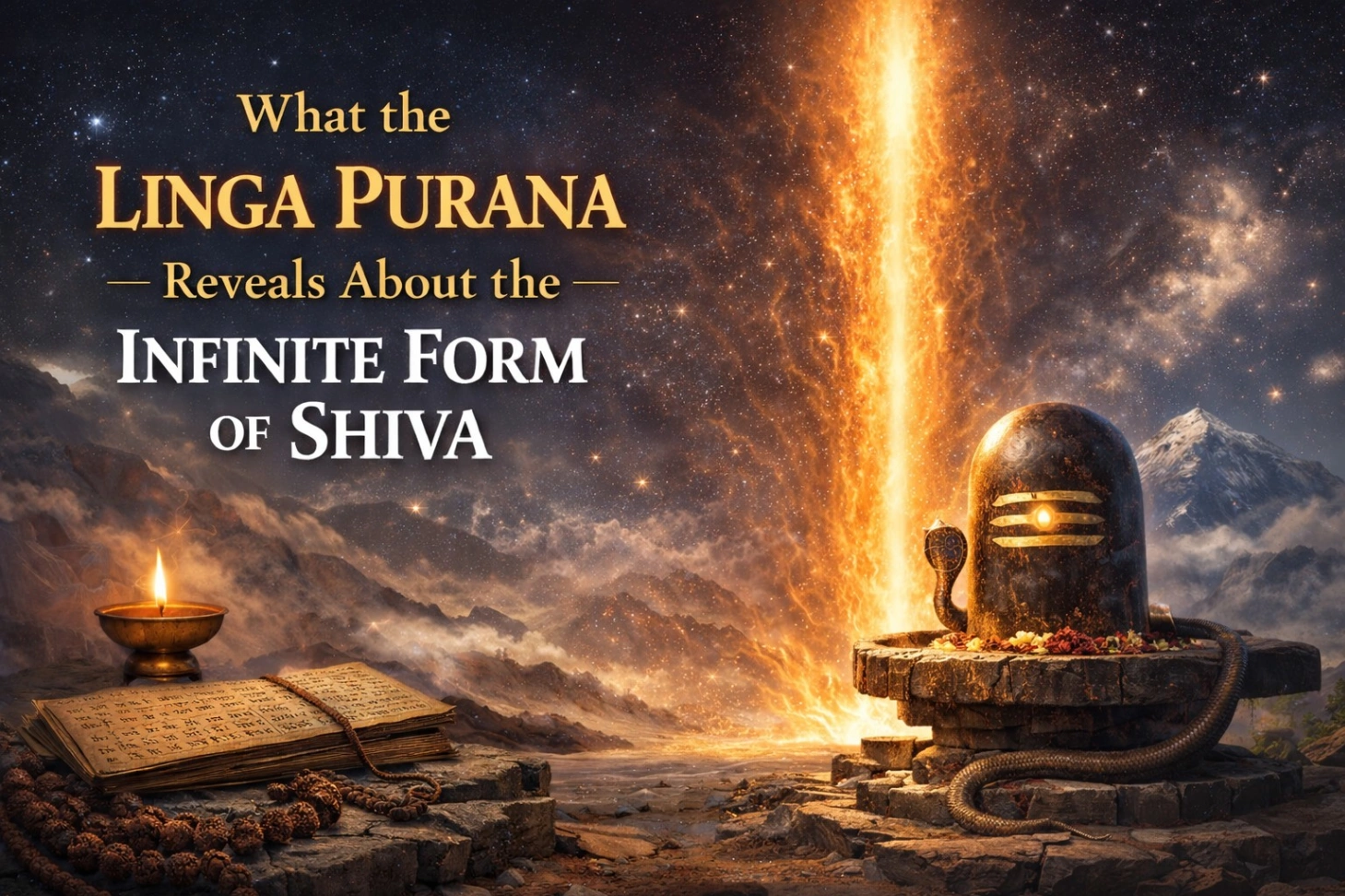
If there is one scripture that dares to speak about Shiva without boundaries, it is the Linga Purana. Unlike many texts that describe gods in human-like forms, the Linga Purana points us toward something far more radical; the infinite form of Shiva, a reality that has no beginning, no end, and no fixed shape. This is not just mythology; it is philosophy, symbolism, and inner science woven together.
In this blog, we explore what the Linga Purana truly reveals about Shiva’s infinite nature, why Shiva is worshipped as a Lingam, and how the famous Lingodbhava story reshapes our understanding of the divine.
Understanding the Linga Purana and Its Core Message
The Linga Purana is one of the eighteen Mahapuranas and is entirely centered on Shiva as the supreme, all-pervading reality. But its Shiva is not limited to a blue-skinned ascetic sitting on Mount Kailash. Instead, the Purana constantly reminds us that Shiva is beyond form and time, beyond creation and destruction.
When the text speaks of Shiva, it does not merely narrate stories; it points toward a truth. The Linga is not introduced as an idol but as a symbol of the infinite, something that cannot be boxed into a human imagination.
What Does the Linga Purana Say About Shiva?
One of the most profound teachings of the Linga Purana is that Shiva has no origin story. He is not born, nor does he die. Creation emerges from him, exists within him, and dissolves back into him.
This is why the Purana repeatedly emphasizes Shiva as:
Infinite consciousness
The substratum of all realities
Beyond gender, form, and limitation
In simple terms, Shiva is not a being inside the universe; the universe appears within Shiva.
The Infinite Form of Shiva Explained
When we hear “infinite form of Shiva,” it does not mean a giant cosmic body stretching endlessly across space. Infinity here is qualitative, not quantitative.
The infinite form of Shiva means:
No fixed beginning or end
No measurable boundaries
No single identity
The Linga Purana describes Shiva as formless, yet capable of manifesting forms— a paradox that invites contemplation rather than logic.
Lingodbhava: The Story of the Endless Pillar of Fire
At the heart of the Linga Purana lies the iconic Lingodbhava story; one of the most powerful metaphors in Hindu philosophy.
According to the story, Brahma and Vishnu once argued over who was supreme. At that moment, Shiva appeared as an infinite pillar of fire, piercing through all realms. Vishnu descended to find its base. Brahma ascended to locate its top. Neither succeeded.
The message is clear:
The absolute truth cannot be measured, conquered, or claimed.
This endless pillar is not just fire; it is pure consciousness, the same reality the Linga represents.
Why Shiva Is Worshipped as a Lingam
The Linga Purana answers a question many still ask today: Why is Shiva worshipped as a Lingam?
Because the Lingam:
Has no beginning or end
Is free from human features
Represents infinity in the simplest form
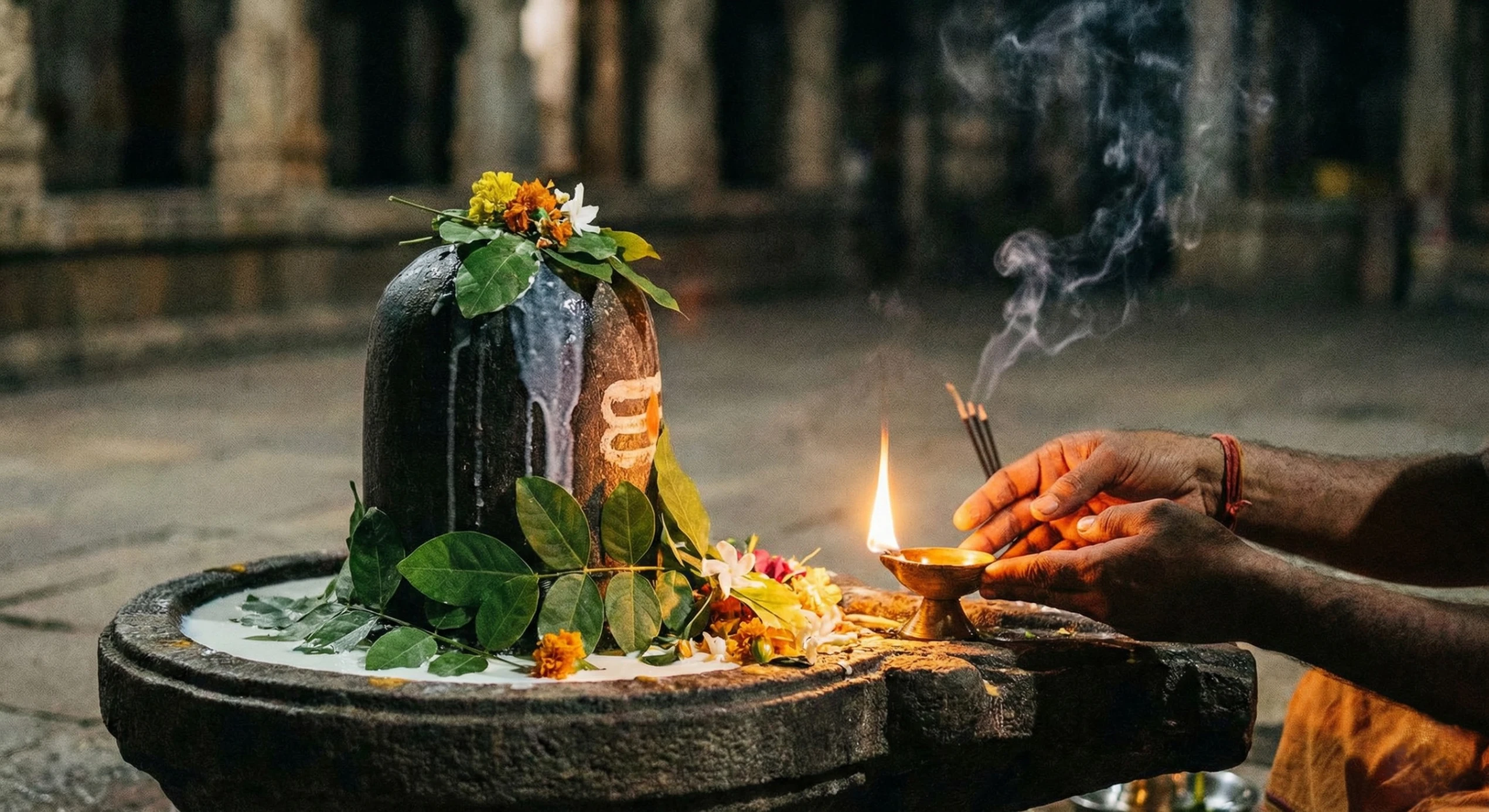
Rather than limiting Shiva to an image, the Lingam liberates the mind from form-based worship. It becomes a doorway to meditate on Shiva as infinite awareness rather than a personality.
Shiva Lingam as a Symbol of Infinity
The shape of the Shiva Lingam is intentionally abstract. It does not depict a body, face, or expression. Instead, it invites silence and inner stillness.
Symbolically, the Lingam represents:
The axis of existence
The union of the formless and the manifest
Shiva as the timeless center of all movement
The Linga Purana consistently reinforces that the Lingam is not Shiva himself, but a pointer to Shiva’s infinite reality.
Shiva Beyond Creation and Destruction
Another key revelation of the Linga Purana is that Shiva is not merely the destroyer. Creation, preservation, and dissolution are functions that arise within Shiva, not actions he performs out of necessity.
This means Shiva is:
Beyond fear of loss
Beyond attachment to form
Beyond cycles of birth and death
Destruction, in this context, is not violence; it is returning to the infinite.
Shiva as Infinite Consciousness
The Purana subtly aligns with what later philosophies would call non-dual awareness. Shiva is described as the consciousness in which all experiences arise thoughts, forms, emotions, and worlds.
This is why Shiva is often called:
Nirguna (without attributes)
Formless yet all-forms
Silent witness of existence
Meditating on Shiva, according to the Linga Purana, is ultimately meditating on one’s own awareness.
The Spiritual Meaning of Lingodbhava Today
The Lingodbhava story is not just ancient lore. It carries a timeless lesson for modern seekers.
It reminds us that:
Ego cannot grasp truth
Authority does not equal wisdom
True divinity humbles all claims
In a world obsessed with control and certainty, Shiva’s infinite form invites surrender; not weakness, but freedom.
What the Linga Purana Reveals About Us
Perhaps the most subtle teaching of the Linga Purana is this:
The same infinity that Shiva represents exists within us.
The Lingam is not asking us to worship an external god alone; it is asking us to recognize the infinite awareness behind our own thoughts and identities.
The Linga Purana does not give easy answers. Instead, it dissolves questions. By revealing Shiva as infinite, it challenges our need to define, label, and limit the divine.
To contemplate Shiva through the Linga is to slowly loosen our grip on form and in that loosening, touch something eternal.
As you reflect on Shiva’s infinite form, prepare yourself for the sacred night of transformation. Read our complete guide on Maha Shivaratri Dos and Don’ts: What to Do and Avoid on This Sacred Night to observe the festival with clarity and devotion.