
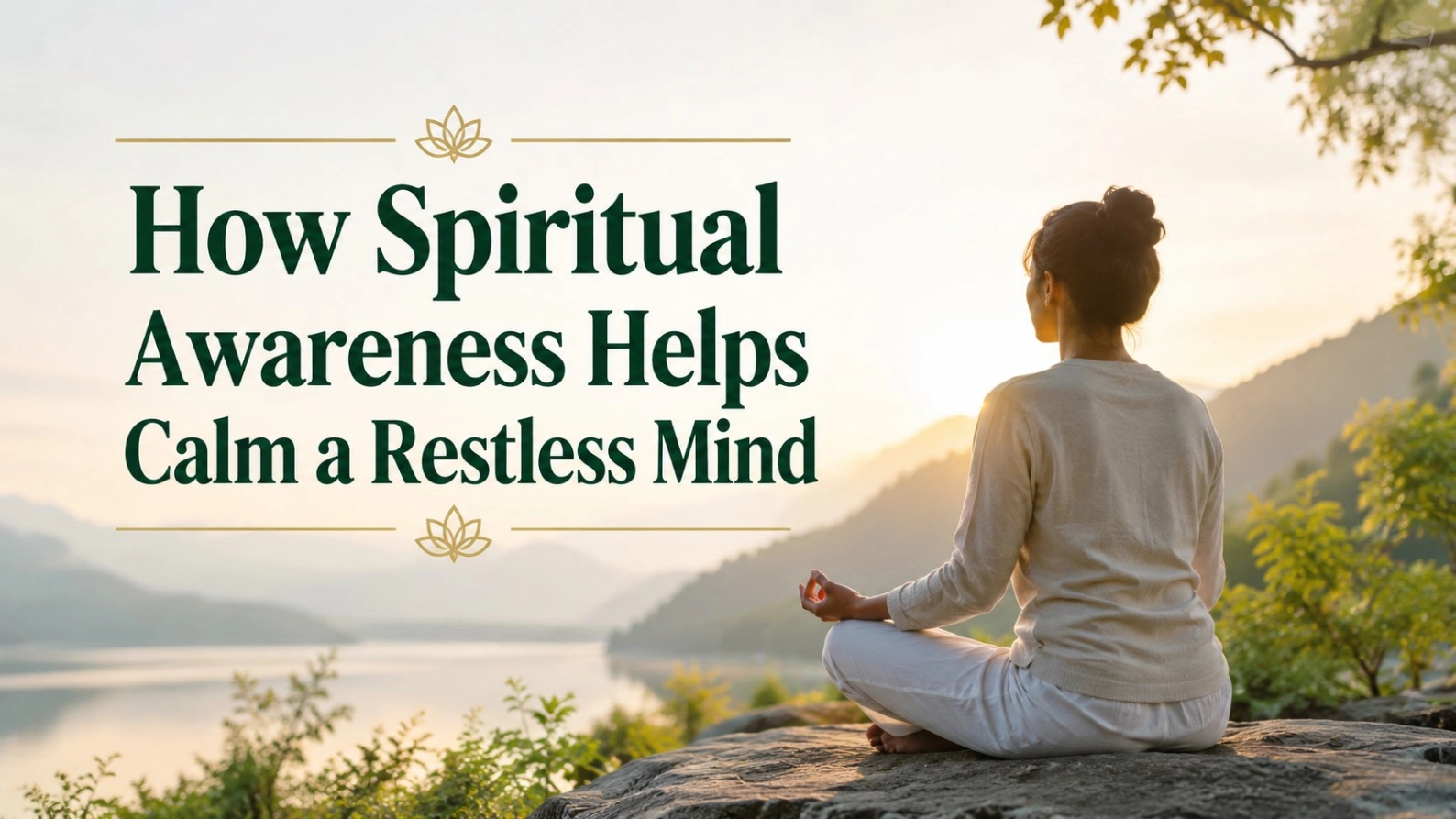
A restless mind can make even a peaceful life feel heavy. You may be sitting quietly, but inside, thoughts keep moving from one worry to another. This is where spiritual awareness becomes deeply helpful. It teaches you to look within, understand your thoughts, and slowly create peace of mind without forcing the mind to become silent.
Many people try to fight their thoughts. They tell themselves, “I should stop overthinking,” or “I should calm down.” But the more we fight the mind, the more restless it often becomes. Spiritual awareness offers a different path. It does not ask you to suppress your thoughts. It invites you to observe them, understand them, and rise above them.
A restless mind is not your enemy. It is often a sign that your inner world needs attention, care, and stillness.
What Is a Restless Mind?
A restless mind is a mind that cannot stay calm for long. It keeps jumping from past memories to future worries. One moment you are thinking about work, the next moment about relationships, then suddenly about something that happened years ago.
This constant movement creates mental tiredness. You may feel physically present but mentally scattered. You may want to relax, but your thoughts do not allow you to rest. This is why many people search for how to calm your mind, how to calm the mind, and how to stop overthinking.
Restlessness can show up in many ways. You may feel impatient, emotionally sensitive, easily irritated, or unable to focus. Sometimes, even when nothing serious is happening outside, the mind creates inner noise.
Spiritual awareness helps you understand that the mind is active by nature, but you are not only the mind. You are the awareness behind the mind.
Design Your Destiny
Are you ready to move from mental restlessness to inner clarity? Join Design Your Destiny and learn how to use spiritual awareness, meditation, and self understanding to create a more peaceful, balanced, and meaningful life.
Start Your Journey!Why Does the Mind Become Restless?
The mind becomes restless when it is constantly pulled by desires, fears, expectations, comparisons, and unresolved emotions. It keeps asking questions like, “What if this goes wrong?” “Why did this happen?” “What will people think?” “Am I doing enough?”
This inner questioning can slowly become overthinking. And overthinking often steals peace of mind.
A restless mind also comes from living too much on the surface. When life becomes only about tasks, achievements, social approval, and external success, the inner self feels ignored. The soul naturally seeks peace, meaning, and connection. When we do not listen to that deeper need, the mind becomes disturbed.
Spiritual growth begins when we pause and ask: “What is my mind really trying to tell me?”
What Is Spiritual Awareness?
Spiritual awareness means becoming conscious of your inner self. It is the ability to observe your thoughts, emotions, reactions, and desires without being completely controlled by them.
It is not limited to rituals or religious practices. Spiritual awareness is a way of living with more presence, clarity, and inner connection. It helps you see the difference between your temporary thoughts and your deeper self.
For example, when anger arises, spiritual awareness helps you notice, “Anger is present in me.” Instead of saying, “I am angry,” you begin to understand that anger is an emotion passing through you. This small shift creates space. And in that space, calmness begins.
Spiritual awareness teaches you that you do not have to believe every thought your mind creates.
How Spiritual Awareness Helps Calm a Restless Mind
Spiritual awareness calms a restless mind by bringing attention back to the present moment. Most mental restlessness comes from living in the past or future. The mind either regrets what happened or fears what may happen.
Awareness gently brings you back to now.
When you become aware, you start watching your thoughts instead of running behind them. You begin to notice patterns. You may realize that your mind repeats the same fears again and again. You may see how one negative thought creates another. Once you see this clearly, the mind starts losing its power over you.
This is the beginning of inner calm.
You cannot calm a restless mind by force. But you can calm it through understanding. Spiritual awareness gives you that understanding.
The Connection Between Spiritual Awareness and Inner Peace
Inner peace does not mean that life will always be easy. It means you learn to remain centered even when life is uncertain.
Spiritual awareness helps you find inner peace by shifting your focus from outer situations to inner stability. When your peace depends only on people, results, or circumstances, it keeps changing. But when peace comes from within, it becomes stronger and more lasting.
A calm mind does not come from controlling everything outside. It comes from becoming steady inside.
This is why spiritual awareness, mindfulness, and meditation are powerful tools for mental peace. They help you return to yourself.

How to Calm Your Mind Through Observation
One of the simplest spiritual practices for inner peace is observation. Sit quietly for a few minutes and watch your thoughts. Do not judge them. Do not try to stop them. Just observe.
You may notice thoughts like, “I have so much work,” “What if things don’t go well?” or “Why can’t I relax?” Let them come and go.
Imagine your thoughts as clouds passing through the sky. You are not the clouds. You are the sky.
This practice helps you understand how to quiet your mind spiritually. The mind becomes calmer when it feels seen, not attacked.
At first, it may feel difficult. The mind may become even more active. That is normal. With regular practice, observation creates distance between you and your thoughts. That distance is peace.
Meditation for a Restless Mind
Meditation is one of the most effective ways to calm restless thoughts. But many beginners feel they cannot meditate because their mind is too active. The truth is, meditation is not about having no thoughts. It is about learning not to get lost in every thought.
Start with simple breathing meditation. Sit comfortably. Close your eyes. Take a deep breath in and slowly breathe out. Keep your attention on the breath.
Whenever the mind wanders, gently bring it back. Do not criticize yourself. This returning is the practice.
Meditation helps reduce overthinking because it trains the mind to slow down. It creates mental clarity, emotional balance, and inner calm. Over time, even a few minutes of daily meditation can help you feel more peaceful inside.
Spiritual Awareness and Overthinking
Overthinking happens when the mind keeps repeating thoughts without reaching peace. You may think you are solving a problem, but often the mind is only creating more confusion.
Spiritual awareness helps you stop overthinking by showing you that not every thought needs your attention. Some thoughts are useful. Others are just mental noise.
When you become aware, you can ask yourself:
“Is this thought helping me?”
“Is this fear real, or is my mind imagining it?”
“Can I respond from peace instead of panic?”
These simple questions bring self awareness. And self awareness helps you move from reaction to clarity.
The goal is not to stop thinking completely. The goal is to stop being controlled by every thought.

Emotional Balance Through Spiritual Awareness
A restless mind often creates emotional imbalance. Small things may feel big. A simple delay, comment, or problem may disturb your entire day.
Spiritual awareness helps you create emotional balance because it teaches you to pause before reacting. Instead of immediately speaking, arguing, worrying, or judging, you take a moment to breathe and observe.
This pause is powerful.
In that pause, you remember that emotions are temporary. You do not have to act from every feeling. You can choose a calmer response.
Emotional balance does not mean you become emotionless. It means you become emotionally mature. You feel deeply, but you do not lose yourself in every feeling.
How to Find Peace of Mind in Daily Life
Peace of mind is not something you need to wait for. You can practice it in small moments every day.
When you wake up, take a few moments before checking your phone. Sit quietly and connect with your breath. Before starting work, set an intention: “Today, I will remain aware and calm.”
During the day, take short pauses. Even one mindful breath can bring you back to yourself. When you feel stressed, place your attention on your heart and breathe slowly.
At night, reflect on your day without judgment. Notice where you reacted, where you stayed calm, and what you learned.
These small practices slowly build spiritual growth. They make awareness part of your lifestyle, not just something you practice during meditation.
Simple Spiritual Ways to Calm the Mind
There are many spiritual ways to calm the mind, but the most powerful ones are often simple.
Practice silence for a few minutes daily. Silence allows the mind to settle. Spend time in nature. Nature naturally brings inner calm. Read spiritual wisdom that reminds you of your higher self. Practice gratitude to shift the mind from lack to abundance.
You can also repeat a calming affirmation such as, “I am peaceful within,” or “I am not my thoughts; I am the awareness behind them.”
These practices help you relax your mind and return to mental peace.

Why You Should Not Force the Mind to Be Silent
Many people believe that a calm mind means a completely blank mind. This belief creates frustration. When thoughts arise, they feel they are failing.
But the mind thinks. That is its nature.
Spiritual awareness does not demand that the mind should stop immediately. It simply helps you change your relationship with the mind. Instead of fighting thoughts, you watch them. Instead of fearing restlessness, you understand it.
When the mind is not judged, it naturally becomes softer. When thoughts are not fed with fear, they slowly lose intensity.
Inner peace grows through acceptance, not force.
How Self Awareness Leads to Spiritual Growth
Self awareness is the foundation of spiritual growth. When you become aware of your thoughts, habits, reactions, and emotional patterns, you begin to understand yourself more deeply.
You may notice that your restlessness comes from wanting everything to happen your way. Or from comparing your life with others. Or from carrying old emotional pain.
Once you see these patterns, transformation begins.
Spiritual growth is not about becoming perfect. It is about becoming conscious. The more conscious you become, the less power unconscious thoughts have over you.
This is how spiritual awareness helps calm a restless mind from within.
What to Do When Your Mind Feels Very Restless
When the mind feels very restless, do not panic. First, pause. Take a few deep breaths. Remind yourself, “This is a restless moment, not my whole life.”
Then bring your attention to something simple: your breath, your body, or the sounds around you. This helps bring the mind back to the present.
Avoid making big decisions when the mind is highly disturbed. Give yourself time to settle. You can also write your thoughts down. Journaling helps release mental pressure and brings clarity.
Most importantly, be gentle with yourself. A restless mind needs compassion, not criticism.

A restless mind can feel exhausting, but it can also become a doorway to deeper awareness. When you stop running from your thoughts and start observing them, something beautiful happens. You begin to discover that peace was never outside you. It was always within, waiting beneath the noise.
Spiritual awareness helps you calm your mind by teaching you to observe, pause, breathe, and reconnect with your inner self. It supports mental peace, emotional balance, mindfulness, meditation, and spiritual growth.
You do not need to control every thought to find peace. You only need to become aware of the space beyond thought.
And in that space, the restless mind slowly becomes calm.
Personal Session
If your mind feels restless, confused, or emotionally heavy, a personal session can help you understand your inner patterns and find the right spiritual guidance for peace of mind, emotional balance, and personal growth.
Book Now