

Death is one of humanity’s deepest mysteries. What happens when the body stops functioning? Does our existence end completely, or does something continue? And if the soul survives, where does it go?
Thousands of years ago, the Bhagavad Gita addressed these very questions through the dialogue between Lord Krishna and Arjuna on the battlefield of Kurukshetra.
Arjuna was overwhelmed by grief at the thought of the deaths that the coming battle would bring. Krishna responded by shifting his understanding from the temporary physical body to the eternal Atman, the true Self or soul.
According to the Bhagavad Gita on death, the destruction of the physical body is not the destruction of the soul. Krishna describes the Atman as unborn, eternal and unaffected by bodily death in Bhagavad Gita 2.20.
Understanding this distinction between body and Self is essential to understanding what happens to the soul after death according to the Bhagavad Gita.
What Does the Bhagavad Gita Say About Death?
The Bhagavad Gita does not present death as the absolute end of existence. It presents death primarily as a transition involving the embodied soul.
The physical body is temporary. It is born, grows, changes, ages and eventually dies. The Atman, however, is described differently.
In Bhagavad Gita 2.20, Krishna explains that the soul does not come into existence at birth and does not cease to exist when the body dies. The transformations that affect the body do not destroy the eternal Self.
This is one of the most important Bhagavad Gita teachings on death.
Our fear of death often comes from complete identification with the body. If we believe, “I am only this body,” the destruction of the body appears to be the destruction of ourselves.
Krishna asks Arjuna to look deeper.
The body changes. The observer of those changes, the Self, is different from those temporary forms.
From the Gita’s spiritual perspective, therefore, death is not simply about asking, “What ends?” It is also about asking, “What remains?”
Design Your Destiny
The Bhagavad Gita reminds us that spiritual transformation does not begin at the moment of death—it begins with how consciously we live today. Join Design Your Destiny and begin exploring the inner patterns, attachments and beliefs shaping your life. Move from unconscious living toward greater awareness, clarity and inner transformation.
Start Your Journey Today!What Happens to the Soul After Death According to the Bhagavad Gita?
One of the clearest explanations comes in Bhagavad Gita 2.22.
Krishna compares the process to a person discarding worn-out clothes and putting on new ones. In the same way, the embodied soul leaves an old body and enters another.
The analogy is simple but profound.
When you change clothes, you do not become the clothes. The clothes change, while the person wearing them continues.
Similarly, according to this teaching, bodily death changes the soul’s physical vehicle rather than destroying the soul itself.
This helps explain the relationship between the Bhagavad Gita after death teachings and the concept of rebirth.
Birth and death belong to the changing body. The soul continues its journey until it becomes liberated from the cycle of repeated birth and death.
Does the Soul Die When the Body Dies?
According to Krishna’s teaching, no.
This point is emphasized repeatedly in the second chapter of the Gita because Arjuna’s grief comes partly from seeing death only from the bodily perspective.
The body can be destroyed. The Atman cannot be destroyed in the same way.
This does not mean that the Gita asks us to become emotionally cold about death or ignore the pain of losing someone. Rather, its spiritual teaching changes the larger perspective from which death is understood.
A loved one’s physical presence may end, and grief is a deeply human experience. Yet the Gita’s message offers another dimension: the essence of the person is not reduced to the temporary body.
This is why Krishna’s teachings on death can be comforting. They move the focus from annihilation to continuity.
Bhagavad Gita Lessons for Controlling Thoughts and Emotions
Where Does the Soul Go After Death?
The Bhagavad Gita on life after death does not reduce the soul’s destination to one identical outcome for everyone.
Instead, Krishna connects the soul’s onward journey with consciousness, spiritual development and the qualities that dominate a person’s life.
Bhagavad Gita 15.8 describes the embodied soul as carrying the mind and senses while leaving one body and entering another, using the analogy of air carrying fragrance from one place to another.
This is significant because the Gita’s picture of rebirth is not merely about a soul randomly entering another body.
There is continuity.
The tendencies cultivated during life matter.
The state of consciousness matters.
And the direction in which a person has shaped their inner life matters.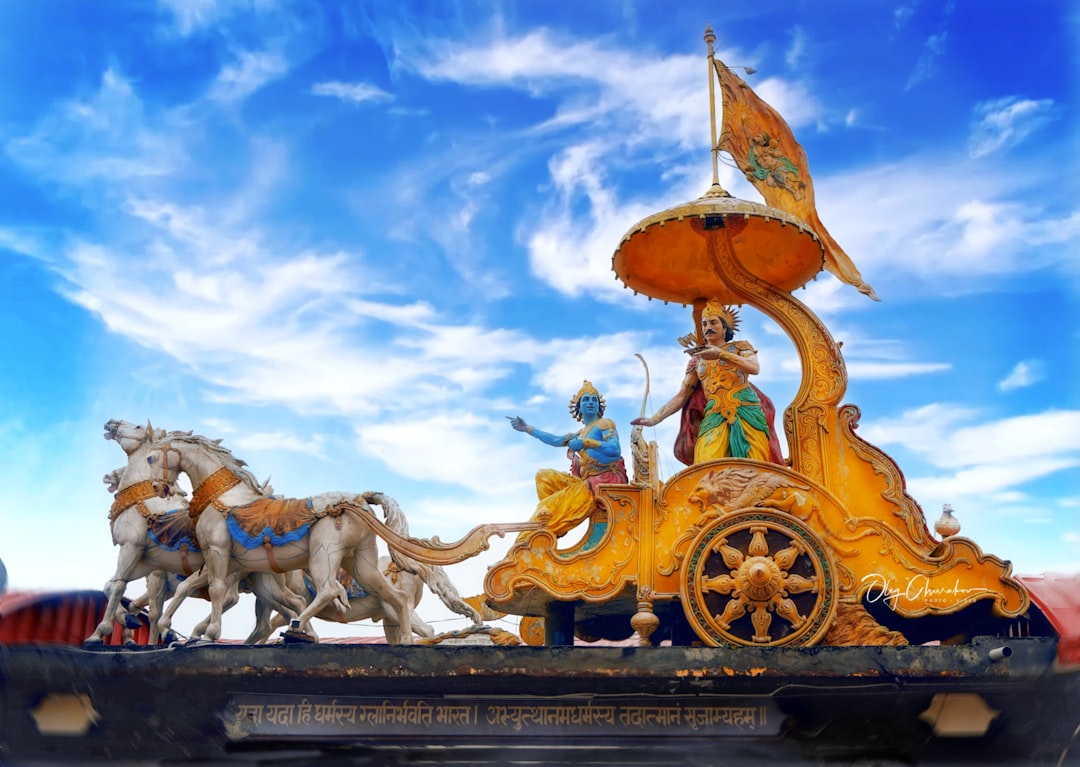
What Role Does Karma Play After Death?
Karma is often misunderstood simply as reward and punishment.
In the broader teaching of the Bhagavad Gita, karma is connected with action, attachment, intention, inner qualities and the spiritual consequences of how one lives.
Chapter 14 discusses the three gunas like sattva, rajas and tamas and connects the dominant quality of consciousness at death with different onward states or births. Bhagavad Gita 14.14–15 describes different destinations associated with sattva, rajas and tamas.
The deeper lesson is that the way we live shapes the consciousness with which we die.
A life dominated by greed, attachment and unconscious impulses creates one kind of inner direction. A life of wisdom, devotion, selfless action and spiritual awareness creates another.
Therefore, the question “What will happen after death?” cannot be separated completely from a more practical question:
“How am I living today?”
That may be one of the most transformative lessons within the Bhagavad Gita teachings on death.
What Krishna Says About the Final Thought at Death
One of the most fascinating teachings appears in Chapter 8.
In Bhagavad Gita 8.6, Krishna explains that the state a person remembers while leaving the body is connected to the state they subsequently attain. Importantly, the verse describes this final consciousness as arising from what the person has been habitually absorbed in.
This teaching should not be reduced to the idea that one can live unconsciously for decades and simply manufacture a spiritual thought during the final seconds of life.
Our final state of mind is connected with the consciousness we repeatedly cultivate.
If the mind spends years deeply attached to possessions, status, anger, fear or desires, those patterns leave impressions.
If it is repeatedly trained toward God, awareness, surrender, love, truth and detachment, those impressions also deepen.
That is why spirituality in the Gita is ultimately a way of living, not merely a ritual performed near death.
Does the Bhagavad Gita Teach Reincarnation?
Yes. Rebirth is directly reflected in Krishna’s comparison of the soul changing bodies just as a person changes old garments for new ones in Bhagavad Gita 2.22.
But reincarnation is not presented as the final spiritual goal.
The aim is not simply to obtain endless better births.
The higher goal is moksha, freedom from the cycle of birth and death.
As long as attachment, ignorance and identification with temporary existence continue, the soul remains within the cycle of worldly experience.
Spiritual realization leads in the opposite direction: toward freedom.
What Is Moksha and What Happens After Liberation?
If the soul continues after death and takes another body, a natural question arises:
Does this cycle ever end?
According to the Bhagavad Gita, yes.
Krishna describes liberation as freedom from repeated rebirth. In Bhagavad Gita 8.15, those who attain the Divine and reach the highest spiritual perfection are described as no longer returning to repeated birth in the temporary material world.
This is moksha.
Moksha means that the soul is no longer compelled to continue through the ordinary cycle of birth, death and rebirth.
This gives the life after death according to Bhagavad Gita teaching its ultimate direction.
The purpose of spirituality is not merely to discover what happens after death.
It is to discover who we truly are before death arrives.
When a person realizes that their deepest identity is not the changing body, possessions, status or ego, fear begins to lose its hold.
Radha Ashtami 2026: When, Date, Shubh Muhurat & Puja Vidhi
Why Are We Afraid of Death?
Much of the fear surrounding death comes from uncertainty.
We know the body will eventually disappear, but we do not know when or how. We also build identities around things that are inherently temporary—our appearance, relationships, possessions, achievements and social roles.
The Gita does not deny impermanence.
Instead, it asks us to distinguish between the temporary and the eternal.
Everything connected with the physical world changes.
Youth becomes old age. Success becomes memory. Relationships change. Bodies change. Circumstances change.
Spiritual wisdom begins when we stop expecting permanent security from temporary things.
This does not make life meaningless.
It can make life more meaningful.
When we recognize that time is limited, love becomes more precious, actions become more conscious, forgiveness becomes easier and spiritual growth becomes more urgent.
Living the Gita Movement
The Bhagavad Gita is not merely something to be read or listened to. It is the art of awakening within oneself and experiencing the truth of life. The vision of the Living the Gita Movement is to bring the wisdom of the Gita out of books and transform it into a lived experience.
Join NowHow Can Krishna’s Teachings on Death Change the Way We Live?
The greatest value of understanding death is not predicting the future. It is transforming the present.
Krishna’s teachings encourage us to live with greater awareness.
Instead of endlessly asking, “What happens after death Bhagavad Gita?”, we can also ask:
What kind of consciousness am I creating every day?
Am I acting from attachment or awareness?
Am I becoming more peaceful or more restless?
Am I controlled by my desires, or can I witness them?
Do I remember the Divine only during difficulty, or does spirituality influence everyday life?
The Gita repeatedly redirects attention toward right action, self-knowledge, devotion and inner transformation.
Death then becomes not merely a frightening event in the distant future but a reminder to awaken now.
Bhagavad Gita on Death: The Deeper Spiritual Message
When Arjuna saw death before him, Krishna did not merely give him information about the afterlife.
He challenged Arjuna’s understanding of identity itself.
You are not merely the body.
The Self is deeper than changing physical existence.
The body has a beginning and an end. The Atman does not undergo death in the same way.
The soul moves through embodied existence, while one’s consciousness and spiritual orientation matter to the journey. And beyond repeated birth and death lies the possibility of liberation.
This is why what Krishna says about death ultimately becomes a teaching about how to live.
If death is certain, life should be conscious.
If the body is temporary, we should not spend our entire existence serving only the body and ego.
If our consciousness matters, we should cultivate it carefully.
And if liberation is possible, spiritual awakening deserves more than occasional attention.
So, what happens to the soul after death according to the Bhagavad Gita?
The Gita teaches that bodily death does not destroy the eternal Atman. Krishna compares the soul’s transition between bodies to changing worn-out clothes. He also teaches that the consciousness cultivated throughout life and present at death is connected with the soul’s onward destination.
Yet the deepest goal is not endless rebirth.
It is freedom.
The Bhagavad Gita on death ultimately invites us to move beyond fear by discovering our true spiritual identity and living in a way that leads toward self-realization and liberation.
Instead of waiting until the final moment to think about the meaning of life, Krishna’s wisdom invites us to begin that inquiry today.
Personal Session
Sometimes spiritual questions are deeply personal. If you are struggling with fear, attachment, uncertainty, purpose or questions about your inner journey, personalized guidance can help you see your situation with greater clarity. Book a Personal Session and receive focused guidance for your spiritual journey, self-understanding and inner transformation. Begin your journey from confusion to clarity, from fear to awareness, and from merely existing to consciously living.
Book NowRead Latest Articles