Shakespeare once famously wrote in Macbeth that life is "a tale told by an idiot, full of sound and fury, signifying nothing." It’s a cynical view that life is chaotic, noisy, and ultimately meaningless.
But if you were to ask Krishna the same question "What is life?" his answer in the Bhagavad Gita would be radically different. He wouldn't call it a tragedy or a meaningless accident.
Krishna simply says: Life is a game. It is a Leela (Divine Play).
This shift in perspective is the foundation of the art of surrender in the Bhagavad Gita. It is the sixth great key to self-realization. When you understand life as a play, the burden of the world lifts off your shoulders. Let’s explore how to transform your life from a struggle into a celebration.
1. Stop Asking "Why?" and Start Playing
One of the biggest traps we fall into is the endless search for a logical "Why."
Why did this happen to me?
Who created the universe?
Who created the creator?
The transcript highlights a profound truth: Logic has no end. If you ask who made the universe, the answer might be God. But if you ask who made God, you enter an infinite regression. You will never arrive at a final answer through logic alone.
Krishna offers a divine solution: Don’t take it so seriously. Life is a play of hide-and-seek. It is the Divine hiding from Itself and seeking Itself. When you stop analyzing the purpose of the game and simply play it, you align with the universe.
The Actor’s Mindset
Imagine a skilled actor on a stage.
He might play a villain, a lover, or a warrior.
He might cry, scream, or fight.
But deep down, he knows it is just a role.
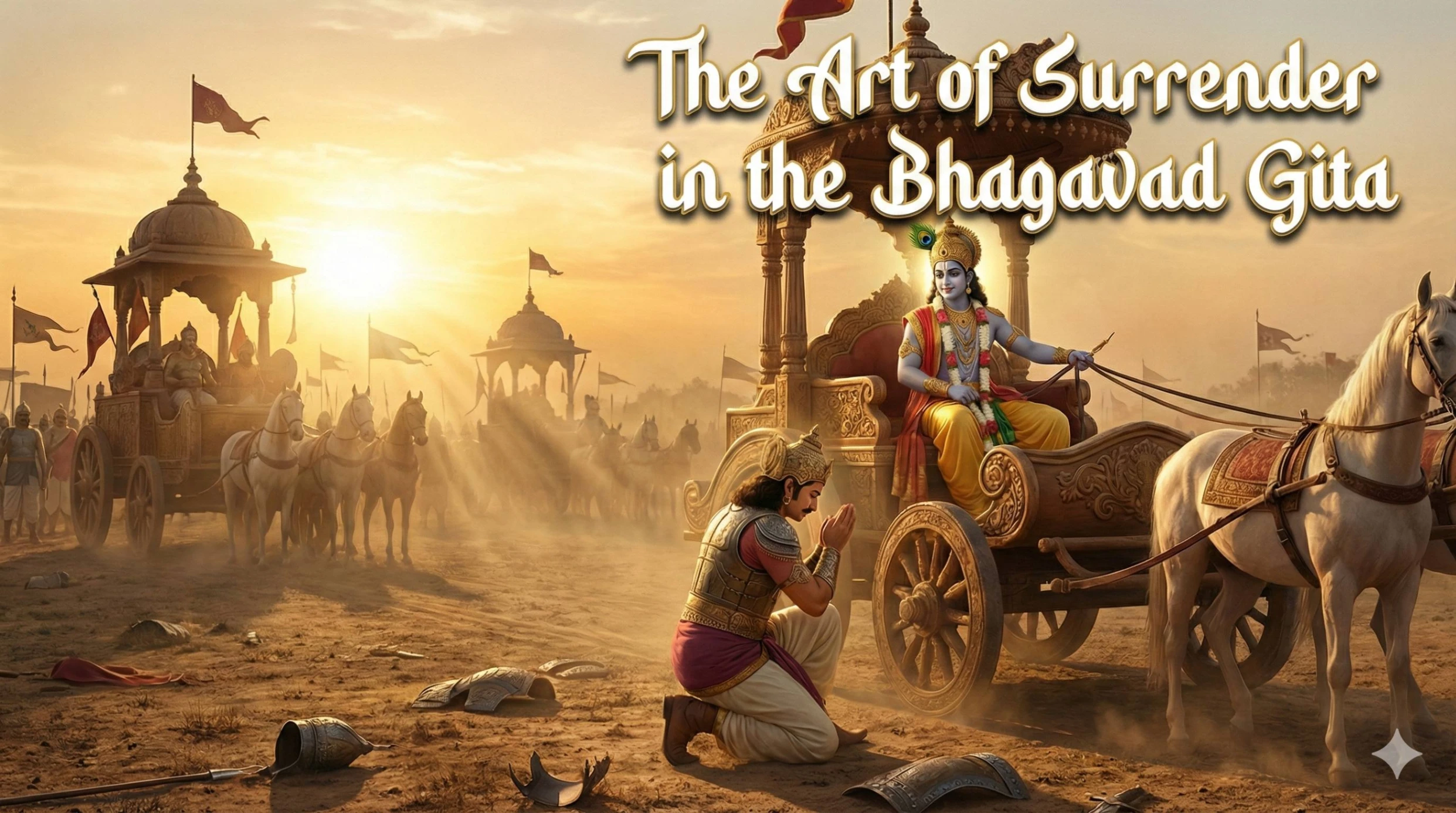
Krishna is the ultimate example of this. He plays the flute with Gopis, and he wields the Sudarshan Chakra in war. He sits casually on a tree, yet delivers the profound wisdom of the Gita. He engages in the fierce war of Mahabharata, yet remains untouched by it.
Takeaway: Your role is to be a skilled actor. Perform your duties parent, employee, leader with total intensity, but do not let the role consume your inner peace.
2. The Great Illusion of "Doership" (Akarta)
Why do we feel stress? It is because we believe we are the ones doing everything. We carry the weight of being the "Doer" (Karta).
The Gita teaches a revolutionary concept: You are not the Doer.
"Actions are performed by the modes of nature (Gunas—Sattva, Rajas, Tamas). But the deluded soul believes, 'I am the doer.'"
The Witness Consciousness (Sakshi Bhav)
Think about the act of walking. Your legs move, your nerves fire, and your breath regulates itself. You, the conscious spirit, are merely the Witness of this walking.
You are the screen; the movie is playing on you.
You are the sky; the clouds (thoughts and actions) pass through you.
When you realize you are just the medium an instrument of the Divine— the ego dissolves. If the result is good, it belongs to existence. If the result is bad, that too belongs to the flow of nature. You are free.
3. The Science of Surrender (Samarpan)
Surrender is often misunderstood as weakness. In the art of surrender in the Bhagavad Gita, it is the ultimate strength.
Surrender does not mean inaction. It means acting without the anxiety of the future. Krishna advises:
Do your work (Karma).
Let go of the outcome (Phala).
Why Future-Thinking Kills Joy
When you are obsessed with the result (the fruit), your energy leaves the present moment and travels to the future.
You are working now, but your mind is on tomorrow.
This split energy creates anxiety and reduces your efficiency.
True joy is found only in the present. Think of when you are lost in music, deep in dance, or in love. In those moments, you forget the future. You are totally "Here." That is the state of surrender.
4. God as the Dancer, Not the Potter
Most religions describe God as a "Creator" like a potter making a pot. The potter is separate from the pot. If the pot breaks, the potter remains.
However, the Gita offers a more intimate view. God is not the Potter; God is the Dancer.
You cannot separate the dancer from the dance. If the dancer stops, the dance vanishes. The universe is Krishna’s dance. He is in every atom, every crisis, and every joy.
Sarva-Swikar: Total Acceptance To worship Krishna is to worship existence itself. It requires Sarva-Swikar (Total Acceptance).
Accept what life brings.
Believe that the universe has infinite wisdom.
Trust that even difficulties are part of the divine choreography meant for your growth.
5. How to Practice Surrender: The Role of Meditation
You cannot force surrender. You cannot say, "I am going to surrender now," because the "I" (ego) is still there trying to control it.
Surrender is a shadow of Meditation.
The Racing Mind: Your mind is constantly running toward the past or future. A running mind cannot surrender.
The Still Mind: Through meditation, the mind slows down.
The Occurrence: When the mind is still, you naturally realize your connection to the Whole. You feel held by existence, like a child in a mother's arms.
The Ultimate Secret: Transform your life into a Yajna (sacrifice). Not just burning wood in a fire, but burning your ego in the fire of awareness. When you offer your ego to the Divine, life becomes a celebration.
Life doesn't have to be a burden. By shifting your perspective to see life as a Leela— a divine play, you reclaim your energy.
Remember the core formula for the art of surrender in the Bhagavad Gita:
Act entirely in the present.
Drop the worry about the future.
Witness the drama without getting lost in it.
When you live this way, anxiety dissolves, and what remains is the pure, unadulterated joy of being alive.