

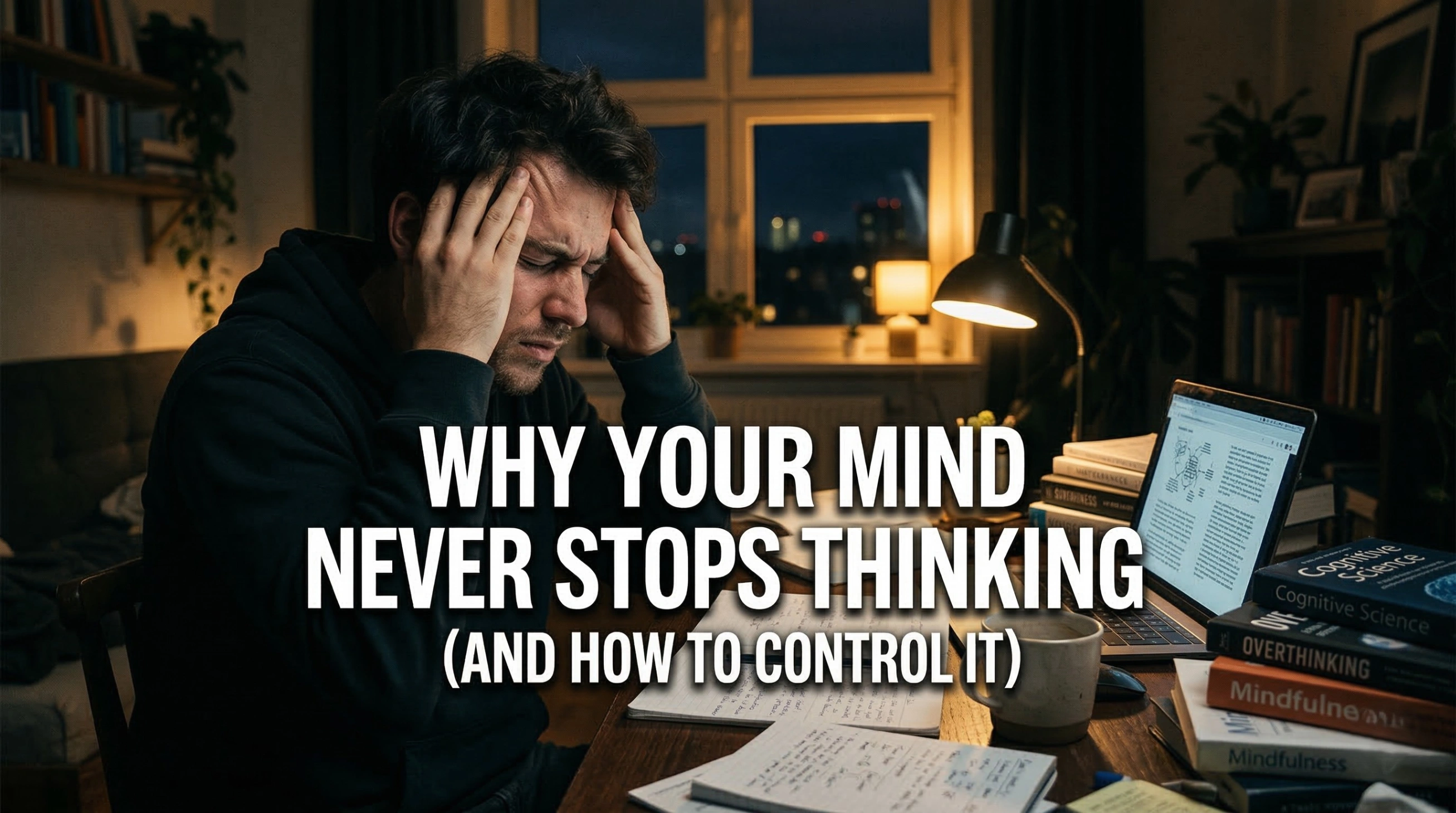
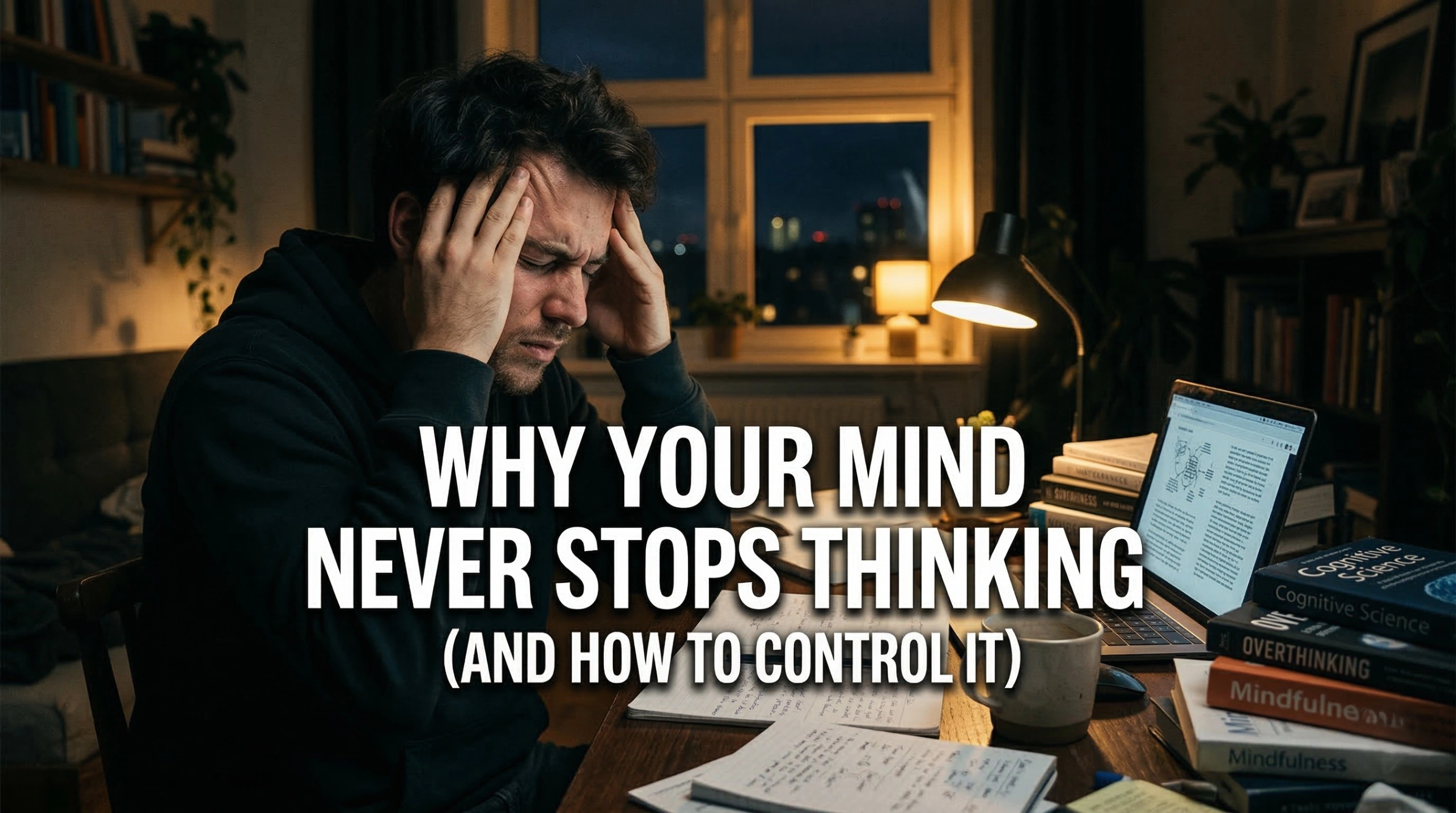
Have you ever wondered why your mind never stops thinking, even when you want it to? Many people struggle with constant thoughts in the mind, especially at night when the brain seems to replay worries, memories, and possibilities endlessly. This experience is often linked to overthinking, a common psychological pattern where the mind repeatedly analyzes situations, fears, and imagined outcomes.
Understanding overthinking meaning is the first step toward learning how to stop overthinking and gain control over your thoughts. While thinking is a natural function of the brain, uncontrolled mental chatter can lead to anxiety, stress, and emotional exhaustion. The good news is that by understanding the psychology of overthinking and learning practical techniques, you can train your mind to become calmer and more focused.
Let’s explore why the mind keeps thinking, what causes mental chatter, and how to control thoughts effectively.
What Is Overthinking?

In simple terms, overthinking means repeatedly analyzing the same thoughts, problems, or possibilities without reaching a conclusion. It often involves worrying about the future, replaying past events, or imagining negative outcomes.
From a psychological perspective, overthinking psychology explains that the brain tries to solve problems by thinking. However, when the mind keeps searching for answers that don’t exist, it creates mental clutter and emotional stress.
Common signs of overthinking include:
Constant thoughts in the mind
Difficulty sleeping due to racing thoughts at night
Replaying conversations or mistakes repeatedly
Imagining worst-case scenarios
Feeling mentally exhausted
These patterns are often connected to overthinking and anxiety, where the brain attempts to protect us by predicting possible threats.
Why Your Mind Never Stops Thinking
Many people ask, “Why my mind never stops thinking?” The answer lies in how the brain works.
The human brain is designed to think constantly. Even when we are resting, the brain’s default mode network remains active, processing memories, emotions, and future possibilities.
Several psychological factors contribute to nonstop thinking.
1. The Brain Is Designed to Solve Problems
Our brain evolved to detect risks and solve problems. This is why the brain keeps thinking even when no immediate action is needed.
When the brain perceives uncertainty, it continues analyzing situations repeatedly. This often leads to obsessive thinking or mental loops.
2. Anxiety and Emotional Stress
Overthinking and anxiety are closely connected. When we feel uncertain or worried, the mind tries to predict every possible outcome.
This creates racing thoughts, especially at night when distractions disappear.
Many people experience overthinking at night, where worries about work, relationships, or the future become amplified.
3. Fear of Making the Wrong Decision
One of the biggest reasons we overthink everything is fear.
Fear of failure, rejection, or making mistakes can cause the brain to analyze decisions repeatedly. This leads to fear-based decision making, where thinking replaces action.
4. Subconscious Mind Patterns
Many of our thoughts come from the subconscious mind. Beliefs formed during childhood, past experiences, or emotional conditioning influence how we think.
If the subconscious mind is programmed with worry or fear, the brain naturally produces constant negative thoughts.
Understanding the connection between the subconscious mind and thoughts is crucial for long-term mental clarity.
Symptoms of Overthinking
Recognizing symptoms of overthinking can help you identify when your mind is stuck in a thinking loop.
Common signs include:
Mental chatter that never stops
Difficulty relaxing or focusing
Constant worrying about the future
Replaying past events repeatedly
Trouble sleeping due to racing thoughts
Feeling mentally drained or overwhelmed
When these patterns continue for long periods, they create mental clutter, making it harder to focus or feel calm.
Why Thoughts Keep Coming
Many people wonder why thoughts keep coming, even when they try to stop them.
The truth is that thoughts are automatic mental processes. Trying to forcefully stop thinking often makes thoughts stronger.
Psychologists explain this through a concept called thought suppression. When we try to push thoughts away, the brain interprets them as important and keeps bringing them back.
This is why techniques that focus on observing thoughts rather than fighting them are more effective.
How to Stop Overthinking

Learning how to stop thinking too much requires training the mind, not suppressing it.
Here are some practical techniques that can help reduce overthinking.
1. Practice Mindfulness
Mindfulness for overthinking is one of the most effective ways to calm the mind.
Mindfulness teaches you to observe thoughts without reacting to them. Instead of trying to stop thoughts, you simply notice them and let them pass.
This gradually reduces mental chatter.
Even a few minutes of daily mindfulness can help quiet the mind and improve emotional balance.
2. Meditation for Overthinking
Meditation for overthinking helps train the brain to focus on the present moment.
During meditation, you bring attention to your breath or body sensations. Whenever thoughts arise, you gently return your focus.
Over time, this practice strengthens your ability to control the mind.
Meditation also helps reduce stress, improve concentration, and promote inner calm.
3. Challenge Negative Thoughts
Many overthinking patterns come from negative thought loops.
Ask yourself:
Is this thought based on facts or assumptions?
Am I imagining worst-case scenarios?
Will this situation matter in five years?
This process helps control negative thoughts and break unnecessary thinking patterns.
4. Train Your Mind Through Action
Sometimes the best way to stop obsessive thinking is to shift attention to meaningful action.
When the mind becomes absorbed in productive activities such as exercise, creative work, or learning, the brain naturally reduces unnecessary thinking.
This is a powerful way to train your mind and improve focus.
5. Reduce Mental Clutter
Just like physical clutter creates chaos in a room, mental clutter creates chaos in the mind.
Writing down your thoughts can help organize them. Journaling allows you to release worries from the mind onto paper.
This technique is effective for clearing the mind from unwanted thoughts.
6. Improve Sleep and Relaxation
Many people experience intense racing thoughts at night because the brain finally slows down enough to notice hidden worries.
Creating a relaxing bedtime routine can help calm the mind.
Helpful habits include:
Avoiding screens before sleep
Practicing deep breathing
Reading or journaling
Gentle stretching or meditation
These practices help relax the mind and improve sleep quality.
How to Discipline Your Mind
Controlling the mind is not about eliminating thoughts. Instead, it involves developing awareness and discipline.
Learning how to discipline your mind takes consistent practice.
Simple habits can make a significant difference:
Daily meditation or mindfulness
Limiting unnecessary distractions
Spending time in nature
Practicing gratitude
Reducing exposure to constant information
These practices gradually help focus the mind and improve emotional stability.

The Goal Is Not to Stop Thinking
It is important to understand that the goal is not to stop thinking completely.
Thinking is a natural function of the brain. The real goal is to develop a healthier relationship with thoughts.
When you learn how to calm the mind, thoughts no longer control you. Instead, you observe them with clarity and choose which ones deserve attention.
This shift creates mental freedom and emotional balance.
If you have ever wondered why your mind never stops thinking, remember that you are not alone. Overthinking is a natural mental habit that many people experience.
By understanding the psychology of overthinking and learning practical techniques like mindfulness, meditation, and conscious awareness, you can gradually reduce mental noise.
Over time, these practices help quiet the mind, control thoughts, and bring greater clarity to your life.
A calm mind does not mean a silent mind. It means a mind that is aware, balanced, and under your control.
If you want to understand your mind, control your thoughts, and transform your inner life, explore the Design Your Destiny program by Sakshi Shree.
This powerful journey helps you understand the subconscious mind, emotional patterns, and deeper awareness, so you can move from confusion to clarity and from overthinking to conscious living.