
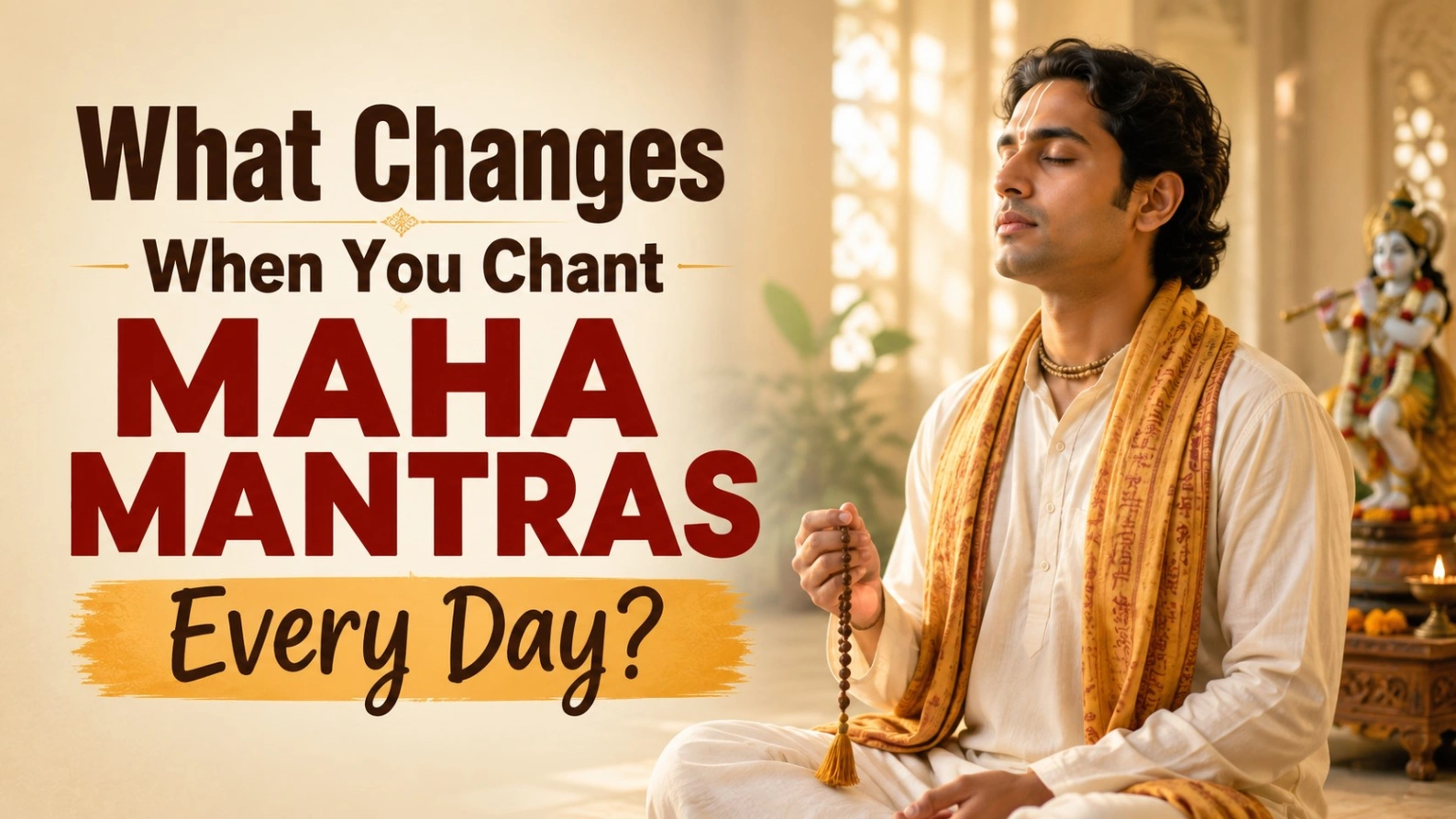
Have you ever wondered what changes when you practise Maha Mantra chanting every day? At first, the experience may appear simple. You sit quietly, repeat sacred words and focus your attention on their sound. However, with regular practice, chanting can gradually influence the way you think, feel, react and connect with yourself.
The benefits of chanting mantras are not always dramatic or immediate. For many people, the changes appear subtly. The mind may feel calmer, reactions may become less intense and a greater sense of inner stability may develop. Over time, daily mantra chanting can become more than a spiritual ritual. It can become a powerful practice for mindfulness, self-awareness and emotional balance.
A Maha Mantra is traditionally understood as a great or highly revered mantra. The word “maha” means great, while “mantra” refers to a sacred sound, word or phrase used to focus the mind. Different spiritual traditions may use different Maha Mantras, but the purpose is often similar: to direct the mind towards a higher awareness and away from constant mental distraction.
Why Does Daily Mantra Chanting Feel So Powerful?
The human mind is rarely silent. It continuously moves between memories, plans, fears, expectations and unfinished thoughts. This mental activity can make it difficult to feel peaceful, even when nothing is wrong externally.
Mantra chanting gives the mind a single, meaningful point of focus. When you repeat a mantra consistently, your attention begins to move away from scattered thinking and towards the sound, rhythm and intention of the chant.
This is one reason mantra meditation is often easier for beginners than trying to sit in complete silence. Instead of forcing the mind to stop thinking, chanting gently occupies it with a steady spiritual sound.
The power of mantras is not only connected to repetition. Intention, awareness, pronunciation, devotion and consistency all influence the experience. Chanting mechanically may still help create concentration, but chanting with attention and sincerity can make the practice feel more personal and transformative.
Design Your Destiny
Your outer life often reflects the thoughts, beliefs and patterns operating within you. Through the Design Your Destiny program, discover practical spiritual tools to develop clarity, overcome limiting patterns and create a more conscious direction for your life.
Start Your Journey Today!1. Your Mind May Become Calmer
One of the first effects of mantra chanting that people commonly notice is a calmer mental state. During chanting, the mind receives fewer opportunities to jump from one thought to another.
This does not mean that every thought disappears. Thoughts may still arise, but the mantra gives you something stable to return to.
With regular daily mantra meditation, you may begin to notice that the mind settles more quickly after stressful situations. You may also become more aware of unnecessary thinking before it develops into overthinking.
Mantra chanting for inner peace works gradually. The purpose is not to fight your thoughts but to reduce your attachment to them. You learn to observe mental activity without being controlled by every thought that appears.
2. Your Emotional Reactions May Become More Balanced
Daily mantra chanting may also change the way you respond emotionally. When the mind is constantly overstimulated, small situations can trigger irritation, fear, impatience or sadness.
A regular chanting practice creates a pause between an external situation and your reaction to it. This pause allows you to respond with greater awareness.
You may still experience strong emotions, but they may not dominate you for as long. Over time, you may find it easier to calm yourself, understand what you are feeling and choose a more thoughtful response.
This is one of the most valuable mantra chanting benefits. It does not remove every difficulty from life. Instead, it may help you face difficulties with greater inner stability.
3. Your Concentration May Improve
Maha Mantra chanting requires you to stay connected to the sound, rhythm and meaning of the mantra. Each time the mind wanders, you gently bring it back.
This repeated return strengthens concentration. It trains the mind to remain with one activity instead of constantly looking for another source of stimulation.
People who practise mantra meditation regularly may notice that they can focus more deeply during work, reading, prayer or meditation. The improvement may be gradual, but the habit of returning to the mantra can support better attention in daily life.
For mantra chanting for beginners, even five to ten minutes of focused practice can be a meaningful starting point.
4. You May Feel More Positive and Grounded
Many people practise mantra chanting for positive energy. In spiritual language, this may refer to feeling lighter, more hopeful, protected or internally balanced.
From a practical perspective, beginning or ending the day with a sacred mantra can influence your mental direction. Instead of starting the morning with stress, notifications or worrying thoughts, you create a few moments of intentional stillness.
This does not mean that chanting will instantly solve every problem or remove all negative energy. However, it may help you stop feeding negative thought patterns continuously.
As the practice deepens, you may become more selective about the thoughts, conversations and environments that influence your inner state.

5. Your Breath May Become Slower and More Rhythmic
Chanting naturally works with the breath. When you repeat a mantra aloud, your exhalation often becomes longer and more controlled.
A slower rhythm of breathing can help the body move towards a calmer state. This is one reason chanting may feel relaxing after a stressful day.
When the breath becomes steady, the mind often follows. You may feel less restless and more present in your body.
Chanting does not need to be loud. It can be practised aloud, softly, in a whisper or mentally. Beginners may find audible chanting helpful because the sound makes it easier to maintain attention and rhythm.
6. Your Self-Awareness May Increase
Daily mantra chanting creates a regular opportunity to observe yourself. You begin to notice how active your mind is, which thoughts repeatedly return and what emotions are present beneath the surface.
This awareness is an important part of spiritual growth through mantra chanting. Before transformation can happen, awareness must develop.
You may realise that certain reactions come from fear, insecurity, attachment or past experiences. The mantra does not force these patterns to disappear. Instead, it gives you a calmer space from which to see them.
This increased awareness can influence your relationships, decisions and habits. You may become more conscious of what you say, how you respond and where you direct your energy.
7. Your Connection With Spirituality May Deepen
For many practitioners, Maha Mantra chanting is not only a method of relaxation. It is an expression of devotion and a way of connecting with the Divine.
Sanskrit mantra chanting and Vedic mantra chanting have been part of spiritual traditions for generations. Sacred mantras are often repeated during prayer, meditation, worship and personal spiritual practice.
When you chant consistently, the mantra may begin to feel familiar and deeply personal. It may accompany you during moments of uncertainty, gratitude, fear or joy.
The spiritual benefits of chanting often emerge through this relationship. You may begin to feel less alone, more trusting and more connected to a presence greater than your individual concerns.

8. You May Become Less Attached to Negative Thoughts
Negative thoughts become powerful when they are repeated without awareness. A person may repeatedly think, “I am not capable,” “Nothing will improve” or “Something will go wrong.”
Daily mantra chanting introduces a different pattern of repetition. Instead of strengthening fearful thinking, you repeat a sacred sound associated with peace, devotion, strength or surrender.
This does not mean you should ignore real problems or replace practical action with chanting. However, chanting may help you approach problems without constantly increasing fear around them.
When people ask, “Can mantra chanting remove negative energy?” a balanced answer is that chanting may help reduce the mental and emotional patterns that make negativity feel overwhelming. External challenges may remain, but your relationship with them can change.
9. Your Daily Routine May Become More Disciplined
A daily spiritual practice strengthens consistency. When you choose a specific time for Maha Mantra chanting, you create a commitment to your inner well-being.
Even a short practice requires discipline. Some days the mind will feel peaceful, while on other days it will feel distracted or impatient. Continuing the practice without depending on mood develops inner strength.
This discipline can gradually influence other areas of life. You may become more regular with sleep, meditation, exercise, reading or mindful eating.
The deeper lesson is that transformation often comes through small practices repeated consistently.
What Happens After Chanting Mantras for 21 Days?
Many people search for what happens after chanting mantras for 21 days. There is no universal result that applies to everyone. Your experience depends on your consistency, intention, lifestyle, emotional state and the mantra you practise.
After 21 days, you may notice that chanting feels easier and more natural. The mind may settle more quickly, and the mantra may begin to arise spontaneously during stressful moments.
Some people notice better concentration, emotional calm or a stronger desire to continue their spiritual routine. Others may experience only subtle changes.
It is important not to chant with unrealistic expectations. A 21-day practice can help establish a habit, but spiritual development does not follow a fixed timetable.
What Happens When You Chant a Mantra 108 Times?
The number 108 holds spiritual significance in several Indian traditions, which is why a mala commonly contains 108 beads.
Chanting a mantra 108 times can create a longer period of uninterrupted focus. Repetition may help the mind move beyond its initial restlessness and enter a deeper state of concentration.
However, the number alone does not guarantee a particular result. Chanting 108 times with awareness is generally more meaningful than rushing through the repetition without attention.
Beginners can start with 11 or 21 repetitions and gradually increase the count. The correct way to chant Maha Mantras is with comfort, respect, steady breathing and sincere attention.
What Is the Best Time to Chant Maha Mantras?
The best time to chant is a time you can follow consistently.
Many spiritual practitioners prefer the early morning because the environment is usually quieter and the mind is less occupied. Morning chanting may also help set a peaceful intention for the day.
Evening chanting can help you release accumulated stress. Chanting before sleep may quiet mental activity and create a calmer transition into rest.
You can choose one fixed time or chant briefly at different points throughout the day. Consistency is more important than choosing a supposedly perfect time and then being unable to maintain it.
How Long Should You Chant a Mantra Daily?
Beginners can start with five to ten minutes. Once the practice feels comfortable, it can gradually be increased to fifteen, twenty or thirty minutes.
You can also use a mala and complete one round of 108 repetitions.
Avoid forcing yourself to chant for a long duration simply to achieve faster results. A short, attentive practice is more valuable than a long session filled with discomfort or impatience.
Daily mantra chanting works best when it becomes sustainable, peaceful and meaningful.
Signs That Mantra Chanting Is Working
The signs that mantra chanting is working may appear in your behaviour rather than through extraordinary experiences.
You may notice that you react less impulsively, recover from stress more quickly or feel more comfortable sitting quietly. You may become more patient, compassionate and aware of your thoughts.
You may also remember the mantra naturally during difficult moments. This shows that the practice is becoming part of your inner response system.
Spiritual growth is not always visible through dramatic visions or sensations. Often, it appears as greater peace, clarity, humility and emotional balance.
Popular Maha Mantras and Sacred Chants
Different mantras are associated with different spiritual traditions and intentions.
The Gayatri Mantra is widely chanted for wisdom, clarity and spiritual illumination. The Maha Mrityunjaya Mantra is traditionally associated with healing, protection and inner strength.
Om Namah Shivaya is a sacred chant connected with Lord Shiva and is often repeated for peace, purification and devotion. Om chanting is commonly used in meditation to create focus and inner stillness.
The Hare Krishna Maha Mantra is a devotional chant centred on remembering and connecting with the Divine.
Choose a mantra respectfully and understand its meaning as much as possible. Learning from a knowledgeable spiritual teacher can be helpful, especially when the mantra belongs to a specific tradition or practice.
What changes when you chant Maha Mantras every day? The most meaningful changes may happen gradually within your mind, emotions, habits and awareness.
You may feel calmer, more focused and less controlled by negative thoughts. Your breathing may become steadier, your reactions may become more balanced and your connection with spirituality may deepen.
Maha Mantra chanting is not a shortcut that removes every problem. It is a daily practice that may change the way you face those problems.
Approach chanting without pressure. Begin with a few sincere minutes, choose a mantra that resonates with you and allow the practice to develop naturally. With patience and consistency, sacred repetition can become a steady source of peace, strength and spiritual direction.
Personal Session
Book a personal session for individual guidance based on your present situation. Receive practical insights to understand your inner patterns, gain clarity and move forward with greater peace, confidence and awareness.
Book Now