
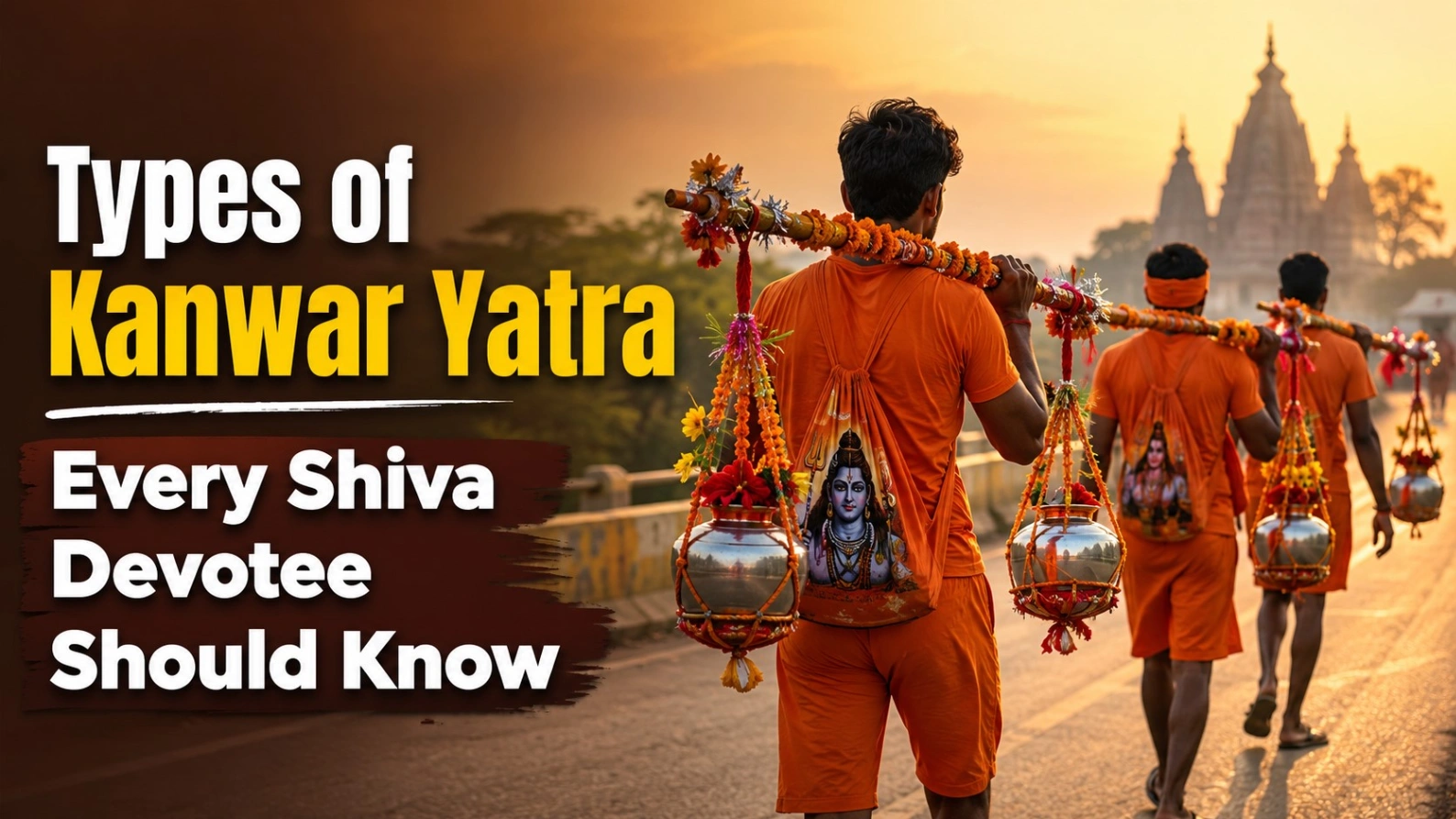
The Kanwar Yatra is one of the most powerful and visible expressions of Shiva bhakti during the sacred Shravan month. Kanwariyas travel to holy water sources, especially the River Ganga, collect Gangajal in decorated vessels and carry it in a Kanwar to a Shiva temple. The journey is completed when the sacred Ganga water is offered to Lord Shiva through Jalabhishek.
The pilgrimage is closely associated with devotion, discipline, surrender and gratitude toward Lord Shiva. Government-owned Akashvani News describes Kanwariyas carrying sacred Ganga water from Haridwar to Shiva temples across India for Jalabhishek during Shravan.
Although people generally refer to it as one pilgrimage, there are several types of Kanwar Yatra. These forms differ according to the pace of the journey, the method of carrying the Kanwar, resting rules and the level of physical austerity involved.
The most widely discussed categories are Samanya Kanwar, Dak Kanwar, Khadi Kanwar and Dandi Kanwar. Other names, such as Jhula Kanwar and Baithi Kanwar, are also used in certain regions or traditions. Because local terminology may differ, devotees should always understand the customs followed by their Kanwar group, temple and route.
What Is a Kanwar?
A Kanwar is traditionally a balanced structure made with a pole and two containers suspended from its ends. The containers hold sacred water collected from the Ganga or another holy river.
The Kanwar is carried across the shoulders as the devotee travels toward a Shiva temple. Kanwariyas may collect water from Haridwar, Gangotri, Gaumukh, Sultanganj or another locally respected pilgrimage centre.
The pilgrimage takes its name from this sacred water-carrying structure. The people who carry it are known as Kanwariyas, Shiv Bhakts or devotees of Lord Shiva.
For a devotee, the Kanwar is not merely a physical object. It represents a sankalp, or sacred resolve. Carrying it becomes an act of discipline, prayer, service and surrender.
Shiv Kavar Samiti describes the Kanwar as a shoulder pole carrying two sealed pots of sacred water, which devotees transport to perform Jalabhishek on a Shivling.
Design Your Destiny
The Kanwar Yatra reminds us that every meaningful transformation begins with a clear sankalp. Your outer circumstances may change, but lasting fulfilment begins when you understand your thoughts, emotions and inner consciousness. Join Design Your Destiny and discover practical spiritual wisdom to overcome limiting patterns, develop inner clarity and consciously create a more peaceful and purposeful life. Begin Your Journey of Inner Transformation Today
Start Your Journey Today!Why Are There Different Types of Kanwar Yatra?
Every devotee has a different physical capacity, spiritual vow, route and support system. As a result, different ways of performing the pilgrimage have developed.
Some Kanwariyas walk at a steady pace and take regular breaks. Others ensure that their Kanwar remains standing throughout the journey. Dak Kanwariyas move quickly, often in relay groups, while Dandi Kanwariyas complete the route through repeated full-body prostrations.
Several contemporary descriptions divide the pilgrimage into four principal forms:
Samanya or normal Kanwar
Dak Kanwar
Khadi or standing Kanwar
Dandi or Dand Kanwar
These four broad categories are also listed by GNT and Shiv Kavar Samiti.
However, classifications are not completely standardized throughout India. Names such as Baithi Kanwar, Jhula Kanwar, normal Kanwar and simple Kanwar may overlap or carry different meanings in different regions.
1. Samanya Kanwar or Normal Kanwar Yatra
The Samanya Kanwar is one of the most common and accessible forms of Kanwar Yatra. It is also called normal Kanwar Yatra, simple Kanwar Yatra or general Kanwar Yatra.
In this form, devotees walk at a manageable pace and may stop at designated camps to rest, sleep, eat or receive medical assistance. After resting, they continue their journey toward the chosen Shiva temple.
The Kanwar should still be handled respectfully. Devotees generally keep it on a proper Kanwar stand, elevated platform or designated support instead of placing it directly on bare ground.
GNT describes Samanya Kanwar as a journey in which pilgrims may stop along the route, rest overnight at camps and later continue toward a Shiva temple for Jalabhishek.
Who Can Choose Samanya Kanwar?
Samanya Kanwar is generally more practical for:
First-time Kanwariyas
Older devotees
Families travelling together
Devotees covering long distances
People who require regular rest
The word “simple” does not mean that the pilgrimage has less spiritual value. Shiva bhakti is measured through sincerity, discipline, humility and pure intention are not only through speed or physical hardship.
2. Baithi Kanwar
Baithi Kanwar is closely connected with the resting or common form of Kanwar Yatra. The term “Baithi” refers to sitting or resting.
Devotees performing Baithi Kanwar may pause during the journey, provided the Kanwar is respectfully placed on a proper stand or raised platform. The sacred water should remain protected and should not be handled carelessly.
Shiv Kavar Samiti describes Baithi Kanwar as another name for the Samanya or common Kanwar. It allows devotees to stop, eat and sleep while keeping the Kanwar on an appropriate stand rather than bare earth.
Baithi Kanwar is often considered suitable for beginners because it offers sufficient time for recovery, prayer and route preparation.
Some traditions treat Samanya and Baithi Kanwar as almost identical, while others make a small distinction between them. Devotees should therefore follow their group’s local customs.
3. Khadi or Khari Kanwar Yatra
Khadi Kanwar, also written as Khari Kanwar, is commonly known as the standing Kanwar Yatra.
In this form, the Kanwar is kept standing, upright or continuously supported. It is not casually placed down when the devotee takes a break.
When the main Kanwariya needs to rest, eat or attend to another necessity, a companion may hold the Kanwar. Some groups use an elevated support according to their traditional rules.
GNT describes Khadi Kanwar as a form in which a supporting companion stays with the pilgrim and keeps the Kanwar upright while the principal bearer rests.
Spiritual Meaning of Khadi Kanwar
Khadi Kanwar represents:
Continuous awareness
Unbroken remembrance of Shiva
Alertness and responsibility
Stability during hardship
Cooperation among devotees
This type requires greater coordination than normal Kanwar Yatra. The bearer and companions must protect the balance of the sacred water while travelling through crowded roads, rain, uneven terrain and pilgrimage camps.
A devotee should understand the rules carefully and travel with dependable companions before choosing this form.
4. Dak Kanwar or Relay Kanwar Yatra
Dak Kanwar is the fast-moving form of Kanwar Yatra. It is also associated with relay Kanwar Yatra because groups may take turns carrying the sacred water toward the destination.
Dak Kanwariyas often move quickly, run or walk briskly. Their objective is to carry the Gangajal to the Shiva temple within a comparatively short period.
Unlike the slower Samanya Kanwar, long resting breaks are generally avoided. The journey may continue through coordinated teams consisting of runners, route coordinators and supporting companions.
GNT describes Dak Kanwar as a demanding form in which devotees travel continuously and may hand the Kanwar to another member of the group when tired.
What Makes Dak Kanwar Difficult?
Dak Kanwar requires:
High physical stamina
Strong team coordination
Route planning
Hydration and nutrition management
Continuous attention
Awareness of traffic and crowd conditions
Speed should never become an excuse for unsafe conduct. Shiva bhakti does not justify creating danger for local residents, road users or fellow pilgrims.
Dak Kanwar groups should respect designated routes, traffic diversions, local authorities and the dignity of the pilgrimage.
5. Dand Kanwar or Dandi Kanwar Yatra
Dand Kanwar, also called Dandi Kanwar or Dandvat Kanwar, is considered one of the most physically demanding types of Kanwar Yatra.
In this form, the devotee covers the pilgrimage route through repeated full-body prostrations. The Kanwariya lies down, marks the point reached by the body, stands up, moves to that point and repeats the process.
The entire distance is effectively measured using the length of the devotee’s body.
Both GNT and Shiv Kavar Samiti describe Dandi Kanwar as an austere form in which the route is completed through continuous prostrations.
Spiritual Meaning of Dandi Kanwar
Dandi Kanwar symbolizes:
Complete surrender
Patience
Tapasya or austerity
Reduction of ego
Unwavering faith
Acceptance of hardship
Because progress is extremely slow, the pilgrimage can require significantly more time than an ordinary walking yatra.
The devotee may face heat, rain, rough roads, fatigue and physical strain. Supporting companions may help with food, the Kanwar, route management and safety.
This form should not be treated as a competition. Anyone considering Dandi Kanwar should seek experienced guidance, assess their health and prepare physically.
6. Jhula Kanwar
Jhula Kanwar generally takes its name from the hanging or swing-like structure used to carry the sacred water.
In this design, vessels containing Gangajal hang from the ends of a decorated bamboo or wooden structure. The balanced containers may appear to swing gently while the Kanwariya walks.
Some Jhula Kanwars are decorated with:
Saffron cloth
Flowers
Bells
Trishul symbols
Images of Lord Shiva
Om and Bol Bam designs
The term is not used uniformly throughout India. Some sources classify Jhula Kanwar as a separate type, while widely cited four-part classifications focus on Samanya, Dak, Khadi and Dandi Kanwar. This suggests that Jhula Kanwar may sometimes describe the design or regional style of the Kanwar rather than a completely separate vow.
The devotee must maintain proper balance so that the Gangajal remains secure throughout the journey.
Difference Between the Main Kanwar Yatra Types
Samanya or Baithi Kanwar
The devotee may take planned breaks and rest while keeping the Kanwar on a proper stand.
Khadi Kanwar
The Kanwar remains standing, upright or continuously supported, even while the main bearer rests.
Dak Kanwar
The journey is completed quickly through continuous movement or relay-style coordination.
Dandi Kanwar
The devotee covers the route through repeated full-body prostrations.
Jhula Kanwar
The name commonly refers to a hanging or swing-like Kanwar structure and may represent a regional design.
Which Is the Most Difficult Type of Kanwar Yatra?
Dandi Kanwar is generally considered one of the most austere forms because devotees cover the route through repeated prostrations.
However, difficulty can be measured in different ways.
Dak Kanwar requires speed, cardiovascular endurance and team coordination. Khadi Kanwar demands constant attention and support. Dandi Kanwar requires patience, physical endurance and much more time. Even a normal Kanwar Yatra can become difficult when the route is long or weather conditions are challenging.
The most demanding Kanwar is not automatically the most spiritually meaningful. Devotion depends on sincerity, discipline and responsible behaviour.
Common Kanwar Yatra Rules
Exact rules may vary according to the route, temple and Kanwar group. However, devotees commonly observe the following disciplines:
Handle the Kanwar and Gangajal respectfully.
Avoid placing the Kanwar directly on bare ground.
Follow a vegetarian and sattvic diet.
Avoid alcohol, tobacco and intoxicants.
Maintain personal cleanliness.
Use disciplined and respectful language.
Avoid anger, arguments and harmful behaviour
Respect other pilgrims and local residents.
Follow designated routes and official advisories.
Keep the journey spiritually focused.
Stay hydrated and seek medical help when required.
Avoid damaging roads, rivers or natural surroundings.
Traditional Kanwar discipline emphasizes purity of food, speech and mind, along with careful protection of the sacred water.
Which Kanwar Should a Beginner Choose?
A first-time devotee should generally consider Samanya or Baithi Kanwar with an experienced group.
These forms allow sufficient rest and give beginners time to understand:
How to carry and balance the Kanwar
Where to stop safely
How to protect the Gangajal
Which route to follow
How to prepare for Jalabhishek
What food and health precautions to take
Dak, Khadi or Dandi Kanwar should not be chosen merely because they appear more impressive.
The appropriate type depends on the devotee’s health, physical preparation, route, support system, spiritual resolve and guidance.
Spiritual Significance of Kanwar Yatra
The outer journey of the Kanwariya carries Gangajal toward a Shivling. The inner journey carries the mind from restlessness toward surrender.
The two balanced containers of the Kanwar may be understood as a reminder to maintain balance between:
Action and awareness
Effort and surrender
Discipline and compassion
Body and consciousness
Faith and responsibility
The hardship of the journey encourages a devotee to become aware of the body, thoughts and reactions.
Whether a person chooses Samanya, Baithi, Khadi, Dak, Dandi or Jhula Kanwar, the central purpose remains Shiva bhakti.
The pilgrimage becomes truly meaningful when chanting is accompanied by compassion, austerity by humility and faith by responsible conduct.
The different types of Kanwar Yatra represent different levels of pace, discipline, teamwork and physical austerity.
Samanya and Baithi Kanwar offer a steady and accessible path. Khadi Kanwar represents continuous attentiveness. Dak Kanwar expresses speed and coordinated effort. Dandi Kanwar reflects intense surrender and tapasya. Jhula Kanwar represents a distinctive hanging or decorative style found in some traditions.
Before beginning the journey, devotees should understand the rules followed by their group and route, assess their health honestly and prepare properly.
The true essence of Kanwar Yatra is not proving who can endure the greatest hardship. It is carrying Gangajal with devotion and offering it to Lord Shiva with a pure, disciplined and compassionate heart.
Personal Session
Every person’s inner journey is different. When confusion, emotional struggles or repeating life patterns become difficult to understand, personalised guidance can help bring clarity. Book a personal session to explore your challenges in a confidential and supportive space and receive spiritual guidance suited to your individual journey. Book Your Personal Session Today
Book Now