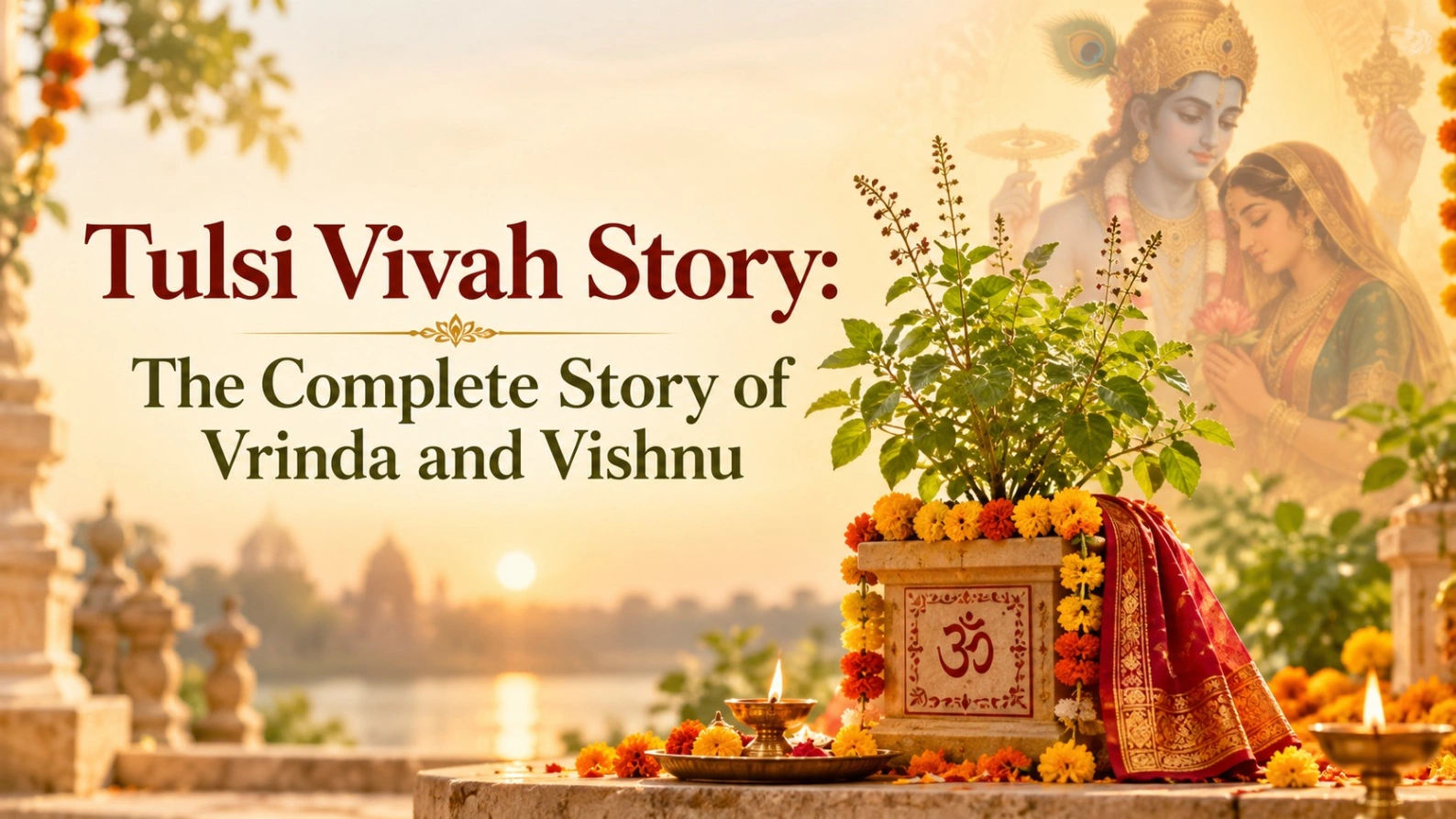
Tulsi Vivah is one of the most meaningful devotional traditions associated with Lord Vishnu and the sacred Tulsi plant. Celebrated during the auspicious period following Devutthana or Prabodhini Ekadashi, the festival symbolically marks the divine wedding of Goddess Tulsi and Lord Vishnu, commonly represented in the form of Shaligram.
Behind this joyous wedding ceremony lies a profound and emotional Tulsi Vivah story involving devotion, loyalty, divine intervention, loss, transformation and ultimately eternal union.
At the centre of the story is Vrinda, also known in many traditions as Brinda, a deeply devoted woman whose spiritual strength became so powerful that it influenced even the devas. Her story explains not only how Vrinda became Tulsi, but also why the Tulsi plant is considered sacred in Hindu households and why Tulsi is ceremonially married to Lord Vishnu.
Different scriptures and regional traditions narrate certain elements of the story differently. However, its central themes remain remarkably consistent: Vrinda's extraordinary devotion, Jalandhar's invincibility, Lord Vishnu's intervention, Vrinda's curse and her transformation into sacred Tulsi.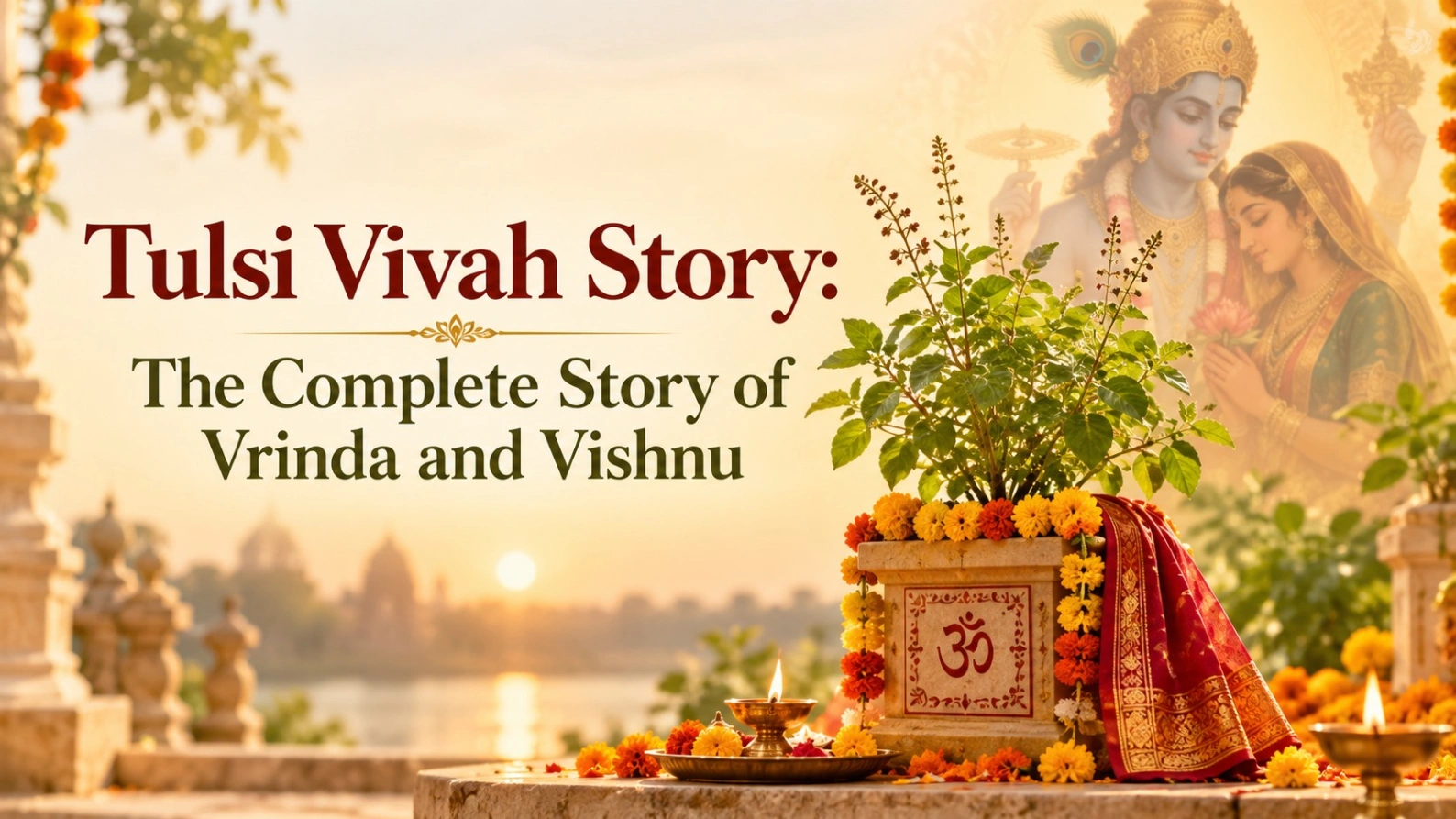
Who Was Vrinda in the Tulsi Vivah Story?
Vrinda was renowned for her purity, devotion and unwavering loyalty toward her husband, Jalandhar.
Jalandhar was an immensely powerful being whose strength posed a serious challenge to the devas. According to the traditional narrative, one of the major sources of his extraordinary protection was Vrinda's steadfast devotion and chastity.
Her spiritual discipline was so strong that as long as her vow remained unbroken, Jalandhar could not easily be defeated.
This is what makes the Vrinda and Vishnu story so significant. Vrinda was not simply a secondary character in Jalandhar's battle. Her devotion itself had become a force capable of influencing the course of cosmic events.
She was also a devoted worshipper of Lord Vishnu.
This created the central moral and emotional conflict of the story: how could Vishnu defeat someone protected by the devotion of one of His own devotees?
Design Your Destiny
Ready to Transform the Way You Experience Life? Ancient wisdom becomes truly powerful when you begin applying it to your everyday thoughts, relationships and decisions. With Design Your Destiny, discover practical spiritual principles that can help you move beyond fear, attachment and overthinking—and live with greater awareness, clarity and inner freedom. Begin your journey from reaction to awareness. Design Your Destiny from within.
Start Your Journey TodayThe Story of Jalandhar and Vrinda
Jalandhar eventually grew enormously powerful and entered into conflict with the devas.
His strength made him extremely difficult to defeat. The devas sought divine assistance, and the battle eventually became associated with Lord Shiva.
Yet defeating Jalandhar was not straightforward.
Vrinda's devotion created a spiritual shield around him. Her unwavering commitment to her husband was believed to sustain his protection.
As long as Vrinda's vow remained intact, Jalandhar continued to possess extraordinary strength.
The gods therefore faced an unusual dilemma.
The battle could not be won merely through weapons. The spiritual power supporting Jalandhar also had to be addressed.
Why Did Lord Vishnu Approach Vrinda?
This is one of the most searched questions connected with the Tulsi Vivah katha.
According to the popular version of the legend, Lord Vishnu assumed the appearance of Jalandhar and appeared before Vrinda.
Believing the figure before her to be her husband, Vrinda's unwavering state of devotion was disrupted. Once the spiritual protection surrounding Jalandhar was broken, he could be defeated.
When Vrinda eventually discovered what had happened, she was devastated.
The person she worshipped as Lord Vishnu had participated in an act that led to the defeat of her husband.
Her grief turned into anger.
Why Did Vrinda Curse Lord Vishnu?
After recognizing Lord Vishnu, Vrinda cursed Him.
Several retellings preserve the curse somewhat differently, but the most important tradition connects it with Shaligram, the sacred stone form in which Lord Vishnu continues to be worshipped.
The curse becomes an important turning point in the story because it transforms an episode of grief and betrayal into the foundation of a sacred relationship between Tulsi and Vishnu.
Lord Vishnu accepted the consequences of Vrinda's words and acknowledged the extraordinary spiritual power of her devotion.
Rather than allowing Vrinda's devotion to disappear, the tradition describes her becoming eternally revered.
How Did Vrinda Become the Tulsi Plant?
After the death of Jalandhar and the events involving Lord Vishnu, Vrinda's earthly life came to an end.
From her sacred presence emerged Tulsi, the holy basil plant that would eventually become one of the most revered plants in Hindu tradition.
This transformation explains the deeper meaning behind the Vrinda Tulsi story.
Tulsi is therefore not regarded merely as an ordinary plant. She is worshipped as Tulsi Devi, representing devotion, purity, surrender and spiritual dedication.
Lord Vishnu granted Tulsi an exalted position in worship.
In Vaishnava traditions especially, Tulsi leaves became closely associated with offerings made to Lord Vishnu and Krishna.
The relationship between Tulsi and Vishnu thus did not end with Vrinda's earthly suffering. It was transformed into an eternal spiritual relationship.
Why Did Lord Vishnu Marry Tulsi?
The symbolic marriage of Tulsi and Lord Vishnu can be understood as the completion of Vrinda's spiritual journey.
Tradition holds that Lord Vishnu promised that Tulsi would remain eternally dear to Him.
This promise is ritually expressed through Tulsi Vivah, in which the Tulsi plant is ceremonially married to Lord Vishnu, Krishna or Shaligram.
Shaligram represents Lord Vishnu, while the Tulsi plant represents Goddess Tulsi or Vrinda.
Their union therefore symbolizes the meeting of devotion and the Divine.
This is why the answer to "Why did Lord Vishnu marry Tulsi?" goes deeper than a literal wedding story.
Tulsi Vivah signifies that genuine devotion ultimately becomes inseparable from the Divine.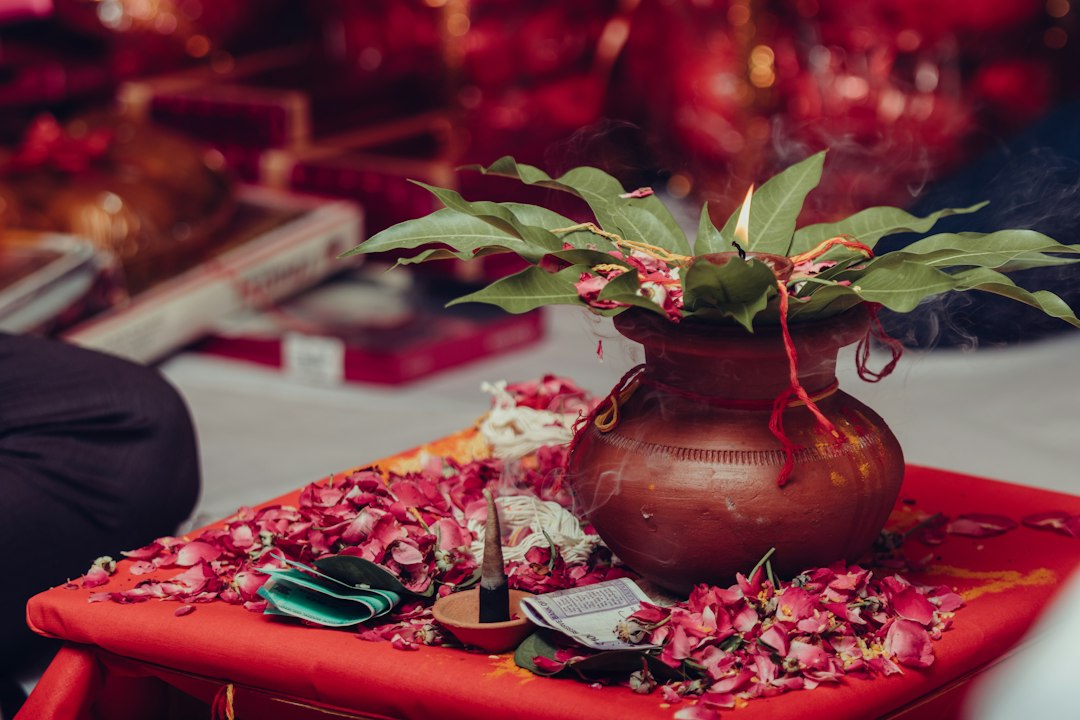
Why Is Tulsi Married to Shaligram?
During Tulsi Vivah, many households conduct the wedding between a beautifully decorated Tulsi plant and Shaligram, the sacred stone worshipped as a form of Lord Vishnu.
This custom reflects the connection between Vrinda's curse and Lord Vishnu's promise that she would remain eternally associated with Him.
A traditional wedding atmosphere is created around the Tulsi plant.
Tulsi may be decorated like a bride with cloth, ornaments, flowers and a small mandap. Shaligram or an image of Vishnu or Krishna represents the groom.
Families may perform wedding rituals, offer sweets, light lamps and sing devotional songs.
The ceremony transforms the ancient Vrinda and Vishnu story into a living household tradition.
When Is Tulsi Vivah 2026?
In 2026, Tulasi Vivah falls on Saturday, November 21, 2026, according to the New Delhi Hindu calendar calculation. Dwadashi Tithi begins at 6:31 AM on November 21 and ends at 4:56 AM on November 22.
Tulsi Vivah is associated with the sacred period beginning around Devutthana or Prabodhini Ekadashi, the occasion traditionally associated with Lord Vishnu awakening from Yoga Nidra.
The precise observance can vary according to regional tradition, sampradaya and local Panchang.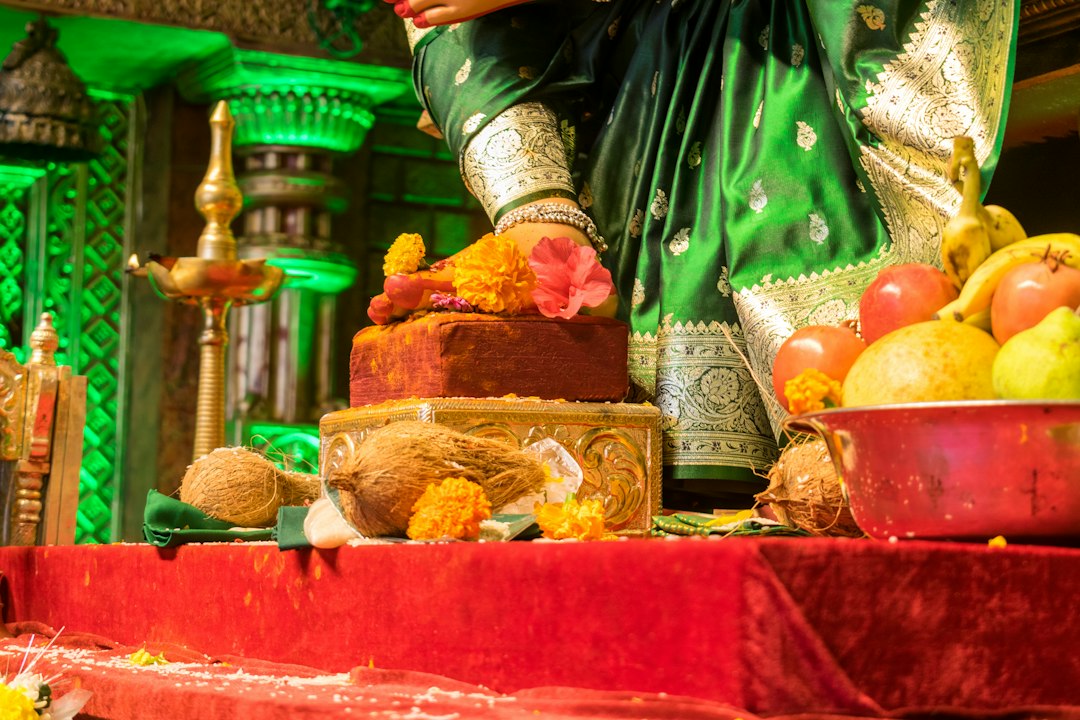
What Is the Spiritual Meaning of the Tulsi Vivah Story?
The story behind Tulsi Vivah is not merely a mythological narrative. It contains several deeper spiritual ideas.
1. Devotion Has Extraordinary Power
Vrinda's devotion was considered powerful enough to protect Jalandhar.
The story therefore presents devotion not as emotional weakness but as spiritual strength.
2. Attachment and Devotion Are Not the Same
Vrinda's journey also raises profound questions about attachment, loyalty and surrender.
Spiritual growth often involves recognizing the difference between attachment to circumstances and devotion to the eternal.
3. Pain Can Become Transformation
Vrinda's story contains loss and grief, yet it does not end in destruction.
Vrinda becomes Tulsi, an enduring symbol of purity and devotion worshipped for generations.
The message is powerful: difficult experiences can become gateways to transformation.
4. The Divine Accepts True Devotion
Tulsi's eventual union with Vishnu suggests that sincere devotion ultimately reaches the Divine.
Even when life's events appear confusing or painful, spiritual surrender can transform the relationship one has with those experiences.
5. Tulsi Represents Purity in Everyday Life
Unlike spirituality confined to temples, Tulsi is traditionally grown within or near the home.
It symbolically brings devotion into everyday family life.
The Tulsi plant therefore becomes a daily reminder that spirituality can be lived, not merely discussed.
Why Is Tulsi Vivah Celebrated?
Tulsi Vivah celebrates the ceremonial union of Goddess Tulsi with Lord Vishnu or Shaligram.
For many communities, the festival also marks the beginning of the auspicious Hindu wedding season following the Chaturmas period.
More importantly, Tulsi Vivah celebrates the union between the devotee and the Divine.
Vrinda's transformation into Tulsi demonstrates that genuine devotion survives even dramatic changes in external circumstances.
Her identity becomes eternal not through worldly status, but through bhakti.
Why Is Durga "Ashtami Celebrated" ? Story and Significance
Tulsi Vivah and Devutthana Ekadashi
Tulsi Vivah is closely connected with Devutthana Ekadashi, also called Prabodhini Ekadashi or Dev Uthani Ekadashi.
Devutthana Ekadashi symbolizes the awakening of Lord Vishnu from Yoga Nidra after the Chaturmas period.
Tulsi Vivah follows within this sacred festive period and represents the return of auspicious ceremonies and celebrations.
The sequence beautifully symbolizes spiritual awakening followed by divine union.
First comes awakening.
Then comes union.
From a deeper perspective, this can also represent the inner spiritual journey: consciousness awakens, attachment begins to dissolve and the seeker moves toward union with the Divine.
Sharad Ramnavami : Katha,Significance & Puja Vidhi
What Does Tulsi Teach Us Today?
The ancient Tulsi Vivah story of Vrinda and Vishnu remains meaningful even in modern life.
We often experience situations we cannot fully control. Relationships change. Expectations collapse. Plans fail. People disappoint us. Sometimes life appears completely different from what we imagined.
Vrinda's story shows that spiritual strength does not necessarily mean avoiding pain.
It means allowing consciousness to transform through it.
Vrinda's life changes completely, yet her devotion is not erased.
Instead, she becomes Tulsi—something sacred, enduring and universally revered.
The deeper lesson is therefore not simply about what happened between Vrinda, Jalandhar and Vishnu.
It asks us:
Can suffering become wisdom?
Can attachment become surrender?
Can devotion survive when circumstances change?
When the answer becomes yes, Tulsi Vivah stops being only an ancient festival story.
It becomes a teaching about how to live.
The Tulsi Vivah story is one of devotion, transformation and divine union. Vrinda's extraordinary loyalty gave Jalandhar immense protection, while the intervention of Lord Vishnu ultimately changed the course of her life.
Her grief and curse could have marked the end of the story.
Instead, they marked a transformation.
Vrinda became Tulsi, the sacred plant cherished in countless Hindu households, while her relationship with Lord Vishnu became eternal through the symbolic marriage of Tulsi and Shaligram.
Tulsi Vivah therefore reminds us that the highest devotion cannot be destroyed by changing circumstances.
It transforms.
It rises beyond attachment.
And eventually, it finds its way back to the Divine
Personal Session
Looking for Personal Spiritual Guidance? Sometimes understanding the teaching is only the first step. Applying it to your own relationships, emotions, career and inner struggles requires deeper clarity. Book a Personal Session for individualized spiritual guidance designed to help you understand your patterns, overcome inner confusion and move toward greater peace, awareness and purpose. Your answers may already be within you. A personal session can help you see them more clearly
Book NowRead Latest Articles
9 Colour of Navratri 2026: DayWise List, Date & Significance
Bhai Dooj Date: Tilak Muhurat, Puja Time & Complete Vidhi
Frequently Asked Questions
Who was Vrinda in the Tulsi Vivah story?
Vrinda was the deeply devoted wife of Jalandhar and a devotee of Lord Vishnu. Her unwavering spiritual devotion was believed to give Jalandhar extraordinary protection and forms the foundation of the Tulsi Vivah legend.How did Vrinda become Tulsi?
According to Hindu tradition, after the events surrounding Jalandhar and Lord Vishnu, Vrinda's earthly existence ended and she became associated with the sacred Tulsi plant. She thereafter came to be worshipped as Tulsi Devi.Why did Vrinda curse Lord Vishnu?
Vrinda cursed Lord Vishnu after discovering His role in breaking the spiritual protection that had safeguarded her husband Jalandhar. Different traditions describe the curse differently, but it is closely linked with Vishnu's Shaligram form.Why is Tulsi married to Shaligram?
Shaligram represents Lord Vishnu while Tulsi represents Goddess Tulsi or Vrinda. Their ceremonial marriage symbolizes the eternal union between Tulsi and Vishnu and, spiritually, between pure devotion and the Divine.Why is Tulsi Vivah celebrated?
Tulsi Vivah celebrates the symbolic wedding of Goddess Tulsi and Lord Vishnu. It honours Tulsi's devotion and also traditionally marks the beginning of an auspicious period for Hindu marriages after Chaturmas.Is Tulsi Vivah celebrated on Dev Uthani Ekadashi?
Tulsi Vivah is closely associated with Devutthana or Prabodhini Ekadashi and the days following it. Exact customs and the chosen day of celebration may vary by region and religious tradition.