

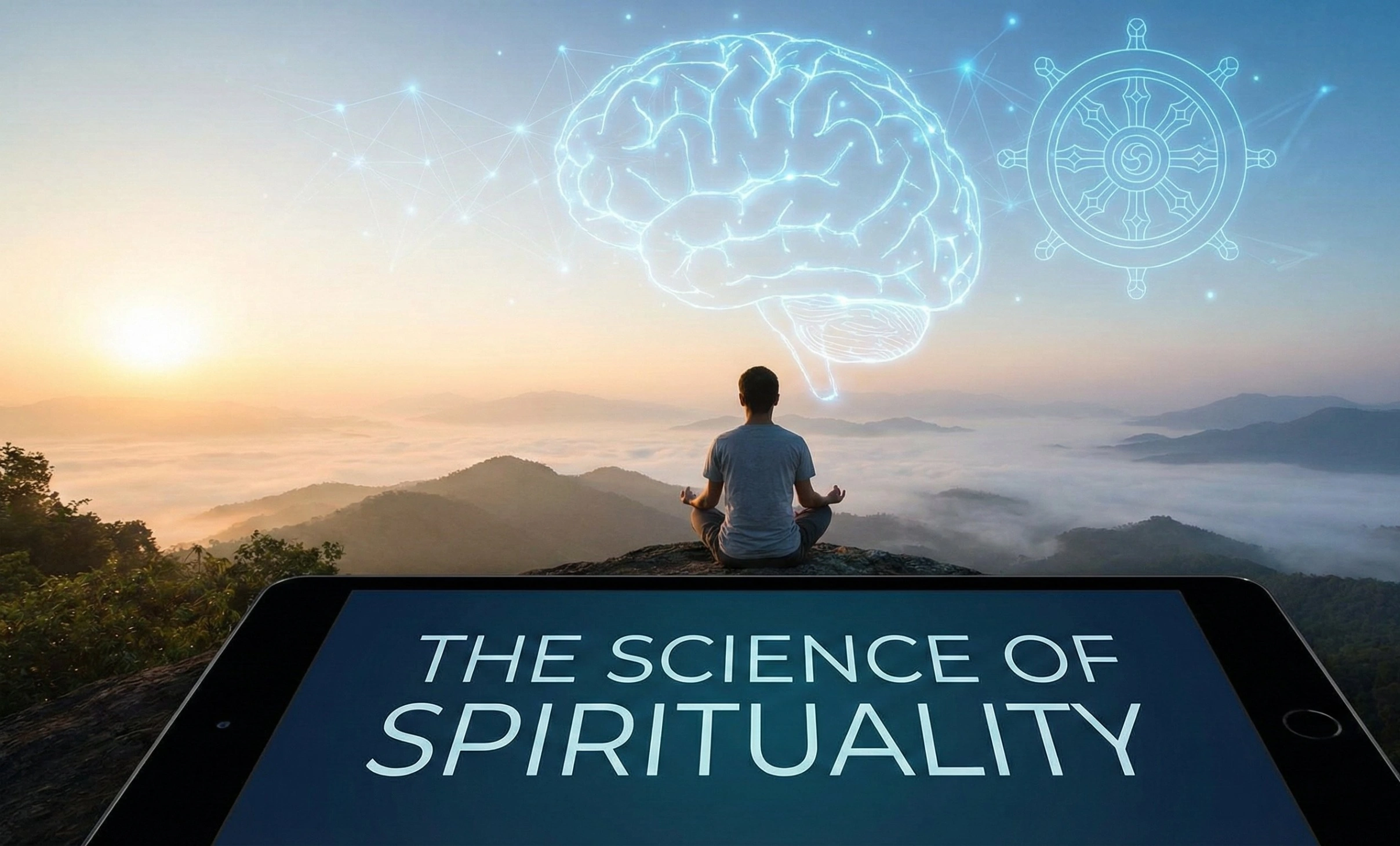
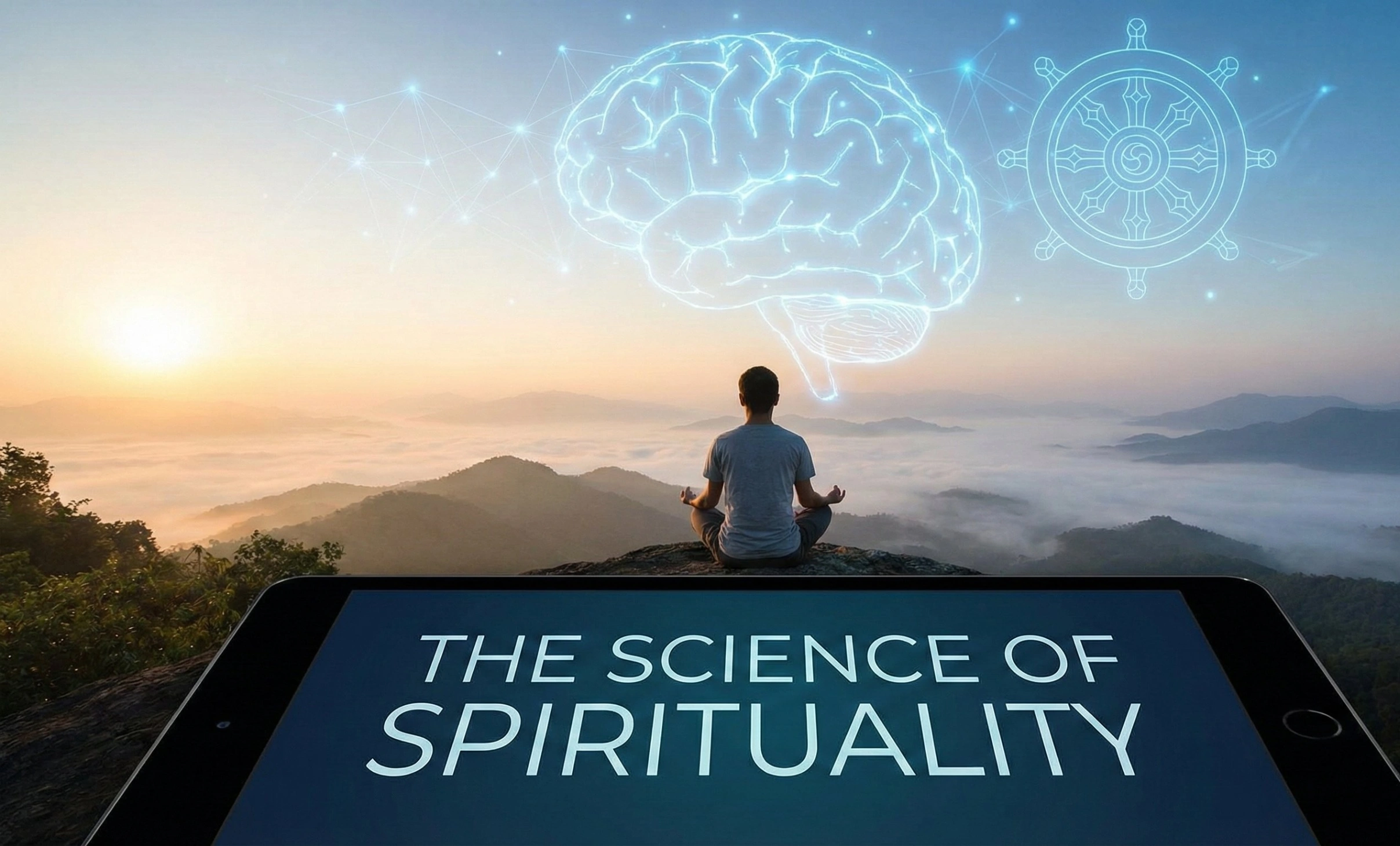
In an age defined by rapid technological advancement and Artificial Intelligence, the ancient questions of existence have not faded; they have become more urgent. We often view science and spirituality as opposing forces, one rooted in logic, the other in faith. However, my life’s work has been dedicated to proving that spirituality is, in fact, a science. It is the subjective science of the self, as systematic and verifiable as physics or chemistry.
Whether we are navigating the complexities of the Law of Karma or facing the rise of AI, the science of spirituality offers a roadmap not just for survival, but for profound evolution.
The Spinning Child: An Unlikely Beginning
My own journey into this science began in the most unassuming of places— a garden in my childhood village. I was ten years old, engaging in a simple game with friends where we would stand with arms outstretched and spin anti-clockwise. The objective was merely to see who could spin the longest.
One day, I spun with such intensity that I crossed a threshold. I felt an invisible force overtake me, and suddenly, my perspective shifted. I was no longer the boy spinning; I was a witness observing my own body from the outside. It was a moment of absolute, indescribable bliss. When I finally collapsed to the ground, I was not in pain, but in ecstasy.
That fleeting experience sparked a forty-year quest. I delved into every available scripture, from the Vedas to Osho’s The Book of Secrets, trying to decode that moment. My search eventually led me to my Guru, Param Pujya Swami Sudarshan Acharya Ji.
The path to him was not easy. I visited him twelve times, and twelve times he refused to see me. On the thirteenth attempt, driven by desperation, I entered his room uninvited, weeping. It was then he revealed a profound truth: the Divine reveals itself only when the thirst is absolute. He had been testing my readiness. That day, I learned that spirituality requires the same dedication as any scientific pursuit.
The Mission of Science Divine
It is a tragedy of the human condition that most individuals utilize only 5% to 7% of their potential. The vast majority of our capabilities remain dormant. I established the Science Divine Movement to address this deficit.
The philosophy is simple yet radical: one need not choose between the material and the spiritual. We can embrace Dhan (Wealth) and Dhyan (Meditation) simultaneously. By applying the science of spirituality, we aim to achieve a sound body, a sound mind, and self-realization.
This is achieved through three "Maha-Mantras" or great keys:
The Science of Thought Power: utilizing the mind to achieve material goals.
The Science of Thoughtlessness: entering the state of meditation for inner peace.
The Art of Constant Joy: maintaining a frequency of bliss that acts as a magnet for abundance.
Demystifying the Law of Karma
The concept of Karma is often misunderstood as a system of divine punishment. In reality, the Law of Karma is simply the Law of Causality: As you sow, so shall you reap. You are the architect of your own life.
Many feel helpless, believing they are bound by a destiny written in their past. To explain the balance between fate and free will, I often use the analogy of the legs.
Imagine you are standing. One leg is your Prarabdha (Past Karma). It is planted firmly on the ground, supporting your weight; it is bound. However, the other leg is your Purushartha (Present Action). It is free to move.
You always have one leg free. While you cannot erase the past, you can use your present freedom; your free leg to maneuver, to step forward, and eventually to untie the knots of the past. We are never fully bound; our power lies in the present moment.

The Reality of Instant Karma
We often delay our moral choices because we believe the consequences will only arrive in the "next life." This is a misconception. Karma is often instant.
Consider the act of anger. The moment you succumb to rage, your blood pressure rises, toxic chemicals flood your system, and you enter a state of psychological hell. The punishment is immediate. Conversely, when you extend a hand to help someone, the immediate feeling of connection and satisfaction is the reward. The reaction begins the moment the action is taken.
Artificial Intelligence: A Catalyst for Human Evolution
There is a pervasive fear that Artificial Intelligence will render humans obsolete. I hold a different view: I welcome the age of AI.
For millennia, human evolution has been centered on the Mind (Manomaya Kosha)— the development of intellect and logic. This is what separated us from animals. However, AI is now poised to surpass human intellect. Within a few years, machines will perform logical and intellectual tasks far better than we can.
This is not a threat; it is an evolutionary pressure. As AI takes over the domain of the mind, humans will be forced to evolve to the next dimension: Consciousness (Vigyanmaya Kosha). A machine can have logic, but it cannot have a Soul. It cannot possess awareness. The rise of AI will push humanity to stop identifying with the intellect and start identifying with the Spirit.
Spirituality is Not Escapism
A common critique of spirituality is that it promotes escapism running away to ashrams or mountains to avoid the trials of life.
True spirituality is the opposite of escapism. It is the practice of Pratyahara— the withdrawal of the senses inward. We are accustomed to our energy flowing outward through our eyes and ears. To be spiritual is to reverse this flow, directing energy back toward the center of one's being.
This can be done anywhere. Whether one is a CEO, a parent, or an artist, the practice is to perform every action with total awareness (Hosh). When we pour our full consciousness into the task at hand, work becomes worship, and daily life becomes a meditation.
Distinguishing Attraction from Karma
Finally, it is important to distinguish between two popular concepts: the Law of Attraction and the Law of Karma.
The Law of Attraction is a modern interpretation focused on "Like attracts Like." It is largely a tool for fulfilling desires and achieving comfort in the material world. The Law of Karma, however, is an eternal spiritual principle focused on liberation (Moksha). It deals with the deep cause-and-effect relationship of our existence.
They are not mutually exclusive; rather, they are complementary. We can use the Law of Attraction to create a comfortable life, but we must use the Law of Karma to create a meaningful one.
The science of spirituality invites us to look inward. It challenges us to verify the truth for ourselves, not through blind belief, but through the rigorous experiment of meditation and awareness.
We have infinite power sleeping within us. Whether we are seeking to rewrite our karma, navigate the digital age, or simply find peace, the keys lie not in the world outside, but in the vast, unexplored universe within.