


In the 21st century, we are conditioned to obsess over results. We are told by productivity gurus and corporate bosses that without a rigid goal, a burning "motive," or a fixation on the quarterly target, action is impossible. We are taught to live in the future, constantly bargaining with the present moment for a better tomorrow.
The result? Chronic anxiety and a feeling that we are constantly running on a treadmill.
The Bhagavad Gita offers a radical psychological shift that challenges this entire hustle culture. It introduces Nishkam Karma. Far from being a dry religious ritual or a call to indifference, this is a sophisticated science of living. It teaches us how to act with total involvement yet total detachment.
But how do you actually practice this when you have bills to pay and deadlines to meet? Let’s explore the seven secrets of Nishkam Karma and how they can turn your daily grind into a flow state.
1. The Mathematical Formula for Peace
To understand this concept, we must first strip away the religious jargon and look at the "math" of consciousness. As explained in the ancient texts, the formula is surprisingly simple:
Karma (Action) – Kamana (Sticky Desire) = Nishkam Karma.
Clarification: Karma here doesn't mean "fate" or "what goes around comes around." It simply means Action. Kamana refers to a specific type of desire— the anxious, sticky craving for a specific outcome.
When we hear "desireless action," we often mistake it for laziness. We think, "If I don't care about the result, why would I even get out of bed?"
This is where we get it wrong. Nishkam Karma isn't about stopping the action; it's about removing the anxiety from the action.
Think of it this way: Have you ever sung in the shower? You belt out the lyrics, you hit the high notes (badly), and you enjoy every second. Why? because you aren't trying to win a Grammy. You aren't worried about the audience. You are acting out of "overflowing energy." That is the essence of Nishkam Karma when your vitality is so high that action just pours out of you, unburdened by the need for applause.
2. Escaping the Pendulum: The Trap of Rag and Dwesh
Most of us think that spiritual freedom means seeking what is good and avoiding what is bad. But the Gita warns that this binary thinking is a trap. The mind swings between two poles:
Rag (Attachment): I need this to be happy.
Dwesh (Aversion): I need to avoid this to be happy.
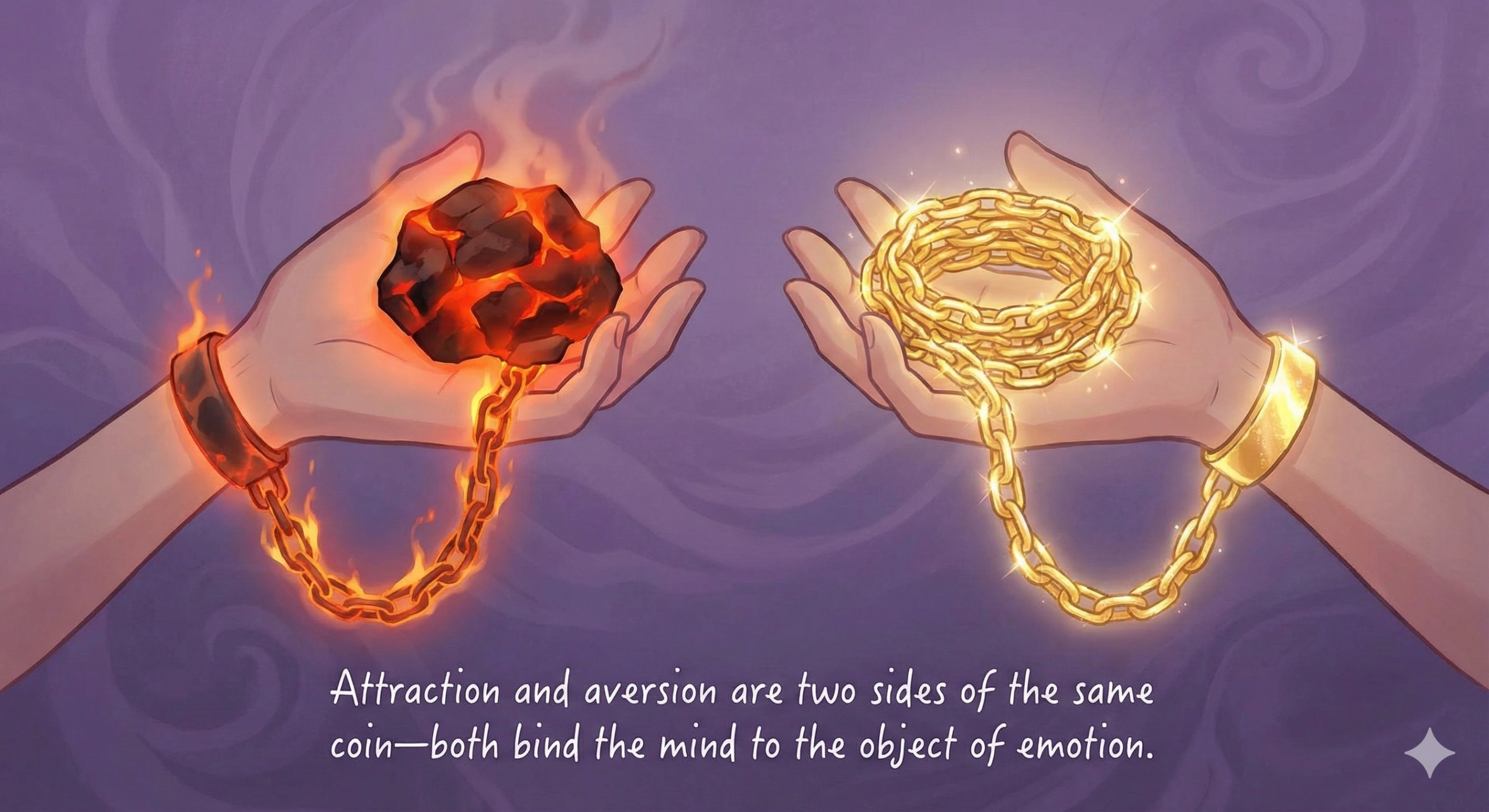
We understand that craving binds us. If you are obsessed with money, you are a slave to it. But we often forget that aversion (hating something) binds us just as tightly.
A Modern Example: Imagine a person who is constantly talking about how much they hate their ex-partner. They think they have moved on because they feel anger instead of love. But in reality, they are still obsessed. The ex-partner still occupies their thoughts 24/7. Whether you hold a hot coal (anger) or a gold bar (desire) tight in your fist, your hand is still trapped.
The Parable of the Diamond
There is a beautiful story involving Saint Kabir and his son, Kamal, that illustrates true freedom.
One day, the King of Kashi visited Kabir to offer a diamond worth billions. Kabir, a strict renunciate, refused to touch it, saying, "Take this back. Stones and diamonds are the same to me; I have no use for it."
The King, confused, went to Kabir's son, Kamal. Kamal didn't make a big show of refusing it. He simply said, "If you brought it, just stick it in the thatched roof."
Months later, the King returned. He found the diamond exactly where he left it in the roof, untouched and unguarded. The King asked Kamal why there was such a difference between him and his father.
Kamal replied with a profound insight: "My father is a great saint, but he still sees a difference between gold and mud that is why he actively refused it. I have reached a state where gold and mud are truly equal. That is why I didn't mind keeping it."
The Lesson: True detachment isn't running away from the world; it is being so centered that holding a diamond or holding dust carries the same emotional weight.
3. Nishkam Karma as "Choiceless Awareness"
How do we apply this in a practical, meditative context? The modern philosopher J. Krishnamurti used a term that perfectly mirrors Nishkam Karma: "Choiceless Awareness."
This is the art of observation without judgment. Usually, when we act, we are constantly judging: This is good, this is bad, I am winning, I am losing. This judgment creates mental noise.
Try the "Spilled Coffee" Practice: Imagine you knock over your coffee mug on a white rug.
The Normal Reaction: "I am such an idiot! Why am I so clumsy? This day is ruined!" (This is judgment).
The Nishkam Reaction: "The coffee has spilled. It requires a cloth. I will clean it."
There is no story. No self-hate. Just the action required by the moment. That is Choiceless Awareness.
4. The Paradox of Results: Why Letting Go Leads to Abundance
The most common question people ask is: "If I don't desire the fruit, how will I ever get it?"
Here is the counter-intuitive truth: Desiring the fruit is not what creates the fruit.
Does anyone in this world desire sadness? Does anyone wake up and pray for failure? No. Yet, sadness and failure still arrive. The transcript argues that results are a product of Prakriti (Natural Laws or Cosmic Order). If you plant a seed and water it perfectly, the tree will grow. It doesn't grow because you sat there worrying about it; it grows because you followed the process.
When you obsess over the result, you are mentally living in the future. But life only happens in the present. Nishkam Karma brings you back to the "Now." And ironically, the gardener who focuses on the soil (the action) rather than the fruit (the result) usually gets the biggest harvest.
5. Unlocking Inner Stability: The Source of True Power
When your mind is split between the work at hand and the fear of the outcome, you are "leaking" energy. Think of it like a smartphone with 50 apps open in the background— the battery drains instantly.
Consider Arjuna, the great warrior of the Mahabharata. On the battlefield, his hands shook, and his bow slipped. Why? Because he was "over-calculating." He was thinking about the death of his kin, the widows, and the chaos that would follow. His mind was so full of the consequences that he lost the ability to perform the action.
The Athlete's Mindset: You see this in sports all the time. The moment a basketball player starts thinking, "If I miss this shot, we lose the championship," they usually miss. The moment they enter "The Zone" where they aren't thinking, just shooting—they score.
Krishna’s advice is simple: Drop the calculation. When you stop calculating, you gain "Internal Stability." You stop leaking energy and become a vessel for high performance.

6. The Tansen Principle: Transaction vs. Devotion
There is a legendary story about Emperor Akbar and his court musician, Tansen. Tansen was considered the greatest singer in the land. One day, Akbar asked, "Tansen, is there anyone who sings better than you?"
Tansen replied, "My Guru, Haridas. I am nothing compared to him."
The Emperor demanded to hear Haridas sing, but Tansen warned him that Haridas would not come to court. He sang only for the divine, not for kings. So, Akbar and Tansen hid in the bushes near Haridas’s hut to listen in secret.
When Akbar heard Haridas sing, he wept. It was unearthly. Later, he asked Tansen, "You know the same notes, the same ragas. Why does his music touch the soul while yours only pleases the ear?"
Tansen’s answer is the essence of Nishkam Karma: "Your Majesty, I sing to get something, to get your praise, your gold coins, your favor. My Guru sings to give something. He has no motive. He sings only for the joy of the existence."
The Shift: Are you working for the "Emperor" (the paycheck, the likes, the promotion)? Or are you letting the work flow through you?
7. Why Nishkam Karma is the "Oxcart" to Enlightenment
Finally, is this path right for you?
In spiritual philosophy, the highest path is Gyan Yoga (The Path of Understanding). This is for people who can simply realize the truth instantly. But for most of us, our minds are too restless. We are like monkeys that need to be kept busy.
The transcript tells a funny story about a drunk man who wouldn't believe he was already home. His neighbors had to put him in an oxcart and drive him around the village for two hours just to bring him back to the same spot. Only then did he feel he had "arrived."
Nishkam Karma is that oxcart. We are addicted to "doing." So, the Gita says: "Okay, you want to act? Fine. But act in a way that purifies you." By engaging in action without the craving for results, we occupy the busy mind until, eventually, we become quiet enough to realize we were "home" all along.
Practical Guide: The 3-Step Nishkam Reset
You don't need to be a monk to do this. Try this checklist the next time you feel stressed at work:
The Pause: Before starting a task, close your eyes for 3 seconds.
The Offering: Mentally say, "I am doing this work to the best of my ability. The result is not my business."
The Immersion: Focus 100% on the process. If your mind jumps to "What if I fail?" gently bring it back to "What is the next step?"
To live the Gita in the 21st century is not about retreating to a Himalayan cave. It is about bringing the silence of the cave into the noise of the marketplace.
The world is divided into two types of people: those running to get something (attachment) and those running to leave something (renunciation). Nishkam Karma asks you to step off the treadmill entirely. Don't hang your life's energy on the peg of success, and don't hang it on the peg of failure. Just let it flow.
When you act with Nishkam Karma, you are no longer a beggar asking the future for happiness. You become a master, expressing your happiness through your work in the present.