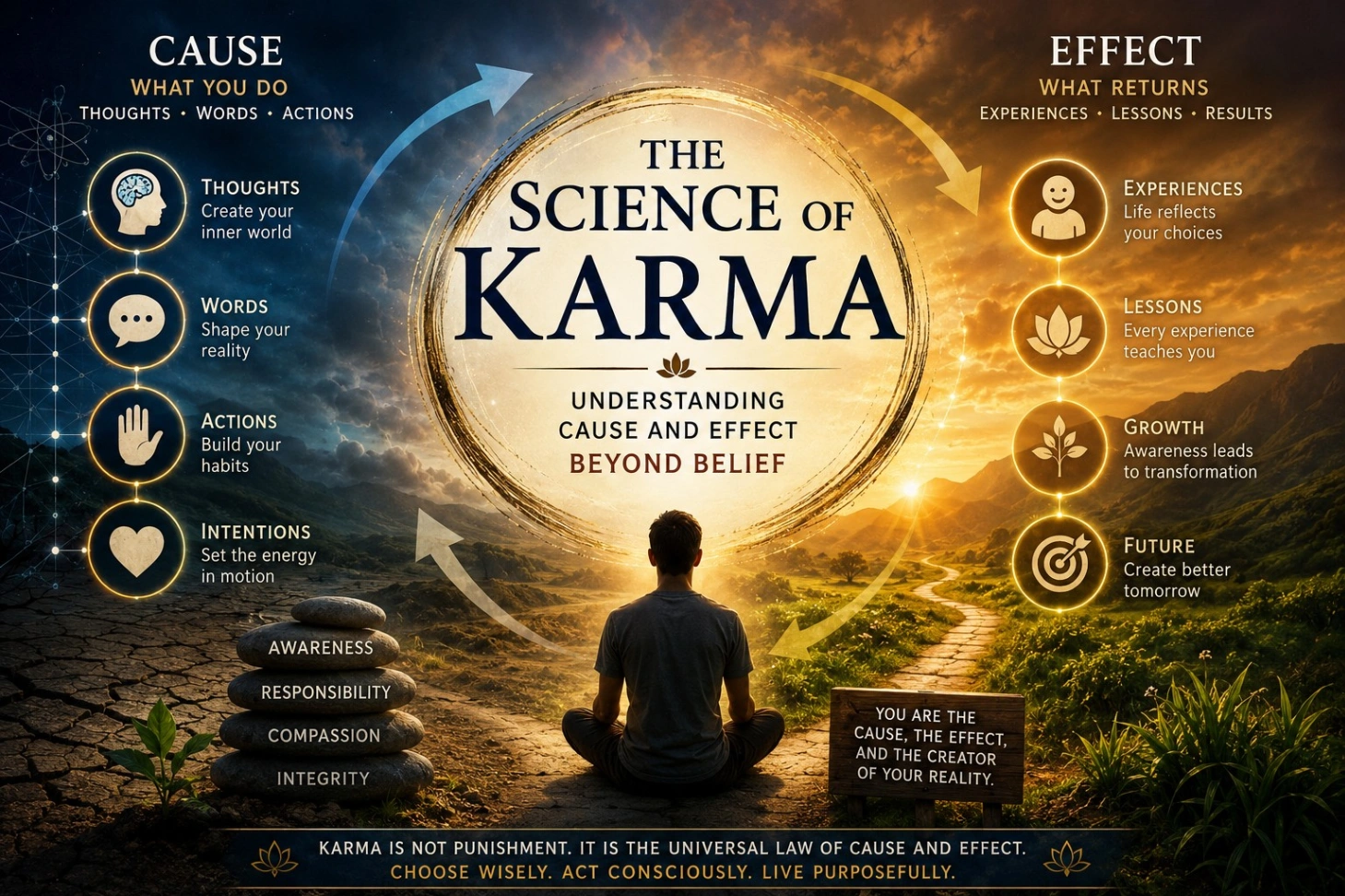
The science of karma begins with a simple idea that most of us can recognise in everyday life: every action creates an effect. A kind word can strengthen a relationship. A careless decision can create regret. A repeated habit can slowly shape our health, confidence, work, and future. Karma is often discussed as a spiritual law, but it can also be understood as a deeper way of looking at cause and effect in life.
Many people hear the word karma and immediately think of fate, punishment, or something mysterious that returns from the past. But karma meaning is much more practical than that. Karma is connected to action, intention, and consequence. It reminds us that life is not only shaped by what happens to us, but also by how we respond, what we choose, and the patterns we continue every day.
Understanding karma beyond religion does not require blind belief. You can see the law of karma in your own life through your habits, emotional reactions, relationships, and decisions. The science behind karma is not about proving that the universe keeps a visible scorecard. It is about seeing how choices create patterns and how those patterns eventually influence outcomes.
What Is Karma Really?
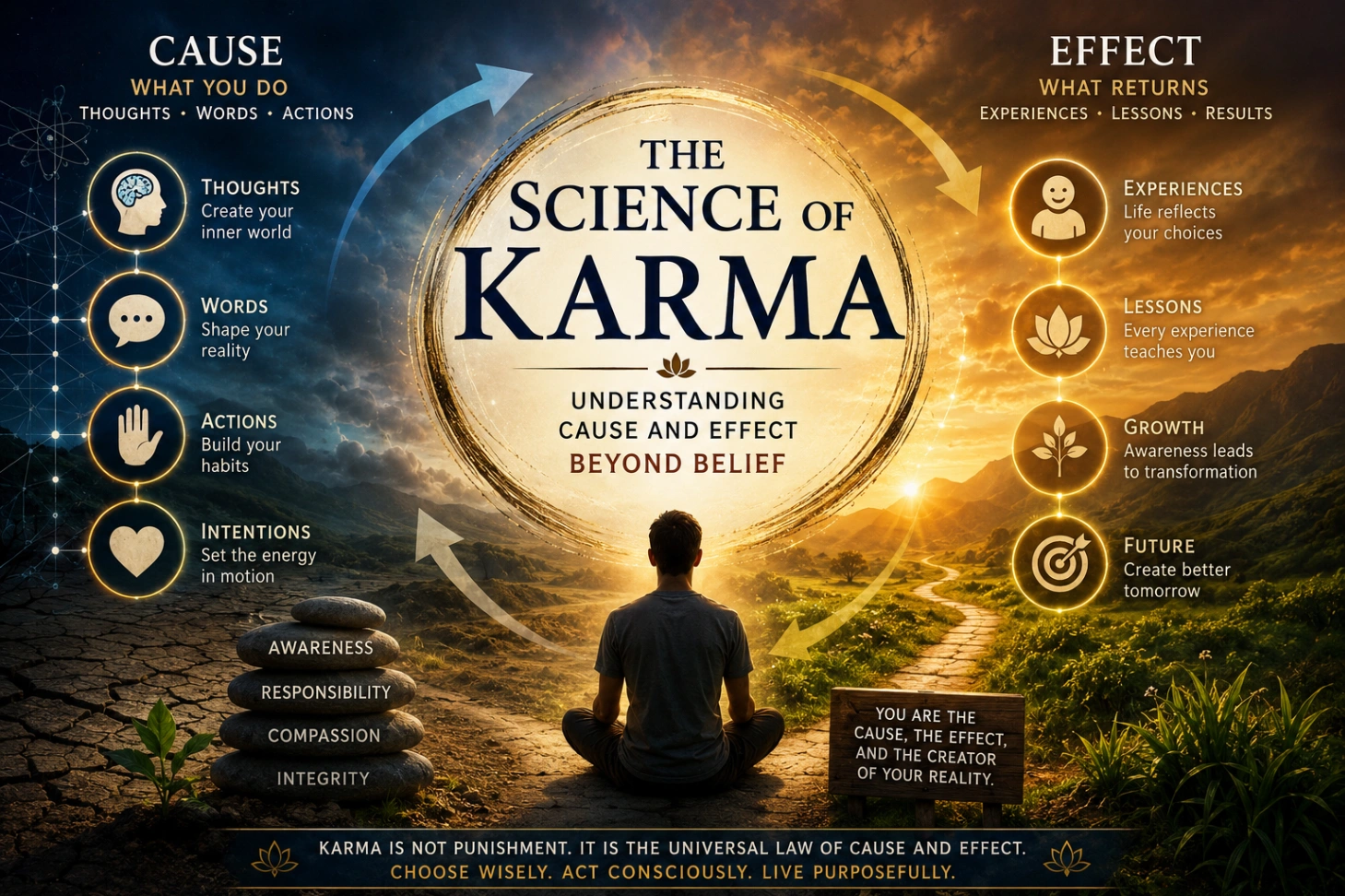
At its simplest, karma means action. Every thought, word, and deed has the potential to create a result. This is why karma and consequences are closely connected. When you act with awareness, honesty, patience, and responsibility, you are more likely to create positive outcomes over time. When you repeatedly act from anger, fear, ego, or carelessness, the consequences may create stress, conflict, guilt, or missed opportunities.
This does not mean every difficult event in life is a punishment for bad karma. Life is complex. Circumstances, other people’s actions, social conditions, health, and chance can all affect what happens. Karma is not a tool for blaming people who are suffering. Instead, it is an invitation to take responsibility for the part of life that is within your control.
The phrase “what goes around comes around” is often used to explain karma. While the phrase is simple, the real idea is deeper. What you repeatedly send into the world through your choices can influence your environment, your relationships, and your own inner state. A person who constantly speaks harshly may create distance around them. A person who acts with respect may build trust. These are visible examples of action and reaction in life.
Design Your Destiny
Your life changes when your choices become more conscious. Design Your Destiny is an opportunity to understand your inner patterns, strengthen self-awareness, and create a life guided by clarity, purpose, and intentional action. Begin choosing the thoughts, habits, and actions that support the future you truly want.
Start Your JourneyCause and Effect in Everyday Life
Cause and effect in life is not always immediate. Some actions create quick results, while others take time. If you skip preparation before an important meeting, the effect may show up that same day. If you avoid difficult conversations for months, the effect may appear later as resentment or emotional distance. If you consistently learn, improve, and show up with discipline, the impact may take longer but can become meaningful over time.
This is why karma in daily life matters. It helps us look beyond short-term pleasure and ask a better question: “What will this choice create in the long run?” A person may choose to react angrily because it feels satisfying for a moment. But that reaction may damage trust. Another person may pause, communicate clearly, and protect the relationship. The outcome may be very different.
The law of cause and effect also applies to how we speak to ourselves. Constant negative self-talk can lower confidence and make action feel harder. On the other hand, self-awareness and compassionate discipline can create a healthier mindset. Karma and mindset are deeply connected because repeated thoughts often become repeated behaviour, and repeated behaviour slowly becomes a way of living.
Karma and Psychology: Why Patterns Repeat
Karma and psychology can be understood together when we look at habits and emotional patterns. A person who has learned to avoid discomfort may keep postponing important decisions. This avoidance can lead to anxiety, missed opportunities, and self-doubt. The person may then believe that life is always working against them, without noticing the pattern that keeps creating the same result.
This does not mean people are responsible for every challenge they face. It means self-awareness can help us notice where our choices are strengthening a difficult cycle. Karma and self awareness work together because awareness gives us the power to pause before repeating an old reaction.
For example, someone who feels ignored may respond by withdrawing completely. Their silence can make communication harder, which may lead to more distance. Over time, the person may feel even more ignored. When they become aware of this cycle, they can choose a different response, such as expressing their needs calmly. This is where karma and personal growth become meaningful. Change begins when we understand the effect of our own actions.
Karma in Relationships
Karma and relationships are often visible in the energy we bring into our interactions. Trust grows through small moments of consistency. Respect grows when people feel heard. Emotional distance grows when needs are dismissed again and again. In this sense, karma is not only something that happens in the future. It is also being created in the present through daily behaviour.
Good karma in relationships can look like honesty, empathy, keeping promises, apologising sincerely, and respecting boundaries. Bad karma can look like manipulation, dishonesty, repeated disrespect, or using people only for personal benefit. These choices influence how safe, valued, and connected people feel around us.
Positive karma does not mean being perfect or pleasing everyone. It means acting with integrity, even when it is difficult. Negative karma is not a permanent label either. Every person can reflect, take responsibility, repair harm where possible, and choose a better path going forward.
Karma in Hinduism and the Bhagavad Gita
Karma in Hinduism is often connected with the idea that actions carry consequences beyond the immediate moment. Karma in Bhagavad Gita is closely linked to responsibility, duty, intention, and detachment from results. The Bhagavad Gita teachings on karma encourage people to focus on rightful action rather than becoming consumed by fear, attachment, or the need to control every outcome.
This is where karma yoga becomes important. Karma Yoga is commonly understood as the path of selfless or conscious action. It teaches that we should do our work sincerely while letting go of unhealthy attachment to the result. This does not mean becoming passive or careless. It means giving your best effort without allowing success or failure to destroy your peace.
When you work with sincerity, learn from outcomes, and remain grounded, you build emotional strength. Karma yoga helps shift attention from “What will I get?” to “What is the right action I can take now?” This simple change can bring clarity in work, relationships, and personal decisions.

Types of Karma and Spiritual Beliefs
In spiritual discussions, people may speak about types of karma, past life karma, and karma and reincarnation. These ideas are matters of faith and are interpreted differently across traditions. Some people believe present experiences may be linked to actions from previous lives. Others understand karma mainly through present choices, personal responsibility, and the visible consequences of behaviour.
Both approaches often encourage the same important lesson: live consciously. Whether you believe in past life karma or not, your actions today still matter. Your words affect people. Your habits affect your future. Your choices affect your peace of mind.
The spiritual meaning of karma is not meant to create fear. It is meant to bring awareness. Instead of asking, “Why is this happening to me?” karma can encourage another question: “What can I learn, change, or do differently from here?”
Karma vs Fate and Destiny
Karma vs fate is a common question because people often wonder whether life is already decided. Fate can feel like something fixed, while karma focuses on action and consequence. Karma and destiny can work together in a more balanced way. You may not control every event, but you can control how you respond to many events.
Karma and free will are connected because free will gives you the ability to make choices in the present. You may not choose every circumstance, but you can choose whether to act with courage or fear, patience or anger, honesty or avoidance. These choices may not change everything overnight, but they can change the direction of your life.
Karma vs destiny does not have to be an either-or debate. Destiny may represent the circumstances you receive, while karma represents the conscious actions you take within those circumstances. Your power lies in your response.
How to Create Good Karma
Creating good karma begins with simple, intentional choices. Speak truthfully without being cruel. Keep your commitments. Help when you can without expecting applause. Take responsibility when you make a mistake. Choose growth instead of blaming others for everything that goes wrong.
You can also create positive karma through your relationship with yourself. Rest when needed, honour your values, avoid self-sabotage, and take small actions towards the life you want. Karma and happiness are not about chasing a perfect life. They are about creating a life that feels aligned with your conscience.
The science of cause and effect reminds us that every small action matters. A daily practice of gratitude can change your focus. A difficult conversation handled with maturity can heal a relationship. One disciplined decision can become the beginning of a new pattern.
Karma is not punishment. It is a lesson in responsibility, awareness, and the power of conscious action. When you understand how karma works, you stop waiting for life to change by itself. You begin participating in the change you want to create.

Personal Session
Feeling stuck in repeated emotional patterns, difficult decisions, or uncertainty about your path? Book a personal session to explore your challenges with deeper clarity, understand the patterns shaping your life, and take practical steps towards inner peace, confidence, and conscious growth.
Book NowRead Latest Articles
Laughing Outside, Crying Within: A Spiritual Disconnect
Frequently Asked Questions
What is karma and how does it work?
Karma is the principle that actions, intentions, words, and choices create consequences. It can be understood spiritually as a law of cause and effect, and practically through habits, relationships, and behaviour. Karma does not mean every hardship is punishment. It encourages self-awareness, responsibility, and conscious action in the present.Is karma the same as fate?
No. Fate is often seen as something fixed, while karma focuses on the results created by actions and choices. You may not control every situation in life, but karma reminds you that your response, behaviour, and decisions can influence what happens next.Can karma change your destiny?
Karma can influence the direction of your life because your repeated choices create habits, relationships, skills, and opportunities. It may not give you control over every event, but conscious action can help you build a different future over time.What is good karma?
Good karma comes from acting with honesty, kindness, responsibility, fairness, and awareness. It does not mean being perfect or expecting rewards from every kind action. It means choosing actions that create greater trust, peace, growth, and wellbeing.Is karma a punishment?
Karma is not punishment. It is better understood as a principle of cause and effect. It helps people reflect on their choices, learn from consequences, and take responsibility for the actions they can change.What does the Bhagavad Gita say about karma?
The Bhagavad Gita teaches the importance of performing one’s duty sincerely while reducing attachment to outcomes. This approach, often connected with Karma Yoga, encourages focused effort, inner balance, and action guided by responsibility rather than fear or ego.