Imagine standing in the middle of a battlefield. Chaos is everywhere, swords are clashing, and death is imminent. Yet, in the center of it all, there is someone with a flute on his lips, a dance in his step, and a song in his heart. This is the image of Lord Krishna in the Mahabharata. He turned a war into a play (Leela).
How is it possible to remain so calm amidst such chaos?
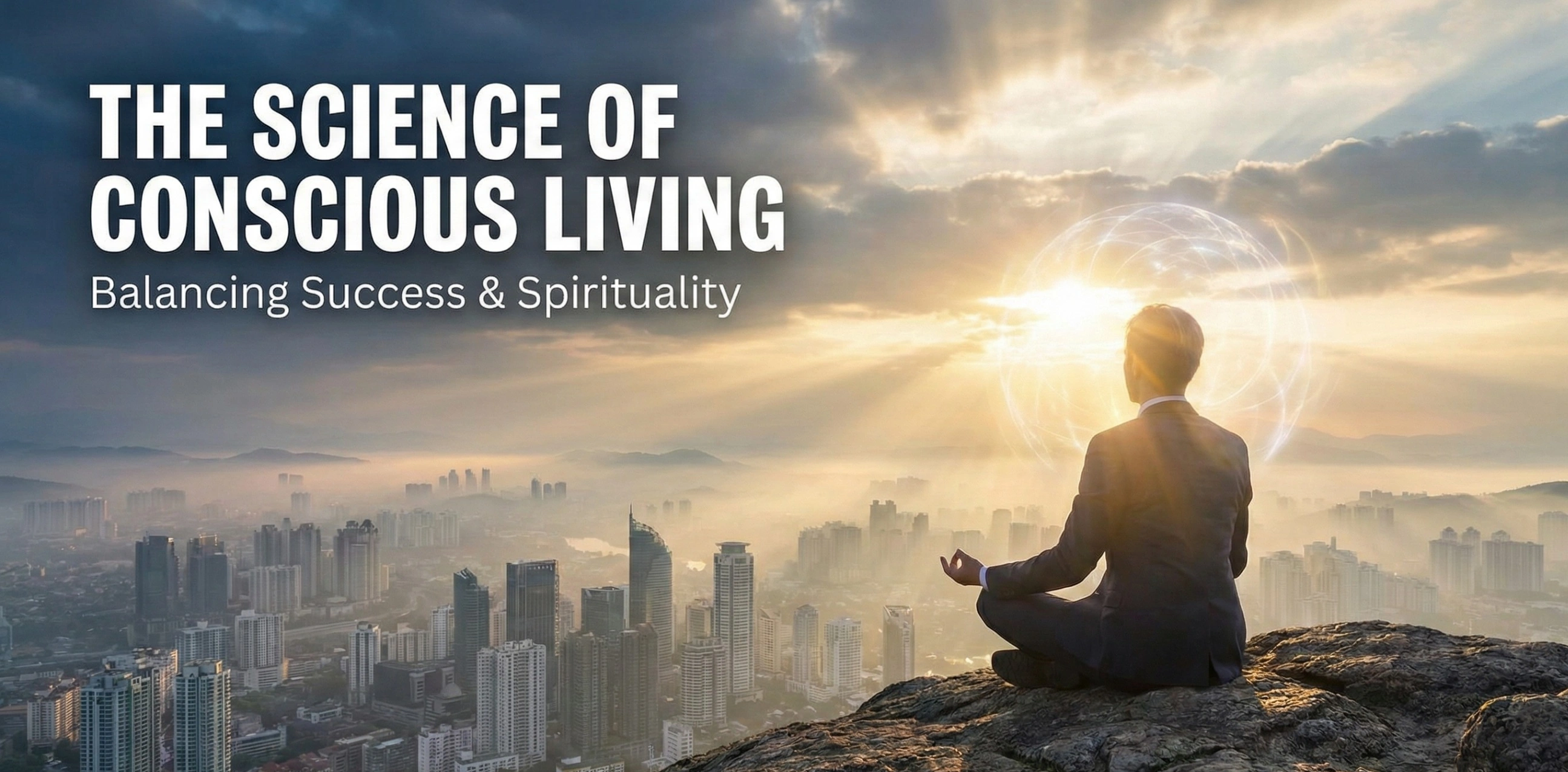
The answer lies in the Science of Conscious Living. Whether you are an administrative officer, a business tycoon, or a homemaker, life throws challenges at you. If your internal instrument; your body, mind, heart, and soul is in harmony, every challenge becomes a game. But if you are out of sync, even the smallest responsibility feels like a burden.
In this blog, we explore the profound insights of Sakshi Shree Maharaj Ji, a modern spiritual master who bridges the gap between ancient mysticism and modern scientific thinking. We will uncover how to master your thoughts, break the cycle of karma, and find bliss without giving up your material ambitions.
Can Material Success and Spirituality Coexist?
There is a long-standing misconception that to be spiritual, you must renounce the world. Sakshi Shree argues that not only can they coexist, but they must.
For centuries, humanity has been divided. The East focused on the "Inner Science" (Soul), achieving great peace but often falling into poverty and helplessness. The West focused on "External Science" (Technology), achieving immense material wealth but losing their sleep and mental peace. Both approaches resulted in an incompleteness.
The 21st-century human needs to be whole. We need to utilize science, technology, and AI to reach the heights of material comfort, while simultaneously using meditation to achieve the heights of inner peace. This balance is the core of the Science Divine. When you master the science of thought power and the art of remaining joyful, success chases you, not the other way around.
The Science of Thought Power and the "No-Mind" State
We often hear about the power of positive thinking, but there is something far more potent: The power of "No-Mind" (Vichara Shunyata).
Your mind has immense power, but when you reach a state of thoughtlessness, your individual life energy connects with the infinite energy of the existence. You become infinitely more powerful.
The Story of the Prince and the Mind-Reading Disciple
To explain this, Sakshi Shree shares a story from the time of Lord Buddha.
A prince took initiation from Buddha and was sent to beg for alms at the house of a female disciple (Shravika). Walking the two miles in the hot sun, the Prince thought, "If I were in my palace, I would be eating delicious food right now, not walking barefoot."
When he arrived, the woman served him exactly the dishes he had been fantasizing about. He was shocked but thought it was a coincidence. Then he thought, "At the palace, I would rest after eating." Immediately, the woman invited him to rest.
Lying on the cot, he compared the rough hut to his royal bed. The woman spoke up from the other room: "Prince, neither the bed belongs to you nor to me. Here, everything belongs to existence."
Terrified that she could read his mind, he ran back to Buddha. He confessed he couldn't return because he had impure thoughts about her beauty, and she surely read those too.
Buddha gave him a technique: "Go back, but this time, observe every thought. Watch your mind without judgment."
The Prince returned, watching his thoughts like a hawk. The result? No thoughts arose. He ate and rested in a state of pure witness. He realized that when you observe the mind, thoughts disappear, and you connect to the source.
What is Real Meditation? (It’s Not What You Think)
Ask 100 people what meditation is, and 99 will get it wrong.
Most people think meditation means concentrating on an image of a Guru, a deity, or a flame. That is concentration, not meditation.
Meditation (Dhyana) means "Content-less Consciousness." It is a state where you are fully awake and aware, but there is no object in your mind. No picture, no thought, no mantra. Just pure awareness. When you achieve this empty space, you align with the universal frequency.
3 Simple Meditation Techniques for Beginners
You don't need to go to the Himalayas to experience this. Here are three simple techniques derived from the Vigyan Bhairav Tantra (a 5000-year-old text on consciousness):
Third Eye Meditation: Close your eyes and gently focus your attention on the space between your eyebrows. Do this for 10 minutes.
Breath Awareness: Close your eyes and simply watch your breath entering and leaving your nostrils. Don't control it; just watch it.
Heart Center Meditation: Close your eyes and focus your attention on the left side of your chest (the spiritual heart). Feel the rhythm there.
Bonus: Bedtime Meditation If you say you don't have time, this is for you. When you lie down to sleep, practice observing your thoughts or watching your breath until you drift off. This transforms your sleep into a spiritual practice.
Breaking the Cycle of Karma: Action vs. Reaction
"If everything is destined by my past karma, why should I try to improve?" This is a common question.
Here is the secret: The Law of Karma only applies to the unconscious.
If you live your life in a sleep-walking state (unconsciously), you are bound by cause and effect. But if you wake up, you break the chain.
The Problem of "Pratikarma" (Reaction)
99% of people are not acting; they are reacting.
Someone insults you (pushes a button).
You immediately insult them back louder (Reaction/Pratikarma).
When you react, you are a slave to the other person. You are not your own master.
The Solution: When someone insults you, take a pause. Decide to answer after 24 hours. In that gap of awareness, you will likely choose not to react with anger. When you stop reacting, you stop creating new karmic entanglements.
Does Astrology Control Your Destiny?
Astrology predicts the future based on the assumption that you will continue to behave in the same patterns you always have.
If you have always been angry, the stars predict you will have conflict.
However, if you become conscious and break the pattern (e.g., you respond to anger with love), the prediction fails.
A conscious person is unpredictable. They have stepped out of the cycle of fate and into the realm of freedom.
How to Turn Daily Habits into Meditation
You don't always need to sit with your eyes closed to meditate. You can turn your "Karma" into "Meditation" by applying total awareness to small acts.
Drinking Tea: For those 5 minutes, do nothing else. Don't scroll on your phone. Just feel the cup, smell the aroma, and taste the tea. Be with the tea.
Bathing: Feel the water on your skin. Let the sensation of the water be the only reality for those 10 minutes.
Eating: Chew your food thoroughly. Experience the taste fully.
When you do this, the act of eating becomes a sacrament (Brahma). This mindfulness eventually spreads to the rest of your day, keeping you in a state of high vibration and preventing the formation of negative karma.
The ultimate goal of the Science of Conscious Living is to move from the level of the body and mind to the level of the Soul.
When you live consciously, you stop seeking validation from social media or others. You realize that you are the creator of your own destiny. You don't need to "believe" in God; you need to become a "seeker" of truth.
Start today. Choose to live happily from moment to moment. As Sakshi Shree says: "If you choose to live happily, your life will automatically get better and better."