
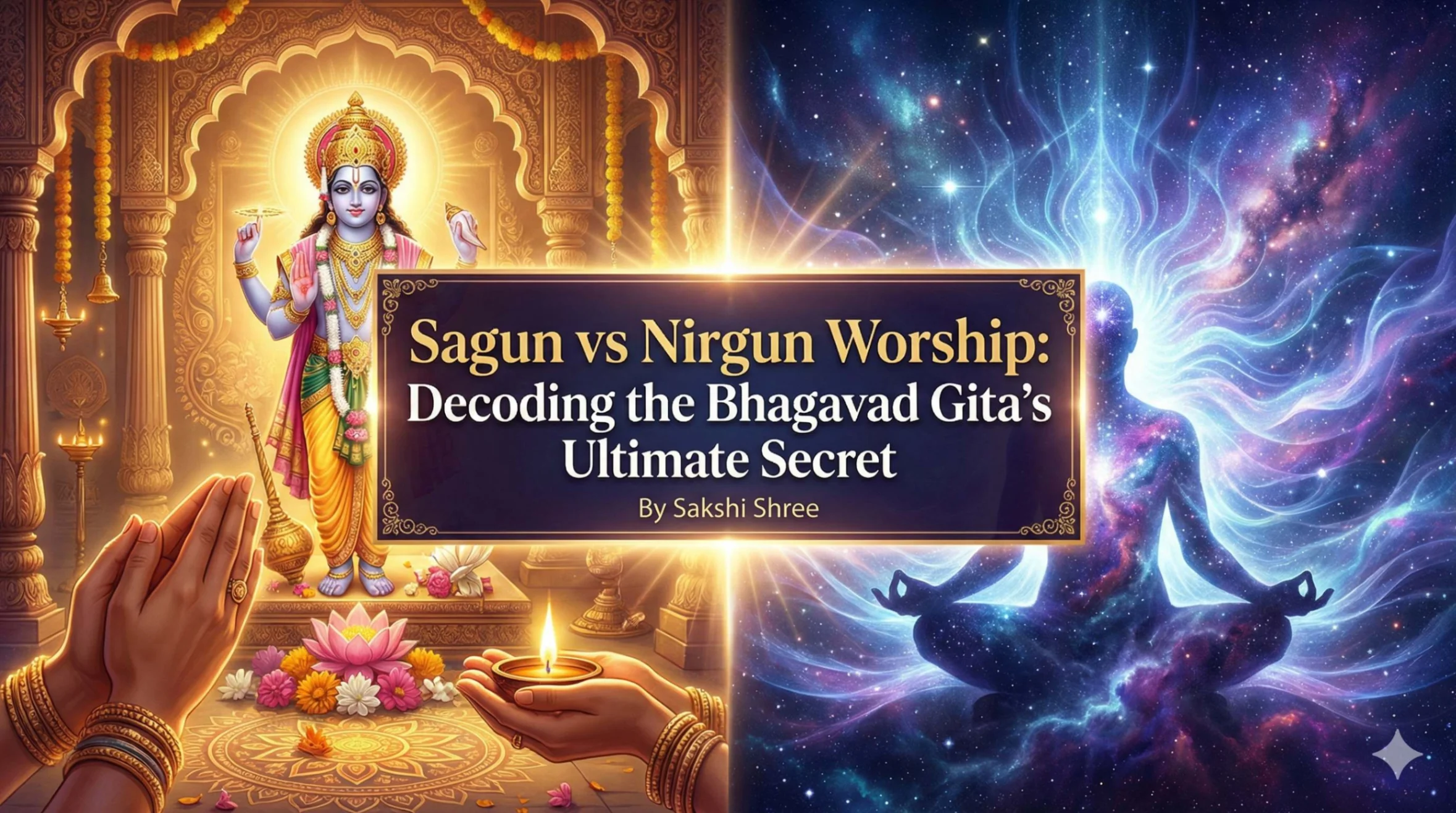
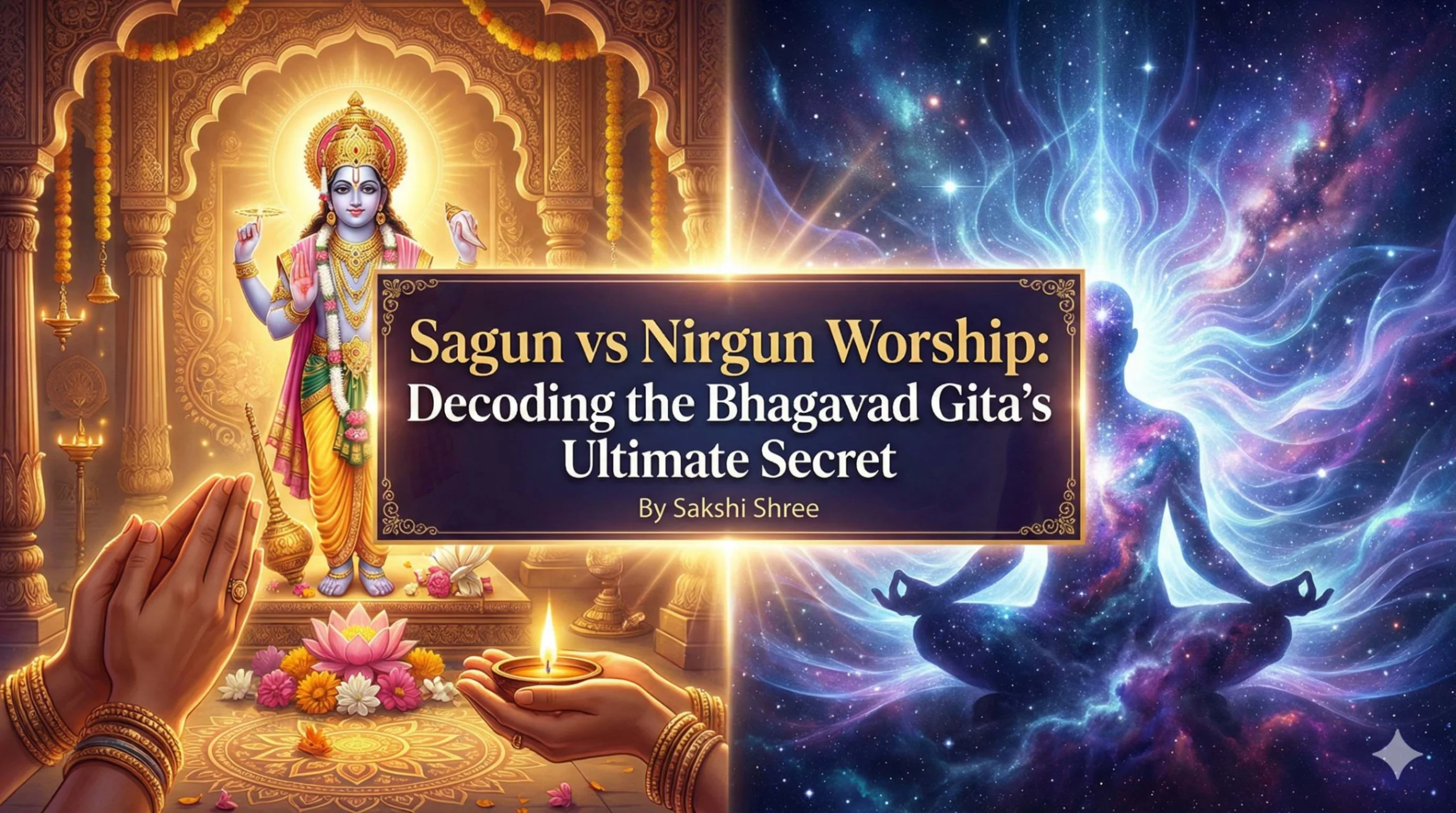
Have you ever found yourself torn between two spiritual worlds? On one side, there are beautiful rituals, temples, and idols (Sagun); on the other, there is the silent, abstract meditation on the formless energy (Nirgun).
This debate isn't new. In the Bhagavad Gita, even Arjuna asks Lord Krishna: "Which path is better?"
If you are struggling to choose between Sagun vs Nirgun worship, you are not alone. The truth is, these aren't opposing teams; they are complementary steps on the same ladder. Whether you are chanting in a temple or sitting in silent meditation, the destination is the same: supreme peace and self-realization.
Let’s dive deep into the science behind these two paths and discover how to rise above the conflict.
Understanding the Core Conflict: Form vs. Formless
In the spiritual community, there is often a struggle. Some claim that worshipping a deity with a form is superior, while others argue that meditating on the formless Brahman is the only way.
In Chapter 12 of the Gita, Krishna clarifies this beautifully. He tells Arjuna that while both paths lead to the same goal—freedom from the bondage of Karma and the attainment of the Divine— Sagun Upasana (worship with form) is generally easier for human beings.
Why? Because humans exist in forms. We have bodies. We live in a world of shapes and objects. Asking a human to immediately jump into the abstract "nothingness" is difficult.
Why Krishna Recommends Sagun Upasana (Worship with Form)
Krishna’s preference for Sagun Upasana isn't because it’s "better" in absolute terms, but because it aligns with human psychology.
Think about how we teach children. When we teach the alphabet, we don't just write the letter 'A'. We say, "A for Apple" and show a picture of an apple. We use a form (the picture) to explain the concept (the letter).
The Starting Point: We are currently operating at the level of the body (form). Therefore, our understanding must start with form.
The Progression: Eventually, the child understands the letter 'A' and no longer needs the picture of the apple. The image becomes irrelevant.
Similarly, we start with idols and deities. However, a time comes when the seeker realizes that the form was just a tool, and they naturally graduate to the formless. But you must start somewhere.
The Science of Idol Worship: A Jumping Board to the Infinite
There is a profound science behind idol worship that is often potential misunderstood. As discussed in the transcript (approx. 12:00 mark), idol worship is actually the science of leaping from the concrete to the abstract.
Imagine the idol as a jumping board. If you want to dive into the infinite ocean, you need a solid platform to jump from. The idol is that platform. It acts as a bridge between your finite senses and the infinite energy of the universe.
How True Worship Happens
True worship begins the moment you "breathe life" into the idol. When you project your own heartbeat, your own love, and your own consciousness into the stone, the stone ceases to be just stone. It starts to pulsate with life.
When you can see God in the idol, a miracle happens: You start seeing God everywhere. You realize that if God is in this stone, He is also in the stones beneath your feet, in the trees, in the rivers, and in the people around you.
The Art of Letting Go: The Meaning of Visarjan
In India, there is a unique tradition. We spend millions creating magnificent idols for festivals like Durga Puja or Ganesh Chaturthi. We worship them with intense devotion. And then? We immerse them in the river (Visarjan).
Why throw away what we worshipped?
This ritual teaches the ultimate spiritual lesson: Non-attachment to the form. If you hold onto the "A for Apple" picture forever, you never truly learn to read. Similarly, if you get stuck on the idol, you miss the divine. The idol is a "spent cartridge" once it has triggered devotion in you. You must learn to dissolve the form to merge with the formless.

Nirgun Upasana: The Path of Knowledge and Meditation
While Sagun appeals to the heart (Bhakti), Nirgun Upasana appeals to the intellect and higher consciousness (Gyana/Dhyana). This is the path of connecting with the energy that is not limited by any boundary.
Just as the air inside a room is the same as the air outside, your soul (Atman) is the same as the Universal Soul (Brahman). The only thing separating them is the "wall" of the mind and ego.
The Three Stages of Gyana Yoga
To break down this wall, the path of knowledge suggests three steps:
Shravan (Listening): deeply listening to the scriptures or the Guru.
Manan (Contemplation): Analysing and thinking about what you have heard.
Nididhyasan (Meditation): The practice of constant awareness to drop the mind.
When the Observer Becomes the Observed
The ultimate goal of Nirgun worship is a state of pure witnessing.
When you practice meditation, you start by watching your thoughts. If you do this consistently say, for 90 days you will notice the thoughts becoming thinner and fewer. Eventually, the thoughts stop completely.
When there are no thoughts left to watch, where does the attention go? The attention turns back onto the watcher. The Observer becomes the Observed.
This is the moment of enlightenment. The wall of the ego collapses. The "I" dissolves. You realize Aham Brahmasmi (I am the Universe). This is where Sagun and Nirgun merge.
The debate of Sagun vs Nirgun worship is ultimately a distraction.
In Sagun, you start with a form, but your ego dissolves in devotion, leading to the formless.
In Nirgun, you use knowledge to dissolve the mind, leading to the same formless state.
Do not waste time standing on the shore debating the best way to swim. Jump in! Whether you choose to bow before an idol or close your eyes in silence, just start. The journey itself will guide you to the destination.
Frequently Asked Questions
Is Sagun worship better than Nirgun?
Why do we immerse idols (Visarjan) if we worship them?
What are the three stages of knowledge in Nirgun worship?
Can I practice both Sagun and Nirgun worship?
What does "The Observer becomes the Observed" mean?
Ready to deepen your practice?
Subscribe to our newsletter for more deep-dives into the Bhagavad Gita.
Join us for a guided 'Sakshi Bhav' (Witnessing) meditation session this Sunday