We live in an era of unprecedented confusion. Despite having more technology, comfort, and resources than any generation before us, we are often more anxious and less fulfilled. We achieve our goals only to ask, "Is this it?"
If you feel this way, you are not alone. In fact, you are standing exactly where a warrior stood 5,000 years ago.
Today, we are going to explore the science of living the Bhagavad Gita. This isn't about religious ritual; it is about the psychology of self-discovery. The Gita is the world's oldest psychological text predating Freud and Jung by millennia and it holds the specific antidote to the confusion of the modern age: the discovery of your Svadharma (your true inner nature).
Let’s dive into how to apply these ancient 18 chapters to your office, your relationships, and your life today.
The Gita: A Manual Written on the Battlefield of Life
The Bhagavad Gita is unique among the great scriptures of the world. The Quran, the Bible, the Torah; most were revealed in moments of solitude or peace. The Gita, however, was born on a battlefield.
It is a text of urgency. It flows in a single, uninterrupted stream.
There is a fascinating story regarding its composition. When the great sage Maharishi Ved Vyasa was ready to compose the Mahabharata (of which the Gita is a part), he needed a scribe who could keep up with his thoughts. He approached Lord Brahma, who suggested Lord Ganesha.
Ganesha agreed to write, but on one condition: "My pen must not stop for a single moment. You must dictate continuously." Vyasa agreed but added a counter-condition: "Agreed. But you must not write a single word without understanding it first."
This created a beautiful rhythm of profound wisdom flowing continuously. The result is a text that doesn't ask you to retreat to a cave, but teaches you how to stand firm when arrows are flying whether those arrows are actual weapons or the deadlines and pressures of the 21st century.
You Are Arjuna: The Modern Crisis of Confusion
In the Gita, Krishna does not act as a commander giving orders. He acts as a catalyst to awaken Arjuna’s own intelligence.
Arjuna is a symbol of our mind. Krishna is a symbol of the Soul (Atman).
Picture Arjuna. He is the greatest archer of his time, yet he stands in the middle of the battlefield paralyzed by Vishada (deep sorrow and confusion). He sees his family and teachers on the opposing side. His hands shake; his bow slips. He wants to run away. He asks, "Is this victory worth it?"
Does this sound familiar?
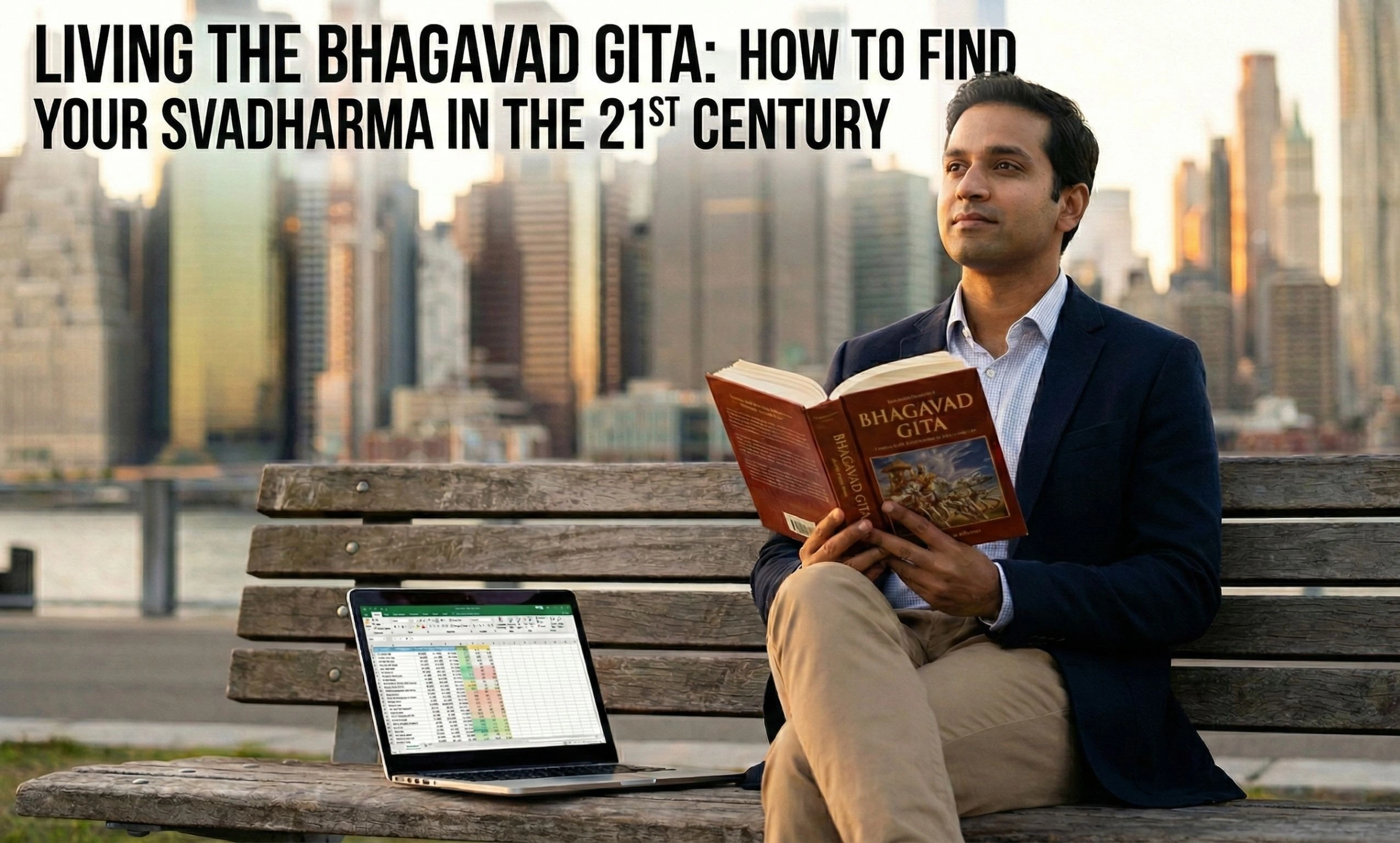
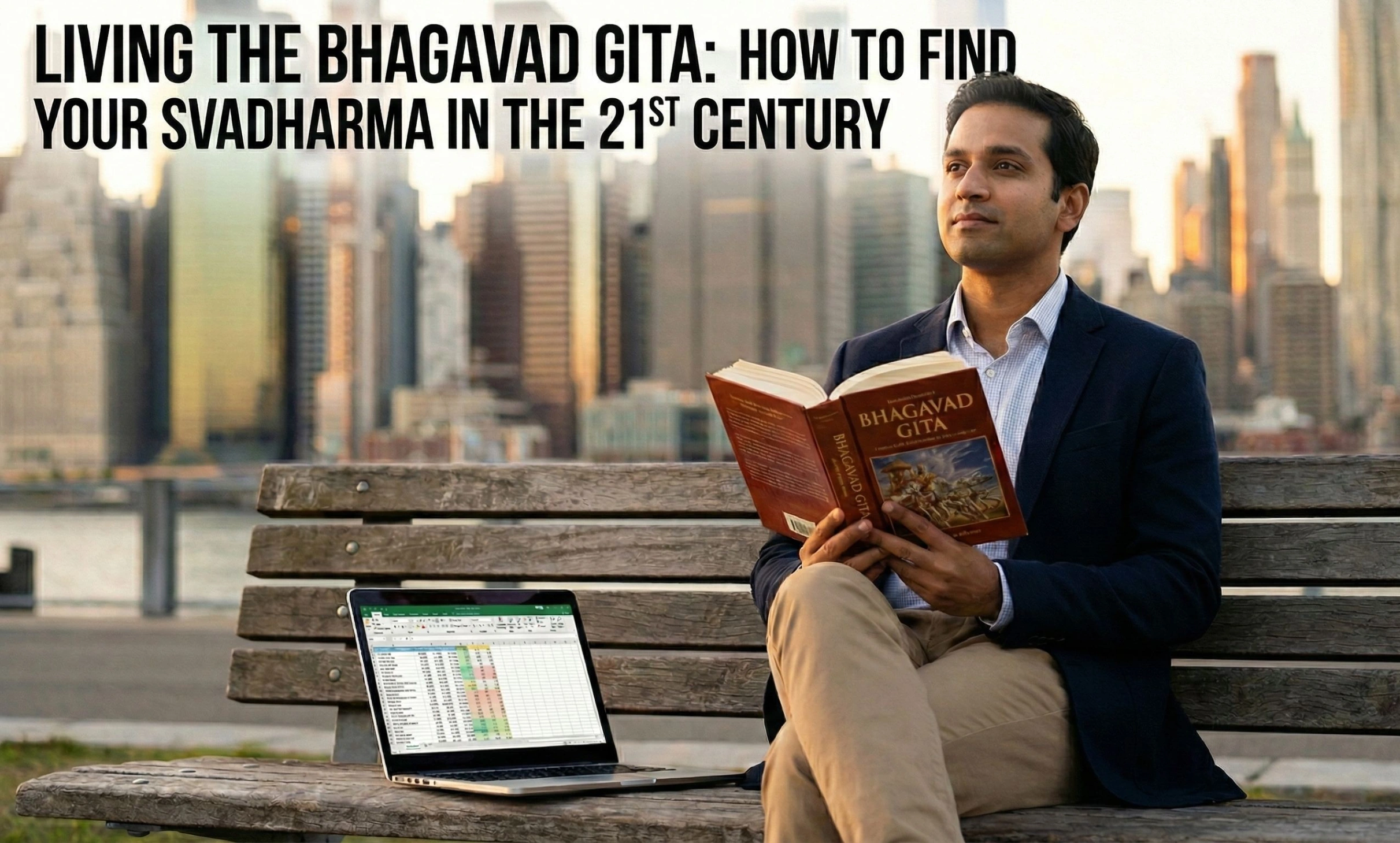
You might not be holding a bow and arrow. You might be holding an Excel sheet, a steering wheel, or a smartphone. You might not be on a battlefield; you might be in a corporate cubicle or a university classroom. But the state of mind is identical.
"Should I take this job or that one?"
"Should I stay in this relationship or leave?"
"I have the money, but why am I empty?"
Just as Arjuna wanted to flee, we often want to escape our circumstances. But Krishna’s message is clear: Don't run away. Wake up.

The Core Philosophy: Understanding Svadharma
The central solution Krishna offers to Arjuna's confusion is the concept of Svadharma.
Sva means "Self." Dharma here means "Nature" or "Duty born of nature."
To understand this, look at nature. As the writer Gertrude Stein famously said: "A rose is a rose is a rose." A rose is perfect being a rose. Its only duty is to bloom fully as a rose. It does not try to be a lotus. It does not try to be a marigold.
Your only duty in life is to be who you essentially are.
Every human being is born with a unique seed— a unique potential. The tragedy of modern life is that we are roses trying desperately to be lotuses because "lotuses" are currently trending or pay better salaries.
The Danger of Imitation (Paradharma)
Krishna warns strictly against Paradharma (the nature of others). He says:
“Swadharme nidhanam shreyah paradharmo bhayavahah” (It is better to die in one’s own duty; the duty of another is fraught with fear.)
When a rose tries to be a lotus, two tragedies happen:
It fails at being a lotus (because it isn't one).
It fails at being a rose (because it wasted its energy trying to be something else).
You remain an unopened bud, withering away without ever releasing your unique fragrance to the world.
3 Practical Steps to Discover Your Life Purpose
So, the million-dollar question is: How do I know what my Svadharma is?
It’s not just about your caste or family trade. Just because you are born to a doctor doesn't mean your nature is medicine. Here are three practical tests to find your authentic path.
1. Listen to the "Still Small Voice" Through Deep Relaxation
Your inner voice knows exactly what you are here to do. But you cannot hear it because of the noise; the noise of social media, family expectations, and your own restless thoughts.
You are like a person in a room with a ticking clock. The clock is always ticking, but you only hear it when the room goes silent.
The Method: You must practice "Doing Nothing." This is deep relaxation (or Sanjeevani Kriya).
Sit for 30 minutes.
Do nothing physically.
Do nothing mentally.
When you reach a state of total relaxation, the noise subsides, and your intuition; the voice of your Svadharma will become audible.
2. The "Financial Freedom" Thought Experiment
We often confuse our "need for money" with our "nature." Here is a mathematical approach: let’s call it the "Algebra of Life."
The Method: Imagine it is May 31st, 2025. Assume that by this date, you have received all the money, accolades, and success you ever desired. You have 500 Crores in the bank. You are set for life. Now, ask yourself: What will I do with the rest of my life?
You still have 40 or 50 years left. You don't need to work for money anymore. The activity that you would choose to do simply because you want to do it; that is your Svadharma.
3. The "Labor of Love" Test
There are certain activities in life where the action itself is the reward. You don't count the hours. You don't stress about the result. You are in a state of "Flow."
The Method: Ask yourself: Which work is my love?
For a true painter, the joy is in the brush touching the canvas, not just the exhibition.
For a true musician, the joy is in the ripple of the notes.
If you find work that you would do even if the result was irrelevant, you have found your nature.
Education and Parenting: A Wake-Up Call
We must apply this wisdom to our education system. Currently, we look at children as raw materials to be molded into "successful professionals" regardless of their nature.
If a child has the soul of a musician, but we force him to become a CEO, we create a "broken" CEO. He may earn millions, but he will live in inner poverty. If a child is a natural engineer but is forced to be a doctor, he will be a dangerous doctor.
The root cause of human misery is simple: People are in places they don't belong, doing jobs they weren't built for.
A Lesson from History: The Story of Rabindranath Tagore
Let me close with a story about the legendary Rabindranath Tagore.
Tagore came from a massive, wealthy family in Bengal. He had many siblings who were "successful" in the traditional sense. But young Rabindranath? The family despaired over him. They would say, "This boy has no spark. He is useless. He just sits around writing poems."
They pressured him to become something "useful"— a landlord, a lawyer, a professional. But Tagore was stubborn. He stuck to his Svadharma. He refused to be a lotus; he insisted on being the rose he was.
The result? He became the first non-European to win the Nobel Prize in Literature. He achieved a state of creative enlightenment. Today, nobody remembers the "successful" lawyers and landlords of his family. The entire clan is remembered solely because of Rabindranath Tagore.
The Bhagavad Gita is not meant to be kept wrapped in red cloth and worshipped from afar. It is meant to be lived.
The first revolution of the Gita is the revolution of Individuality. Stop imitating. Stop looking at your neighbor's plate. Look within. Find that seed that existence planted in you, and dedicate your life to making it bloom.
When you follow your Svadharma, you don't just achieve success; you become an offering to the Divine. Your work becomes your worship.
Frequently Asked Questions
What is Svadharma in the Bhagavad Gita?
What does "Swadharme nidhanam shreyah" mean?
How can the Bhagavad Gita help with career confusion?
Is Svadharma determined by my birth or caste?
What is the "Rose is a Rose" analogy?
How do I hear my inner voice?
Would you like to start today? Take 20 minutes this evening. Turn off your phone. Sit in silence. Ask yourself: "If money were no object, what would I create?" The answer might just change your life.