Human life is constantly entangled in action. From the moment we wake up to the moment we fall asleep, we are doing something — thinking, speaking, reacting, deciding. According to Karma Ka Vigyan, every action shapes our inner and outer world.
But here’s the real question:
Is karma universally good or bad?
Most of us assume we know the answer. Giving charity is good. Getting angry is bad. Helping someone is good. Yelling at a loved one is bad.
Yet the science of karma goes much deeper than this surface-level morality.
Let’s explore.
Is Karma Universally Good or Bad?
We often judge actions based on culture, religion, or societal norms. What is considered acceptable in one society may be unacceptable in another. A custom in one culture might be seen as inappropriate elsewhere.
This means that labeling actions as absolutely good or absolutely bad becomes complicated.
According to Karma Ka Vigyan, the real determining factor is not the action itself but the state of consciousness from which it arises.
Actions done in awareness are शुभ (auspicious).
Actions done in unconsciousness are अशुभ (inauspicious).
This shifts the entire discussion from morality to consciousness.
Action vs Reaction: The Hidden Trap
Most people believe they act consciously. But in reality, they react.
Someone insults you.
You immediately insult them back perhaps even more harshly.
Was that action? Or reaction?
This is what Karma Ka Vigyan calls “pratikarma” — reactive action. It arises not from awareness, but from conditioning. Your past experiences, emotional triggers, fears, and habits respond automatically.
You don’t choose your response. It chooses you.
And that unconscious reaction becomes negative karma not because society says so, but because it was born out of sleep, not awareness.
What Is Conscious Action?
Conscious action happens in the present moment.
It is not influenced by past resentment.
It is not driven by future fear.
It is not controlled by psychological programming.
When you are fully present, your response emerges freshly from awareness. In that state, the capacity to choose wisely arises naturally.
A person who is truly conscious cannot intentionally commit harm. When awareness is complete, harmful action becomes almost impossible. The clarity of consciousness itself guides behavior.
So the real question becomes:
Are we awake while acting? Or are we programmed?
Conditioning: The Invisible Cage
No one is born as a blank slate. Each individual carries tendencies, impressions, and mental patterns — often described as past-life impressions or deep subconscious conditioning.
Beyond that, society adds layers:
Cultural rules
Religious beliefs
Parental expectations
Social fears
Moral judgments
Over time, these layers become a rigid psychological structure. We start living on autopilot.
“If this happens, I must react like that.”
“If it’s Tuesday, I must do this.”
“If someone criticizes me, I must defend.”
This programmed pattern becomes our personality.
And when we live through programming, we stop truly living.
Do Past Actions Influence Present Life?
Karma Ka Vigyan suggests that thoughts and emotions form impressions. These impressions travel with the soul and shape tendencies in future experiences.
This explains why:
Some children show strong inclinations toward music or science from an early age.
Some individuals feel naturally drawn to certain paths without external influence.
These are not random preferences. They reflect inner tendencies seeking expression.
However, these tendencies are not destiny. They are starting points.
Awareness can transform them.
The Burden of Negative Patterns
According to the deeper understanding of karma, everyone carries both positive and negative tendencies.
Then life adds more layers of fear, restriction, and limitation.
Children are often raised with:
Warnings
Restrictions
Fear-based discipline
Suppressed expression
Over time, this builds emotional weight.
When this weight remains unexamined, life feels heavy. Reactions multiply. Suffering increases.
And the person feels trapped as if fate is stronger than free will.
Is Destiny Fixed?
Many people say, “It’s my destiny.”
But what is destiny?
If you are unconsciously repeating old patterns, then yes — life becomes predictable. The same reactions create the same results. The same fears create the same failures.
This repetition is mistaken for fate.
But awareness interrupts the cycle.
When you learn the science of observing your thoughts and reactions, you stop being a puppet. You begin choosing consciously.
And that is the beginning of freedom from karmic cycles.
Why Focusing on Results Weakens Action
One of the most misunderstood teachings about karma is:
“Do not focus on the results.”
But why?
Because when your energy is divided between action and outcome, your performance weakens.
If your attention is constantly asking:
“Will I succeed?”
“What if I fail?”
“What will I get?”
Then your action loses intensity.
Your energy fragments.
When action becomes a burden something you must do to achieve something else — joy disappears. Stress increases. Fatigue sets in faster.
But when action itself becomes fulfilling, your entire energy aligns.
Then results naturally follow.
Action Is in Your Hands. Results Are Not.
You can:
Study sincerely.
Practice consistently.
Improve your skills.
Prepare fully.
But can you force success?
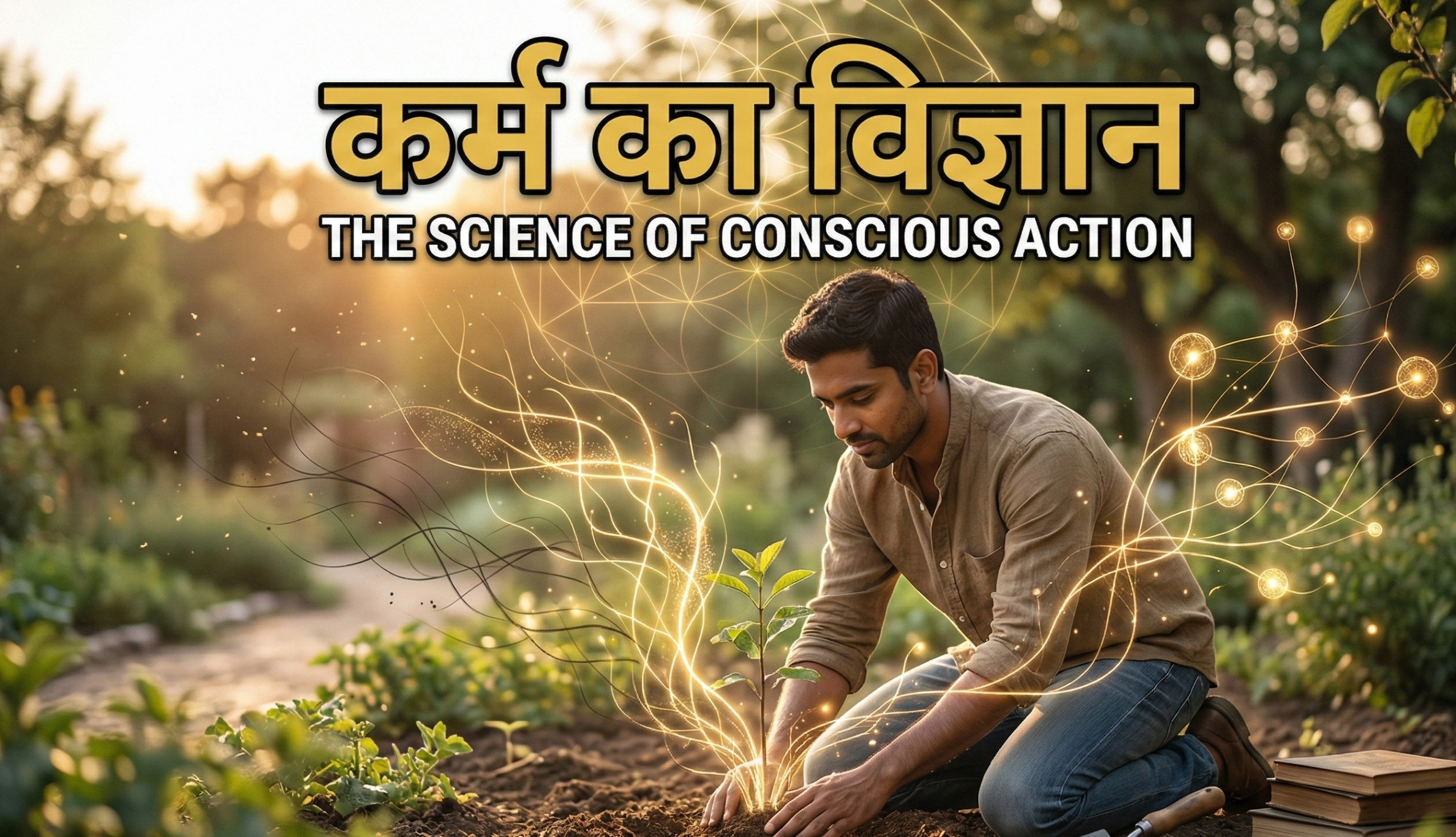
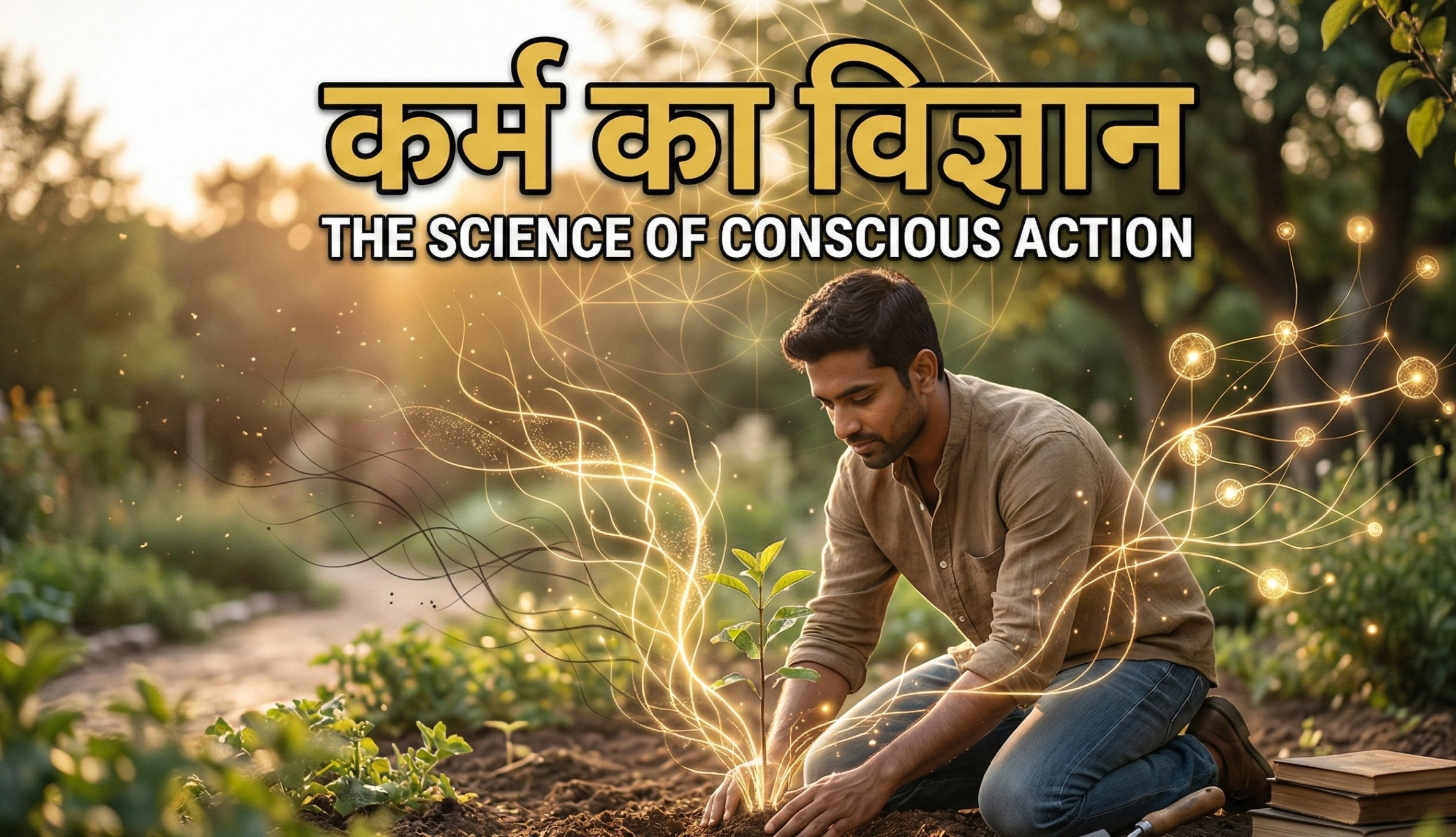
You can plant a seed.
Water it.
Protect it.
But you cannot pull the fruit out of it.
The fruit ripens in its own time.
Results belong to existence. Action belongs to you.
Understanding this truth reduces anxiety and increases clarity.
What About Failure?
Let’s say a student studies hard but doesn’t score well. Or a businessperson works tirelessly but faces losses.
The mind immediately shifts to results:
“I worked so hard. Why didn’t it work?”
But worrying about outcomes does not improve outcomes.
Instead, the intelligent approach is to examine:
Where can the quality of action improve?
Which skill needs refinement?
What strategy requires change?
When attention shifts back to action, growth resumes.
When attention stays stuck on results, stagnation begins.
Good Deeds That Bring No Result?
Many people perform “good deeds” expecting reward.
They donate money hoping for blessings.
They help someone expecting recognition.
They act kindly expecting appreciation.
But if the intention behind the action is transactional, it is not truly conscious.
Karma Ka Vigyan emphasizes that real goodness arises from inner inspiration, not from expectation.
When compassion flows naturally, the joy of giving is immediate. You don’t wait for future reward.
If you help an elderly person from falling and see gratitude in their eyes, the happiness you feel in that moment is the fruit.
No future accounting required.
The Real Fruit of Conscious Action
When action arises from love and awareness:
Joy happens instantly.
Peace deepens.
Ego reduces.
Freedom increases.
That immediate inner expansion is the real fruit of karma.
Waiting for cosmic rewards in the future is unnecessary.
The reward is in the doing when done consciously.
Turning Karma into a Game
Life becomes heavy when every action is tied to pressure.
“I must succeed.”
“I must prove myself.”
“I must achieve.”
But what if action becomes play?
When you engage fully like an athlete in practice — the game itself becomes satisfying.
Performance improves naturally.
The same applies to life.
When action becomes playful, creative, and wholehearted, both success and peace follow.
The Core Teaching of Karma Ka Vigyan
To summarize:
Actions are not universally good or bad.
Consciousness determines the quality of karma.
Reaction is unconscious; action is aware.
Results are not in your control.
Focusing on outcomes drains energy.
True goodness arises from inner inspiration.
Awareness frees you from repetitive karmic cycles.
Ultimately, Karma Ka Vigyan is not about moral judgment.
It is about awakening.
Transform Your Karma with Conscious Living
Understanding karma intellectually is one step.
Living it is another.
If you truly want to break free from conditioning, release negative patterns, and learn how to act with full awareness — it’s time to go deeper.
The Design Your Destiny course is created to help you:
Understand your inner patterns
Break subconscious conditioning
Act consciously instead of reacting
Align action with awareness
Create results without anxiety
Stop being driven by unconscious programming.
Start living consciously.