

It’s that time of year again. You buy a shiny new planner, download three different apps, and vow that this is the year everything changes. But if you’re looking at New Year's resolution statistics 2026, the odds feel stacked against you. Research suggests that nearly 80% of resolutions are abandoned by the second week of February (often called "Quitter’s Day").
The problem isn't your willpower; it's your strategy.
In 2026, the era of "hustle culture" is fading, replaced by slow productivity and data-driven consistency. If you want to know how to keep New Year's resolutions this time around, you need to stop relying on motivation and start building systems. Here is your roadmap to actually making it stick.
The Grim Reality: Why Do New Year's Resolutions Fail?
To fix the problem, we first have to understand the failure points. Why do New Year's resolutions fail so consistently?
Psychologists point to a phenomenon called the "False Hope Syndrome." We set massive, life-altering goals on January 1st when our motivation is at its peak. But motivation is a finite resource. When life gets busy in mid-January, that motivation evaporates, and because we haven't built a system, the habit collapses.
Common pitfalls include:
Vague Ambitions: Saying "I want to get fit" instead of "I will lift weights for 30 minutes on Tuesdays and Thursdays."
Too Many Goals: Trying to overhaul your finances, health, and career simultaneously leads to decision fatigue.
Lack of Tracking: You can't improve what you don't measure.
The 2026 Shift: Goal Setting vs. Systems
The most successful people in 2026 aren't setting goals; they are building systems. This is a core concept from James Clear's Atomic Habits for New Year planning.
A goal is a one-time event (e.g., "Run a marathon"). A system is a recurring process (e.g., "Run for 30 minutes every morning"). Goal setting vs systems is the difference between a temporary win and a permanent lifestyle change.
The Rise of "Slow Productivity"
One of the biggest trends this year is slow productivity. Instead of cramming your day with 20 tasks, this philosophy focuses on doing fewer things with higher quality. It is the antidote to burnout. By reducing the volume of your resolutions, you actually increase the likelihood of achieving them.
The Blueprint: Goal Setting Tips 2026
If you want to beat the odds, you need a framework. Here are three goal setting tips 2026 to structure your year.
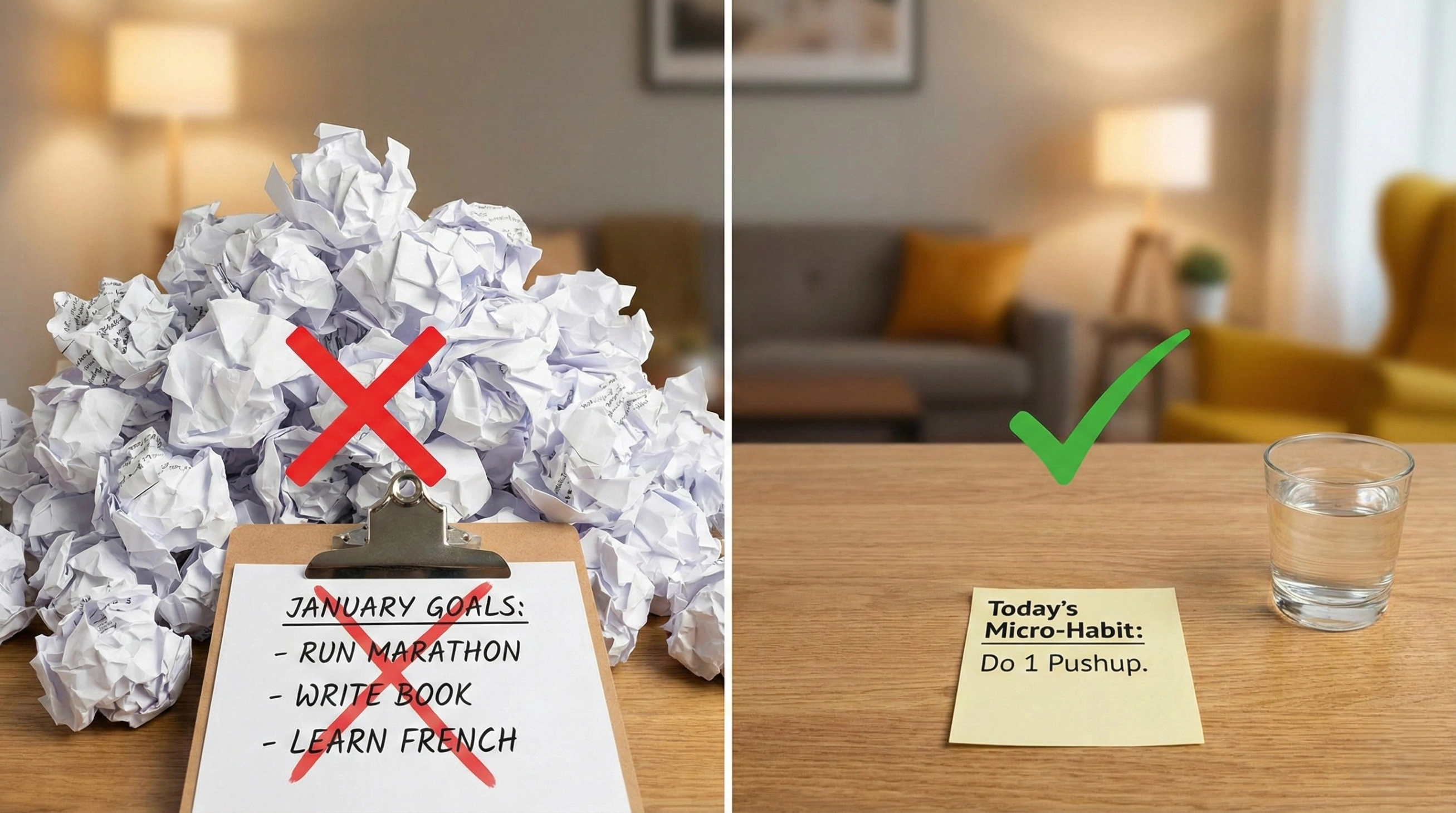
1. Embrace Micro-Habits
Micro-habits 2026 are the secret weapon for long-term consistency. These are habits so small they feel ridiculous to skip.
Instead of: "Read 30 books this year."
Try: "Read one page before bed."
The goal is to establish the neural pathway of the habit before worrying about the intensity.
2. Update Your S.M.A.R.T. Goals
You likely know the acronym, but here are SMART goals examples for 2026 updated for the modern worker:
Specific: I will use ChatGPT to automate my weekly reporting.
Measurable: I will save 2 hours per week.
Achievable: I have the subscription and the data access.
Relevant: This allows me to focus on creative strategy.
Time-bound: I will have the workflow running by January 31st.
3. Habit Stacking
This technique involves pairing a new habit with an existing one.
"After I pour my morning coffee (current habit), I will write down my top 3 priorities for the day (new habit)."
The Tech Stack: Best Habit Tracker Apps 2026
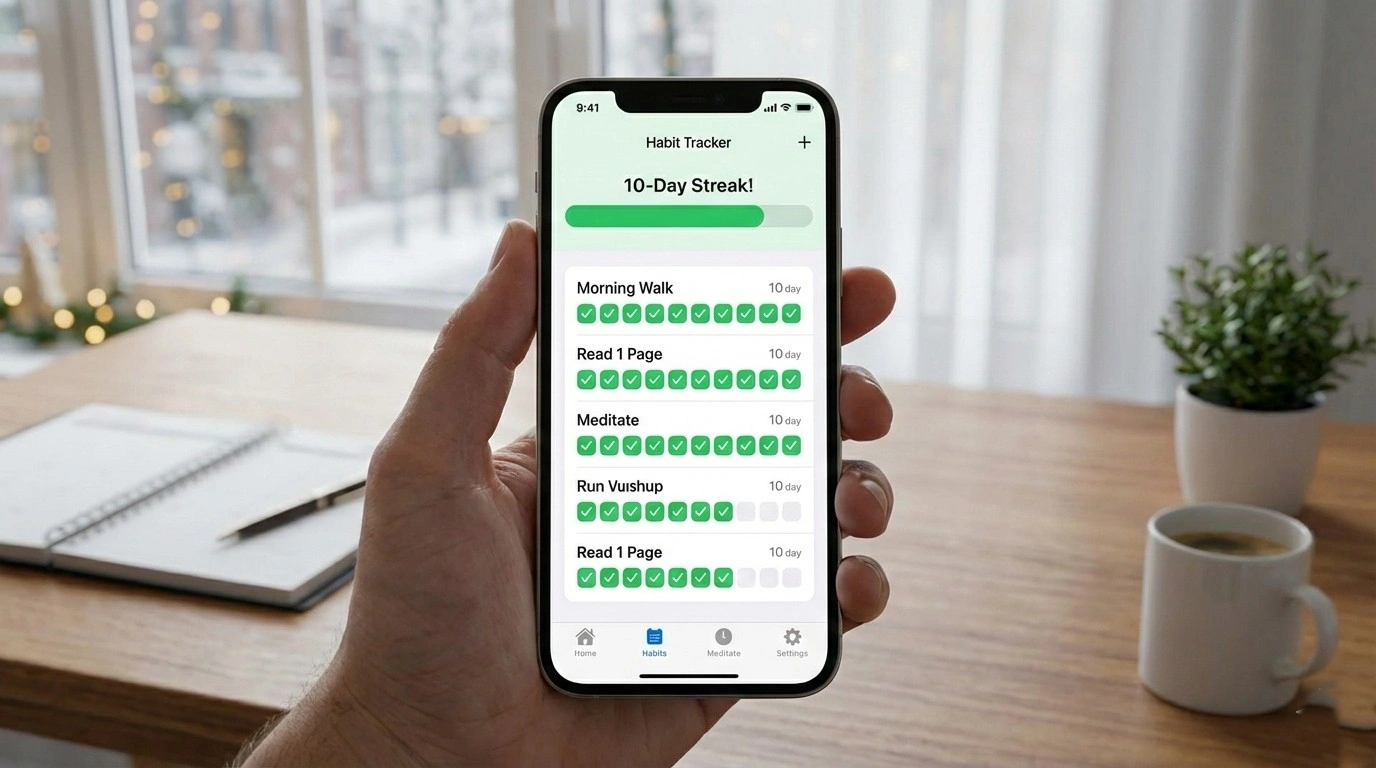
You don't have to do this alone. Technology has evolved to become a powerful accountability partner. Here are the best habit tracker apps 2026 that are dominating the market:
Notion (The All-in-One): The ultimate New Year's resolution planner. With the new AI integration, Notion can now analyze your progress and suggest adjustments to your routine.
Streaks (For iOS Users): A minimalist app that won a specialized Apple Design Award. It integrates with Apple Health to automatically mark fitness tasks as complete.
Habitica (Gamification): If you struggle with boredom, this app turns your life into an RPG game. Completing tasks levels up your character, making self-improvement fun.
Opal (Focus): Essential for your digital detox challenge 2026. It blocks distracting apps during your deep work sessions.
Protecting Your Mindset: Burnout Prevention
Sticking to resolutions isn't just about doing more; it's about protecting your energy. Burnout prevention should be a resolution in itself.
In 2026, we are seeing a massive push toward "Digital Minimalism." A popular challenge is the digital detox challenge 2026, where you commit to one screen-free day per week. This resets your dopamine receptors and lowers anxiety, giving you the mental clarity needed to stick to your other goals.
Consistency is not about never messing up; it's about never missing twice. If you skip a workout, don't spiral into shame. Just get back to the plan the next day. That is the essence of motivation vs discipline.
The difference between the 92% who fail and the 8% who succeed isn't magic. It’s the willingness to start small, track progress, and forgive yourself for the bad days.
Ditch the massive, vague resolutions. Pick one or two sustainable lifestyle changes, download a tracker, and focus on showing up today. That is how to build discipline in 2026.