
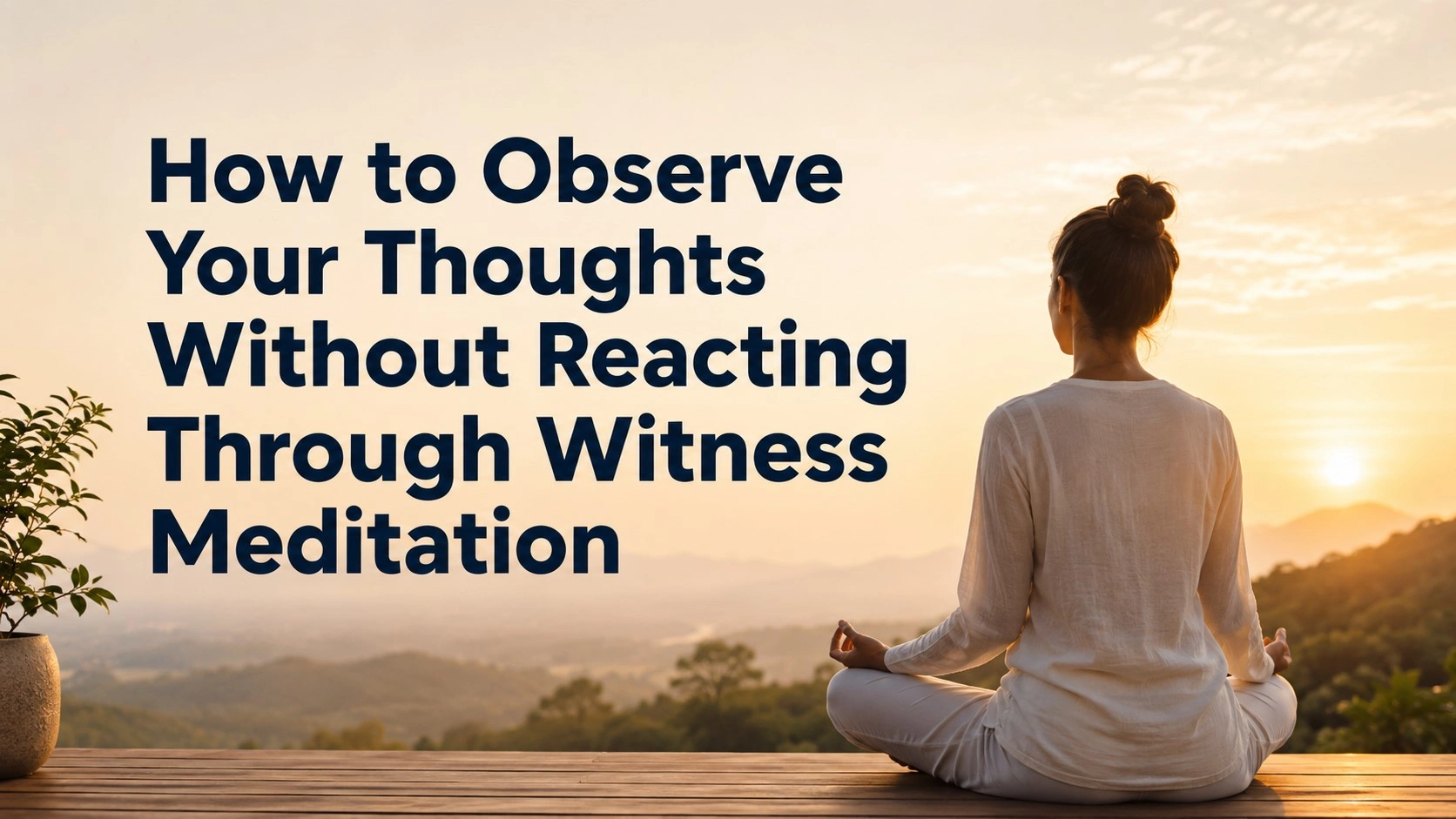
Witness meditation is a simple yet powerful spiritual practice that teaches you to observe your thoughts without reacting to them. Instead of fighting your mind, suppressing emotions, or getting lost in overthinking, this practice helps you become the silent observer of your inner world. You begin to notice your thoughts, feelings, memories, and reactions as passing experiences rather than absolute truths.
In today’s fast-moving life, the mind is constantly busy. One thought leads to another, and before we realize it, we are caught in worry, stress, comparison, fear, or emotional reactions. This is where witness meditation becomes deeply useful. It does not ask you to stop thinking. It teaches you to watch your thoughts with awareness.
When you learn how to observe your thoughts without reacting, you create a small but powerful space between the thought and your response. In that space, inner peace begins.
What Is Witness Meditation?
Witness meditation is the practice of becoming aware of your thoughts, emotions,and sensations without judging, resisting, or reacting to them. You simply watch what is happening inside you, as if you are sitting on the riverbank and watching the river flow.
The thoughts are the river. You are not the river. You are the one watching it.
This is also connected to witness consciousness, which means recognizing that there is an inner awareness within you that can observe the mind. Your thoughts may change, your emotions may rise and fall, your moods may shift, but the awareness that sees all of this remains steady.
For example, one moment you may feel angry. A few minutes later, you may feel calm. Then you may feel anxious, hopeful, or distracted. If all these states keep changing, then who is aware of them? That awareness is the witness within you.
Witnessing thoughts meditation helps you connect with this inner observer. Slowly, you realize that you do not have to believe every thought or act on everyemotion.
Design Your Destiny CTA
Your thoughts shape your reactions, and your reactions shape your life. If you want to move beyond overthinking, emotional patterns, and inner confusion, join the Design Your Destiny program. Learn powerful spiritual practices to awaken awareness, strengthen your inner self, and create a more conscious, peaceful, and purposeful life.
Start Your Journey!Why Do We React to Thoughts?
Most people react to thoughts because they identify with them. A negative thought appears, and immediately the mind says, “This is true.” A fearful thought appears, and the body starts feeling tense. A memory appears, and emotions from the past become alive again.
This happens because the mind has a habit of attachment. It catches thoughts and turns them into stories. One small thought can become a long chain of overthinking.
For example, a simple thought like “What if I fail?” can quickly become:
“What will people think?”
“What if I disappoint everyone?”
“What if my future is ruined?”
The original thought may have passed in a second, but the reaction keeps it alive.
Witness meditation helps break this chain. It teaches you to pause and notice: “A thought of fear has come.” This small shift changes everything. You are no longer completely inside the thought. You are watching it.
The Difference Between Thinking and Observing
Thinking means being involved in the thought. Observing means being aware that the thought is present.
When you are thinking, you are inside the story. When you are observing, you are watching the story.
For example, if the mind says, “I am not good enough,” thinking will pull you into sadness, comparison, or self-doubt. Observing will help you notice, “There is a thought of self-doubt in my mind.”
This does not mean you ignore your emotions. It means you stop becoming a prisoner of every thought. You allow the thought to be seen clearly.
Thought observation meditation is not about controlling the mind by force. It is about understanding the mind with awareness. The more you observe, the less power unconscious thoughts have over you.
How Witness Meditation Helps with Overthinking
Meditation for overthinking works best when you stop trying to fight thoughts. Many people sit for meditation and feel frustrated because their mind does not become silent immediately. But the goal of witness meditation is not to create instant silence. The goal is to become aware.
Overthinking becomes stronger when you keep feeding thoughts with attention and reaction. Witness meditation reduces overthinking by helping you watch thoughts without adding more stories to them.
You may notice a thought like, “I should have done better.” Instead of entering guilt, you simply observe, “This is a thought about the past.” Then you return to your breath, body, or inner stillness.
With daily meditation, this practice can help you become less reactive. Thoughts may still come, but they do not disturb you in the same way. You begin to understand that a thought is only a movement of the mind. It does not always need your emotional energy.
How to Practice Witness Meditation
To practice witness meditation, you do not need a complicated setup. You only need a quiet space, a few minutes, and a willingness to observe your inner world honestly.
Start by sitting comfortably. Keep your spine relaxed but upright. You may close your eyes or keep them softly open. Take a few slow breaths and allow your body to settle.
Now bring your attention to your natural breathing. Do not force the breath. Simply notice it. Feel the air entering and leaving the body.
After a few moments, thoughts will naturally appear. Do not try to stop them. Do not judge them as good or bad. Just notice them.
If a thought comes, silently say, “thinking.”
If an emotion comes, say, “feeling.”
If a memory comes, say, “memory.”
If a worry comes, say, “worry.”
Then gently return to awareness.
The key is not to react. You are not pushing thoughts away. You are not holding them tightly. You are simply watching.
This simple practice can be done for five to ten minutes daily. Over time, you can increase the duration if it feels natural.

A Simple Witness Meditation Technique for Beginners
Here is an easy technique for beginners:
Sit quietly and close your eyes. Take three deep breaths. Now imagine that your mind is like the sky and your thoughts are like clouds. Some clouds may be dark, some maybe light, and some may move quickly. But the sky does not fight the clouds. It simply allows them to pass.
In the same way, allow your thoughts to come and go.
When a thought appears, do not follow it. Just notice it. If you get carried away, do not feel guilty. The moment you realize you were lost in thought, you have already returned to awareness.
This is the beauty of witness meditation. Every time you come back to observing, you strengthen your inner awareness.
How to Observe Thoughts Without Judgment
One of the most important parts of witness meditation is learning how to observe thoughts without judgment. Many people judge themselves during meditation. They think, “Why am I having such thoughts?” or “I am not meditating properly.”
But these judgments are also thoughts.Instead of judging the mind, become curious. Watch how thoughts arise. Watch how they change. Watch how they disappear when you do not feed them.
A thought may look powerful when it first appears, but if you simply observe it, you will see that it is temporary. It comes, stays for a while, and passes.
This understanding creates mental peace. You stop treating every thought as your identity.
Witness Consciousness and Emotional Balance
Witness consciousness can help bring emotional balance because it allows you to pause before reacting. When anger, fear, jealousy, sadness, or anxiety arises, you learn to observe the emotion instead of becoming completely controlled by it.
For example, if someone says something hurtful, your first reaction may be anger. But with witness awareness, you may notice, “Anger is rising in me.” This awareness gives you a choice. You can respond with clarity instead of reacting impulsively.This does not mean you become emotionless. It means you become more conscious of your emotions. You feel them, but you do not let them blindly control your words and actions.
Meditation for emotional balance is not about escaping life. It is about meeting life with awareness.

Is Witness Meditation the Same as Mindfulness Meditation?
Witness meditation and mindfulness meditation are closely related, but they are not exactly the same.
Mindfulness meditation usually focuses on being present in the moment. You may observe your breath, body sensations, sounds, or daily activities with awareness.
Witness meditation goes deeper into the understanding that you are the observer of the mind. It helps you notice that thoughts, emotions, and reactions are objects of awareness. You are the awareness watching them.Both practices can support inner peace, stress reduction, and self-awareness. Mindfulness meditation brings you into the present moment, while witness meditation helps you recognize the silent observer within.
Spiritual Meditation and the Inner Observer
In spiritual meditation, the purpose is not only relaxation. It is also self-understanding. Witness meditation helps you ask deeper questions: Who is watching these thoughts? Who is aware of this emotion? Am I the thought, or am I the awareness behind it?
These questions slowly shift your attention from the restless mind to the peaceful presence within.
This is why witness meditation is also called inner observer meditation or silent observer meditation. It brings you closer to the part of you that remains calm even when the mind is noisy.
The more you connect with this inner observer, the less you depend on outsidesituations for peace. You begin to discover a quiet strength within yourself.
Common Mistakes in Witness Meditation
One common mistake is trying to stop all thoughts. The mind naturally produces thoughts. Meditation does not mean the mind must become blank immediately. It means you become aware of whatever is present.
Another mistake is judging the practice. Some days your meditation may feel peaceful. Other days it may feel restless. Both are okay. The witness simply observes both peace and restlessness.
A third mistake is expecting instant results. Witness meditation is a practice. Like any inner discipline, it deepens with patience and consistency.
Do not measure your meditation by how many thoughts came. Measure it by how gently you returned toawareness.

How to Bring Witness Meditation into Daily Life
You do not have to practice witness meditation only while sitting quietly. You can bring it into daily life.
When you are walking, observe your steps.
When you are eating, observe the taste and movement.
When you are speaking, observe your tone.
When you feel angry, observe the heat in the body.
When you feel anxious, observe the speed of thoughts.
This makes meditation a way of living, not just a practice done for a few minutes.
Daily meditation becomes more powerful when awareness continues throughout the day. Slowly, you start responding to life with more patience, clarity, andcompassion.
Meditation for Anxiety and Stress
Witness meditation may also support people who experience stress and anxiety by helping them relate differently to their thoughts. When anxious thoughts appear, the usual habit is to believe them immediately. But through meditation, you can learn to notice them as mental events.
For example, instead of saying, “I am anxious,” you may observe, “Anxiety is present.” This small change creates distance. You are not denying the feeling. You are simply not becoming fully identified with it.
Breathing meditation can also be combined with witness meditation. When thoughts feel overwhelming, return to slow, natural breathing. Let the breath become your anchor while awareness watches the mind.
If anxiety or stress feels intense or ongoing, it is always wise to seek support from a qualified professional. Meditation can be a helpful inner practice, but it should notreplace necessary medical or mental health care.
Benefits of Witness Meditation
The benefits of witness meditation unfold gradually. With consistent practice, you may experience more calmness, better emotional balance, reduced overthinking, and deeper self-awareness.
You may become less reactive in difficult situations. You may notice negative thoughts without getting trapped in them. You may feel more connected to your inner self.
Most importantly, you begin to understand that peace is not created by controlling every outer situation. Peace grows when you stop fighting your inner experience and start observing it with awareness.
This is the heart of witness meditation: watch, understand, and letgo.
Learning how to observe your thoughts without reacting through witness meditation is a powerful step toward inner freedom. The mind will continue to think. Emotions will continue to arise. Life will continue to bring challenges. But your relationship with all of it can change.
Instead of being pulled by every thought, you can become the silent observer. Instead of reacting instantly, you can pause. Instead of being lost in overthinking, you can return to awareness.
Witness meditation reminds you that you are not every thought that appears in your mind. You are the awareness that can see the thought. And when this understanding becomes deeper, meditation becomes more than a practice. It becomes a way of living with peace, clarity, and spiritual strength.
Personal Session CTA
If you feel stuck in repeated thoughts, emotional reactions, or inner restlessness, a personal session can help you understand your patterns with clarity. Book a personal guidance session and receive practical spiritual support to calm the mind, observe your thoughts, and reconnect with your inner peace.
Book Now