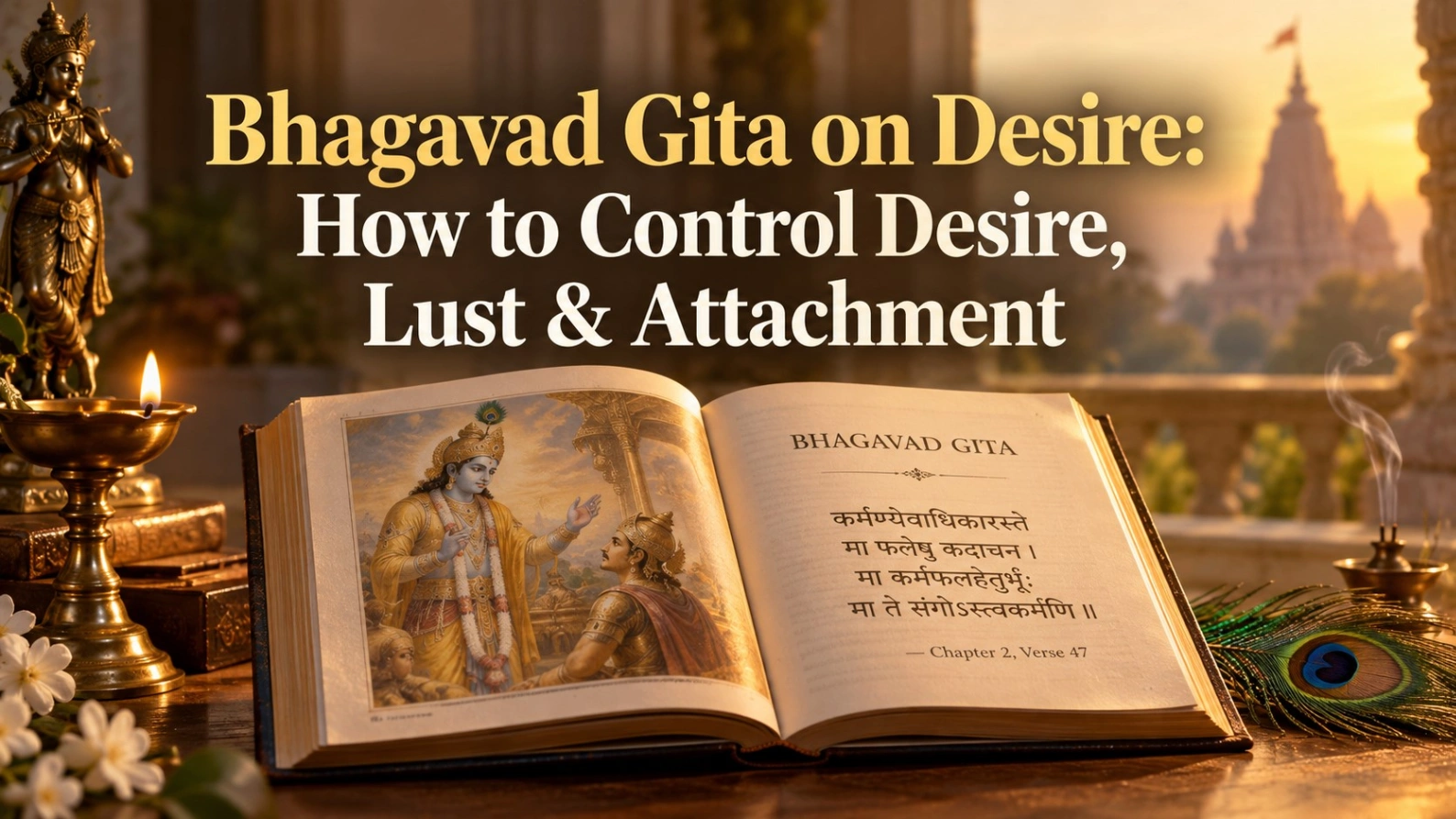


In a world full of stress, confusion and constant distractions, Bhagavad Gita teachings offer a timeless path toward peace, purpose and clarity. The Gita is not just a spiritual text to be read during religious moments. It is a practical guide for everyday life, helping us understand our mind, our duties, our emotions and our deeper purpose. Whether someone is facing anxiety, overthinking, failure, relationship struggles or career confusion, the wisdom of the Bhagavad Gita can bring direction and inner strength.
The beauty of the Bhagavad Gita lies in its simplicity and depth. It speaks to the human condition. Arjuna’s confusion on the battlefield is not very different from the inner battles people face today. We may not stand between two armies, but we often stand between fear and courage, attachment and wisdom, action and hesitation, purpose and confusion. This is why Bhagavad Gita lessons continue to feel relevant even in modern life.

The Bhagavad Gita Begins with Confusion
The Bhagavad Gita begins when Arjuna feels overwhelmed. He is a warrior, but at the moment of action, his mind becomes clouded with doubt, grief and fear. He does not know what is right. He questions his duty, his relationships and the meaning of action itself.
This moment is deeply human. Many people experience similar confusion in daily life. A student may feel lost about the future. A professional may feel stuck in work. A person may feel emotionally burdened by family expectations. Someone else may feel tired of chasing success but still not feel peaceful inside.
Lord Krishna does not simply tell Arjuna to ignore his emotions. Instead, He guides him toward a higher understanding. This is one of the most powerful Bhagavad Gita life lessons: clarity does not come by escaping life, but by understanding it correctly.
Design Your Destiny
Are you ready to move from confusion to clarity and from stress to inner peace? Join the Design Your Destiny program and learn practical spiritual tools to understand your mind, align with your purpose and live with greater awareness every day.
Start Your Journey Today!Bhagavad Gita for Inner Peace
One of the biggest reasons people turn to the Bhagavad Gita is for inner peace. The Gita teaches that peace does not depend only on external situations. It comes from mastering the mind, understanding the self and learning how to act without being disturbed by results.
Most people lose peace because they become too attached to outcomes. They work hard, but fear failure. They love deeply, but fear loss. They dream big, but fear judgment. The Bhagavad Gita teaches a balanced way of living where we give our best effort but do not become mentally trapped by the result.
This does not mean becoming careless or emotionless. It means becoming steady. When we understand that our responsibility is action, not complete control over the outcome, the mind becomes lighter. This is why Bhagavad Gita for mental peace is such a powerful concept. It teaches us to live with sincerity, effort and surrender.
Finding Purpose Through Dharma
Purpose is one of the most searched questions in modern life. People often ask, “What is my purpose?” or “Am I doing the right thing with my life?” The Bhagavad Gita answers this through the idea of dharma.
Dharma can be understood as rightful duty, inner responsibility and the path aligned with truth. It is not only about profession or social role. It is about living in harmony with your higher values. When a person follows dharma, life becomes meaningful because actions are no longer random. They become connected to a deeper intention.
Bhagavad Gita teachings on dharma remind us that everyone has a role to play. We do not need to copy someone else’s journey. Arjuna’s dharma was different from another person’s dharma. Similarly, each person must understand their own nature, strengths, responsibilities and inner calling.
Purpose does not always appear suddenly. Sometimes it becomes clear through disciplined action. When you do what is right, keep learning, serve others and act with honesty, purpose slowly unfolds. The Gita teaches us that clarity is born through action, not endless overthinking.
Karma Yoga: Acting Without Anxiety
The teaching of karma is central to the Bhagavad Gita. Karma Yoga means the path of selfless action. It teaches us to perform our duties with dedication, without becoming overly attached to rewards, praise or recognition.
This is one of the most practical Bhagavad Gita lessons for modern life. Today, many people feel anxious because they constantly measure themselves through results. Marks, salary, promotions, social media likes, status and comparison create pressure. The Gita does not ask us to stop working. It asks us to change our relationship with work.
When we act only for reward, we become restless. When we act with sincerity, discipline and devotion, the same action becomes peaceful. Karma Yoga teaches us to focus on the quality of our effort. This brings freedom from unnecessary stress.
This teaching is especially helpful for people dealing with failure or uncertainty. If the result is not in our favor, we can still learn, improve and continue. The Bhagavad Gita gives the strength to act without fear and accept outcomes without losing balance.
Bhagavad Gita for Clarity of Mind
A confused mind makes even simple situations difficult. The Bhagavad Gita gives clarity by helping us understand the difference between the body, mind, ego and true self. It teaches that our thoughts and emotions are important, but they are not the whole of who we are.
When we identify completely with every thought, we become unstable. One negative thought can ruin the day. One criticism can disturb the heart. One failure can shake our confidence. The Gita reminds us to become aware of the deeper self that is beyond temporary mental waves.
Bhagavad Gita teachings on mind control do not mean forcing the mind into silence. They mean training the mind through awareness, discipline and wisdom. A controlled mind becomes a friend. An uncontrolled mind becomes a source of suffering.
Clarity comes when the mind becomes calm. A restless mind exaggerates problems. A steady mind sees things as they are. This is why the Bhagavad Gita is not only spiritual wisdom, but also a practical guide for emotional strength.

Detachment Does Not Mean Giving Up
Many people misunderstand detachment. They think it means leaving family, work, ambition or relationships. But Bhagavad Gita teachings on detachment are much deeper. Detachment means being fully involved in life without becoming mentally enslaved by it.
You can love your family and still be detached from unhealthy expectations. You can work hard and still be detached from ego. You can enjoy success and still not become arrogant. You can face failure and still not feel broken.
Detachment gives freedom. It allows us to participate in life with a calm heart. When we are attached, we constantly fear losing something. When we are detached, we appreciate what we have while remaining rooted in inner stability.
This is one of the reasons Bhagavad Gita wisdom is so helpful for stress and anxiety. Much of our anxiety comes from trying to control everything. Detachment teaches us to do our duty and trust the larger flow of life.
Bhagavad Gita in Daily Life
The teachings of Bhagavad Gita become powerful when applied in daily life. It is not enough to only read the verses. The real transformation begins when we practice the wisdom in small moments.
When you feel angry, pause before reacting. When you feel confused, ask what is right, not only what is easy. When you feel anxious, focus on your action rather than the result. When you feel jealous, return to your own dharma. When you feel defeated, remember that one outcome does not define your life.
This is how to apply Bhagavad Gita in daily life. The Gita becomes a mirror. It shows where the mind is restless, where the ego is active and where wisdom is needed. Over time, these teachings create a more balanced personality.
Bhagavad Gita for beginners can start with one simple practice: read a few lines daily and reflect on how they apply to your current situation. The aim is not to memorize everything. The aim is to live more consciously.
Bhagavad Gita for Stress, Anxiety and Overthinking
Stress and overthinking often come from fear of the future or regret about the past. The Bhagavad Gita brings the mind back to the present duty. It teaches that we should act wisely in the present moment instead of becoming lost in endless worry.
For someone dealing with anxiety, this can be deeply healing. The Gita does not promise that life will always be easy. It teaches that inner strength can be developed even when life is difficult. This is why Bhagavad Gita helps in difficult times. It gives courage, patience and perspective.
When the mind asks, “What if I fail?” the Gita teaches effort. When the mind asks, “Why is this happening to me?” the Gita teaches understanding. When the mind asks, “What should I do?” the Gita teaches dharma.
Overthinking reduces when action becomes clear. Anxiety reduces when surrender deepens. Stress reduces when the mind stops demanding complete control.

The Role of Lord Krishna’s Teachings
Lord Krishna teachings in the Bhagavad Gita are compassionate, practical and deeply transformative. He does not encourage weakness, escapism or blind belief. He guides Arjuna toward wisdom, courage and action.
Krishna teaches that life must be lived with awareness. He shows that spirituality is not separate from responsibility. Meditation, devotion, selfless action, wisdom and discipline are all part of a complete life.
This makes the Bhagavad Gita a guide for both inner and outer life. It teaches how to think, how to act, how to handle emotions and how to remain connected to something higher than the ego.
Life-Changing Lessons from Bhagavad Gita
There are many life-changing lessons from Bhagavad Gita, but some stand out clearly.
First, do your duty with sincerity. Second, do not let results control your peace. Third, understand your dharma and walk your own path. Fourth, train the mind because it shapes your experience of life. Fifth, practice detachment while staying fully engaged. Sixth, remember that true peace comes from within.
These lessons are simple, but they require practice. The Gita is not meant to be read once and forgotten. It is meant to be reflected upon again and again. Each time we read it, we may discover a new meaning because our own life situation changes.
Why Bhagavad Gita Is Relevant in Modern Life
Modern life is fast, competitive and often emotionally exhausting. People are connected digitally but disconnected internally. There is more information than ever, yet many people feel unclear about what truly matters.
This is where Bhagavad Gita for modern life becomes important. It does not reject the world. It teaches how to live in the world with wisdom. It helps us work without burnout, love without fear, succeed without ego and face difficulties without losing ourselves.
The Gita reminds us that peace is not laziness, purpose is not pressure and clarity is not control. Peace comes from inner alignment. Purpose comes from dharma. Clarity comes from a calm and disciplined mind.
The Bhagavad Gita helps you find peace, purpose and clarity by changing the way you look at life. It teaches that peace is possible even in challenging situations, purpose is found through dharma and clarity comes when the mind is guided by wisdom.

Whether you are struggling with stress, confusion, overthinking or self-doubt, Bhagavad Gita teachings offer practical guidance. They show us how to act with courage, accept results with balance and live with deeper awareness.
The Gita is not only a scripture. It is a life guide. Its wisdom helps us understand ourselves, our duties and our relationship with the world. When applied sincerely, it can transform the way we think, act and live.
Personal Session
If you feel stuck, emotionally overwhelmed or unsure about your life direction, book a personal session for deeper guidance. Discover how timeless Bhagavad Gita wisdom can help you find peace, purpose and clarity in your own journey.
Book Now