
We all know the feeling. One moment, you’re on top of the world maybe you just got a promotion, fell in love, or had a fantastic weekend trip. You feel ecstatic. But then, Monday rolls around, or a small conflict arises, and suddenly you crash.
You go from a ten out of ten to a zero.
This exhausting cycle is what many of us call "life," but in reality, it's just an emotional rollercoaster. We spend our energy chasing the highs and dreading the lows. But what if there was a middle ground? Not a boring, flat-line middle ground, but a lively, vibrant baseline of joy that doesn’t disappear when things get tough?
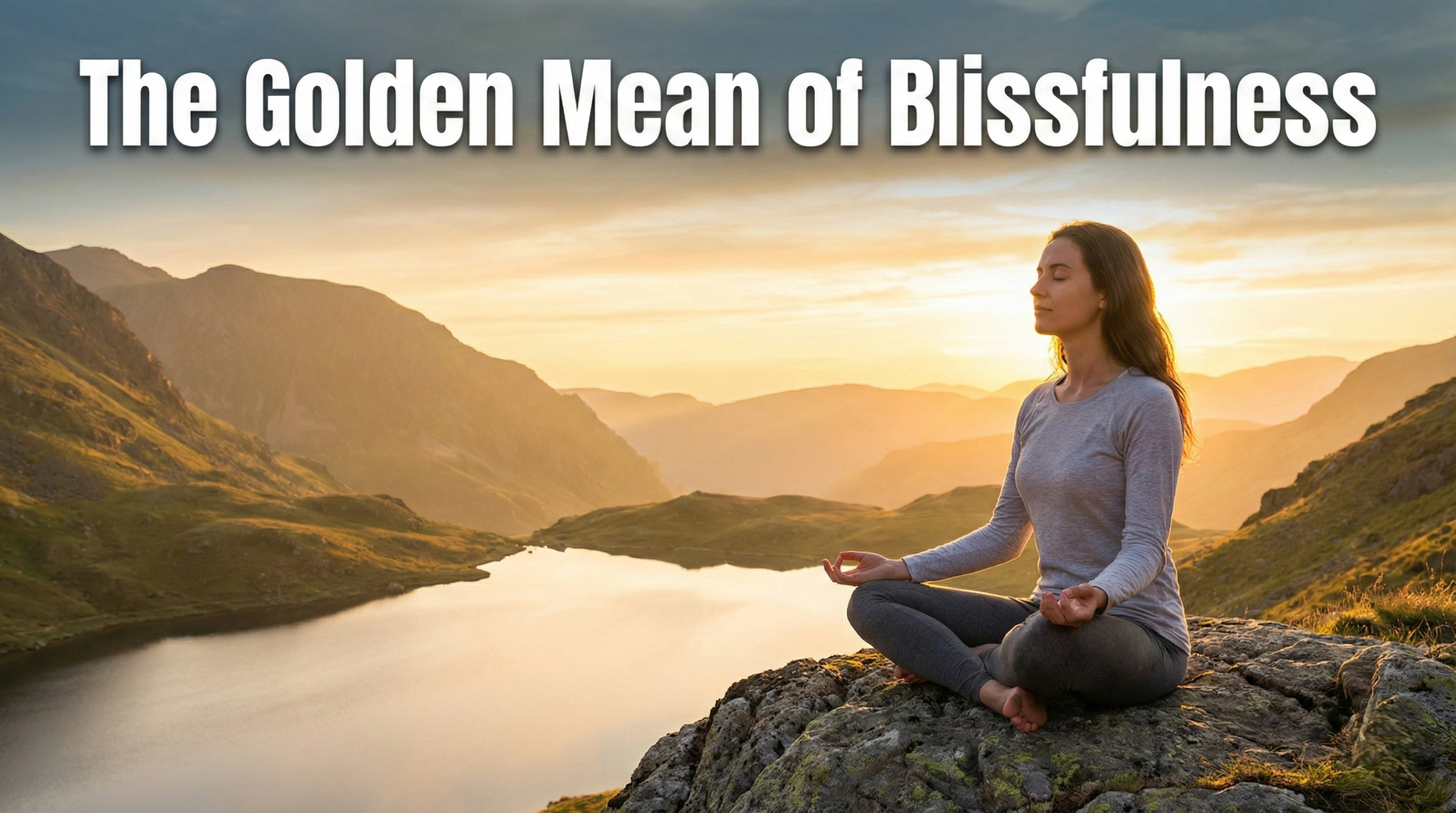
This is what is known as the Golden Mean of Blissfulness.
If you are looking for sustainable happiness rather than just fleeting moments of excitement, understanding this concept is the most important step you can take today. Let’s break down exactly what this means, how it differs from the "happiness" we usually chase, and how you can actually achieve it.
The Problem with Chasing Ecstasy
To understand the solution, we first have to look at the problem. Most of us believe that the goal of life is to be ecstatic 24/7. We want the fireworks. We want the adrenaline.
However, ancient wisdom on happiness and modern psychology both point out a biological reality: you cannot remain in a state of high-octane ecstasy forever. Your body and mind aren't built for it. If you were in a state of peak excitement for 24 hours straight, you would likely burn out or lose your mental balance.
Because we can’t sustain the high, we inevitably fall. And when we fall, we usually don't land softly; we crash into sadness, boredom, or stress.
This oscillation is the enemy of finding balance in life. It ruins our productivity, damages our relationships, and leaves us feeling drained. We start believing that happiness is something we have to "earn" or "chase" constantly.

Defining the Golden Mean
The spiritual meaning of the golden mean isn't about compromising. It isn't about saying, "Okay, I won't be too happy, just so I don't get too sad."
Instead, think of the Golden Mean of Blissfulness as a platform.
Imagine your emotional state is a trampoline. If the trampoline is sitting in a deep pit (misery), you have to work incredibly hard just to jump up to ground level. But if you raise the trampoline up to a high platform (blissfulness), you are already in a great place. You can jump higher into ecstasy if you want, but when you land, you don't land in the mud. You land back on the platform of bliss.
This is the core of mental equanimity. It is a lively, pleasant state like a beautiful morning where there are no fireworks, but everything feels just right.
Pleasure vs. Ecstasy vs. Bliss: The Key Differences
When we talk about how to stay happy all the time, we often confuse three very different terms. Clearing up this confusion is one of the biggest secrets to a happy life.
1. Pleasure
Pleasure is usually physical and dependent on external stimuli. It’s that delicious meal, the comfort of a warm bed, or a massage. While wonderful, pleasure is fleeting. As soon as the stimulus is gone (or if you have too much of it), the pleasure fades or even turns into pain. You cannot build a life solely on pleasure.
2. Ecstasy
Ecstasy is a peak state of energy. It is intense and explosive. In the debate of joy vs ecstasy, the teaching is clear: Ecstasy is great, but it is not a place of residence. It’s a place you visit. If you try to live there, you lose your grounding.
3. Bliss (The Golden Mean)
Bliss is different. Bliss is of your own nature. It is sustainable happiness. It is a background atmosphere that you carry with you. When you are blissful, you are not necessarily laughing out loud or dancing on tables; you are simply at ease. You are free from friction. This is the difference between pleasure and bliss one is a reaction to the outside world; the other is your internal climate.

Why You Need "The Golden Mean" for Success
You might be thinking, "This sounds nice for a monk, but I have a job and bills."
Actually, this state is even more critical for people with busy lives. When you are oscillating between stress and excitement, your intelligence is compromised. You are reacting, not responding.
Emotional stability tips usually focus on "coping" mechanisms. But the Golden Mean isn't about coping; it's about optimizing. When your internal chemistry is pleasant, your mind is sharp. You need less sleep. You don't get irritated by small things.
Overcoming mood swings becomes natural because you aren't looking to the outside world to fix how you feel. You become an independent energy source. This is the ultimate freedom.
How to Find Inner Peace: Practical Steps
So, how do we get there? We can’t just "think" our way into blissfulness. If positive thinking worked perfectly, we’d all be happy by now. Achieving the Golden Mean requires doing some work on your internal system.
Here are practical ways to move toward this state.
1. Stop Outsourcing Your Happiness
The first step in how to find inner peace is taking responsibility. As long as you believe your happiness depends on your spouse behaving well, the stock market going up, or the weather being sunny, you will never be stable. Remind yourself daily: "My inner reality is my responsibility." This shift in perspective is the foundation of spiritual balance.
2. Commit to Inner Work
One of the most effective ways to stabilize your chemistry is through structured practice. This is where the benefits of inner work come into play. Whether it’s specific breathwork (Pranayama), deep introspection, or structured self-inquiry, the goal is to align your body, mind, and energy. When your energy is aligned, blissfulness isn't a goal; it's a natural byproduct. You don't have to "try" to be happy, just like you don't have to "try" to make your heart beat.
3. Yoga for Mental Health
We often treat yoga as just exercise, but yoga for mental health is about changing your fundamental chemistry. Simple Hatha Yoga practices can help level out the peaks and valleys of your mood. If you are physically stiff and tense, your mind will be stiff and tense. By loosening the body and allowing energy to flow, you create a physical vessel that is capable of holding the Golden Mean.
4. Mindfulness for Beginners
You don't need to be an expert to start. Mindfulness for beginners can be as simple as separating yourself from your thoughts. Try this: Sit for 5 minutes. Watch your thoughts like they are traffic on a street. You are standing on the sidewalk. You see the angry thought, the sad thought, the happy thought but you don't get in the car with them. This distance is crucial for how to control emotions. You realize that you are not your thoughts, and you are not your emotions. You are the one witnessing them.
Overcoming Obstacles: The Mind Game
Even with these practices, the mind is tricky. It loves drama. It loves to overthink.
How to stop overthinking is a massive query for a reason. Our minds are compulsive. To stay in the Golden Mean, you have to stop feeding the drama.
When you feel yourself spiraling into a negative story ("Why did she say that?", "I'm never going to succeed"), catch yourself. Do not fight the thought; just drop it. Return to your breath. Return to the sensation of being alive.
The Golden Mean is not achieved by fighting the darkness; it is achieved by turning on the light. Daily meditation practice is that light switch. It doesn't have to be hours long. Even 15 minutes of dedicated silence in the morning can set the tone for the next 12 hours.
A New Way to Live
Imagine walking into a meeting, a family dinner, or a traffic jam, and feeling completely fine. Not forcing a smile, but genuinely feeling pleasant inside.
That is the power of the Golden Mean of Blissfulness.
It allows you to play the game of life fully. You can still strive for success, you can still enjoy parties, and you can still love deeply. But you are no longer desperate. You are no longer a beggar seeking happiness from the world; you become a radiator of happiness into the world.
This shift from "seeking" to "expressing" is the ultimate sign that you have hit the Golden Mean.
The Golden Mean of Blissfulness is not a myth, and it’s not reserved for mystics in the Himalayas. It is a scientifically and spiritually accessible state for anyone willing to do the work.
By understanding the difference between fleeting pleasure and sustainable bliss, and by using tools like yoga, breathwork, and meditation, you can stabilize your system. You can get off the rollercoaster.
Start small. Dedicate a few minutes today to sit and just be. Don't look for ecstasy. Look for that quiet, lively pleasantness that sits right in the middle. That is your platform. That is your home.