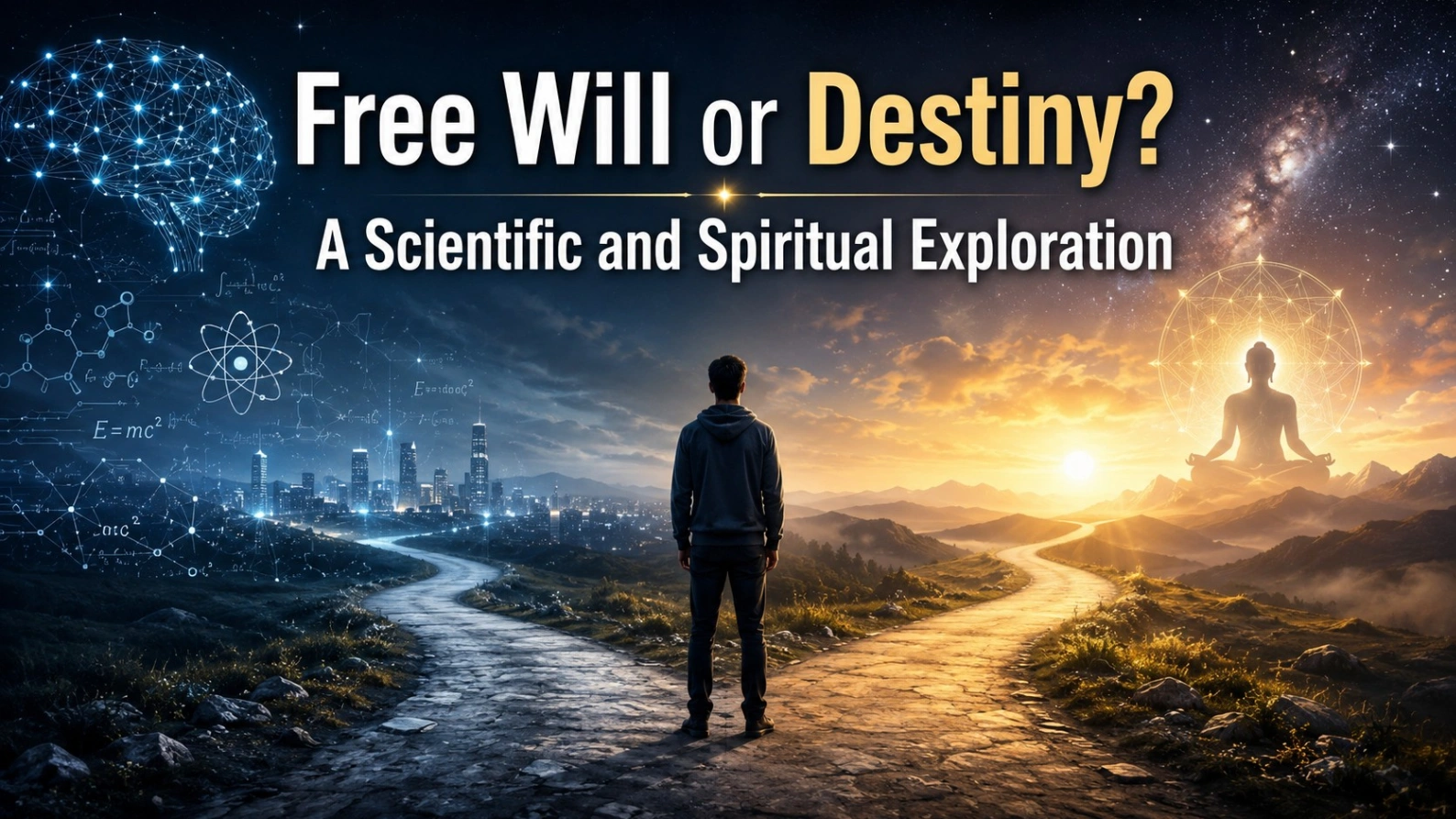



One of the most common questions people ask during moments of struggle, confusion, or transformation is this: Is destiny fixed, or can we change it? Are our lives already written, or do our choices truly matter? This question sits at the heart of the timeless debate of destiny vs free will, and no scripture explores this balance more deeply than the Bhagavad Gita.
Many people believe destiny is rigid decided at birth, sealed by past karma, and impossible to escape. Others feel that effort, intention, and conscious action can rewrite life’s direction. The Bhagavad Gita offers a profound and surprisingly practical perspective that goes beyond extremes. It neither promotes blind fate nor absolute control. Instead, it reveals how karma, free will, and spiritual awareness work together to shape human destiny.
In this blog, we will explore what the Gita truly says about destiny, karma, effort, and inner freedom and whether humans can genuinely consciously change their destiny.
The Common Belief: Is Destiny Fixed?
Across cultures, people often believe that destiny is fixed. Phrases like “It was meant to happen” or “This is my fate” reflect a deeply ingrained mindset. In Hindu philosophy, this belief is often linked to past-life karma, where current circumstances are seen as the unavoidable result of previous actions.
This belief is not entirely incorrect; but it is incomplete.
The Bhagavad Gita does acknowledge the role of past karma. It accepts that certain conditions; birth, family, talents, and life situations are influenced by actions from the past. However, it strongly rejects the idea that humans are helpless prisoners of fate.
If destiny were entirely fixed, the Gita’s emphasis on action (karma) would make little sense.
Destiny vs Free Will: What the Gita Actually Teaches
The Bhagavad Gita presents a balanced view of destiny vs free will. It explains that life is shaped by three forces:
Past karma (what you inherit)
Present effort (what you choose now)
Inner consciousness (how aware your actions are)
Krishna repeatedly reminds Arjuna that while he cannot control every outcome, he must act. Avoiding action is not freedom; it is ignorance.
“You have the right to perform your duty, but not to the fruits of action.” Bhagavad Gita 2.47
This verse is often misunderstood. It does not say effort is useless. It says effort is essential, but attachment to results creates suffering. Destiny is influenced not just by action, but by the quality of intention and awareness behind action.

Karma and Destiny: Understanding the Relationship
A crucial concept in the Gita is the relationship between karma and destiny. Karma is not punishment or reward; it is cause and effect.
Past karma shapes current circumstances
Present karma shapes future possibilities
This means destiny is not a fixed script, but a flowing process.
The Gita explains that while you may not be able to erase the past, you can absolutely change the direction of the future through conscious action. Just as a river’s source determines its flow, but human effort can redirect it, destiny too can be transformed.
So when people ask, “Does karma change destiny?” the Gita’s answer is clear: Yes, present karma has the power to reshape destiny.
Is Everything Predestined According to Hinduism?
Another common question is: Is everything predestined?
The Bhagavad Gita clearly says no.
If everything were predestined, there would be no purpose in:
Self-effort
Spiritual practice
Moral responsibility
Conscious choice
Krishna does not tell Arjuna, “This war will happen anyway.” He urges him to stand up, act, and choose rightly, even when the outcome is uncertain.
Hindu philosophy does not promote fatalism. Instead, it teaches responsibility with surrender; a rare and powerful combination.

Free Will in the Bhagavad Gita
The concept of free will in the Bhagavad Gita is subtle but powerful. The Gita does not claim humans have unlimited freedom. Instead, it says humans have freedom of response.
You may not choose:
Where you are born
What challenges appear
What circumstances arise
But you can always choose:
How you respond
Whether you act consciously or unconsciously
Whether you grow or repeat patterns
This freedom is where destiny begins to change.
Self-Effort vs Destiny: Which Is Stronger?
One of the most practical teachings of the Gita is the balance between self-effort and destiny.
Self-effort alone can create ego and frustration.
Blind belief in destiny creates laziness and fear.
The Gita teaches detached effort doing your best without clinging to outcomes. This approach purifies karma and gradually dissolves karmic patterns.
When effort becomes conscious, destiny begins to loosen its grip.
Can Humans Change Their Destiny Spiritually?
Yes; but not in the way most people think.
The Gita explains that destiny changes first internally, then externally. When consciousness shifts, perception changes. When perception changes, decisions change. And when decisions change, destiny follows.
Spiritual practices like:
Karma Yoga (selfless action)
Bhakti Yoga (devotion)
Jnana Yoga (self-inquiry)
help dissolve unconscious patterns that repeatedly create the same outcomes.
This is why two people in similar circumstances experience life very differently. Destiny responds to consciousness.
Destiny According to the Bhagavad Gita: A Living Process
According to the Bhagavad Gita, destiny is not a fixed destination; it is a living process shaped by awareness.
Unconscious action creates repetitive destiny
Conscious action creates liberating destiny
The Gita does not promise control over life. It promises freedom within life.
Life Purpose According to the Bhagavad Gita
The ultimate goal of the Gita is not to “fix” destiny, but to transcend bondage to it. When actions are aligned with dharma (inner truth), destiny becomes a tool for growth rather than suffering.
Life purpose, according to the Bhagavad Gita, is not external success; it is inner alignment. When this alignment happens, destiny naturally unfolds in harmony.
Is Destiny Fixed or Changeable?
So, is destiny fixed or changeable?
The Bhagavad Gita gives a nuanced answer:
Past creates conditions
Present effort creates direction
Consciousness creates freedom
Destiny is not your enemy. It is your teacher.
When action becomes conscious and intention becomes pure, destiny transforms not through force, but through understanding.