

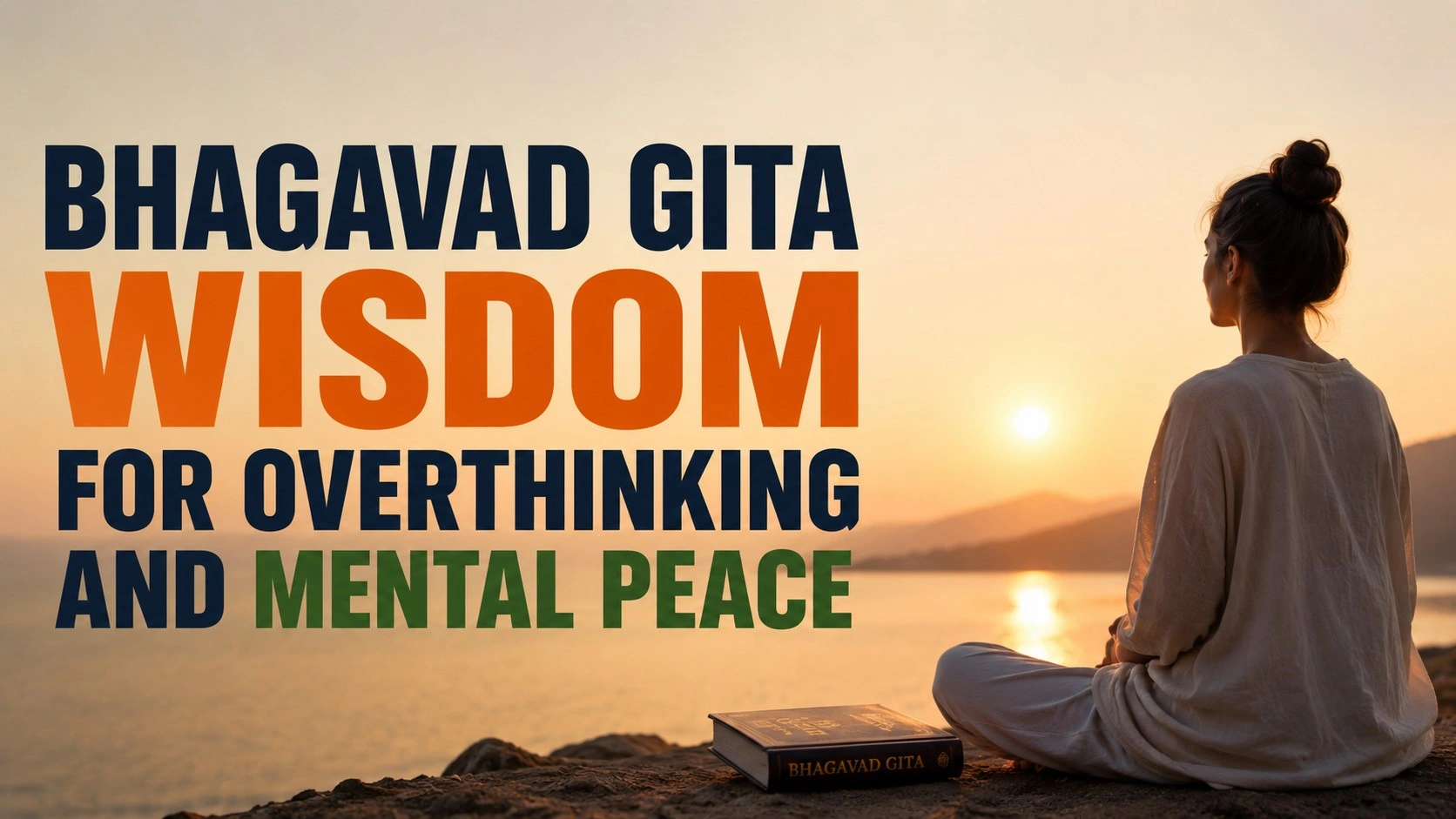
Have you ever felt exhausted not because of physical work but because your mind simply refuses to stop thinking? One thought leads to another, and before you know it, you are replaying old conversations, worrying about the future, or imagining situations that may never happen. Overthinking has quietly become one of the biggest challenges of modern life, affecting our happiness, relationships, productivity, and overall well-being. While there are countless books and techniques promising quick relief, the Bhagavad Gita offers something much deeper a timeless understanding of the human mind and the path to lasting inner peace. The Bhagavad Gita teachings are not merely religious philosophy; they are practical life lessons that help us navigate stress, anxiety, emotional struggles, and mental confusion with wisdom and clarity.
Krishna's First Lesson: You Are Not Your Thoughts
The setting of the Bhagavad Gita itself is significant. Arjuna, one of the greatest warriors, stands on the battlefield overwhelmed by fear, doubt, guilt, and emotional conflict. His body trembles, his mind becomes restless, and he loses the confidence to move forward. In many ways, Arjuna's struggle resembles what millions of people experience today. We may not stand on a battlefield with weapons, but we fight daily battles within our own minds. We worry about our careers, relationships, finances, health, and future. We constantly compare ourselves with others and question our own worth. Lord Krishna's teachings begin precisely at this moment of emotional collapse, showing that mental peace does not come from changing external circumstances but from transforming our inner perspective.
Design Your Destiny
If you're ready to move beyond overthinking and discover lasting peace, Design Your Destiny offers practical spiritual wisdom inspired by the Bhagavad Gita. Through guided meditation, self-awareness practices, and timeless teachings, you'll learn how to overcome fear, develop emotional resilience, and create a life filled with clarity, confidence, and purpose. Your journey toward a peaceful mind begins with one conscious step.
Start Your Journey Today!One of the most profound lessons in the Bhagavad Gita is that we are not our thoughts. The mind constantly produces ideas, fears, memories, and desires, but these are temporary experiences rather than our true identity. Most people become trapped because they believe every thought that appears in their mind. A negative thought becomes a permanent truth. A fearful imagination becomes tomorrow's reality. Krishna gently teaches Arjuna to observe the mind instead of becoming controlled by it. This shift may seem simple, but it has the power to change everything. When we realize that thoughts come and go like clouds passing through the sky, we stop allowing them to define our emotions.
Stop Trying to Control Everything
Another reason people struggle with overthinking is their attachment to outcomes. We constantly worry about what might happen tomorrow, whether people will approve of us, whether our efforts will succeed, or whether life will unfold according to our expectations. The Bhagavad Gita introduces one of its most famous teachings perform your duty sincerely but do not become attached to the results. This does not encourage laziness or indifference. Instead, it teaches us to focus our energy on actions rather than outcomes. The future is never fully within our control, but our present effort always is. When we stop trying to control every possible outcome, the mind naturally becomes lighter and calmer.
Fear also plays a major role in overthinking. Much of our mental suffering comes from imagining situations that have not yet happened. We fear failure before beginning. We fear rejection before speaking. We fear loss even while life is going well. Lord Krishna reminds Arjuna that fear arises when we forget our true nature and become identified only with temporary circumstances. The soul remains untouched by success and failure, pleasure and pain. Understanding this truth gives us the courage to face uncertainty with confidence instead of anxiety. Rather than allowing fear to dictate our decisions, the Bhagavad Gita encourages us to act with faith, wisdom, and inner stability.
Accept Change as a Law of Life
The Bhagavad Gita also teaches that attachment is one of the greatest causes of emotional suffering. We become attached to relationships, achievements, recognition, and expectations. Whenever reality fails to match our expectations, the mind reacts with disappointment, frustration, or anger. Krishna never asks us to stop loving people or enjoying life. Instead, He teaches balanced attachment. Love deeply, work sincerely, and live wholeheartedly, but do not let your happiness depend entirely on external situations. True peace comes when your inner stability is not shaken by changing circumstances.

The Power of Equanimity
One of the most practical teachings of the Bhagavad Gita is Karma Yoga, the yoga of selfless action. Karma Yoga encourages us to give our best effort in every task without becoming emotionally dependent on the result. Imagine working wholeheartedly without constantly worrying about success or failure. Imagine studying with complete focus rather than fearing examination results. Imagine helping others without expecting appreciation. This mindset frees the mind from unnecessary anxiety because attention remains rooted in the present moment instead of imagined future outcomes. Overthinking loses its power when our awareness returns to the action before us.
Meditation is another essential practice recommended by Lord Krishna for achieving mental peace. The Bhagavad Gita explains that the mind is naturally restless, but it can be trained through regular practice and detachment. Meditation does not require extraordinary abilities or long hours of sitting. Even a few minutes of silent observation each day helps us become aware of our thoughts without reacting to them. Gradually, the distance between the observer and the thought increases. Instead of becoming overwhelmed by emotions, we learn to witness them calmly. This growing awareness creates space for better decisions, healthier relationships, and greater emotional resilience.
Self-awareness is equally important in Krishna's teachings. Many of our reactions happen automatically. Someone criticizes us, and we immediately become defensive. Someone ignores us, and we assume the worst. A small setback convinces us that we have failed completely. The Bhagavad Gita encourages us to pause before reacting. When we become aware of our emotional patterns, we no longer remain slaves to them. Self-awareness allows us to respond with wisdom rather than impulse. Over time, this practice transforms not only our mental health but also the quality of our relationships and daily interactions.

Another timeless lesson from the Bhagavad Gita is the acceptance of change. Everything in life changes our circumstances, relationships, health, careers, and emotions. Much of our suffering comes from resisting this natural flow. We desperately try to hold on to pleasant experiences while pushing away uncomfortable ones. Krishna reminds us that change is the law of life. Accepting change does not mean giving up; it means developing the strength to remain peaceful even when life becomes uncertain. This acceptance frees the mind from constant resistance and opens the door to lasting inner peace.
The Bhagavad Gita also emphasizes the importance of living in the present. Most overthinking is rooted either in regrets about the past or worries about the future. Very little of our mental energy is spent appreciating the present moment. Krishna repeatedly brings Arjuna's attention back to his present duty. The present is where life unfolds, where decisions are made, and where transformation becomes possible. By focusing on today's actions rather than tomorrow's fears, we gradually reduce anxiety and cultivate a calm, centered mind.
Perhaps one of the greatest qualities described in the Bhagavad Gita is equanimity the ability to remain balanced during both success and failure. Modern life often teaches us to celebrate achievements excessively and become devastated by setbacks. Krishna offers a different perspective. He encourages us to remain steady regardless of external circumstances. A balanced mind is not easily disturbed by praise or criticism, gain or loss, victory or defeat. This emotional stability is not emotional suppression; it is emotional maturity. It allows us to make wiser decisions and experience greater peace in every situation.
The beauty of the Bhagavad Gita lies in its timeless relevance. Although it was spoken thousands of years ago, its wisdom addresses the exact problems people face today. Anxiety, stress, comparison, emotional exhaustion, lack of purpose, and overthinking are not new challenges; they simply appear in different forms across generations. Krishna's teachings remind us that true happiness cannot be found by constantly changing the external world. It begins with understanding and mastering our own minds.

Why Bhagavad Gita Still Matters Today
If you wish to experience the benefits of the Bhagavad Gita, begin with small, consistent practices. Spend a few minutes each day reading a verse and reflecting on its meaning. Practice meditation, even if only for ten minutes. Focus on your efforts instead of worrying about results. Observe your thoughts without believing every story your mind creates. Learn to accept uncertainty with grace. As these habits become part of your daily life, you will notice that your reactions become calmer, your decisions become clearer, and your mind becomes more peaceful.
Overthinking often convinces us that the answer lies in thinking more, but the Bhagavad Gita teaches exactly the opposite. Peace is not achieved by accumulating more thoughts but by developing greater awareness. Lord Krishna's wisdom invites us to replace fear with faith, attachment with acceptance, and confusion with clarity. The journey toward mental peace does not require changing the world around us it begins by transforming the world within us. When we learn to live according to these timeless teachings, we discover that the calmness we have been searching for has always existed within our own hearts.
Personal Session
Sometimes the right guidance can transform the way you see yourself and your life. If you're struggling with anxiety, emotional stress, confusion, or constant overthinking, book a Personal Spiritual Session and receive personalized guidance based on the timeless wisdom of the Bhagavad Gita. Discover practical solutions, gain deeper self-understanding, and take meaningful steps toward lasting mental peace and inner transformation.
Book Now