

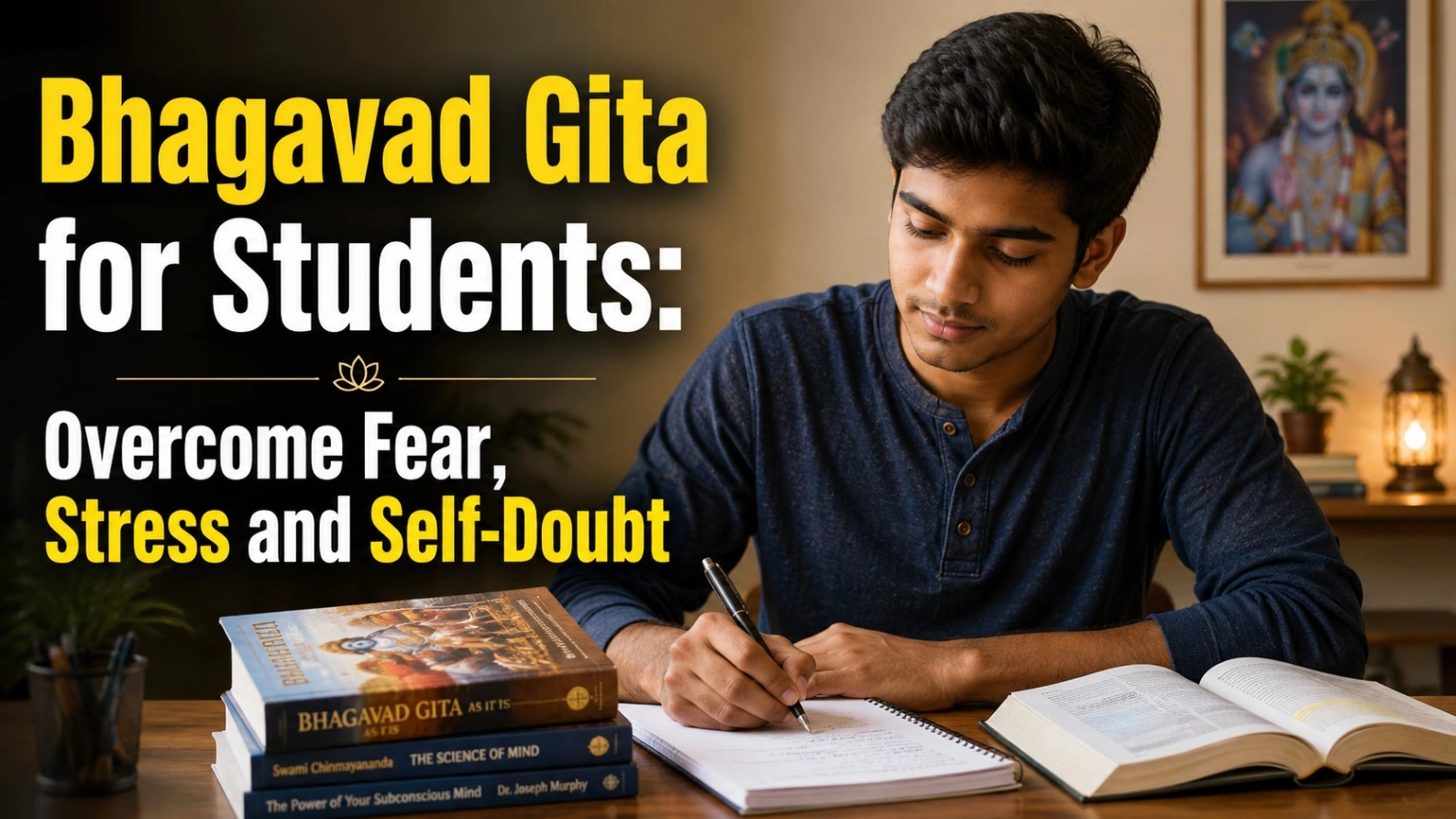
Student life looks exciting from the outside, but inside it can often feel heavy. There is exam stress, academic pressure, fear of failure, comparison with others, pressure from parents, confusion about the future, and constant self-doubt. This is where Bhagavad Gita for students becomes deeply relevant. The Bhagavad Gita is not only a spiritual scripture; it is also a practical guide for focus, discipline, emotional strength and mental peace.
In the Gita, Arjuna stands confused, fearful and overwhelmed before an important battle. He is not lazy or weak. He is sincere, capable and talented, yet he feels stuck because his mind is disturbed. This situation is very similar to what many students experience before exams, interviews, results or major life decisions. Krishna’s guidance to Arjuna teaches us how to control the mind, perform our duty, overcome fear and act with confidence.
For students, the Bhagavad Gita offers timeless wisdom: focus on your action, not just the result; build discipline without anxiety; face fear with clarity; and understand that your worth is not decided by marks alone. When these teachings are applied in daily life, students can handle stress, anxiety and self-doubt with a calmer and strongermind.
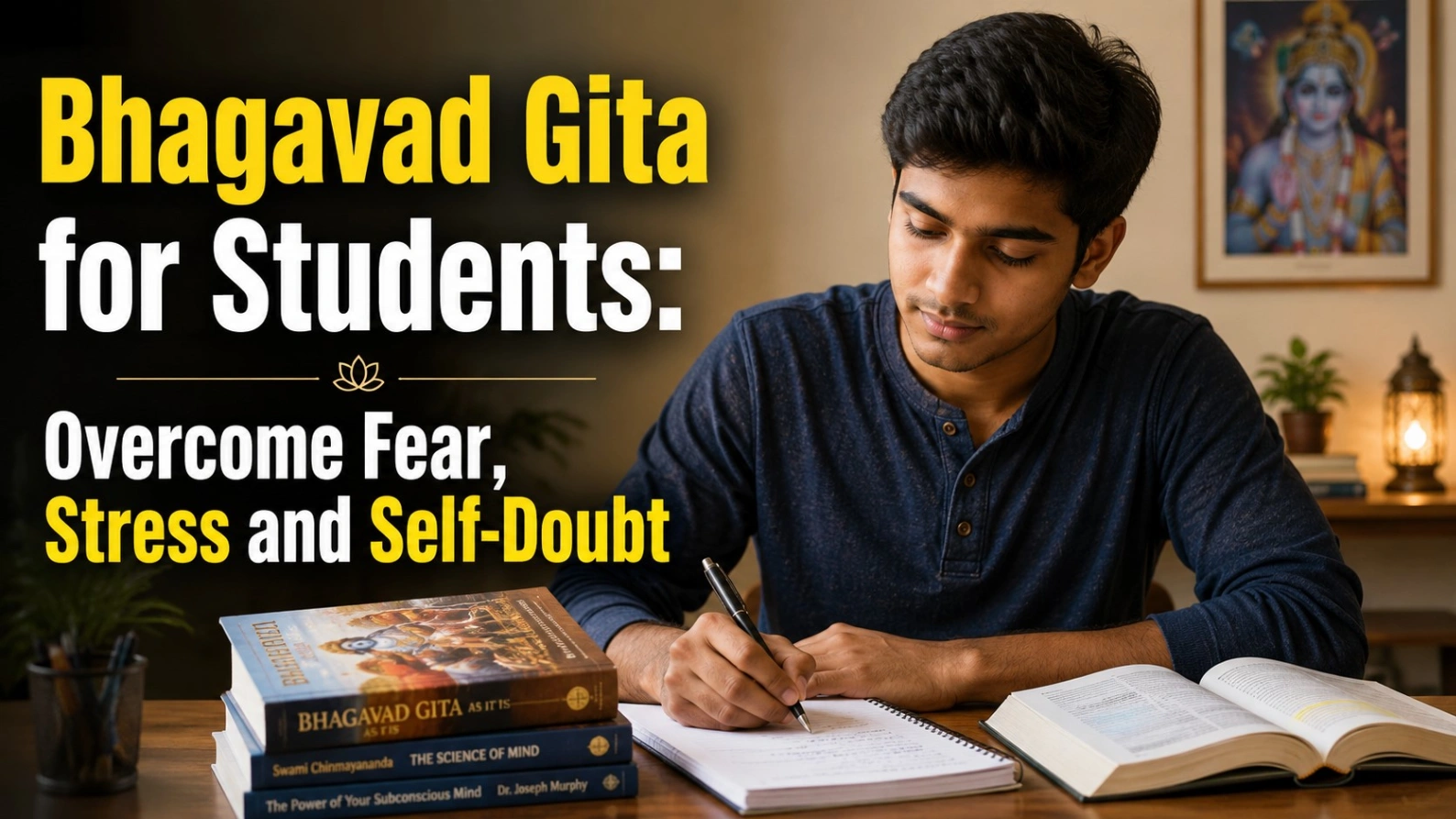
Why Students Feel Fear, Stress and Self-Doubt
Students today are surrounded by expectations. Everyone wants good marks, better performance, a successful career and a secure future. While ambition is good, too much pressure can disturb the mind. Many students begin to think, “What if I fail?”, “What if others do better than me?”, “What if I disappoint my parents?”, or “Am I good enough?”
These thoughts create fear of failure. Slowly, fear becomes stress, stress becomes overthinking, and overthinking becomes self-doubt. A student may sit with books for hours but still feel unable to focus. This is not always because of lack of intelligence. Often, it is because the mind is restless.
The Bhagavad Gita teaches that the mind can be either your friend or your enemy. When the mind is trained, it supports you. When it is uncontrolled, it creates confusion, fear and anxiety. That is why Krishna’s teachings are so powerful forstudents. They do not only tell you to study harder; they teach you how to make your mind steady.
Design Your Destiny
If you want to overcome fear, stress and confusion with deeper spiritual understanding, join the Design Your Destiny program. Learn practical tools to build focus, emotional balance, self-discipline and inner strength through spiritual wisdom.
Start Your Journey Today!Bhagavad Gita Teaching 1: Focus on Action, Not Fear of Results
One of the most famous teachings of the Bhagavad Gita is to focus on your duty and action, without being attached to the result. For students, this lesson is extremely important.
Many students do not fear studying; they fear the result. They worry about marks, rank, selection, rejection and comparison. Because of this, their attention moves away from preparation and gets trapped in imagination. The Gita reminds students that the result is not fully in their control, but sincere effort is.
This does not mean students should not care about results. It means they should not become mentally dependent on results. Your role is to study honestly, revise regularly, manage time, practice questions and give your best. The final result depends on many factors, but your effort is in yourhands.
When students understand this, exam stress reduces. Instead of thinking, “What if I fail?”, they begin to think, “What can I do today?” This shift brings focus, discipline and peace.
Bhagavad Gita Teaching 2: Control the Mind Before It Controls You
The biggest challenge for students is often not the syllabus but the mind. Distraction, social media, negative thoughts, comparison and overthinking make studying difficult. The Bhagavad Gita repeatedly highlights the importance of mastering the mind.
A student may plan to study for three hours but after ten minutes, the mind starts wandering. It thinks about results, friends, entertainment, fear, or past mistakes. This is natural, but it should not become a habit.
Krishna teaches that the mind can be brought back through practice and detachment. For students, this means two things: practice focusing again and again, and detachfrom distractions that weaken concentration.
If your mind wanders while studying, do not hate yourself. Gently bring it back. If you get distracted by your phone, keep it away during study time. If you keep comparing yourself with others, remind yourself that your journey is your own.
Mind control is not built in one day. It is built through small daily discipline.
Bhagavad Gita Teaching 3: Do Your Duty with Discipline
Student life has a clear duty: to learn, grow, study sincerely and prepare for the future. But discipline does not mean forcing yourself with fear. Real discipline comes from understanding the value of your actions.
The Bhagavad Gita teaches the importance of doing one’s duty with sincerity. For students, this means showing up every day even when motivation is low. You may not always feel inspired to study, but discipline helps you continue.
A disciplined student does not wait for the perfect mood. They create a routine. Theyrevise on time. They take breaks wisely. They do not postpone everything until the last moment. This kind of discipline reduces exam anxiety because preparation becomes steady.
Discipline is not punishment. It is self-respect. When you follow your study routine, you send a message to your mind: “I am capable. I can trust myself.” This slowly builds confidence and reduces self-doubt.
Bhagavad Gita Teaching 4: Overcome Fear with Clarity
Fear becomes stronger when the mind is confused. Arjuna was afraid because he could not see clearly what he should do. Krishna did not simply say, “Don’t be afraid.” He gave Arjuna clarity.
Students also need clarity. Many times, fear comes from unclear preparation. The syllabus feels too big, time feels too short, and the mind feels scattered. Instead of panicking, divide the problem.
Ask yourself: What exactly am I afraid of? Is it a subject? A chapter? Lack of revision?Time management? Once you identify the real issue, fear becomes manageable.
For example, if you are afraid of mathematics, the solution is not endless worrying. The solution is daily practice, clearing concepts, solving previous papers and asking for help. If you are afraid of forgetting answers, the solution is revision and writing practice.
The Bhagavad Gita teaches that clarity leads to right action. When students act with clarity, fear loses its power.

Bhagavad Gita Teaching 5: Stop Comparing Your Journey
One major reason for student stress is comparison. Someone else may score higher, study faster, speak better, or seem more confident. But the Gita teaches the importance of following your own path.
Every student has different strengths, weaknesses, speed and circumstances. Comparing your chapter one with someone else’s chapter ten only creates unnecessary pressure. Your goal should not be to become someone else. Your goalshould be to become better than your previous self.
If another student performs well, take inspiration, not insecurity. Their success does not reduce your possibilities. The Bhagavad Gita encourages inner growth, not jealousy or comparison.
A student who focuses on self-improvement becomes peaceful. A student who constantly compares becomes restless. Choose growth over comparison.
Bhagavad Gita Teaching 6: Build Confidence Through Effort
Self-doubt often appears when students forget their own effort. They think, “I cannot do this,” even before trying properly. The Bhagavad Gita teaches that strength comes from action.
Confidence is not magic. It is built when you keep promises to yourself. If you decide to study one chapter and complete it, confidence grows. If you revise regularly, confidence grows. If you face a difficult subject instead of avoiding it, confidence grows.
The Gita does not promote weakness. It encourages courage, action and inner strength. Krishna reminds Arjuna to rise and perform his duty. In the same way, students must rise from fear and take practical steps.
Even if your progress is slow, do not stop. Small efforts repeated daily can create powerful results.
Bhagavad Gita Teaching 7: Stay Calm During Exams
Exam anxiety is common. Some students know the answers but panic during the exam. Some overthink before entering the hall. Some lose sleep because they are worried about performance.
The Bhagavad Gita teaches balance of mind. A calm mind performs better than a fearful mind. Before exams, students should focus on simple practices: deep breathing, short revision, positive self-talk and trust in preparation.
Instead of saying, “I will forget everything,” say, “I have prepared, and I will do my best.” Instead of discussing panic with everyone before the exam, sit quietly for a few minutes. Avoid last-minute comparison. Protect your mental energy.
Peace does not mean you do not care. Peace means you are not controlled by panic.

How to Apply Bhagavad Gita Teachings in Student Life
The wisdom of the Bhagavad Gita becomes useful only when applied. Students can start with small steps.
Begin your day with a calm mind. Before studying, sit silently for two minutes and take deep breaths. Set a clear study goal for the day. Focus on one task at a time instead of worrying about the entire syllabus.
Practice detachment from results by reminding yourself that your job is sincere effort. Reduce distractions by keeping your phone away during study hours. When negative thoughts arise, do not fight them aggressively. Observe them and return to your work.
Use short affirmations inspired by Gita wisdom: “I will focus on my action,” “My effort is in my control,” “I am stronger than my fear,” “I will not compare my journey,” and “I will study with a calm mind.”
These small practices help students build focus, discipline, emotional strength and inner peace.
Bhagavad Gita Quotes for Students: The Deeper Meaning
Students often search for Bhagavad Gita quotes for motivation, but the real value lies in understanding the meaning behind them. The Gita’s message is not only about success; it is about becoming steady, wise and courageous.
For students, the most important message is this: do not run away from your duty because of fear. Arjuna wanted to step back when he felt overwhelmed. Krishna guided him to stand up with wisdom. Similarly, students should not avoid studies, exams or challenges because of self-doubt.
The Gita teaches that challenges are not always obstacles. Sometimes, they are opportunities to discover your inner strength.
Spiritual Tips for Students to Reduce Stress
Spirituality does not mean leaving studies or becoming inactive. True spirituality makes students more focused, peaceful and responsible.
Students can reduce stress by practicing simple meditation, reading a few lines of the Bhagavad Gita, maintaining a gratitude journal, avoiding negative comparison and respecting their daily routine. Even five minutes of silence can help calm the mind.
A peaceful student is not one who has no exams. A peaceful student is one who knows how to remain steady during exams.

The Bhagavad Gita for students is a powerful guide to overcome fear, stress and self-doubt. It teaches students to focus on action, control the mind, build discipline, stop comparison and face challenges with courage.
Exam stress, academic pressure and fear of failure may be part of student life, but they do not have to control your life. With Krishna’s teachings, students can learn to study with focus, act with confidence and accept results with maturity.
The real lesson of the Bhagavad Gita is not just how to succeed in exams, but how to become mentally strong, emotionally balanced and spiritually aware. When students understand this, education becomes not just a race for marks, but a journey of inner growth.
Personal Session
Feeling stuck, stressed or unsure about your path? Book a personal session and receive guided support to understand your challenges, calm your mind and move forward with clarity, confidence and spiritual awareness.
Book Now