

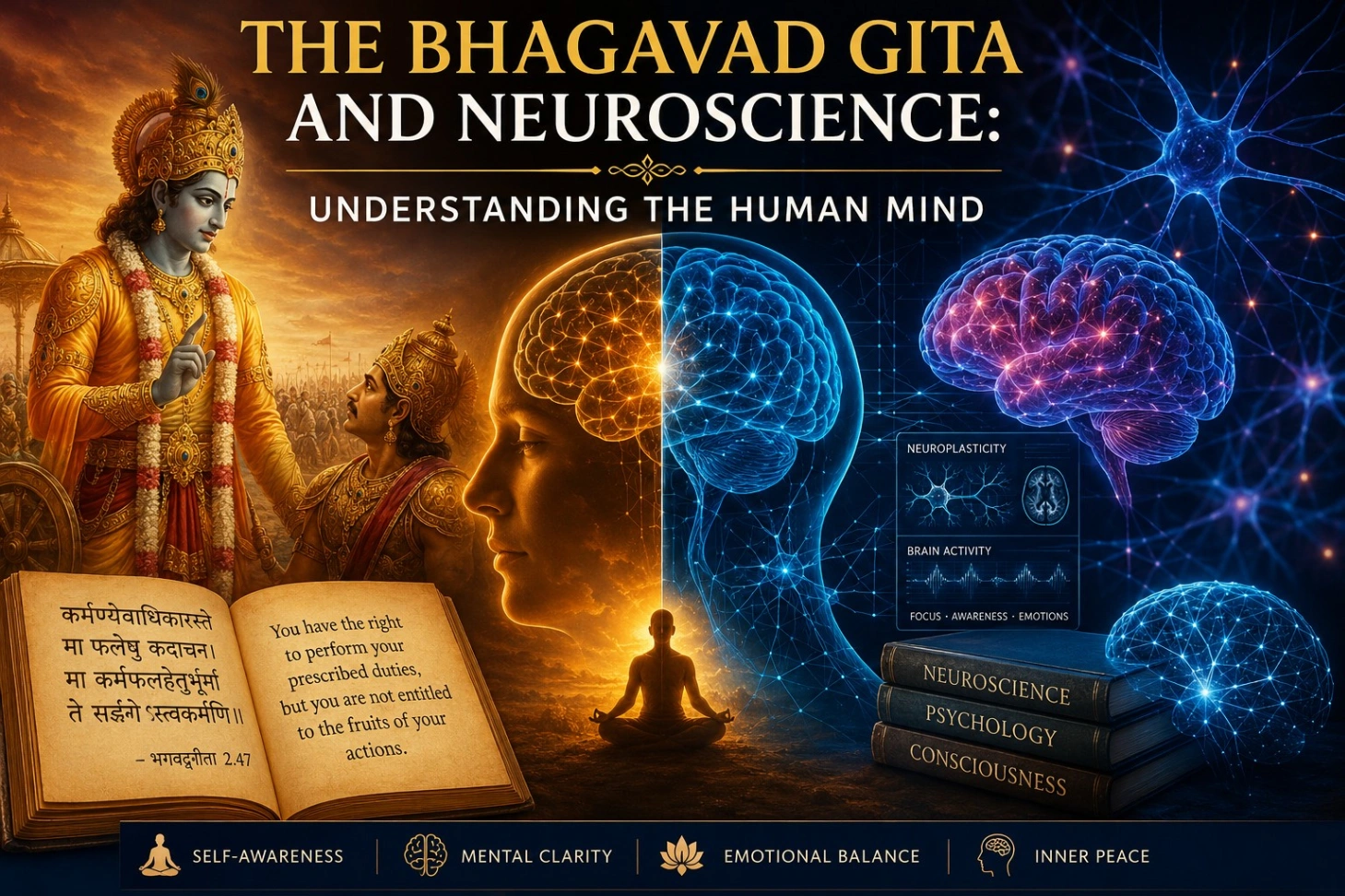
For thousands of years, the Bhagavad Gita has served as one of humanity's greatest guides to understanding the mind, emotions, consciousness, and the inner self. Long before the birth of neuroscience, the Gita explored why people suffer from anxiety, attachment, fear, anger, confusion, and emotional instability. Today, advances in brain science, cognitive neuroscience, and psychology are uncovering fascinating insights into how the brain processes thoughts, emotions, habits, and decision-making. Although the Bhagavad Gita is a spiritual scripture and neuroscience is a scientific discipline, both seek to answer one profound question: How does the human mind work, and how can we master it?
Rather than seeing these two perspectives as opposing forces, many people now view them as complementary. The Bhagavad Gita provides practical wisdom for transforming the mind, while neuroscience explains the biological mechanisms behind many of these mental processes. Together, they offer a holistic framework for cultivating mental clarity, self-awareness, emotional balance, and inner peace.
The Human Mind: More Powerful Than We Imagine
The Bhagavad Gita repeatedly emphasizes that the mind is one of our greatest strengths when properly trained and one of our greatest obstacles when left uncontrolled. Lord Krishna teaches Arjuna that the mind can become either our closest friend or our worst enemy depending on how we direct it.
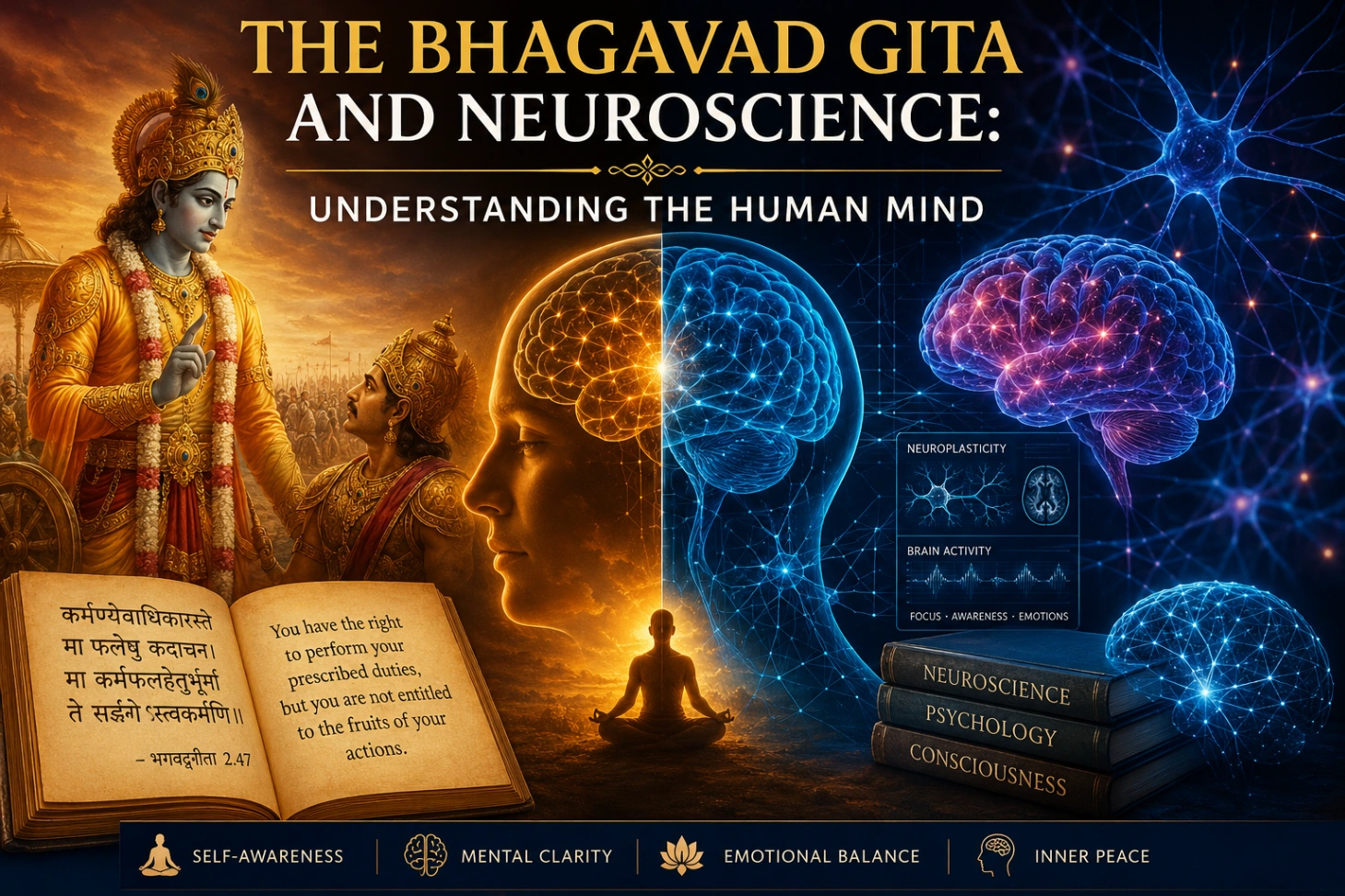
Modern neuroscience echoes this idea in a different language. Scientists have discovered that the brain constantly changes through a process known as neuroplasticity. Every thought, habit, emotion, and repeated behavior strengthens specific neural pathways. The more often we think or behave in a certain way, the stronger those neural connections become.
This means that our mental habits are not permanently fixed. Just as the Bhagavad Gita encourages discipline, meditation, and right thinking to transform one's inner world, neuroscience shows that consistent mental practices can literally reshape the brain over time.
This remarkable overlap demonstrates that both ancient wisdom and modern science recognize that change begins from within.
CTA – Design Your Destiny
The Bhagavad Gita teaches that every thought, action, and decision shapes the direction of your life. If you're ready to discover your true potential, overcome inner limitations, and live with clarity and purpose, begin your journey today with our Design Your Destiny program. Learn practical spiritual principles that help you transform your mindset, relationships, career, and overall well-being.
Start Your JourneyWhy the Mind Wanders
Almost everyone has experienced a wandering mind. During meditation, work, prayer, or even conversations, thoughts constantly drift from one subject to another. Arjuna himself admits in the Bhagavad Gita that controlling the mind seems as difficult as controlling the wind.
Neuroscience provides a biological explanation for this experience. Researchers have identified networks within the brain that become active during periods of mind wandering and self-referential thinking. While this natural activity allows creativity and reflection, excessive mental wandering often contributes to stress, rumination, and overthinking.
The Bhagavad Gita approaches this challenge differently. Instead of fighting the mind, Krishna teaches gentle discipline through repeated practice and detachment. Rather than suppressing thoughts, we learn to observe them without becoming controlled by them.
This insight aligns surprisingly well with modern mindfulness practices, which encourage awareness without judgment.
Meditation: Where Ancient Wisdom Meets Brain Science
One of the strongest connections between the Bhagavad Gita and neuroscience is meditation.
The Gita describes meditation not merely as a relaxation technique but as a path toward mastering the senses, calming mental fluctuations, and realizing one's higher nature. Meditation gradually reduces attachment to distracting thoughts and strengthens inner awareness.
Neuroscience has spent decades studying meditation and has found that regular practice is associated with changes in brain function related to attention, emotional regulation, and stress management. Researchers continue to investigate these effects, but many studies suggest that consistent meditation can support improved focus and emotional resilience.
The Bhagavad Gita, however, reminds us that meditation is ultimately more than improving cognitive performance. It is a means of cultivating wisdom, compassion, equanimity, and spiritual growth.
Science explains what may happen inside the brain during meditation, while the Gita explains why these practices matter for living a meaningful life.
Understanding Emotions Through Both Perspectives
Fear, anger, attachment, desire, and grief are central themes throughout the Bhagavad Gita. Arjuna's emotional crisis on the battlefield is deeply human. His confusion reflects the emotional struggles that many people experience today.
Krishna never tells Arjuna to suppress his emotions. Instead, He guides him toward understanding them through wisdom and self-awareness.
Modern neuroscience similarly recognizes that emotions are natural aspects of human functioning. Emotional regulation involves multiple interconnected brain systems rather than simply eliminating negative feelings.
The Bhagavad Gita teaches that suffering often arises not because emotions exist but because we become excessively attached to them or identify ourselves entirely with temporary mental states.
Learning to observe emotions rather than immediately reacting to them creates greater emotional intelligence and resilience.
This timeless teaching continues to resonate with modern approaches to mindfulness, cognitive psychology, and emotional well-being.
Self-Awareness: The Beginning of Transformation
One of the most important teachings in both neuroscience and the Bhagavad Gita is the importance of self-awareness.
The Gita repeatedly encourages individuals to become observers of their own thoughts, actions, desires, and motivations. This awareness creates freedom because we stop reacting automatically to every impulse.
Neuroscience also highlights the importance of metacognition—the ability to think about our own thinking. Developing this awareness allows us to interrupt automatic habits, improve decision-making, and respond more intentionally.
Whether described as witnessing consciousness in the Bhagavad Gita or reflective awareness in psychology, the underlying principle remains remarkably similar: awareness precedes transformation.
As self-awareness grows, emotional reactivity decreases, mental clarity improves, and our choices become more aligned with our deeper values instead of temporary impulses.

Consciousness: Where Science Meets Spirituality
Perhaps the most fascinating point of comparison between the Bhagavad Gita and neuroscience is the idea of consciousness. Neuroscience studies consciousness by examining brain activity, neural networks, and cognitive processes that give rise to awareness, perception, and decision-making. Scientists continue to explore one of the greatest mysteries in modern research: how subjective experience emerges from the physical brain.
The Bhagavad Gita approaches consciousness from a different perspective. It teaches that while the brain and body are instruments through which we experience the world, our deepest identity is the eternal Self, or Atman, which is beyond birth and death. According to the Gita, thoughts, emotions, and physical sensations constantly change, but the witnessing consciousness remains unchanged.
These viewpoints are not necessarily in conflict because they address different questions. Neuroscience seeks to understand the mechanisms of conscious experience, while the Bhagavad Gita explores the nature of the conscious observer. Together, they encourage us to investigate both the functioning of the brain and the deeper experience of awareness itself.
Stress, Anxiety, and the Restless Mind
Stress and anxiety have become defining challenges of modern life. Constant notifications, demanding schedules, and endless streams of information leave many people feeling mentally exhausted. While neuroscience studies the brain's response to stress and the physiological changes it produces, the Bhagavad Gita examines the mental habits that often intensify suffering.
Krishna explains that attachment, uncontrolled desires, fear of outcomes, and identification with temporary circumstances disturb the mind. When we become completely dependent on external success, our inner peace becomes fragile.
Modern psychology similarly recognizes that persistent worry often stems from repetitive thought patterns and our interpretation of situations rather than the situations themselves. This is why practices such as mindfulness, emotional awareness, and cognitive reframing have become widely recommended for improving mental well-being.
The Bhagavad Gita offers a timeless solution by encouraging individuals to focus on right action rather than constant worry about results. This shift helps reduce mental burden and creates greater emotional stability.
Detachment Is Not Indifference
One of the most misunderstood teachings of the Bhagavad Gita is detachment. Many assume detachment means becoming emotionally cold or disconnected from life. In reality, Krishna teaches active participation combined with inner freedom.
Detachment means giving your best effort without allowing success or failure to define your identity. It encourages full commitment while releasing unhealthy attachment to outcomes.
Neuroscience offers an interesting perspective here. When people become overwhelmed by fear, uncertainty, or excessive emotional reactions, decision-making can become impaired. Developing emotional regulation supports clearer thinking, better judgment, and healthier responses during challenging situations.
The Bhagavad Gita therefore promotes a balanced state in which emotions are acknowledged but do not dominate our actions. This mindset supports resilience, adaptability, and long-term mental well-being.

Karma Yoga and the Science of Decision-Making
Every day, the brain makes thousands of decisions, many of them automatic. Neuroscience has shown that habits, emotions, past experiences, and environmental cues all influence our choices.
The Bhagavad Gita introduces the principle of Karma Yoga, the path of selfless action. Krishna encourages Arjuna to perform his duties with sincerity, integrity, and dedication without becoming attached to personal gain.
From a psychological perspective, this approach can reduce excessive pressure and perfectionism. When our motivation shifts from external rewards toward meaningful action, we often experience greater satisfaction, purpose, and emotional balance.
Karma Yoga reminds us that while we cannot control every outcome, we can always choose the quality of our effort, our attitude, and our intentions.
Neuroplasticity and Personal Transformation
One of the most exciting discoveries in neuroscience is neuroplasticity, the brain's ability to adapt and reorganize throughout life. New experiences, learning, and repeated behaviors continually shape neural connections.
This scientific understanding beautifully complements the Bhagavad Gita's teaching that human beings are capable of inner transformation. Krishna repeatedly encourages Arjuna to cultivate discipline, wisdom, compassion, devotion, and self-control through consistent practice.
Neither neuroscience nor the Bhagavad Gita suggests that meaningful change happens overnight. Instead, both emphasize gradual progress through repeated effort.
Every meditation session, every conscious decision, every act of kindness, and every moment of self-awareness contributes to building healthier mental patterns. Small actions repeated consistently often lead to profound long-term transformation.
Can Neuroscience Explain the Soul?
This question continues to inspire both scientists and spiritual seekers.
Neuroscience investigates the biological processes associated with consciousness, memory, emotions, and behavior. However, it does not claim to have fully explained the nature of subjective awareness or whether consciousness exists independently of the brain.
The Bhagavad Gita presents a spiritual perspective, describing the soul as eternal, unchanging, and distinct from the physical body. This teaching belongs to the realm of philosophy and spirituality rather than empirical science.
Because these perspectives operate within different frameworks, it is important not to present one as proof of the other. Instead, they invite thoughtful dialogue. Science helps us understand the workings of the brain, while the Bhagavad Gita offers insights into questions of meaning, identity, purpose, and inner realization.
Respecting the strengths and limitations of both approaches allows for a richer understanding of the human experience.
Practical Lessons You Can Apply Every Day
The wisdom shared by the Bhagavad Gita and supported by many principles explored in neuroscience becomes meaningful only when applied in daily life.
Begin each morning with a few minutes of quiet reflection or meditation before engaging with technology. Practice observing your thoughts instead of reacting immediately to them. Develop the habit of focusing on actions that are within your control while letting go of excessive attachment to outcomes. Spend time cultivating gratitude, compassion, and self-awareness. Build healthy routines that support both physical and mental well-being, including quality sleep, mindful breathing, balanced nutrition, and regular movement.
Most importantly, remember that lasting transformation is rarely dramatic. It is the result of small, consistent choices repeated over time.
The Bhagavad Gita and neuroscience come from different traditions, yet both seek to understand one of humanity's greatest mysteries: the human mind. Neuroscience explains how the brain functions, adapts, and processes information. The Bhagavad Gita teaches how wisdom, self-awareness, discipline, and spiritual insight can help us live with greater peace and purpose.
While neuroscience continues to expand our understanding of brain science, consciousness, emotional intelligence, and cognitive psychology, the Bhagavad Gita reminds us that true transformation begins with understanding ourselves.
Rather than choosing between ancient wisdom and modern science, we can appreciate how each contributes valuable insights. Science helps explain the mechanisms of the mind, while the Bhagavad Gita provides timeless guidance on how to use that mind wisely.
Together, they encourage us to cultivate clarity instead of confusion, awareness instead of automatic reactions, compassion instead of fear, and inner peace instead of constant mental struggle. In a fast-moving world, this combination of scientific understanding and spiritual wisdom offers a meaningful path toward emotional resilience, mental well-being, and a more conscious way of living.
CTA – Personal Session
Every individual walks a unique path, and sometimes the right guidance can make all the difference. If you're seeking clarity about life, relationships, career, emotional challenges, or your spiritual journey, book a Personal Session with our experienced mentors. Receive practical insights rooted in timeless wisdom to help you move forward with confidence, peace, and purpose.
Book NowRead Latest Articles
Laughing Outside, Crying Within: A Spiritual Disconnect
Frequently Asked Questions
What is the connection between the Bhagavad Gita and neuroscience?
The Bhagavad Gita and neuroscience both explore how the human mind functions, though from different perspectives. Neuroscience studies the brain's biological processes, while the Bhagavad Gita focuses on self-awareness, emotional balance, and spiritual growth. Together, they provide complementary insights into understanding thoughts, emotions, habits, and cultivating lasting mental well-being.Does the Bhagavad Gita talk about the human mind?
Yes. The Bhagavad Gita discusses the nature of the mind, emotions, desires, attachment, discipline, and self-awareness, offering practical guidance for achieving inner peace and emotional balance.Is there scientific evidence supporting meditation mentioned in the Bhagavad Gita?
Modern research suggests that regular meditation is associated with improvements in attention, emotional regulation, and stress management. While these findings are encouraging, the Bhagavad Gita also emphasizes meditation as a spiritual practice for self-realization and inner growth.What is neuroplasticity, and how does it relate to the Bhagavad Gita?
Neuroplasticity refers to the brain's ability to reorganize and form new neural connections through repeated experiences and learning. This aligns with the Bhagavad Gita's teaching that consistent practice, discipline, and right thinking can gradually transform the mind.Does neuroscience prove the teachings of the Bhagavad Gita?
No. Neuroscience and the Bhagavad Gita belong to different domains. Neuroscience investigates biological processes through scientific methods, while the Bhagavad Gita offers spiritual and philosophical guidance. They can complement one another without one proving the other.How can I apply these teachings in everyday life?
You can practice daily meditation, develop self-awareness, observe your thoughts without reacting immediately, focus on your actions rather than outcomes, cultivate gratitude, and build healthy habits that support both mental and emotional well-being.