

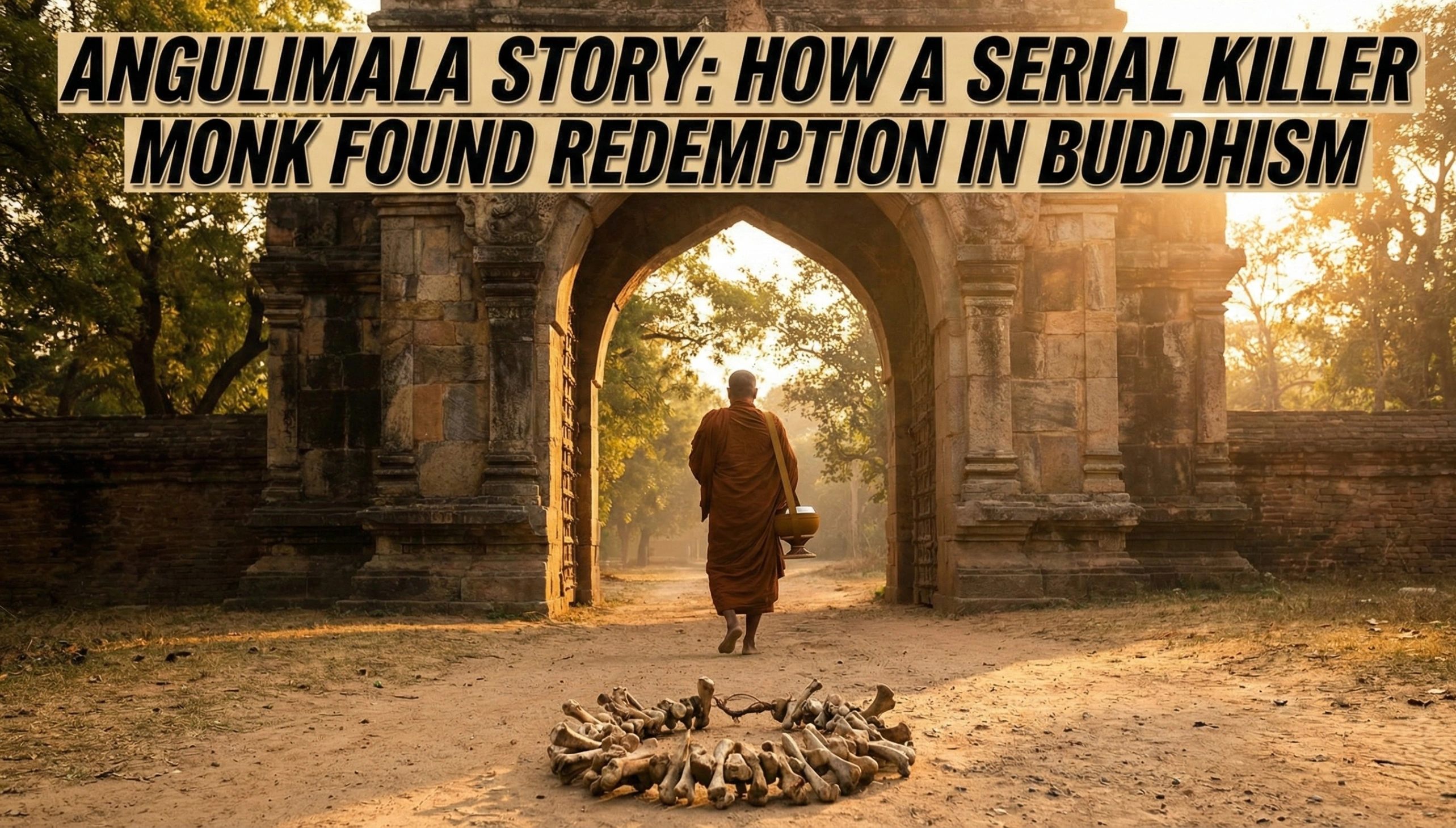
It is easy to believe that some people are simply "evil" and beyond saving. We look at the violence in the world and think that redemption is reserved only for the mildly flawed, not the truly broken. But the Angulimala story challenges that assumption in the most dramatic way possible.
It is one of the most famous, gritty, and shocking narratives in the Buddhist canon. It tells the tale of a man who didn't just break the rules; he was a mass murderer, a terror who wore the severed fingers of his victims around his neck. Yet, this same man became an Arahant, an enlightened being.
How does a serial killer become a saint? Let’s dive into the history, the legend, and the profound psychological lessons of Angulimala.
The Man Before the Monster: Who Was Ahimsaka?
Before he was a nightmare, he was a student.
In the ancient kingdom of Kosala, under the reign of King Pasenadi, a boy was born to the royal chaplain. His parents named him Ahimsaka, which ironically means "The Harmless One." By all accounts, the name fit. He was intelligent, obedient, and incredibly strong.
Ahimsaka was sent to Taxila, the ancient world's equivalent of an Ivy League university, to study under a renowned guru. He was the star pupil; dedicated and brilliant. However, his success bred jealousy. Other students, envious of the teacher's favoritism toward Ahimsaka, hatched a plan to destroy him.
They whispered poison into the guru’s ear, claiming Ahimsaka was sleeping with the guru’s wife. At first, the teacher refused to believe it. But after constant repetition, doubt took root, and eventually, rage took over.
The teacher wanted Ahimsaka dead, but he couldn't kill him directly without ruining his own reputation. So, he devised a sinister graduation requirement. He told Ahimsaka that to complete his studies, he needed to provide a dakshina (a guru’s fee).
The fee? One thousand human fingers, taken from the right hands of one thousand different people.
The Descent into Madness
This is where the tragedy begins. Ahimsaka, bound by a misguided sense of duty and obedience to his teacher, eventually snapped. He went into the Jalini forest and began his grisly task.
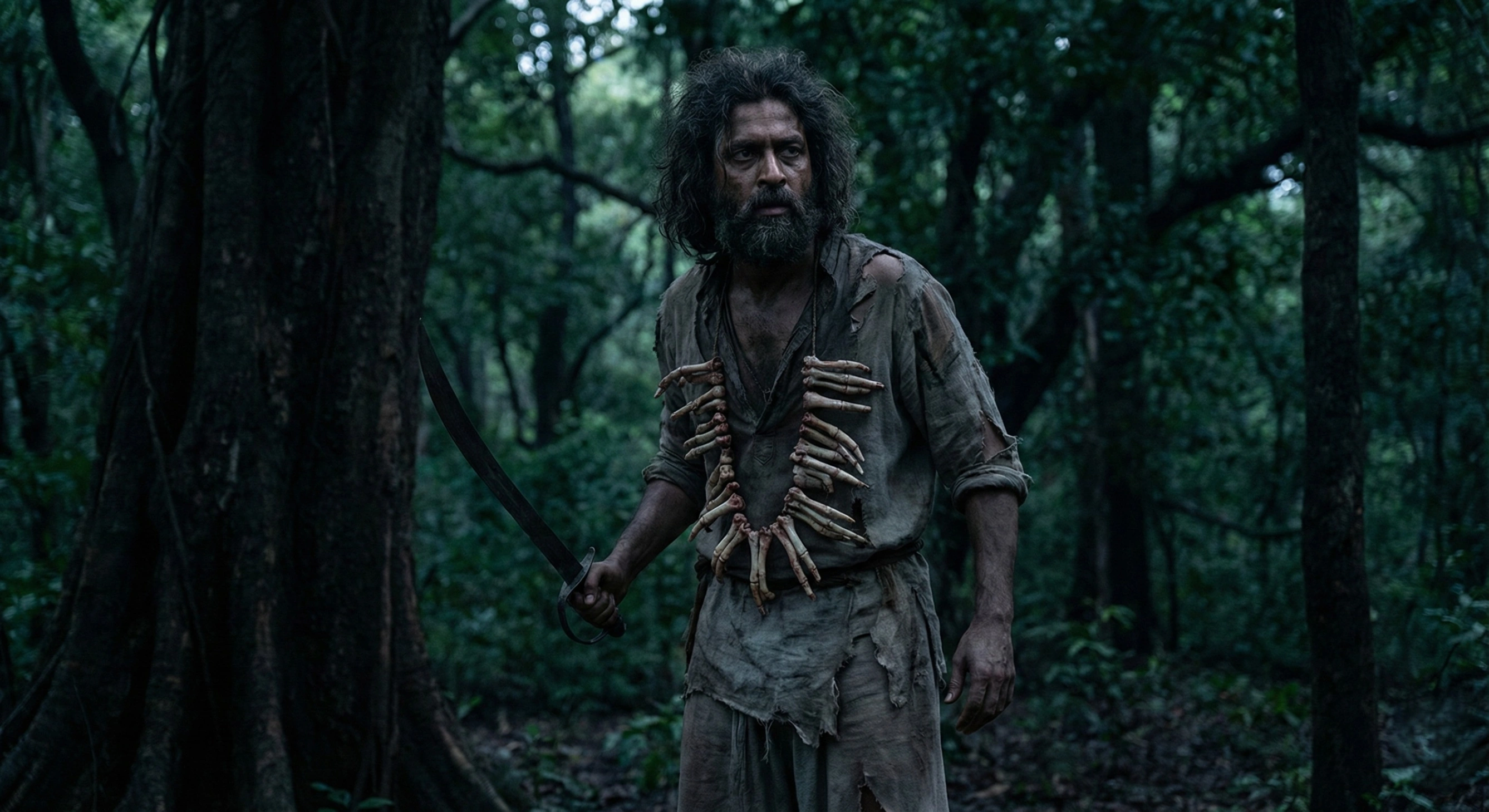
At first, he likely acted out of a twisted sense of obligation, but violence changes the brain. To kill once is trauma; to kill a hundred times is madness. He stopped being Ahimsaka. He became a bandit, attacking travelers, cutting off their fingers, and stringing them around his neck to keep count.
The people of Kosala gave him a new name: Angulimala "The One with the Garland of Fingers."
Villages were abandoned. The King sent armies to hunt him down. Angulimala had collected 999 fingers. He needed just one more to complete his debt and, in his deluded mind, find peace.
On that specific morning, his mother, driven by love, walked into the forest to warn him that the King’s army was coming. Angulimala, now completely consumed by bloodlust, saw a figure approaching. He didn't see his mother; he only saw the thousandth finger. He prepared to commit matricide; one of the gravest sins in Buddhism.
The Encounter: "I Have Stopped, Angulimala"
This is the pivotal moment in the Angulimala story. The Buddha, surveying the world with his psychic vision, saw the impending tragedy. Despite warnings from villagers ("Don't go there, monk! He will kill you!"), the Buddha walked calmly into the forest.
Angulimala saw the monk. He thought, "This is easy prey."
He drew his sword and ran after the Buddha. Angulimala was known for being able to outrun horses, yet, strangest of all, he could not catch up to the walking monk. Angulimala sprinted, sweating and gasping, while the Buddha glided peacefully ahead, always just out of reach.
Frustrated and exhausted, Angulimala screamed, "Stop, monk! Stop!"
The Buddha turned, looked him in the eye, and spoke the words that would shatter Angulimala’s world:
"I have stopped, Angulimala. You are the one who has not stopped."
Confused, the killer asked what he meant. The Buddha explained:
"I have stopped harming all living beings. I have laid aside violence. You, however, are unrestrained regarding life. Therefore, I have stopped, and you have not."
The Psychological Break and Conversion
Why did these simple words work?
Psychologically, Angulimala was likely in a state of extreme cognitive dissonance. He was exhausted, paranoid, and carrying the heavy burden of his guilt. The Buddha didn't attack him with a weapon; he attacked his logic.
The Buddha’s immense presence of peace acted as a mirror. In front of this serene being, Angulimala saw the monster he had become. The realization broke him. He threw away his sword, bowed at the Buddha's feet, and asked to be ordained.
In an instant, the serial killer was gone. The monk was born.
The Hard Road of Redemption
Many stories end here; the bad guy turns good, and everyone lives happily ever after. But Buddhism is realistic. It teaches Karma. You cannot simply erase the past.
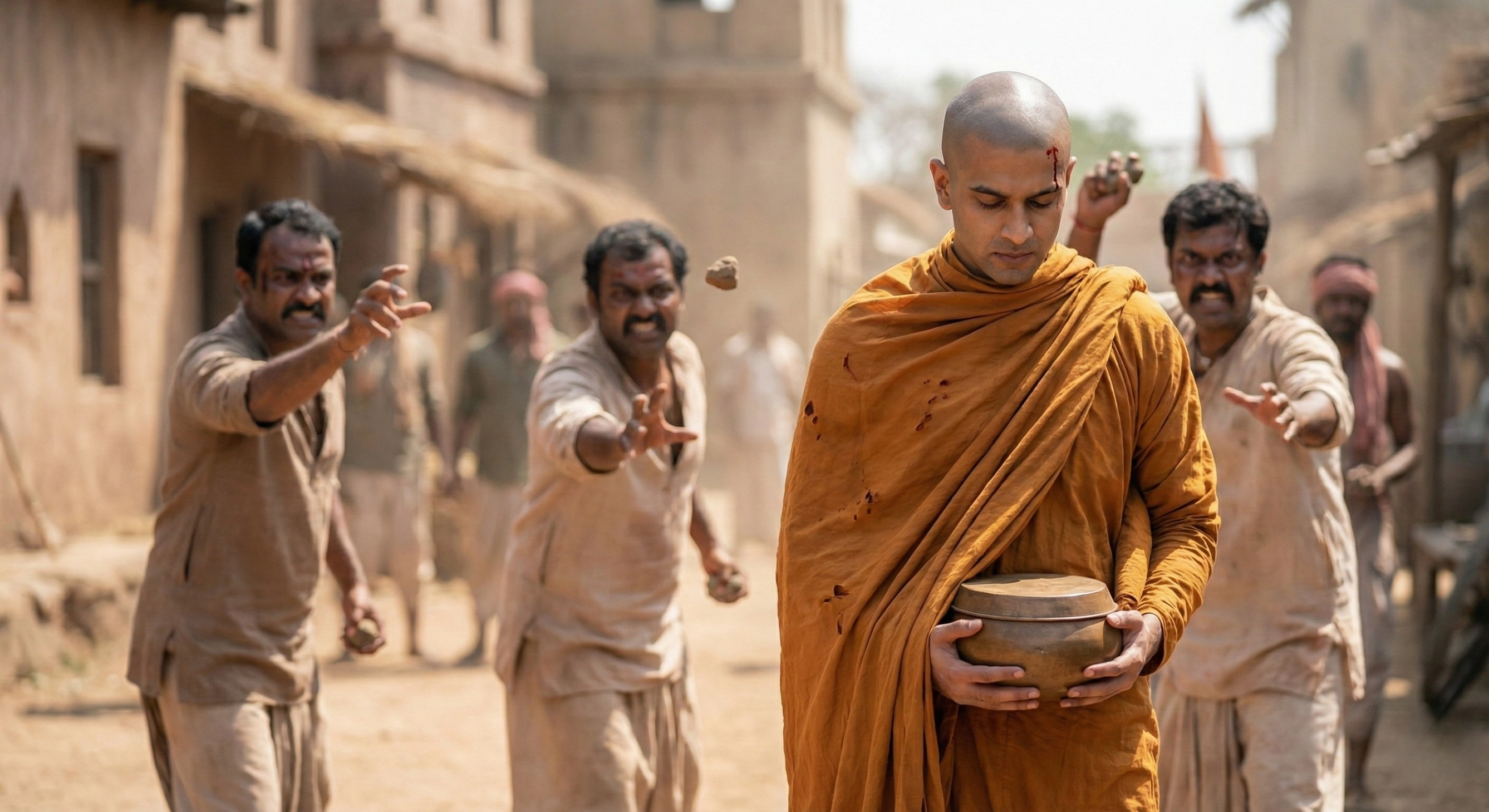
Angulimala became a monk, but he was not immediately accepted by society. When he went into the city for alms (food), people didn't give him rice; they threw rocks. They recognized him.
He would return to the monastery bleeding, his bowl broken, his robes torn.
When he went to the Buddha, in pain and perhaps feeling the injustice of it all, the Buddha didn't pity him. He gave him a reality check. The Buddha told him:
"Bear it, Brahmin! Bear it! You are experiencing here and now the result of deeds that might have caused you to boil in hell for many years, for hundreds of years."
This is a crucial lesson in understanding the law of Karma. Angulimala had achieved enlightenment, his mind was free but his body still had to pay the debt of his past actions. He accepted this abuse without anger, proving his transformation was genuine.
The Angulimala Paritta: The Power of Truth
One day, while walking for alms, Angulimala encountered a woman in difficult labor. She was screaming in pain, unable to deliver the baby, and both their lives were at risk.
Angulimala, once a killer, now felt a surge of compassion. But he felt helpless. He ran back to the Buddha and asked what he could do.
The Buddha told him to go back to the woman and say: "Sister, since I was born, I do not recall intentionally killing a living being. By this truth, may you be well and may your unborn child be well."
Angulimala hesitated. "Lord, that would be a lie! I have killed many people."
The Buddha corrected him: "You were born nobly (born again into the spiritual life) when you became a monk. Since that birth, you have not killed."
Angulimala returned to the woman. He performed this "Act of Truth" (Satyakriya). He announced that since his spiritual rebirth, he had harmed no one. The power of this truth was so strong that the woman immediately gave birth safely.
To this day, Buddhist monks recite the Angulimala Paritta to pregnant women to bless them for a safe delivery. The man who once took lives became the protector of new life.
4 Lessons from the Angulimala Story for Modern Life
The story of Angulimala isn't just ancient history; it is a template for human psychology and spiritual growth. Here is what we can learn:
1. No One is Beyond Redemption
This is the most obvious but difficult lesson. In our "cancel culture" society, we often write people off after one mistake. Angulimala made 999 mistakes of the worst kind. The Buddha showed that the potential for enlightenment exists in everyone, regardless of their past. If a serial killer can become a saint, there is hope for all of us.
2. The Company You Keep Matters
Angulimala was a good person corrupted by a bad environment and false teachers. It serves as a warning: intelligence and strength are not enough if you are guided by the wrong people. We must be vigilant about the influences we allow into our lives.
3. "Stopping" is a Mental Act
When the Buddha said, "I have stopped," he was referring to the mind. We often run through life chasing money, chasing status, chasing revenge just like Angulimala chased the Buddha. We are physically moving, but spiritually stuck. To "stop" means to find stillness, contentment, and harmlessness.
4. You Must Face Your Karma
Forgiveness doesn't mean no consequences. Angulimala was forgiven by the Buddha, but he still had to face the anger of the villagers. Redemption isn't an escape hatch; it’s the courage to face the consequences of your actions with a calm mind, without generating new negative karma.
The Finger Garland of Today
We may not wear a necklace of fingers, but we often wear a garland of our regrets, our grudges, and our bad habits. We carry them around, letting them define us.
The Angulimala story invites us to cut the string. It asks us to stop running. It reminds us that no matter how far down a dark path we have gone, we can always turn around.
Transformation begins the moment we stop pointing fingers at the world and start looking at our own minds. As the Buddha taught, the greatest victory is not defeating a thousand enemies in battle, but conquering oneself.