

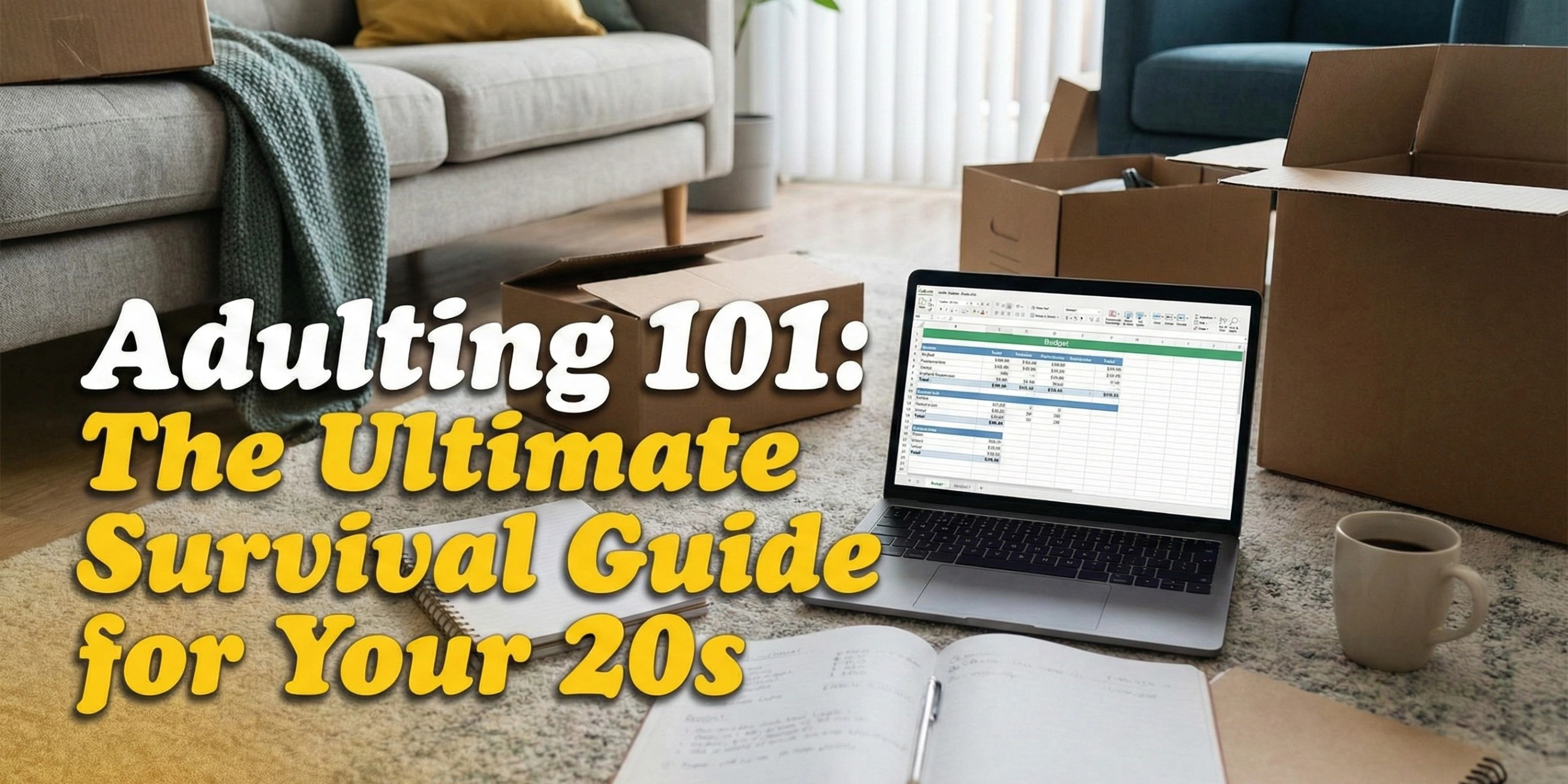
Let’s be honest for a second: growing up is a trap. One minute you’re worried about passing a geometry test, and the next, you’re standing in the aisle of a grocery store wondering which health insurance deductible makes sense and why cheese is so expensive.
If you’ve ever Googled "Why is adulting so hard?" at 2 AM, you are officially part of the club.
The truth is, nobody hands you a manual when you turn 18. There is a massive gap between graduation and actually feeling capable. This is your Adulting 101 crash course. We’re going to cover the skills they didn't teach you in school, from the terrifying world of credit scores to the surprisingly difficult task of making friends when you no longer share a dorm room.
Whether you are preparing to move out or just trying to stop feeling like a "fake adult," this is the ultimate checklist for surviving your 20s.

Part 1: The Financial Guide to Adulting (Budgeting, Taxes, and Credit)
Money is usually the biggest stressor when you first start out. It’s the primary reason people feel like they are "failing" at adulthood. Let’s demystify the scary stuff.
How to Build Credit From Scratch
Your credit score is essentially your "trustworthiness" rating for banks. If you want an apartment, a car, or even a good cell phone plan, you need a score.
Get a secured card: If you have zero history, a secured credit card (where you put down a cash deposit as your limit) is the safest way to start.
The 30% Rule: Never use more than 30% of your credit limit. If your limit is $1,000, don’t spend more than $300.
Autopay is your best friend: One missed payment can tank your score. Set up autopay for the minimum amount immediately.
How to File Taxes for the First Time
If the word "audit" makes you sweat, you aren't alone. But for most people in their 20s, filing taxes is straightforward.
Wait for your W-2: Your employer will mail this by late January. Do not file before you have it.
Use Free Software: Unless you own a business or have complex investments, use free filing software (like TurboTax Free Edition or FreeTaxUSA). They walk you through it like a questionnaire.
The Standard Deduction: You likely don’t need to itemize every receipt. Taking the "Standard Deduction" is easier and often saves you more money.
How Much Money Should I Save for Emergencies?
You will hear experts say "3 to 6 months of expenses." That is a great goal, but it’s overwhelming when you’re entry-level. Start with a $1,000 micro-fund. This covers a blown tire, a surprise medical bill, or a lost phone. Once you have that safety net, aim for one month of rent. Build it slowly even $50 a month counts.

Part 2: Adulting for Beginners: A Survival Guide to Moving Out
Moving out is the biggest milestone, but the cost of living alone breakdown often shocks people. It isn't just rent; it's electricity, internet, water, trash, and the realization that toilet paper doesn't replenish itself.
First Apartment Essentials Checklist
Don't blow your budget on decor before you buy the boring stuff. Here is what you actually need on day one:
The "Oh No" Kit: Plunger (buy this before you need it), flashlight, batteries, and a basic toolkit (hammer, screwdriver).
Kitchen Basics: You don’t need a 12-piece knife set. You need one good Chef’s knife, a non-stick pan, a pot for boiling water, and a baking sheet.
Cleaning: Vacuum, multi-surface spray, and laundry detergent.
Weekly Apartment Cleaning Checklist
Cleaning isn't about deep scrubbing every day; it's about maintenance so your weekend isn't ruined by chores.
Daily: 10-minute "closing shift." Wash the dishes and wipe counters before bed.
Weekly: Vacuum/sweep floors, clean the toilet/shower, change bed sheets.
Monthly: Clean the fridge, dust high shelves, wipe down baseboards.
Grocery Shopping Hacks for Beginners
If you find yourself throwing away bags of spinach every week, you’re shopping wrong.
Never shop hungry: You will buy snacks, not meals.
Shop the perimeter: The outside aisles have the fresh stuff (produce, meat, dairy). The middle aisles are processed foods.
Check unit prices: Look at the small print on the shelf tag (price per ounce). Sometimes the "bulk" size is actually more expensive.
Easy Meal Prep for One
Cooking for one is hard because recipes are designed for families of four. The trick isn't eating the same meal for five days straight; it's ingredient prepping. Instead of making a full casserole, just roast a tray of chicken and a tray of veggies on Sunday. You can use them in tacos on Monday, pasta on Tuesday, and a salad on Wednesday. This keeps dinner fresh without cooking from scratch every night.
Part 3: The Career and Health Hurdles
Understanding Health Insurance Deductibles
This is the most boring sentence in the English language, but it’s critical.
Premium: What you pay every month just to have insurance.
Deductible: How much you have to pay out of pocket before insurance starts helping. If your deductible is $2,000, you pay the first $2,000 of medical bills yourself.
Copay: A flat fee you pay for a doctor visit (e.g., $25).
Tip: If you are healthy, a high deductible plan (lower monthly cost) usually makes sense. If you have chronic conditions, you want a low deductible.
Overcoming Imposter Syndrome in Your Career
Why do I feel like a fake adult? This feeling peaks at work. You look around and assume everyone else knows exactly what they are doing. Spoiler alert: They don't. Most people are figuring it out as they go. If you feel like a fraud, it usually means you are pushing yourself into new territory, which is a sign of growth, not incompetence. Document your wins. Keep a "Kudos" folder in your email where you save positive feedback. Read it when you feel unqualified.
Navigating Work-Life Boundaries
In the age of remote work, your office is your living room. It is vital to set hard stops.
Turn off email notifications on your phone after 6 PM.
Do not reply to non-urgent Slacks on weekends.
"Quiet Quitting" isn't about being lazy; it's about doing the job you are paid for and preserving your energy for your actual life.
Part 4: The Social Shift (Dealing with Loneliness in Your 20s)
This is the part nobody talks about. We expect the financial struggle, but we don't expect the social isolation. When you leave school, you lose the "proximity convenience" that made friendship easy.
How to Make Friends as an Adult
The "friendship recession" is real. Making friends now requires active effort, not just proximity.
The Consistency Rule: You can't make friends by showing up once. You need a "third place" (not work, not home) where you go weekly. A run club, a pottery class, a volunteer shift. Familiarity breeds friendship.
Be the planner: Everyone is waiting for an invite. Be the one who sends the text: "Hey, I'm trying that new coffee shop on Saturday, want to come?"
How to Stop Feeling Behind in Life
Social media is a highlight reel. You see your friend’s engagement ring, another friend’s promotion, and someone else’s Europe trip. You don't see their credit card debt, their relationship struggles, or their anxiety. Comparison is the thief of joy. If you are paying your bills and keeping yourself alive, you are succeeding. There is no timeline. You are exactly where you need to be.
Adulting 101 isn't about perfection. It’s about survival and slow improvement. You will burn dinner. You will forget to pay a bill once. You will feel lonely sometimes. That doesn't mean you're bad at this; it means you're human.
Take a deep breath. You’ve got this. And if you don't? Well, that's what Google and this guide is for.